THE LIVING TIBETAN SPIRITS SPEAK ABOUT THE GREAT PROBLEM OF TIBET :
THE GREAT PROBLEM OF TIBET IS THAT OF ITS ILLEGAL OCCUPATION.
I speak on behalf of ‘The Living Tibetan Spirits’ who had given their mortal lives in the hope of evicting the illegal occupier from the Land of Tibet. Occupation is not a natural condition and hence it would remain a problem. Apparently, China got transformed into a huge economic and military power and hence, the problem of Tibet is great. The greatness of the problem would not dampen my hopes and expectations about the future of Tibet. I am not seeking separation of Tibet from China. Tibet is not a part of China and separation is not the issue. I am supporting the view of ‘The Living Tibetan Spirits’. Freedom is a natural state or condition known to Tibetans over centuries of their existence as a Country with its own history and traditions. This historical experience of the people cannot be wiped out by decades of brutal, illegal, military occupation. By removing the military forces from the Land of Tibet, China could initiate a process of healing and restoration of normal conditions inside Tibet.
I am pleased to share this article published by Claude Arpi from Rediff.com
Dr. R. Rudra Narasimham, B.Sc., M.B.B.S.,
Kurnool Medical College, Kurnool, Andhra Pradesh, India,
M.B.B.S., Class of April, 1970.
A top US diplomat in China was apparently summoned to convey Beijing’s [ Images ] ‘strong indignation’ over President Barack Obama’s [ Images ] meeting with the Dalai Lama: it amounted to ‘gross interference’ which would damage bilateral ties, said Beijing.
Chinese foreign ministry spokesman Ma Zhaoxu objected ‘sternly’, saying, “The encounter had not only hurt the feelings of Chinese people,’ but he demanded that the US start to seriously consider China’s stance and ‘immediately adopt measures to wipe out the baneful impact and cease to connive and support anti-China separatist forces that seek ‘Tibet independence’.
The meeting between the Dalai Lama and Barack Obama was, however, not that crucial because the US is not in a position to influence China in any way, especially on its ‘internal’ policies.
A few days ago, Xinhua placidly analysed the possibility of the US going bankrupt, saying, “No one wants to see the US breach its debt obligations, but everyone has to be prepared in case it happens… any US ‘action to repudiate its debts will benefit [the US] at a cost to others.”
Beijing knows perfectly well that it can only be the loser.
“In the current situation, only by repudiating its debts can the US rapidly decrease its debt ratio and reduce its heavy debt burden, so as to have consumption recover,” said Xinhua.
It added, “The world’s countries will have nothing to say but acknowledge their bad luck if the US defaults on its debt. If the default causes the collapse of bond prices and the skyrocketing of commodity prices, those who suffer will be countries with foreign exchange reserves and industrial manufacturing countries.”
In other words, China!
This is also why even though Beijing can’t do much about the US debt (and about its own money in US coffers), the Communist leadership is certainly not ready to listen to Washington when it concerns its ‘internal’ affairs’.
The US, even if it manages to escape the debt trap, does not anymore have the clout (or the muscle) to impose anything on China.
But there is something else; during the last few months, the world media, and particularly the US press, highlighted the ‘democratic’ wind coming from Dharamsala and applauded the Dalai Lama’s self-retirement.
The logical next step for a nation promoting democracy in North Africa or the Middle East would have been to invite the ‘elected’ leader of the Tibetan diaspora along with the Dalai Lama.
But no, Washington prefers to receive the Dalai Lama and ignore Dr Lobsang Sangay, the new ‘elected’ Kalon Tripa. It is more convenient to receive a ‘religious’ leader.
Then, in case China sees red, Washington can always say that it was a non-political encounter.
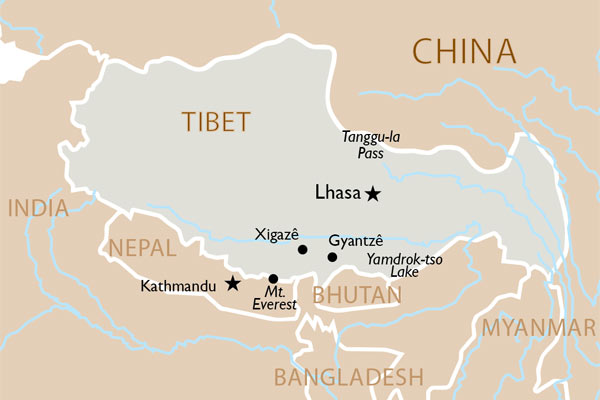
More interesting is the trip of the Chinese Vice-PresidentXi Jinping to Tibet [ Images ]. It is the highest level visit to the restive region since 2001, when the then Vice-President (today President) Hu Jintao went to celebrate 50 years of the ‘liberation’ of Tibet. Tibet Information Network then reported, ‘Several thousand Tibetans were required to be present at the main anniversary ceremony on July 19, which was attended by Hu Jintao in the Potala Square, surrounded by armed security personnel.
‘Others, including children, students and monks, were required to form part of various delegations welcoming the official visitors to Lhasa,’ it said.
That was 10 years ago.
Strangely, on Tuesday, in a lead article, Xinhua merely said, ‘Central government delegation arrives for Tibet’s 60th anniversary of peaceful liberation,’ adding, ‘A delegation of China’s central government arrives in Lhasa, capital of southwest China’s Tibet Autonomous Region, on July 17, 2011.
‘The delegation came to attend the celebrations marking the 60th anniversary of Tibet’s peaceful liberation,’ it adds.
Is it not strange that Xi Jinping’s name is not even mentioned? Why?
Let’s not forget that in 15 months’ time, Xi Jinping will be China’s president, as well as the Communist Party of China’s general secretary and chairman of the all-powerful Central Military Commission.
While Xi’s name is mentioned in secondary articles, it is intriguing that his name did not figure in the lead article.
It probably has something to do with a not-so-smooth succession and the announced-and-later-denied death of his mentor, former President Jiang Zemin.
Chinese ways are sometimes difficult to grasp.
Apart from the old ‘Tibetan’ guard (Raidi, Pagpalha), Vice Premier Hui Liangyu and more, interesting for India [ Images ], General Chen Bingde, the People’s Liberation Army’s boss, travelled with Xi.
Xi’s visit to Tibet has obviously made many nervous. An article in Asia News affirms, ‘Beijing is afraid of more anti-China protests and has increased its control over its borders with Nepal ahead of the visit.’
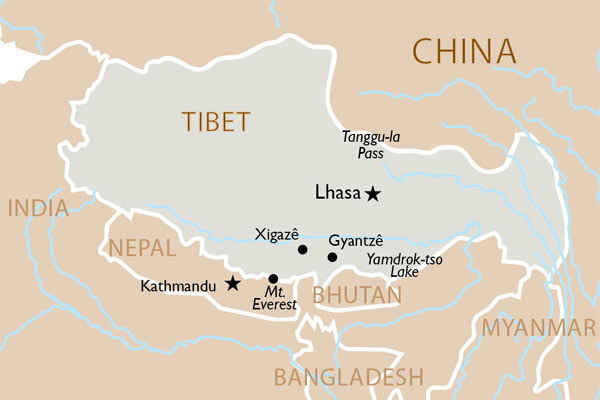
Is it really the reason why on July 12, Beijing announced a closure of the Tibet-Nepal border, mainly targeting ‘foreigners, especially Americans, Indians and Europeans, who could sympathise with the Tibetan activists. According to local media, Beijing’s decision has resulted in a sharp drop in tourist reservations.’
Another interesting aspect of Xi’s visit to Tibet is that Xi Zhongxun, the vice-president’s father who was a vice-premier himself, played a relatively positive role in Tibet in the 1950s, till he was purged in September 1962 (he wrote that the Panchen Lama was right in his assessment of the situation in Tibet where lakhs of people died during the Great Leap Forward).
When the communists came to power in 1947, Xi Zhongxun was deputy political commissar of the North West Field Army commanded by Marshal Peng Dehuai.
Later Xi was elevated to the post of political commissar of the army which entered north-western Tibet in 1949.
While Xi Zhongxun had a military background, he was very close to the late Panchen Lama (and later to the Dalai Lama). When the former passed away in mysterious circumstances in 1989 in Shigatse, Xi wrote his obituary in The People’s Daily.
Strangely, very little has been written about Xi Jinping and the Tibet connection. Probably Xi Jinping does want to highlight this ‘connection’ a year before his elevation to the top of the party and some links to his past seem to have been removed.
In any case, the vice president’s visit to Tibet should not be seen as negative and there is no reason for the West to support large-scale protests.
On the contrary, Xi Jinping should be encouraged to see for himself the tense situation in the Himalayan region, at a time when the official propaganda continues to hammer on that the Tibetans are happy and liberated.
A white paper on The Liberation of Tibet recently released by the State Council’s Information Office affirms, ‘The 60 years following Tibet’s peaceful liberation have proved that Tibet, as an inseparable part of China, shares its destiny with the motherland, and its development is also impossible without that of China.’
Going through the paper, one discovers astonishing information: ‘After the founding of the People’s Republic of China in 1949, Tibet was peacefully liberated,’ it reads.
It goes on to say, ‘Under the leadership of and with special care from the Central People’s government, and through democratic reform, the founding of the autonomous region, socialist construction and the reform and opening-up, Tibet abolished serfdom and theocracy, become a modern, democratic socialist society, achieved rapid and comprehensive economic and social development, and embarked on the road to modernity.’
Nobody is fooled, either about the ‘democratic socialist society’ or the serfdom. The words just do not tally with ground reality.
Why should Tibet be closed to foreigners for such a ‘special celebration’ if life is so rosy and if Tibetans are so grateful to the ‘motherland’?
As the White Paper was released, the Tibetan Centre for Human Rights and Democracy announced that the Kardze County People’s Court in Eastern Tibet had sentenced 13 Tibetans out of those arrested after a demonstration.
The TCHRD further stated that on July 5, 2011, the Public Security Bureau arrested Pema Rinchen, a famous writer from his house in Drango County of Kardze Prefecture.
‘On July 6, 2011, the second day of his arrest, he had to be taken to the Drango county hospital for emergency treatment, because he was reportedly savagely beaten by the police after his arrest,’ a report read.
‘On hearing the news, his family members rushed to hospital. However, several policemen were standing guard outside his hospital room and refused to allow his family to see him,’ it said.
Recent examples of the violent demonstrations, particularly in Kirti monastery, confirm that Beijing has a big problem on its table.
What is flabbergasting is that Beijing continues to publish photos of ‘happy Tibetans’ enjoying life under their benevolent and compassionate ‘motherland’.
Let us hope that Xi Jinping will be able to grasp the situation and follow in the footsteps of his father, a moderate and open-minded leader.
Dr. Manmohan Singh, current Prime Minister of India. (Photo credit: Wikipedia)The Battle Plan of Operation Eagle 1971-Chittagong Hill Tracts must be disclosed.OPERATION EAGLE(1971)- MILITARY ACTION IN CHITTAGONG HILL TRACTS: PERMISSION FOR DISCLOSURE OF THE BATTLE PLAN. The battle plan had originated and was sanctioned by Prime Minister of India at the Secretariat Building, South Block, New Delhi.
SPECIAL FRONTIER FORCE – OPERATION EAGLE:
To: manmohan@sansad.nic.in Subject: The Battle Plan of Operation Eagle – Permission for disclosure Date: Thu, 21 Jul 2011
From, R.Pratap Narayan,
To:
Dr. Manmohan Singh Honourable Prime Minister of India, Prime Minister’s Office, New Delhi – 110 011.
Attn: Prime Minister’s Office – Shri. Amar Dass, Section Officer.
Respected Sir,
Subject:- The Battle Plan of Operation Eagle – Permission for Disclosure.
References:- 1. My representation dated 24/5/2011. 2. PMO ID No. 6/3/2011-PMP3/298009 dated 16/6/2011.
3. MoD ID No. 3533/2009/D( Cer ) dated 01 July 2011. 4. Integrated HQ MoD(Army), Military Secretary’s Branch ID No. A/45101/REP/MS( X ) dated 08 July 2011.
1. Military Secretary’s Branch, Integrated HQ MoD( Army ) in its letter ID No. A/45101/REP/MS( X ) dated 08 Jul 2011 had rejected my representation dated 24/5/2011 regarding my brother’s petition to receive a Gallantry Award that was duly recommended by Special Frontier Force which operated under the Command of Major General Sujan Singh Uban, Inspector General SFF, Directorate General of Security, R. K. Puram, New Delhi. As per the decision made by the Prime Minister of India, the Battle Plan of Operation Eagle had included the eligibility criteria for receiving Service Medals and Decorations. My brother is eligible to receive this Gallantry Award because he had participated in Operation Eagle as a Citizen of India. For example, foreign nationals like Bangla refugees who had also participated in Operation Eagle are not entitled to receive Service Medals and Decorations.
2. The Military Secretary, MoD( Army ) while rejecting my representation had also claimed that this battle action took place nearly 39 years ago. However, it must be noted that the Military Secretary has not mentioned the date or dates of this battle action. It appears that the MS Branch is not aware of this basic information or the MS Branch is deliberately concealing information with an intention to deny the grant of this Gallantry Award to an Indian National who had participated in military action on the basis of his Citizenship.
3. In the history of Republic of India, for the very first time, the Prime Minister of India had planned and had personally executed this kind of military operation( Op Eagle ) drawing assistance from nontraditional fighting elements from the Directorate General of Security.
4. Because of the historical importance of Operation Eagle, it would be in public interest to disclose the details of the Battle Plan. Since this Battle Action took place a long time ago, it is assumed that Government of India has no objection if the Battle Plan is disclosed to the People of India.
5. If you have any concerns in this matter, kindly inform me.
Thanking You,
Yours Faithfully,
R.Pratap Narayan. Hyderabad. 21 st July, 2011.
This letter from Ministry of Defence again fails to mention my Unit affiliation and does not reveal the name of the military act called Operation Eagle. Public have a Right to Information about the Battle Plan of Operation Eagle.
This letter from Ministry of Defence again fails to mention my Unit affiliation and does not reveal the name of the military act called Operation Eagle. Public have a Right to Information about the Battle Plan of Operation Eagle.This letter from Ministry of Defence again fails to mention my Unit affiliation and does not reveal the name of the military act called Operation Eagle. Public have a Right to Information about the Battle Plan of Operation Eagle.A Personal Tribute to Colonel B K Narayan, The Regiment of Artillery, Indian Army.
A Sermon in Kaptai, Bangladesh Ops 1971-72. A personal tribute to Colonel B K Narayan, Islamic Scholar who served in Olive Green Uniform. The Imam of Friday Prayer in Kaptai on December 17, 1971: Glorious Quran, Surah VIII, SPOILS OF WAR, Verse 01: “And if they incline to peace, incline thou also to it, and trust in Allah.Lo! He is the Hearer, the Knower.”
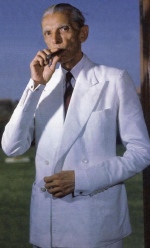
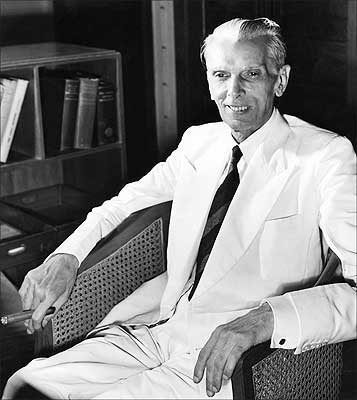
Jinnah, a great leader with a simple addiction to Tobacco.
WHAT IS SECONDHAND SMOKE?
When you breathe in smoke that comes from the end of a lit cigarette, cigar, or pipe ( often described as ‘sidestream smoke’ ), or when you breathe in smoke that is exhaled by a smoker(often described as ‘mainstream smoke’ ), you are exposed to the risk of secondhand smoke. You will be inhaling almost the same amount of chemicals as the smoker breathes in. Tobacco smoke contains more than 4,000 different chemical compounds, and more than 50 of them are known to cause Cancer. Some of these known carcinogens are Hydrogen Cyanide, Benzene, Formaldehyde, and Carbon monoxide. Involuntary or passive smoking can kill. There is no amount of exposure to secondhand smoke that is considered as a safe level of exposure. The more secondhand smoke that you breathe in, the more your health risk increases. Secondhand smoke exposure causes nearly 50,000 deaths per year in adult nonsmokers in the United States. 3,000 deaths are from Lung Cancer, and 46,000 deaths are from heart disease. Nonsmokers increase their risk of developing Lung Cancer by 20% to 30%, and heart disease by 25% to 30% when they are exposed to secondhand smoke. The risks of Breast Cancer and Cervical Cancer and other types of Cancer are also higher. Women who are exposed to secondhand smoke face a 69% higher risk of heart disease and a 56% higher risk of Stroke than those who are not exposed to smoke. Children are particularly vulnerable to the effects of secondhand smoke because of their bodies are still growing and they breathe at a faster rate than adults. The effects of smoking can be very significant especially for those who live or work with a smoker. In reality, most of the smoke from a burning cigarette doesn’t get sucked down into smoker’s lungs- it simply escapes into the air where it can be inhaled by anyone unfortunate enough to be nearby. Living under the shadow of a great person may give some benefits, protection, and a sense of security. But, life under the shadow of secondhand smoke is a prescription for death. There was such an unfortunate victim who had lived under the shadow of a great leader known as Mohammed Ali Jinnah.
MOHAMMED ALI JINNAH, QUAID- E-AZAM – THE GREAT LEADER OF PAKISTAN:
Life Under the Shadow of Secondhand Smoke. Mohammed Ali Jinnah, the Great Leader of Pakistan.
Jinnah, Indian Muslim politician was the founder and first Governor General of Pakistan (1947-1948). His parents arranged for an early marriage for him before he left for England at the age of 16. While in London, Jinnah suffered the loss of his wife and mother. In 1895, at the age of 19, he was called o the Bar on completion of his formal studies to become a barrister. He had supported the election of Dadabhai Naoroji, a Parsi leader, a leading Indian nationalist who ran for the English Parliament. Naoroji became the first Indian to sit in the British House of Commons. In 1896, Jinnah returned to Karachi and then moved to Bombay to start his legal practice. He met Ruttenbai, the daughter of Dinshaw Petit, a Bombay Parsi millionaire. Jinnah had married this young and beautiful lady over tremendous opposition from her parents and others. The great love and the marriage withered and proved to be an unhappy union. The stress imposed by exposure to secondhand smoke was not known and was not recognized those days. Jinnah’s addiction to Tobacco and the price paid by his wife describe the other side of Jinnah which many people in Pakistan and India tend to ignore.
The Other side of Mohammed Ali Jinnah:
Life Under the Shadow of Secondhand Smoke.The human costs of involuntary or passive smoking.Life Under the Shadow of Secondhand Smoke. The Life of Ms. Ruttenbai.She paid the price for living under the Shadow of a Great Leader.
I would like to share the very interesting and powerful story about the life of Ruttenbai who had lived under the shadow of Mohammed Ali Jinnah . Unfortunately, this story posted below my post fails to mention the nature of cancer that had killed this beautiful lady at such an young age. I am very sure about the nature of her illness. She died of Lung Cancer. She developed Cancer because of inhaling tobacco smoke and it is a very well recognized risk factor now. Secondhand Tobacco smoke kills people and even now the chances of survival are not good. I had personally witnessed a similar case and had narrated that story at my Home page of BhavanaJagat and the story is titled ‘Living Under the Shadow – A Prescription for Death’. A young, beautiful lady, the first wife of Chief of Army Staff (under Prime Minister Rajiv Gandhi), General K S Sundarji ( who is well-known for Operation Blue Star ) died of Lung Cancer in Army Hospital, New Delhi during 1978. The connection between smoking and Lung Cancer was well understood but at that time the risk of Lung Cancer due to Secondhand Tobacco Smoke was not properly recognized.
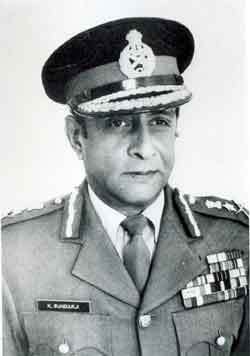
Life Under the Shadow of Secondhand Smoke. The human costs of Tobacco Smoking. General K S Sundarji Commanded the First Armoured Division (1976-78).
Dr. R. Rudra Narasimham, B.Sc., M.B.B.S., Kurnool Medical College, Kurnool, Andhra Pradesh, India, M.B.B.S., Class of April 1970.
The Softer Side of Mr. Jinnah
More than 61 years have passed since the death of founder of Pakistan , Quaid-i-Azam Mohammad Ali Jinnah. But even today, nothing about Jinnah seems ordinary —not his legal career, politics, personal life, his legacy and even the property he left behind.
The great South Asian intellectual Eqbal Ahmed once described Jinnah as an enigma of modern history. His aristocratic English lifestyle, Victorian manners, and secular outlook rendered him a most unlikely leader of India ’s Muslims. Yet, he led them to separate statehood, creating history, and in Saad R. Khairi’s apt phrase, “altering geography”.
Much has been written about Jinnah’s legal career, politics, his role as a founder of Pakistan and his vision, but even today, very little is known about Jinnah’s personal life. This was probably because Jinnah never had time to write a diary or an autobiography and whatever little he wrote was formal and matter of fact. For most of his life, he remained reserved, taciturn and secretive. He wrote his will in May, 1939, but it was only after his death that Liaquat Ali Khan, his close associate and the first Prime Minister of Pakistan, came to know that he was its trustee and executor. His only child, Dina Wadia, has hardly ever spoken about her father in public. So furious was Jinnah with Dina that he disowned her after she married a Parsi man against his wishes, and yet he left two lacs for her in his will. Akbar Ahmed’s movie Jinnah had just ten to fifteen minutes on Jinnah’s personal life, which are nowhere near enough.
Life Under the Shadow of Secondhand Smoke.Life under the Shadow of Secondhand Smoke.Life Under the Shadow of Secondhand Smoke. Jinnah and Ruttenbai or Ruttie.
Jinnah’s first wife, fourteen year old Emibai from Paneli village, died just eight months after he left for London at age sixteen in 1892, to join Graham’s Shipping and Trading Company, which conducted business with his father in Karachi. It was a forced marriage, as Jinnah’s mother was afraid that if he went to England , he might end up marrying an English girl. He barely knew Emibai.
Jinnah’s second marriage with the most beautiful girl of Bombay – Ruttie: The Flower of Bombay – was like a fairy tale. It began in the summer of 1916 in Darjeeling or “Town of the Thunderbolt” (how appropriate considering what was to happen there).
Life Under the Shadow of Secondhand Smoke. Jinnah and Ruttenbai.
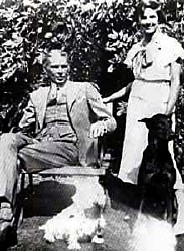
Jinnah had established himself as a lawyer and a politician by then and had become friends with Sir Dinshaw Maneckji Petit, the son of one of the richest and most devoutly orthodox Parsis of the 19th century. The Petit`s chateau overlooked Mount Everest and it was there Jinnah met his only daughter Ruttenbai Petit or Ruttie as she was popularly called. Merely sixteen at that time, Ruttie was a charming young girl. Stanley Wolpert writes in Jinnah of Pakistan :“Precociously bright, gifted in every art, beautiful in every way. As she matured, all of her talents, gifts and beauty were magnified in so delightful and unaffected a manner that she seemed a fairy princess”.
A dazzling beauty and full of life, Ruttie had exquisite taste and affable manners. Quick-witted, she was easily one of the best dressed and most popular women among the elitist circles of Bombay . She was intellectually far more mature than other girls of her age, with diverse interests ranging from poetry (Oscar Wilde being her favorite, whom she often recited) to politics. Her large collection of books, which remained in Jinnah’s possession after her death, reflected her deep interest in poetry, literature, history, occultism, mysticism and sorcery. She was an excellent horse-rider. She attended all public meetings and was inspired by Annie Besant’s Home Rule League.
A fierce supporter of India for Indians, Ruttie was once asked about rumors of Jinnah’s possible knighthood and whether she would like to be Lady Jinnah. She snapped that she would rather be separated from her husband than take on an English title. Jinnah on the other hand also had a special interest in acting and in Shakespeare’s dramas. While in London , he had acted in some Shakespearean plays and even considered seriously taking up acting as a profession. It was his dream to play Romeo at The Globe in London . Khwaja Razi Haider thinks it was probably Jinnah’s deep interest in Shakespeare that gave him insight into the intricacies of the human character, which he was to use for grasping the essentials of Indian politics. Jinnah was thirty-nine and Ruttie sixteen, but the age difference proved no obstacle in their love. Love has no logic.
He was enamored by her beauty and charm and she was awe- struck by “Jay”, as she called him. Jinnah asked Sir Dinshaw for Ruttie’s hand in marriage, who became furious and refused. Jinnah repeatedly pleaded his case but Dinshaw never gave in, as Jinnah had a different faith and he was more than twice Ruttie’s age. Their friendship ended and Dinshaw forbade Ruttie from meeting Jinnah while she lived in his house. He even got a court injunction restraining Jinnah from meeting her (a pity no biographer has yet traced the court papers).
The couple continued to meet secretly, and patiently waited for two years until February 1918 when Ruttie turned eighteen, and was free to marry. She walked out of her parental home to which she was never to return, and converted to Islam at Bombay ’s Jamia Mosque, under the Muslim Shiite doctrine, on April 18, 1918.
The very next day, Jinnah and Ruttie got married in a quiet ceremony at Jinnah’s Malabar Hill house in Bombay . Located in a most highly-priced area today, with Maharashtra’s Chief Minister as its next-door neighbor, Jinnah House remains a dispute between India , Pakistan and Dina Wadia. Jinnah owned another house at 10 Aurangzeb Road , Delhi , which he sold just before Partition for Rs 3 lacs. The Dutch Ambassador to India lives there now. The Raja Sahib of Mahmudabad, who signed as Jinnah’s witness, and a few other friends, attended the wedding. Maulana Muhammad Hasan Najafi was Ruttie’s witness. Jinnah presented the wedding ring to Ruttie, a gift from Raja Sahab, and paid Rs 125,000 as haq mehr . Nobody from Ruttie’s family attended the wedding. Interestingly, the Nikah Nama stated “Ruttenbai” as the bride’s name instead of Marium, her Islamic name. The honeymoon was first at Raja Sahab’s Nainital mansion, and then at the Maidens Hotel, a magnificent property just beyond the Red Fort.
Life Under the Shadow of Secondhand Smoke. Jinnah and Ruttenbai’ s Nikahnama.Life Under the Shadow of Secondhand Smoke. Jinnah’s house in Bombay.
Gandhi’s grandson Rajmohan Gandhi writes about the wedding in his book Understanding the Muslim Mind: “For the first time in his life, a girl had absorbed Jinnah’s emotions. Living for sometime now in a large but somber Malabar Hill house, bowing to ladies (on occasional parties) and praising their sarees but otherwise keeping a distance from them, (he) fell in love with Ruttenbai. Joy and laughter entered Jinnah’s life. The Malabar Hill house became brighter.’ She presented him with a daughter, Dina. But, ‘Alas the happiness was not destined to last; Sarojini’s veiled prediction of trouble came true”.
Sarojini Naidu was a huge admirer of Jinnah, wrote several poems and prose pieces on him, and many historians believe she was in love with him. She wrote this about the wedding in a letter to Sir Syed’s son, Syed Mahmud: “So Jinnah has at last plucked the Blue Flower of his desire. It was all very sudden and caused terrible agitation and anger among the Parsis; but I think the child has made far bigger sacrifices than she yet realises. Jinnah is worth it all – he loves her; the one really human and genuine emotion of his reserved and self-centred nature. And he will make her happy.”
The first few years of the marriage were a dream for Ruttie and Jinnah, the happiest time of their lives. They traveled across India , Europe and North America together. Ruttie watched with a great sense of pride the feverish political activity of her husband. She would be seen in the visitors’ gallery when Jinnah was due to speak, accompanied him to the High Court, and even attended the Nagpur session of the Congress in December 1920. According to Wolpert: “They were a head- turning couple; he in his elegant suits, stitched in London , she with her long, flowing hair decked in flowers. There was no limit to their joy and satisfaction at that time. Their only woe was Ruttie’s complete isolation and ostracism from her family.”
Kanji Dwarkadas, a veteran leader of Congress and a close friend of the couple, who looked after Ruttie during her last days, wrote in his book Ruttie Jinnah: The story of a great friendship: “For Jinnah, who was not generous in many matters, no expense was too great to satisfy the extravagant claims of the baronet’s spoilt child. During a visit to Kashmir , she spent Rs 50,000 in refurnishing the boathouse and Jinnah gladly paid all the bills. He treated her wonderfully well, and paid without a murmur all the bills necessitated by the luxurious life she led.Ruttie’s fabulous beauty, spontaneous wit, and immense charm have been praised to the neglect of her serious interests.”
Even though Ruttie was much younger than Jinnah, she made him a very happy man. They had no separate existence and Jinnah found her a great source of inspiration. He resigned from the Orient Club where he used to play chess and billiards. He was so deeply in love with Ruttie that he would return from the law courts on time each day and talk to her for hours on end. Unfortunately, their happiness was short- lived and the marriage started to crack after 1922-3. What caused the ruination of the Jinnah-Ruttie marriage? Was it Jinnah’s busy political life and his inability to give enough time to Ruttie, their age difference, or their incompatibility of temperaments? He was cold, introverted and domineering. She was young, extroverted, glamorous. There is no clear answer but the fact remains that Ruttie and Jinnah still loved each other despite the rift in their marriage. It is evident in every letter Ruttie wrote during that period, and every book written on their relationship. She moved to London with Dina in 1922 and from there too, her heart was still set on her life with Jinnah. She wrote in a letter to Kanji in India :“And just one thing more – go and see Jinnah and tell me how he is – he has a habit of overworking himself and now that I am not there to tease and bother him, he will be worse than ever.”
After her return, the couple tried one more time to save their failing marriage and took a five-month tour to Europe and North America together. But the rift grew and by January 1928 they were virtually separated, when Ruttie became seriously ill with cancer. Shortly before her death, she wrote a letter to Jinnah from Marseilles , France where she had gone for treatment. It turned out to be her last letter to him (larger view of original hand-written letter with typed text here
S. S. Rajputana,
Marseilles 5 Oct 1928 Darling – thank you for all you have done. If ever in my bearing your once tuned senses found any irritability or unkindness – be assured that in my heart there was place only for a great tenderness and a greater pain – a pain my love without hurt. When one has been as near to the reality of Life (which after all is Death) as I have been dearest, one only remembers the beautiful and tender moments and all the rest becomes a half veiled mist of unrealities. Try and remember me beloved as the flower you plucked and not the flower you tread upon.
I have suffered much sweetheart because I have loved much. The measure of my agony has been in accord to the measure of my love. Darling I love you – I love you – and had I loved you just a little less I might have remained with you – only after one has created a very beautiful blossom one does not drag it through the mire. The higher you set your ideal the lower it falls. I have loved you my darling as it is given to few men to be loved. I only beseech you that the tragedy which commenced in love should also end with it.
Darling Goodnight and Goodbye Ruttie
Life Under the Shadow of Secondhand Smoke.Life Under the Shadow of Secondhand Smoke. Ruttie’ s Letter to Jinnah.
It is a pity that none of the letters that Jinnah wrote to Ruttie have ever been made public. M.C. Chagla, a former Chief Justice of the Bombay High Court and a diplomat at the UN, has described the last days of Ruttie and Jinnah’s marriage in his book “Roses in December”. Chagla knew the couple very well, as he assisted Jinnah at his chambers during that time. He idealized Jinnah but severed all ties when he began working on the idea of an independent state for the Muslims of India. He writes:
By 1927, Ruttie and Jinnah had virtually separated. Ruttie’s health deteriorated rapidly in the years after they returned from their final trip together. Ruttie lived at the Taj Hotel in Bombay, almost a recluse as she became more and more bed-ridden. Kanji continued to be her constant companion. By February 18, 1929 she had become so weak that all she could manage to say to him was a request to look after her cats.Two days later, Ruttie Petit Jinnah died. It was her 29th birthday.
She was buried on February 22 in Bombay according to Muslim rites. Jinnah sat like a statue throughout the funeral but when asked to throw earth on the grave, he broke down and wept. That was the only time when I found Jinnah betraying some shadow of human weakness. It’s not a well publicised fact that as a young student in England it had been one of Jinnah’s dreams to play Romeo at The Globe. It is a strange twist of fate that a love story that started like a fairy tale ended as a haunting tragedy to rival any of Shakespeare’s dramas.”
The second time Jinnah ever broke down was in August 1947 when he visited Ruttie’s grave one last time before leaving for Pakistan . The architect of Pakistan paid a high price for Partition by leaving two of his most beloved possessions on ‘the other’ side of the border, the Jinnah House on Malabar Hill where he had the happiest moments of his life, and his beloved wife Ruttie who remains buried in Bombay. Jinnah left India in August 1947, never to return again, but he left behind a piece of his heart in a little grave in a cemetery in Bombay .
Life Under the Shadow of Secondhand Smoke. Ruttenbai’ s grave in Bombay.
SPECIAL FRONTIER FORCE – OPERATION EAGLE – LIBERATION OF BANGLADESH 1971:
OPERATION EAGLE 1971 – A LETTER TO THE LIVING TIBETAN SPIRITS
A LETTER TO THE LIVING TIBETAN SPIRITS :
I got exposed to the spirits of young Tibetan men who had given their lives in Chittagong Hill Tracts during 1971. They had no desires in their hearts. They had emptied their minds of all desires. They have experienced Joy in Emptiness. I had joined them to evict the illegal occupier from the Land of Tibet. We are not seeking Independence from People’s Republic of China. Freedom is a natural state or condition. Tibet has always existed in a serene and unperturbed state for several centuries until October 1950 when Communist China’s People’s Liberation Army invaded Tibetan soil. The Liberation of Tibet from its illegal occupation by a foreign military force is not about human desire or human passion. Tibetans need not desire for Independence. Freedom is the natural right, Freedom is the natural condition, and Freedom is the natural state of The Land of Tibet. The Land has always existed as a Free entity and foreign rulers have come and gone.
Government of India Ministry of Defence sent this letter by Registered Post and it is delivered to The Living Tibetan Spirits that inhabit my Consciousness. This letter refers to the military action in Chittagong Hill Tracts during Indo-Pak War of 1971. That War is over and The Spirit is not DEAD.
“THE PAST IS NEVER DEAD – IT’S NOT EVEN PAST” :
Using the famous words of Nobel Laureate William Faulkner, I will assert that the Past is never Past.
In the Indian tradition, I believe that the Past is never Past. The Past flows into the Present, and the Present flows into the Future, and the Future becomes the Past during the Cyclical Flow of Time. The illegal military occupation of The Land of Tibet would not exist as a Past event. The eviction of the illegal occupier would change the Past and in Future Tibet will exist in its FREE and NATURAL condition as it was in the Past.
THE BATTLE OF RIGHT AGAINST MIGHT :
The tyrant will always find a pretext for his tyranny and it is useless for the innocent to try by reasoning to get Justice, when the Oppressor intends to be unjust. The Communist China’s oppression and tyranny in the occupied Land of Tibet may not end by reasoning and by negotiations.
THE PROBLEM OF TIBET – EVICT THE OCCUPIER :
The Problem of Tibet is about its illegal military occupation. Freedom is the Reality and is the Truth that describes the natural condition of the Land of Tibet.
THE ESSENCE AND THE EXISTENCE OF TIBET :
What describes the essence of Tibet? How is this essence is reflected in the existence of Tibet? The existence of Tibet as an occupied territory of Communist China is not consistent with its essence; its people, its history, its culture and traditions, its religion, its language and its Identity as a Free Land.
WHO AM I? WHY AM I LIKE THIS? :
In the epic poem of Valmiki Ramayana, Book Six, Yuddha Kanda, the final Book called ‘WAR’, Chapter(Sarga)117, verse#11, Prince Rama had inquired, “Who am I?, and Why am I like this?”-This is a question His Holiness Dalai Lama and every Tibetan must ask oneself.
Every Tibetan, Tibetans living inside the occupied Land of Tibet, and Tibetans living in exile must ask oneself the same question that Prince Rama had asked in the epic poem of Valmiki Ramayana. Ask yourself; WHO AM I? and WHY AM I LIKE THIS? The answer will liberate you and will show you the path to your natural condition called Freedom. Military Occupation describes the Subjective Reality of Tibet’s Physical Existence. Freedom describes the Objective Reality of Tibet’s Natural Existence.
SET YOUR MIND FREE AND LET FREEDOM FLOW IN TIBET :
The romantic British poet Richard Lovelace described that no one can imprison or enslave the human mind. The Living Tibetan Spirits have set their minds free and would ask Tibetans to let Freedom flow in the Land of Tibet.
A romantic English poet and soldier Richard Lovelace(1618-1657) was confined within the walls of Gate House, a prison in Westminster, London. Those who had confined him could not stop him from exercising his ability to think and dream. He wrote from the prison, a famous poem known as “To Althea, from prison.” It reads as follows:
“Stone walls do not a prison make,
Nor Iron bars a cage;
Minds innocent and quiet take
That for a hermitage;
If I have freedom in my love
And in my soul am free,
Angels alone, that soar above,
Enjoy such liberty.”
A human being remains free to think and dream even though his body has limited mobility. A human being essentially seeks to exist in a free state and when imprisoned the man can set his mind free to think and dream. A mind that is free, expresses its freedom in speech, in writing, in songs, in paintings, and in dance and music. I would ask all Tibetans, Tibetans in the occupied Land, and Tibetans living in exile, to set their minds free and to let freedom flow in the Land of Tibet. Express your sense of Freedom in your prayers, in your meditation, in your thoughts, in your words, in your speech, in your writing, in your songs, in your paintings, and in your music and dance.
THE LAND OF RISING SUN – A REASON TO HOPE AND A REASON TO FACE THE CHALLENGE :
The National Flag of Tibet gives us a sense of Hope and tells us that we need to face the Challenge.
The rising Sun gives us a sense of Hope, and a Hope for a better future. At the same time, we recognize that to advance to a higher position, man faces a Challenge. It needs moral effort, physical struggle, and to overcome the obstacles. The first step to face this Challenge would be that of seeking Freedom in mind and thought. Tibetans must not embrace the Subjective Reality of Occupation and the Objective Reality of Freedom must rule their hearts and minds.
The Individual is Association of Cells that performs living functions because of a Connection, Association, Partnership, or Relationship called Spirituality. Sri Sathya Sai Baba is that Spiritual Individual.
This blog post is dedicated to Bhagavan Sri Satya Sai Baba who has defined the word “SAI” : The letter ‘S’ stands for Spirituality, the letter ‘A’ stands for Association, and the letter ‘I’ stands for Individual. Man is an Individual, an Association of trillions of Individual Cells which formulate the Identity of the Individual because of a Cellular function known as Consciousness which establishes God-Connection, or Spiritual Connection between the energy dependent Individual and the Cosmic Source of Energy/Power/Force which supports, sustains, and preserves the Living Functions of the Individual and all that is living on the planet Earth.
THE THREE FUNDAMENTAL DISTINCTIONS:
The Totality of Things have been divided by describing The Three Fundamental Distinctions; 1. the Distinction between the natural and the supernatural, 2. the Distinction between the material and spiritual, and 3. the Distinction between the lifeless and the living(inanimate/animate, non-living/living, inorganic/organic). How do we make these Distinctions? The Difference, is that of Kind or that of Degree? If physical matter is called natural material substance, Is there an immaterial, transcendental substance called supernatural? The material substance is governed by The Laws of Physics and interacts with other material substances as per The Laws of Chemistry. Who or what governs the nature of Spiritual substance? The Laws of Thermodynamics are applicable to both non-living, and living systems. What is the Difference? The Living matter or Living cell is a thermodynamically unstable system. This means that without a continuous input of energy, a Living cell will degrade spontaneously into a non-living collection of molecules. If Deoxyribonucleic Acid or DNA is viewed as a Living Organic Molecule, it lives as long as energy is supplied to manifest its living functions. If the supply of energy is withdrawn, this Organic Molecule degrades into its constituent inorganic elements, and molecules.
THE DISTINCTION BETWEEN LIFE AND DEATH:
Death is defined as the extinction or cessation of Life. Dr. Oliver Wendell Holmes, Professor of Anatomy and Physiology, Dean of the Harvard Medical School(1847-1882), defined Life: “To live is to function, and that is all there is in living.” Life is defined as function at the level of physiology, of molecular biology, biochemistry, and of genetic potential. If Life is defined by function, Who or What is the Subject who lives because of its Function? What is that Function that could establish all other living functions? If living functions are goal-oriented, purposeful, sequential and not random, who provides the guidance or what is the source of Knowledge to perform goal-oriented functions? Life is described as a state of an organism characterized by certain processes, abilities that include metabolism, growth, motion, reproduction, responsiveness to stimuli, and awareness of its own condition of existence in a given environment. Functions depend upon the use of information; the information that is stored at a particular site or location is transferred to a different site or location where its is transformed into action which describes the nature of the function performed. Life could be defined as “Knowledge in Action.” The living functions or actions depend upon the use of energy. If Life is a manifestation of a System that is energy dependent, it requires Knowledge to acquire energy from an external source of energy. Life could be defined as a State of Knowing the Connection between energy- seeker and energy-provider. If a cell or matter to exist as Life, it must exist in a State of Knowing, or Awareness, or Consciousness that gives it the ability to acquire energy from its environment. Man has the Capacity of Consciousness in the presence of the vital functions operated by structures in Brain Stem. Man is certified to be dead when Consciousness departs and the same is evidenced by the absence of his Brain Stem functions. Consciousness is a transcendental term. It establishes a connection between matter or substance and a source of energy that is extraterrestrial or of Cosmic origin.
THE ROLE OF DEATH – IDENTITY, INDIVIDUALITY, AND MULTICELLULARITY:
In a multicellular organism, cells have short lives as individuals. The Whole Organism has a life span of its own. However, the Identity of the Individual who is seen as a living person is defined by a process called Cellular Death. The Identity is formulated by what is known as Programmed Cell Death. To achieve proper numerical balance between functionally related cell groups, the death of many cells is necessary for others. This Programmed Cell Death plays an important role in embryological Growth and Development of human fetus. Waves of genetically driven Cell Deaths are critical to the proper modeling of organs and organ systems. Such Programmed Cell Death events are essential if the organism as a whole is to develop its normal, final form and acquire a recognizable morphological appearance. Lord Gautama Buddha had observed; “Whatever is born, produced, conditioned, contains within itself the nature of its own dissolution.” Life and Death are the two sides or the two faces of the same coin. Without death, the Identity can not be expressed, and death also takes away the Identity that it has established. Identity and Individuality are not the same. Identity is established by the Phenotype which undergoes changes under the influence of Time. The Individuality is supported by Consciousness which operates the Genotype. Man’s Essence( Who you are ) is defined and is preceded by the Physical Reality of Existence. There is no Essence without Existence. There is no Existence without Connection, Association, or Partnership between energy-seeker and energy-provider. There is no Connection, Association, or Partnership without Consciousness. Man begins his life journey as a single cell and during his entire life journey the individual cells that describe his physical body constantly experience Cell Death while the Conscious entity survives the dying process. Consciousness is not affected by the dying process that gives the human a shape, a size, a form, and an Identity. Identity is dependent upon Consciousness and Consciousness is independent of the changing Identity such as infancy, boyhood, adulthood, and old age.
THE INDIVIDUAL AND THE INDIVIDUALITY:
The Individual is a Physical being and is a mortal being. The Individuality survives unchanged during the physical life journey of the Individual who lives with changing identity all his life. What happens to the Individuality? Does it continue without change? It depends upon the Flow of Time. Things in Nature change with Time but certain things like Mass, Energy, Momentum remain constant, unchanged, and they can not be created or destroyed. If Time flows in a cyclical manner, the Past flows into the Present, the Present flows into Future, and the Future soon becomes a Past event. Man’s existence depends upon the cyclical flow of Time, and Man’s existence depends upon his inability to directly experience the events that cause this cyclical flow of Time. Man exists not because of things that change in nature, but because of the constancy or unchanging nature of the change he perceives. Day is followed by Night, and the Winter Season is followed by the Spring Season with unfailing constancy. Very often, the cynical people would ask for verification. If not Sri Sathya Sai Baba, Jesus has provided some experience to His disciples and had verified the fact of His Resurrection. The Book of John, Chapter 20, verse 29 quotes the conversation between Jesus and His disciple Thomas. Today, Sunday, April 24, the Christian community is celebrating the Holiday known as Easter. Man will have no direct experience about the unchanging, eternal nature of his Individuality as his perception abilities, his cognitive abilities operate under the powerful influence of Illusion. As long as man lives on this planet Earth without direct experience of Earth’s Angular Speed, and Linear Speed, he will not know what changes and what may not change under the influence of Time. Man has to be uplifted from his State of Conditioned Existence to know his true nature. In a changing world, that is characterized by changes in function such as Life and Death, man has to seek the Unchanging Reality, the Unchanging Constancy that supports all Life.
Dr. R. Rudra Narasimham, B.Sc., M.B.B.S., Kurnool Medical College, Kurnool, Andhra Pradesh, India, M.B.B.S., Class of April, 1970.
Bhagwan Sri Sathya Sai Baba passes away on Sunday, April 24, 2011 at 7:40 a.m. at Puttaparthi
The Hindu A child pays floral tribute to a portrait of Sri Sathya Sai Baba at the Satya Sai Nigamagamam in Hyderabad on Sunday after the spiritual leader passed away at Puttaparthi in Anantapur district of Andhra Pradesh . Photo: P.V. Sivakumar
“Bhagwan Sri Sathya Sai Baba is no more with us physically. He left his earthly body on April 24, 2011 at 7:40 a.m. due to cardio-respiratory failure,” Director of Sri Sathya Sai Institute of Higher Medical Sciences Dr. A.N. Safaya said in a bulletin »
A historical occasion: The Separation of Church and State: The Separation of Spiritual and Temporal Powers of the Dalai Lama.
The institution of Dalai Lama or Gaden Phodrang dates back to 1642 when the Great 5th Dalai Lama assumed Tibet’s political leadership role. The 3rd Dalai Lama while on a visit to the Mongol Chief Altan Khan, received from that ruler the honorific title “TA-LE” which got anglicized as “DALAI”, the Mongolian equivalent of the Tibetan “RGYA-MTSHO” meaning “Ocean”. Tibet existed in a serene and unperturbed state for several centuries until October 1950 when Communist China’s People’s Liberation Army invaded Tibetan soil. Tenzin Gyatso, the present 14th Dalai Lama fled from Tibet following the failed Tibetan National Uprising in 1959.
52nd Anniversary of the Tibetan National Uprising – March 10, 2011 :
The 14th Dalai Lama has voluntarily relinquished his political powers. The Tibetan Parliament-in-Exile must derive its power from The Constitution of Tibet. The power of the people of Tibet must be now vested in the Constitution of Tibet. Amendments in Charter of Tibetans in Exile to pass political authority to an elected leadership would not suffice.
March 10, 2011 could be marked as a historical moment in the long history of Tibet. The 14th Dalai Lama had issued a statement to voluntarily relinquish his political leadership role. The Dalai Lama formally communicated his decision to the 15th Tibetan Parliament-in-Exile on March 14, 2011. He has recommended a democratic system of governance for the Tibetan polity. He has recommended Amendments in Charter of Tibetans in Exile to pass political authority to an elected leadership.
THE SEPARATION OF TEMPORAL AND SPIRITUAL POWERS :
The Dalai Lama will continue as the Spiritual Leader of the People of Tibet. Tibetans must now derive their political rights and authority to govern themselves from powers vested in the Constitution of Tibet.
I welcome this statement from 14th Dalai Lama seeking the separation of temporal and spiritual powers from the institution of Dalai Lama or Gaden Phodrang. The Dalai Lama institution will continue to exist and the Dalai Lama would continue as the Spiritual Leader of the people of Tibet. The Living Tibetan Spirits tell me that they would accept this decision made by the 14th Dalai Lama. Now, the people of Tibet need to derive their rights from a duly established Constitution of Tibet, a written document that would state the fundamental laws and the principles of governance for Tibetan people. The Tibetan Parliament-in-Exile must derive its authority and power from the Constitution of Tibet. Amendments in Charter of Tibetans in Exile will not help this transition of political power from the Dalai Lama to the people of Tibet. The Tibetan community in Exile must draft the Constitution of Tibet and get it ratified by all people of Tibetan origin and Tibetans inside Tibet should be given an opportunity to ratify this Constitution of Tibet at a later date when the foreign occupier of Tibet is evicted from the Land of Tibet. Tibetans are not seeking separation from China. Tibet is not a part of China and the Problem of Tibet is its military occupation. Special Frontier Force is a multinational defense plan that aims to establish freedom and democracy in the Land of Tibet.
Rudra N. Rebbapragada, Ann Arbor, Michigan, SERVICE INFORMATION: Service Number: MS-8466/MR-03277K; Rank: Lieutenant/Captain/Major; Branch: Army Medical Corps/Short Service Regular Commission/Direct Permanent Commission(1969-1984); Unit: Headquarters Establishment Number. 22, C/O 56 APO(1971-1974); Designation: Medical Officer; Organization: Special Frontier Force.
I dedicate this blog post to the nuclear engineers of the Tokyo Electric Power Company who are currently serving at the Fukushima Nuclear Plant. I sincerely applaud their spirit, dedication, and courage to confront the challenge of averting an imminent nuclear meltdown at this Nuclear Plant where Plutonium is being used as fuel at Reactor #3. I would remember the people of Japan in my prayers as I firmly understand that man is a created being who exists in the physical world depending upon the Power/Force/Energy which bestows Mercy, Compassion, and Grace upon all of us. The natural disaster, a combination of a powerful earthquake and a massive tsunami on March 11, 2011 resulted in loss of life and property and yet there is Hope. As per the Laws of Conservation of Mass and Energy, matter is indestructible. I pray for renewal, regeneration, and regrowth in Japan. Man has no choice, and has no alternative as the Subjective Reality of his physical existence is conditioned. Man exists in the physical world depending upon energy provided to him by his Creator and this acquisition of energy for biological existence is sustained by God-Connection. Man’s dependence upon Nuclear Energy and the consequences of Radiation exposure and injury should be fully understood.
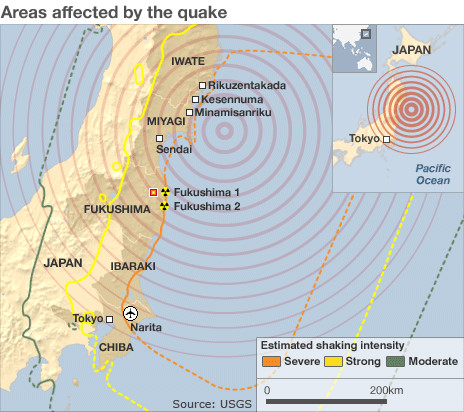
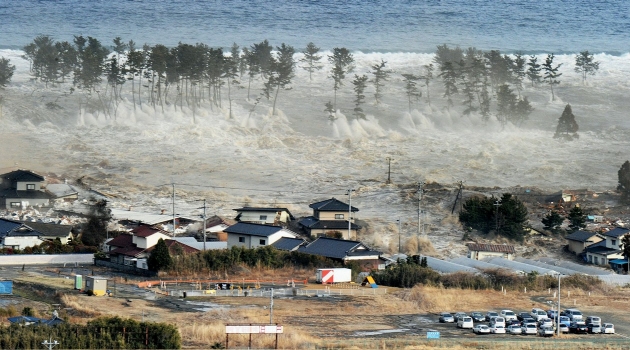
A very powerful Earthquake and a devastating Tsunami initiated the Japanese Nuclear Disaster on March 11, 2011.
Nature's Fury- Tsunami hitting Natori, Japan. The Disaster that followed this tsunami is more frightening.
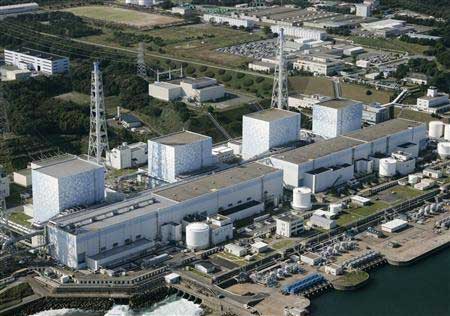
Man's dependence upon Nuclear Energy is the real issue to be faced by Japan, and the rest of the World.
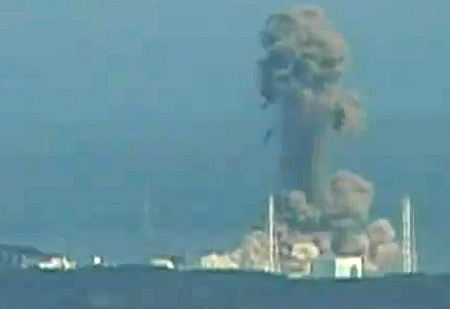
Japan's Nuclear Disaster - Explosions and Fire at Fukushima Nuclear Power Plant.
The explosions at Fukushima Daiichi Nuclear Plant has caused a breach in all the three containment structures and the risk of radiation escaping into the environment has become real and the consequences would be inescapable.
We need to earnestly ask ourselves: Is this Safe? Is this Cheap? Is this Green? In human history, the Japanese Nuclear Disaster on March 11, 2011 will be the most unforgettable Moment. Nuclear Power is more frightening than the Earthquake and the Tsunami that initiated this Nuclear Crisis. It also speaks about the effects of human activities on their environment and on the survival of other species.
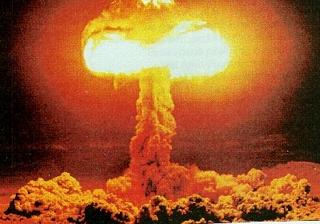
The Safety of Nuclear Power is exposed by this image. The containment structures have failed and could not prevent the escape of radiation from the Reactor Core.
ECOLOGICAL AWARENESS OR CONSCIOUSNESS :
We understand the term Evacuation, Exclusion, or Danger Zone only in terms of its significance to human beings. We need to always think of the entire Ecological Community and man simply belongs to the greater Ecological Community.
The nuclear disaster in Japan will give us a reason to reflect upon the fragile nature of human existence. The Earthquake and the devastating Tsunami are understandable natural calamities and man has no control on geological events and Plate Tectonics. Man has no control over the tidal waves unleashed by the earthquake. However, man has to come to terms with his dependence upon Nuclear Power. This tragedy would also give us a chance to understand the interconnectedness, interrelatedness, and the interdependence of all forms of life. Consciousness is the awareness of something; the awareness of one’s own state of existence and the awareness of the existence of other conscious entities present in the environment. A living organism’s ability to detect the presence of other living organisms in its environment is the characteristic of the biological function known as consciousness. A living cell is conscious as it displays awareness of other living cells present in its environment. The relationship between the organism and all the factors including other organisms that make up its environment is described as Ecology. Consciousness establishes the interconnectedness, the interrelatedness, and the interdependence of a diverse population of living organisms that constitute a continuous ecological chain. This disaster speaks about the effects of human made radiation; the effects on the environment, the effects on other members of human community, and the effects on the Ecological Community in the areas affected by the disaster.
MAN AND NATURE – WHAT IS THE RELATIONSHIP ? :
The Science known as Ecology, Bioecology, Bionomics, and Environmental Biology study the relationships between organisms and all factors including other organisms, that make up their environment. I derive Knowledge from Spirituality Science to understand as to how the relationship between man, and other organisms gets established.
Ecology considers organisms at the levels of individuals, populations, and communities. It will be easy to visualize the human toll in terms of sickness, death, and forced displacement of a large population of human beings. The loss, the pain, and the suffering that is endured by each human individual reveals only a part of this disaster of epic proportions. While we humans try to escape from a disaster zone or area, we need to recognize that our evacuation plans during an emergency fail to include the plant, and animal life with which we share our living environment. We need to take into account the land and water that exist in the area affected by a disaster. The problem is not that of simple relocation of human beings. The human costs are further aggravated by the lack of gasoline, the damage done to the roads and the lack of transportation to move a large number of people quickly and efficiently. The lack of food, safe drinking water, the lack of housing is often understood as a problem just affecting the human victims of the disaster. We have to give attention to the impact upon the Ecological Community as a whole. We need to understand the costs of nuclear industry, the risks it poses to life, and environment, and the long-term consequences imposed by nuclear plant shutdowns. Nuclear accidents get very dramatic attention. There is a fundamental problem with Nuclear energy it is not clean, it is not cheap, and it is not safe. It is very frightening when we face the uncertainties this disaster has imposed on us.
THE BIOLOGICAL EFFECTS OF RADIATION :
The Biological effects of Radiation are well understood. The human risks from exposure to Ionizing Radiation are known. We need to realistically assess the safety levels for the entire Ecological Community.
The General Electric Company designed Boiling water reactors at Japan’s Fukushima Daiichi Nuclear plant had posed safety concerns when they went into operation during 1972. These reactors have about 1000 MW capacity per year and are similar to the Chernobyl 4 Reactor that exploded in 1986. However, in Japan, the reactors have better safety features. This type of Nuclear Crisis is an inherent risk that could happen at any time during the life of the reactor for a variety of reasons. The containment structures have faced a stress and sustained damage. The explosions on March 12 have demonstrated that the danger of radiation leak is not fully contained. These nuclear reactors built-in 1972 have an average lifespan of about 40 years and they are at the end of their operational life. We can never ignore the problem of aging that is an inseparable characteristic of the operation of nuclear plants. We have to recognize the risks imposed by the Suppression Pools that are designed to cool and trap the radioactive particles of Iodine, Cesium, and Strontium. It has been reported that levels of 400 millisieverts per hour had been recorded near the No.4 reactor at Fukushima. At that level of radiation exposure, the operators would be at a high risk of getting radiation sickness after two and half hours of continued stay. According to the World Nuclear Association, radiation exposure to over 100 millisieverts a year can lead to cancer. It has been stated that 1,000 millisieverts of radiation exposure causes immediate or Acute Radiation Sickness. The fatal dose of radiation exposure is about 5,000 millisieverts. The biological effects of radiation are determined by the amount of energy absorbed. Energy dissipation must be quantified to determine the exposure levels. The amount of exposure, the duration of exposure, and the area of the body surface that is exposed are the important factors that determine the nature of radiation injury or illness. The radiation enters the body either as waves or as particles that are electrically charged. Radiation enters body like minute bullets that cause localized injuries in the cells affected. Whether the cell dies immediately or shows molecular changes depends upon the number of sites in the cell that are bombarded and upon how critical these locations are. In the chromosomes, the molecular DNA structure could be damaged. High radiation doses cause rapid cell death. If the cell changes are more subtle, the damage to DNA would unable the cell to reproduce, or the new cells produced could be abnormal and not viable. The tissues most affected by radiation are those that undergo rapid replacement, such as bone marrow, intestinal tract, and skin. Some of the direct effects of radiation exposure include cell depletion, inability to produce new tissue, lowered resistance to infections, decreased number of Red Blood Cells, bleeding from disrupted blood vessels, effects of toxins released by tissue breakdown, and slower blood clotting time. The indirect effects of radiation exposure include tumor growths, a shortened life span, recurrent bacterial infections, anemia, and body ulcers. The explosions at Fukushima Nuclear Plant have exposed the highly radioactive material to environment and radiation levels have increased in the surroundings and in distant areas. It is not known as to how long the population would remain exposed to radiation risk as the population could not be fully evacuated. People in the Danger Zone have been warned to stay indoors. The longer-term exposure to radiation can raise the risk of Thyroid, and Bone cancers, and Leukemia. The incidence of birth defects and deformities would increase. People would become more vulnerable because of suppression of immunological functions. Children, pregnant women, women of child-bearing age would face the brunt of this nuclear disaster while the environment takes its time to recover. There can never be a happy ending to a very tragic story of this kind. There is no Winner and we are all Losers.
THE TWO FACES OF THE NUCLEAR INDUSTRY :
Nuclear Energy - Is there a Winner? Are we all not the Losers?
The civilian uses of Nuclear Power often conceals the use of Nukes as weapons of warfare. The radioactive waste from both civilian and military use remains toxic for thousands of years. The waste is disposed by concentration and storage in casks. This disaster would reveal more information about the fate of highly radioactive waste that is often stored at the nuclear plant on a permanent basis.
BLESSINGS TO PEOPLE OF JAPAN :
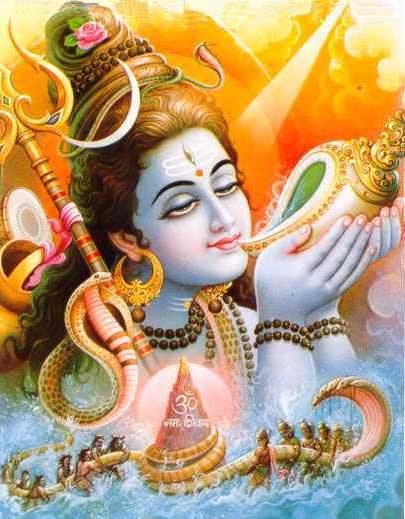
Indian tradition, in the epic story of Samudra Manthan or Churning of the Ocean, glorifies Lord Shiva who had protected humanity from utter destruction by holding a deadly poison in His throat. We need a Savior to protect humanity from deadly toxins like Plutonium.
I seek the Blessings of Lord Shiva to protect and defend the existence of the people of Japan and wish them a success in their efforts to contain the problem of radiation leaking into the environment.
A LESSON FOR INDIA AND ITS NUCLEAR LIABILITY :
Japan's Nuclear Disaster offers a valuable Lesson to India. India must carefully review its Bill for Civil Liability for Nuclear Damage.
Kindly review my blog post titled Civil Liability for Nuclear Damage Bill 2010 – A Himalayan Blunder.
On March 11, 2012, I am pleased to share the following photographs from Japan that display Time’s Divine Power of Healing. I continue to seek the well-being of people of Japan and the full recovery of its Land and all of its inhabitants.
“SARVESHAM SWASTIR BHAVATU” : This is a statement expressed in Sanskrit language and it seeks the well-being of all people, of all nations, of all religions, of all races and of all living entities in their environment and community.
Dr. R. Rudra Narasimham, B.Sc., M.B.B.S., Kurnool Medical College, Kurnool, Andhra Pradesh, India, M.B.B,S., Class of April, 1970.
After the triple blow of a massive earthquake, aftershocks, and a tsunami,
much of the infrastructure in northeast Japan is reeling, and the energy
sector is descending into a significant crisis.
Already, a casualty has emerged: The resurgence of nuclear power as an alternative energy source worldwide has taken a direct hit.
Japan has now introduced electricity rationing, as more and more nuclear-generated power comes off-line.
As of Sunday morning, four of the six nuclear power plants in the district suffered damage from the natural disasters, while technicians lost the ability to cool six nuclear reactors at two of those plants.
Three of those units are at the Tokyo Electric Power Co. (Tepco, TYO:9501) Fukishima Dai-ichi power complex, where a hydrogen explosion occurred Saturday at Unit 1 and a separate explosion was feared likely at Unit 3.
Such explosions are in the outer building – not in the one surrounding the reactor core itself. The Japanese facilities have two complete structures separating the core from the outside world, unlike the 1986 Chernobyl disaster (where the plant had only a single encasement). Nonetheless, the overriding concern in Japan is to prevent a meltdown at each facility.
If a full meltdown occurs, a huge, molten, radioactive mass would burn through both containments and all supporting structures, destroy the buildings, and release a mixture of highly radioactive particles to be spread by wind and rain.
How bad the aftermath would be depends on two things – how much radiation is released and the weather.
At least through Wednesday (March 16), the wind is blowing out to sea, rather than inland, toward population centers. That’s good.
However, reports yesterday about the detection of highly radioactive cesium-137 and iodine-131 outside the Dai-ichi complex means a small amount of dangerous radioactivity has escaped. Experts believe that the radiation problem is thus far localized and minor. Nonetheless, upwards of 200,000 people have been evacuated from the area surrounding the Dai-ichi complex.
To prevent the meltdowns – the worst scenario reminiscent of the cinematic treatment in “The China Syndrome” (1979) – operators have been pumping in seawater in a last-ditch effort to cool down the reactor core. Absent another significant tremor de-stabilizing the plants even further, most specialists believe this will be successful.
But there will be some major costs.
For one thing, seawater corrodes the reactors, making them unusable. There will be significant downtime for other reactors, as detailed technical examinations take place, to say nothing of the massive cleanup required at a number of plants. The largest damage, however, is to the credibility of nuclear power in general.
Nuclear Expansion Plans Are Likely to Be Delayed
This calamity is not about inadequate company oversight or technical deficiencies.
This is all about how Mother Nature can undermine even the best-laid plans of mere mortals.
As the larger Asian region begins to ascertain the damage done to the nuclear-as-remedy approach, major nuclear expansion plans in China, India, throughout East Asia, and in Australia are likely to be delayed. The same goes for the two new reactors under construction in Japan and the 12 more currently in the planning stage.
The real impact, however, is likely to be felt well beyond Asia.
According to London’s World Nuclear Association, there are at present 442 reactors worldwide providing around 15% of global electricity. Plans are already announced to build more than 155 additional reactors, most of them in Asia, with 65 reactors currently under construction.
Back at the epicenter of the present disaster, the impact upon Japanese electricity volume is already wreaking havoc on factories attempting to jumpstart production.
In trading today throughout Asia, shares were tumbling on concerns that major companies would be unable to return to any normal level of production anytime soon.
The Tokyo Stock Exchange also suspended any trading in Tepco. The company is facing an avalanche of sell orders that would greatly exceed the exchange’s 24% limit in the decline of share price.
Yet, despite the current sourcing problems, energy needs will certainly not abate.
LNG Is the Immediate Alternative
Prior to the earthquake, 54 nuclear reactors at 17 plants nationwide produced more than 30% of Japan’s power. Japan has already requested additional electricity from Russia, but the rolling blackouts introduced today will continue throughout the country.
The immediate alternative source of power will be an accelerated usage of liquefied natural gas (LNG). Japan had traditionally been one of the two primary users of LNG (the other being South Korea).
More recently, LNG has been increasing in transport volume throughout the world, even establishing a northern European spot market to challenge long-term conventional pipeline prices from Russia and prompting Canada to revise the terminal under construction at Kitimat on the British Columbia coast to move LNG to Asia.
Closer to Japan, the Gorgon and other northwestern Australian projects, along with those in Papua New Guinea and on Sakhalin Island off of the Pacific coast of Russia, are gearing up a rising volume of LNG for export.
Much of that increase is bound for China, where five receiving terminals are right now at various stages of completion, and three additional ones are in planning. Still, there is more volume that can be brought to market, and Japanese utilities have been actively locking in additional LNG consignments governed by multi-year contract agreements.
Japanese energy needs are tailor-made for a transition to LNG as a rising fuel source for power generation. The country had already embarked on a robust project to expand existing LNG terminals and build new ones well before the earthquake occurred.
These are not coming on-line in short order… But neither are the problems with the Japanese nuclear network going away anytime soon.
Reporting of Sanskrit as Second Language-Census of India 2011. Sanskrit is a cultural tool that we use everyday.Reporting of Sanskrit as Second Language. Sanskrit is a Cultural tool that most Indians use to express their ideas in their physical behavior, actions, and interactions.
I am happy to share a letter that I received from Arsha Vidya Gurukulam asking fellow Indians to mention Sanskrit as their Second Language while participating in Census of India 2011. Unfortunately, I may not take part in Census of India 2011, but nothing would prevent me from sending my Blessings and Best Wishes for the success of their humble proposal or initiative to give recognition to the Sanskrit Language and its role in shaping Indian Life and Existence.
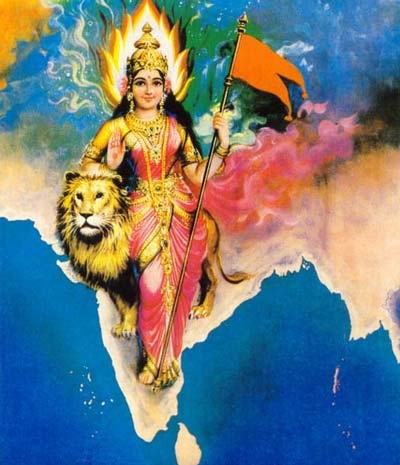
I seek the Blessings of Goddess Sarasvati, the Goddess of Learning and Speech even when I express my ideas and thoughts in English.
SANSKRIT IS THE LANGUAGE OF OUR NATIONAL LIFE:
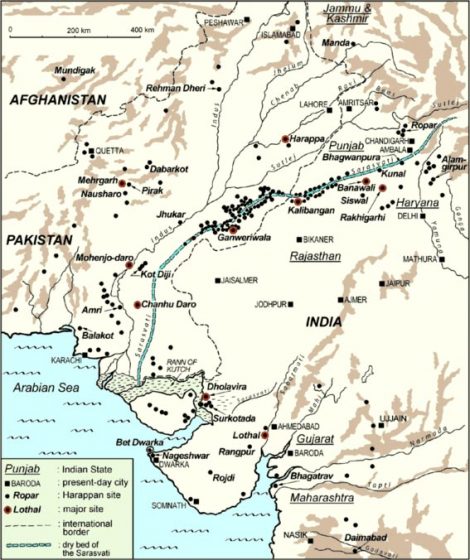
The Rig Vedic River Sarasvati is associated with the birth of Devanagari Script and Sanskrit Language. The ideas and thoughts that are expressed in Sanskrit Language flow through our National Life and the Language has become the Language of our actions, interactions, our Culture, our Customs, and our Traditions.Sanskrit is the tool that I use to discover the God-Connection.
WHAT IS CULTURE?
Five Letter Mantra for Learning. AUM NAMAH SHIVAYA. Namah is the most used Sanskrit word in all human interactions, worship, and the Learning Process.
The word ‘CULTURE’ is defined as ideas, customs, skills, arts, etc., of a people or group, that are transferred, communicated, or passed along, as in or to succeeding generations.
My human body can biologically exist without using any of the human languages. If the human person, the physical being is viewed as an Association of trillions of cells, none of these cells need the human languages to communicate with each other. However, for man to exist as a mental being, a social being, a moral being, and as a spiritual being, ideas are required to formulate the behavior, the attitudes, and the customs. The contents of such ideas are more important than the language in which they may be communicated. Sanskrit is the Cultural tool that I received while growing up in India and it is the tool that I use in my everyday life to exist as a mental, social, moral, and spiritual being. It does not require the use of Sanskrit as a language for my reading, writing, or speaking. I use Sanskrit to draw upon those ideas that are Culturally transmitted to me. Hence, Sanskrit should be recognized as the Mother of ideas, customs, and traditions that gives us our Indian Identity and Sanskrit is an unspoken tool that we use to lead our daily lives. If I use the word ‘NAMASKAR’ or ‘NAMASTE’ or any other equivalent word to greet you, or to acknowledge your presence, I have derived that ‘NAMAH’ thought from Sanskrit. The word ‘NAMAH’ is the most used word of expression in the Sanskrit language. If any of us use that word, by verbally speaking it and by physically joining hands, I would claim that we use Sanskrit language. I have seen deaf, mute, and blind people and they have greeted me with Namaskar or Namaste, or its equivalent, and they are able to do so as the Language is communicated by their physical actions and not by the simple use of words; the words that we use in writing, listening, and speaking.
SANSKRIT IS THE LANGUAGE FOR PHYSICAL ACTION:
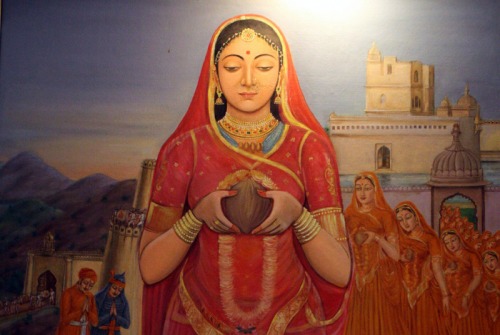
Essence and Existence- Indians express their Essence in the manner they exist. Rani Padmini of Chittorgarh had expressed her essence as a moral, and spiritual being by ending her physical existence. Sanskrit is the Cultural tool that Indians use to define their Essence.
Our simple daily activities like greeting people, showing respect to others, entertaining guests, learning at Schools, our simple acts of River Worship, or touching feet to receive blessings from elders are all evidence of our use of the Sanskrit Language in action.
Dr. R. Rudra Narasimham,
Kurnool Medical College, Kurnool, Andhra Pradesh, India,
M.B.B.S., Class of April, 1970.
From: Arsha Vidya Newsletter <newsletter@arshavidya.in> Date: Wed, Feb 16, 2011 at 9:43 PM Subject: Request for mentioning Sanskrit as your second language in the census
Dear Devotee,
The Census of this country has started from 09.02.2011. In their questionnaire, they will ask our mother tongue and also 2nd language. As far as possible, in this census, please show Sanskrit as your mother tongue or 2nd language. We may say that Sanskrit is the base for all Indian languages. It is the unifying Language in which our Cultural and Spiritual Traditions are enshrined. Remove and eliminate this Language and you can destroy our Culture.Mentioning of Sanskrit by more people will enable the language get bigger slots in Doordarshan and other benefits from the Central Government. Otherwise we will lose out and hence our culture will lose out.Please also pass on this information to as many as possible.
Whole Concept – The Perception of Time and Unchanging Reality: Happy Makara Sankranti to all of my readers. We observe and Celebrate the Movement of Sun across the Celestial Sphere and since human existence is conditioned by Illusion, there is a reason for Joy and define our Whole Concept of an Unchanging Reality.
UNDERSTANDING TIME AND THE CONCEPT OF UNCHANGING REALITY :
Earth’s Rotational Spin provides the experience of Time by causing changes in the environment which Man perceives as Day and Night. This cyclical change of alternating periods of Light and Darkness is synchronized with Man’s Biological Rhythms.
Time is defined as the period or interval between two events or during which something exists, happens or acts; the duration is a measurable interval. Indian thinkers have described ‘Time’ or ‘KAALA’ as a Power or a Force that is eternal suggesting that ‘Time’ existed before the formation of this created universe, Time operates during the existence of this created universe, and Time remains after the total dissolution of this created universe. ‘Things in Nature change with Time’. Does Time exert a force entirely of its own to change things in Nature? If Time is viewed as a Power or Force, who controls this Force and what are the Laws that operate this Force?
The Subjective Reality of Man’s physical existence is operated by the Biological Clock which may have a plan for Dissolution.
Everything that is born, everything that has come into existence, and everything that is conditioned arrives with its own plan for dissolution. Whosoever had arrived on this planet Earth, is sure to depart. Time operates this plan for dissolution. Time has the power to cause dissolution of the animate as well as the inanimate world and the physical universe. Whatever qualities or attributes such as material wealth, social status, social position, and physical state of well-being that man cherishes and desires most would be dissolved and would be rendered useless by the effects of Time. Humans lack the material, and the biological abilities to transform their physical beings into sources of perpetual enjoyment. Time with its Power of Dissolution would eventually compel us to investigate and to explore the concept of Absolute and Unchanging Reality. This Subjective Reality of Man’s existence on this planet Earth which is a member of the Solar System would be dissolved by the influence of Time. Dissolution of Sun and the Solar System would not result in the dissolution of this universe that we currently know and understand. Even when a man is dissolved, the conditioned reality of this physical universe will continue and remains as before as Earth and Sun do not describe the total reality of this conditioned universe.
THE PERCEPTION OF CHANGE AND HUMAN CONCEPTS ABOUT TIME:
The Moving Train and the Perception of changing the landscape. Photo Credit: Indyeahforever.
Many of you who learned Physics understand the term Speed and Velocity. A person riding in a train or any other moving object could perceive a change that is caused by the motion. The nature of this perception depends upon the Speed or Velocity of that moving object. If the person jumps out of the train, the change that he has been perceiving immediately stops. There would be no changing landscape. As the speed of train increases, the perception of change also alters and at very high speeds man actually loses the ability of visual perception. The visual image becomes a blur. If a man is viewing a Motion Picture, his visual ability to view the Picture could be destroyed by simply increasing the speed of the Projector. Any given point on the surface of the Earth moves with the Speed of the Earth. Earth is moving at a great speed and man has no ability to perceive this motion or the speed. Man perceives a change in his environment and calls it day and night. We run our lives by numbers on clocks and calendars. The clocks and calendars create the illusion that we live in a world of mathematically measured segments of time. Time is looked upon as a flow like a river. Sir Issac Newton(1687) stated that the flow of Time is absolute; “It flows equably without relation to anything external.” In 1905 while postulating the Theory of Relativity, Albert Einstein had observed that Time is not absolute and the measurement of Time is affected by the motion of the observer. The Relativity of Time becomes significant only at great speeds. Gravity affects both Light and Time. Gravity bends both Space and Light. Time is affected by the gravitational field of each celestial body. Time is unique to any one spot in the universe. If you and I do not exist at the same spot in the universe, our experience of Time remains conditioned by the place or position of that particular spot in the universe. Thus, the experience of Time on this planet is an illusionary experience and is not an absolute experience.
‘KAALA CHAKRA’ OR THE CYCLICAL FLOW OF TIME:
The Cyclical Flow of Time brings Cyclical Changes at expected Time intervals. Life exists because of the Cyclical Flow of Time.
Herman Minkowski, a mathematician, added Time as the Fourth Dimension of Three Dimensional Space. Time is seen as a Dimension as it gives meaning to events and the order in which they occur. Physicists describe Time and Space as the building blocks of this universe. Biologists see Time in the internal clocks that keep all living entities in sync with Nature. Human existence and the existence of all other living entities depend upon this illusionary experience of Time. Life exists and operates only if Time flows in a cyclical manner just like a wheel that moves, rotates on an axle or axis. Man needs this experience of day and night during his entire life journey. Man needs the changing Seasons with its cyclical regularity. Just imagine the consequences to human existence if Spring Season does not arrive at the Time it is expected. You have correctly pointed out that planet Earth is not at the same location or place in Space as Time flows. Last year, we had experienced the Spring Season while Earth existed at an entirely different location and we look forward to the arrival of a new Spring Season in spite of the Change in the position. In spite of Changes in location or position, in relative terms, the Spring Season is the Unchanging Reality of the Conditioned State of Human Existence. Because of the Conditioned nature of Human Existence, Man always looks forward and hopes that Time would flow in a cyclical manner bringing cyclical changes. Biologists describe Life in terms of Life Cycles. All living functions have a rhythmic or cyclical quality. The exchange of gases during a cycle called Respiration involves the cyclical events of Inspiration and Expiration. The vital functions sustained by Circulation demands cyclical flow of Blood. The Individual and his State or Condition of Individuality remains existing as an Unchanging Reality as long as he experiences the cyclical changes in his bodily functions and in the environment in which he exists. I am that Unchanging Reality, the Reality of my Identity and my Individuality remains unchanged as my physical body experiences cyclical changes in its substance and in the environment where it exists. My phenotype or morphological appearance or outward appearance undergoes a constant change and this change is synchronized with the cyclical change called alternating periods of Day and Night. The Biological Clock precisely measures this Time interval or duration of my existence relative to the illusionary change; in Reality, the Sun is shining with all His brightness at all times with no significant change that I can perceive.
THE GOD CONNECTION:
Face Recognition Technology helps in identification of an Individual. Under the influence of Time, the outward appearance undergoes changes all the time during Life’s Journey and yet the Identity and the Individuality survives the Time’s Power of Dissolution.
My Identity and my Individuality is the Unchanging Reality of my conditioned state of human existence. I had explored the Nature of this Unchanging Identity and Individuality. This Unchanging Reality of Identity and Individuality exists during the Time interval or duration of my God Connection. I know that Time existed before my creation, Time is operating during my existence as a created being, and Time would continue to operate after my physical dissolution. Time with its great power of Dissolution could not change my perception about my Unchanging Identity and Individuality because of my God Connection. It is rational, it is logical, and it is reasonable to reflect upon Absolute and Unchanging Reality as long as I maintain my Identity and Individuality which cannot be changed or altered by the flow of Time.
A Designer Universe is described by a Greek word called ‘COSMOS’ which means Beauty and Order.
If an object comes into existence as a new object, and if it is unique, distinctive, and one of its kind, I would describe that object as a created object and it cannot be described as a manufactured object. The distinction between creating an object and manufacturing an object is that of inspiration; the action must be characterized by creative thought or influence. Astronomer John Gribbin in his article about the origin of Universe makes an attempt to discuss “Unknown” “Unknowns”. He considers that God is unknown and incomprehensible. Instead of discussing “Unknown” ‘Unknowns”, we may rather try to understand known “Unknowns.” If the Universe is a “Multiverse” with unknown physical laws operating equally unknown universes, the discussion would be futile. We are not present at the time of the birth of this Universe in which we exist today. The birth and the origin of this Universe is unknown. However, we know the Universe as it exists today and it is partly known and comprehensible. It is reasonable to reflect upon the known aspects of this known Universe.
PLANET EARTH IS A CREATED OBJECT:
Different planets have different rates of Rotation. Earth’s Rotational Spin makes it a unique Celestial Body. This Rotational Spin is a characteristic of its Design with purpose, and imagination.This is the photo image of a new Exoplanet. It is not an Earth like object. This new planet has a different rate of rotation.
There are good and valid reasons to believe that planet Earth is unique, distinctive, and one of its own kind. Man has not discovered any object in this Universe which could be comparable to planet Earth. Man is endowed with Sensory Perception, Mind, Intellect, and Consciousness. The sky that man visualizes while existing on Earth is BLUE in color and the color of the sky beyond planet Earth is BLACK. This Visual Sense Perception demands existence of special organs for Color perception and an appropriate physical medium that can scatter Light rays. Man has organs for Hearing, his environment has the natural ability to propagate Sound Waves, and several of the living entities have special organs to generate Sound. This ability to produce Sound, Propagate Sound Energy, and Perception of Sound is unique to our planet Earth. Unless demonstrated by evidence of Sound Recordings, this Auditory Sense Perception prevails only on planet Earth. Apart from the Soil of this Earth which has a unique fragrance of its own called ‘GEOSMIN’, Man exists in a fragrant world. This Olfactory Sense Perception is a unique experience and could exist only on planet Earth. For this Olfactory Sense function we need the simultaneous operation of physical, chemical, and biotic factors. The Fresh Water that supports Man’s Life has an original, and distinctive pure taste of its own. Man lives tasting unique organic molecules which produce the Gustatory experience. As the saying goes, ‘The Proof of the Pudding is in the Eating’; we need acceptable proof about the existence of such unique organic molecules in the rest of the Universe. Today, planet Earth is the only place where Man can Dine and Wine. Man has the ability to actually experience the Power of Creation. The Tactile Sense Perception gives Man the ability to hold his own Baby in his arms and directly experience the New Product as a Created Object. Man always comes into existence as a new, distinctive, unique, and one of his own kind Object. The unique GENOME with which Man takes his birth and comes to Life has not existed before and would not exist again after his Death.
Astronaut Edwin Buzz Aldrin, Apollo 11 Mission on Lunar Soil. Man has not yet discovered “BLUE SKY” in the rest of the Universe away from his Planetary Home.
INTELLIGENCE AND CONSCIOUSNESS:
Intelligence is the ability to acquire and to retain Knowledge. Hence, it may be stated that Intelligence is characterized by the presence of Knowledge. The Laws that operate in the material universe have no intelligence. Nonliving matter has no intelligence. Intelligence can only exist in living entities that have the abilities of Perception, Cognition, Awareness, and Consciousness. Knowledge means the Act of Knowing, the State of Knowing, and the Fact of Knowing a range of information. Man, and other living entities which are endowed with Intelligence can use and exploit the Natural Laws that operate in the material Universe to sustain their own existence. Physical Systems do not need Intelligence in their mechanical operations. I must also add that “Unintelligent Laws” that operate material Nature and Universe cannot give birth to “Intelligent” minds. Intelligence and Knowledge are Biological Functions and they characterize only Living Systems. Both Intelligence and Knowledge are revealed in application of information in a function/action/activity of a living organism. This ability which gives a sense of ‘Awareness’ of the environment in which a living organism exists is called ‘Consciousness’. The Living Organism is a Conscious entity, and it demonstrates its intelligence and knowledge in its living functions. Man uses his intelligence to exploit the Laws of Nature to his advantage. Man harnesses energy from wind, sun, flowing water, and surf. He generates a new form of energy using these resources of energy. He uses intelligence to transform coal energy into fossil fuel, or to generate electrical power. If water flows only in the direction of a natural gradient, man installs a pump and makes the water flow in the opposite direction. Similarly, plants trap light energy and transform radiation energy into chemical energy and create organic molecules. Man oxidizes these organic molecules and converts oxidative energy into chemical energy which he further uses for all of his living functions. A stone could also get heated by Sun and trap some light energy. Stone has no Intelligence or Knowledge and it cannot convert the energy it gained into a different form of energy and use it to build molecules of its own kind. Metals, liquids, and gases do physically expand upon heating and such expansion is not associated with addition of new molecules of their own kind. Only living entities have the “ability” to exploit energy from material nature. The “DESIGNER” who has Mind and Intelligence could be defined as a Living System as Life could be defined as “Knowledge in Action.”
The Mind and Intellect of the Designer is always imprinted on His Design. Man experiences his Life on planet Earth with the help of a ‘Biological Clock’ which acts as an internal timing mechanism.
The Indian Tradition offers a very simple and reasonable explanation to all this. Bhagavad Gita, Chapter VII( Knowledge of the Absolute ), verses 4 and 5 states that “Earth, water, fire, air, ether, mind, intelligence, and false ego – altogether these eight comprise My separated material energies. ( Material Nature is known as ‘Prakriti’ ). There is a superior energy of Mine; which are all living entities who are struggling with material nature and who sustain the universe.” Further, verse 9 states that, “I am the life of all that lives.” Verse 10 states that, “I am the original seed of all existences.” Verse 8 affirms that, “I am …… ability in man.” If Mind, and Intelligence are viewed as forms of material energy, the embodied Soul has the “ABILITY” to exploit that energy apart from energies of material nature or Prakriti. The Knowledge of the Absolute describes Living entities as manifestations of Lord Krishna’s Superior Energy. Man is related to the Superior Energy and hence the Living Systems and the Absolute share the same characteristics like Knowledge, Intelligence, and Consciousness. The Bhagavad Gita in Chapter X ( The Opulence of the Absolute), verse 22 states that “……… in living beings I am Consciousness.” The Status of Man in Nature and his conditioned Existence on planet Earth describes the Design and testifies about the Mind and Intellect of the Designer, a Creator God.
The Bhagavad Gita reveals the Mind and Intellect of the Designer. The Design for this Universe and the Plan of Creation are Revealed in Chapter X ( The Opulence of the Absolute ), verse 8 states:”I am the source of everything; from Me the entire Creation flows.”
The Bhagavad Gita, Chapter XVIII (The Perfection of Renunciation) in verses 13 and 14 explains that there are five “causes” in the accomplishment of any action, or any kind of work including that of creation and designing the Universe and the living entities that struggle and sustain this Universe. If there are no living entities, there would be no struggle with material nature, and there would be no purpose for the Universe to exist. The five factors of action are 1. the Place of Action, 2. The Doer, 3. the Senses, 4. the Endeavor, 5. and ultimately the Super Soul (which is often stated as the PRIME CAUSE). The Absolute, or the Super Soul has functioning Sense Organs or a Sensory System, and has Intelligence, Mind, Knowledge, Ability, and Consciousness. Lord Krishna has described Himself as the “Consciousness in all the living entities.”
There are five factors of action; the place of action, the doer, the senses, the endeavor, and the Supersoul or Prime Cause. This Designer Universe in which the man exists reveals all the five causes that accomplished the Act of Creation.
Please review my blog post titled “I am Consciousness, therefore I am” for further discussion about ‘SOUL AND CONSCIOUSNESS’.
The Richard Dawkins Foundation for Reason and Science
Are we living in a designer universe?
By JOHN GRIBBIN – THE DAILY TELEGRAPH Added: Tuesday, 31 August 2010 at 4:41 PM
The argument over whether the universe has a creator, and who that might be, is among the oldest in human history. But amid the raging arguments between believers and skeptics one possibility has been almost ignored – the idea that the universe around us was created by people very much like ourselves, using devices not too dissimilar to those available to scientists today.
As with much else in modern physics, the idea involves particle acceleration, the kind of thing that goes on in the Large Hadron Collider in Switzerland. Before the LHC began operating, a few alarmists worried that it might create a black hole which would destroy the world. That was never on the cards: although it is just possible that the device could generate an artificial black hole, it would be too small to swallow an atom, let alone the Earth.
However, to create a new universe would require a machine only slightly more powerful than the LHC – and there is every chance that our own universe may have been manufactured in this way.
This is possible for two reasons. First, black holes may – as science fiction aficionados will be well aware – act as gateways to other regions of space and time. Second, because of the curious fact that gravity has negative energy, it takes no energy to make a universe. Despite the colossal amount of energy contained in every atom of matter, it is precisely balanced by the negativity of gravity.
Black holes, moreover, are relatively easy to make. For any object, there is a critical radius, called the Schwarzschild radius, at which its mass will form a black hole. The Schwarzschild radius for the Sun is about two miles, 1/200,000th of its current width; for the Earth to become a black hole, it would have to be squeezed into a ball with a radius of one centimetre.
The black holes that could be created in a particle accelerator would be far smaller: tiny masses squeezed into incredibly tiny volumes. But because of gravity’s negative energy, it doesn’t matter how small such holes are: they still have the potential to inflate and expand in their own dimensions (rather than gobbling up our own). Such expansion was precisely what our universe did in the Big Bang, when it suddenly exploded from a tiny clump of matter into a fully-fledged cosmos.
Alan Guth of the Massachusetts Institute of Technology first proposed the now widely accepted idea of cosmic inflation – that the starting point of the Big Bang was far smaller, and its expansion far more rapid, than had been assumed. He has investigated the technicalities of “the creation of universes in the laboratory”, and concluded that the laws of physics do, in principle, make it possible.
The big question is whether that has already happened – is our universe a designer universe? By this, I do not mean a God figure, an “intelligent designer” monitoring and shaping all aspects of life. Evolution by natural selection, and all the other processes that produced our planet and the life on it, are sufficient to explain how we got to be the way we are, given the laws of physics that operate in our universe.
However, there is still scope for an intelligent designer of universes as a whole. Modern physics suggest that our universe is one of many, part of a “multiverse” where different regions of space and time may have different properties (the strength of gravity may be stronger in some and weaker in others). If our universe was made by a technologically advanced civilization in another part of the multiverse, the designer may have been responsible for the Big Bang, but nothing more.
If such designers make universes by manufacturing black holes – the only way to do it that we are aware of – there are three levels at which they might operate. The first is just to manufacture black holes, without influencing the laws of physics in the new universe. Humanity is nearly at this level, which Gregory Benford’s novel Cosm puts in an entertaining context: an American researcher finds herself, after an explosion in a particle accelerator, with a new universe on her hands, the size of a baseball.
The second level, for a slightly more advanced civilization would involve nudging the properties of the baby universes in a certain direction. It might be possible to tweak the black holes in such a way that the force of gravity was a little stronger than in the parent universe, without the designers being able to say exactly how much stronger.
The third level, for a very advanced civilization would involve the ability to set precise parameters, thereby designing it in detail. An analogy would be with designer babies – instead of tinkering with DNA to get a perfect child, a scientists might tinker with the laws of physics to get a perfect universe. Crucially, though, it would not be possible in any of these cases – even at the most advanced level – for the designers to interfere with the baby universes once they had formed. From the moment of its own Big Bang, each universe would be on its own.
This might sound far-fetched, but the startling thing about this theory is how likely it is to happen – and to have happened already. All that is required is that evolution occurs naturally in the multiverse until, in at least one universe, intelligence reaches roughly our level. From that seed point, intelligent designers create enough universes suitable for evolution, which bud off their own universes, that universes like our own (in other words, suitable for intelligent life) proliferate rapidly, with “unintelligent” universes coming to represent a tiny fraction of the whole multiverse. It therefore becomes overwhelmingly likely that any given universe, our own included, would be designed rather than “natural”.
While the intelligence required to do the job may be (slightly) superior to ours, it is of a kind that is recognizably similar to our own, rather than that of an infinite and incomprehensible God. And the most likely reason for such an intelligence to make universes is the same for doing things like climbing mountains, or studying the nature of subatomic particles – because we can. A civilization that has the technology to make baby universes would surely find the temptation irresistible. And if the intelligences are anything like our own, there would be an overwhelming temptation at the higher levels of universe design to improve upon the results.
This idea provides the best resolution yet to the puzzle Albert Einstein used to raise, that “the most incomprehensible thing about the Universe is that it is comprehensible”. The universe is comprehensible to the human mind because it was designed, at least to some extent, by intelligent beings with minds similar to our own.
The great British astronomer Fred Hoyle suggested that the laws of physics were so uniquely conducive to human existence that the universe must be “a put-up job”. I believe he was right: the universe was indeed set up to provide a home for life, even if it evolved through a process of natural selection, with no need for outside interference. It isn’t that man was created in God’s image – rather that our universe was created, more or less, in the image of its designers.
Dr John Gribbin is a visiting fellow in Astronomy at the University of Sussex and author of ‘In Search of the Multiverse‘ (Penguin), available from Telegraph Books for £9.99 plus 99p p&p. Call 0844 8711515 or go to books.telegraph.co.uk