This article is in response to a claim about Samkhya or Sankhya Doctrine found in ‘GURBANI’ Holy Book of Sikhism. Firstly, I state that I have not met any person of Sikh faith who may not believe in existence of Infinite God. Because of that Belief or Faith, they attend Worship Service to seek wisdom of Guru with sense of devotion, respect, obedience, and humility.
Secondly, to discuss the validity of Samkhya or Sankhya doctrine, I have to discuss each term used in conversation. For example, the term ‘AKASA’ simply refers to Earthly phenomenon and it demands interaction between Light rays and Earthly atmosphere apart from presence of living things with faculties of Sense Perception.
WHAT IS PRAKRTI OR NATURAL ENVIRONMENT?
I ask my readers to reflect on one particular term at a time to focus on the subject matter. Again, my concern is not about God’s existence. There is not even one term used by Sankhya Doctrine that is inferentially correct. For example, the understanding of ‘PRAKRTI’ or Nature or Natural Environment is flawed. Every living thing establishes its own existence by separating itself from its external environment. Every Living Cell functions by separating itself from other Living Cells even if all the Cells represent the same Living Organism. Prakrti refers to external, environment of specific Living Things. In modern Science it includes Physical, Social, Cultural, Political, Economic, and Biological Environment. Other Living Things present in my Environment determine my Actions and my Human Behavior. While ‘PURUSHA’ is an individualized term, Prakrit includes other Purushas and all other Living Things including Bacteria and Viruses.
For each Living Thing exists as Individual with Individuality, Self-Identity, Self-Recognition, Ego, and Ahamkara is prerequisite for sustaining reality of existence.
Rudranarasimham Rebbapragada Ann Arbor, MI 48104-4162 USA BHAVANAJAGAT.ORG
From: DEVINDER SINGH GULATI:
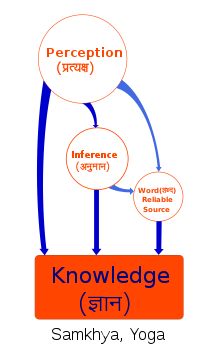
The Sankhya doctrine does take reason into account. It considers perception, inference and reliable testimony as three reliable means to knowledge. The Samkhya system espouses dualism between consciousness and matter by postulating two “irreducible, innate and independent realities: puruṣa and prakṛti. While the prakṛti is a single entity, the Samkhya admits a plurality of the puruṣas in this world. Unintelligent, unmanifest, uncaused, ever-active, imperceptible and eternal prakṛti is alone the final source of the world of objects which is implicitly and potentially contained in its bosom. The puruṣa is considered as the conscious principle, a passive enjoyer (bhokta) and the prakṛti is the enjoyed (bhogya). Samkhya believes that the puruṣa cannot be regarded as the source of inanimate world, because an intelligent principle cannot transform itself into the unconscious world.
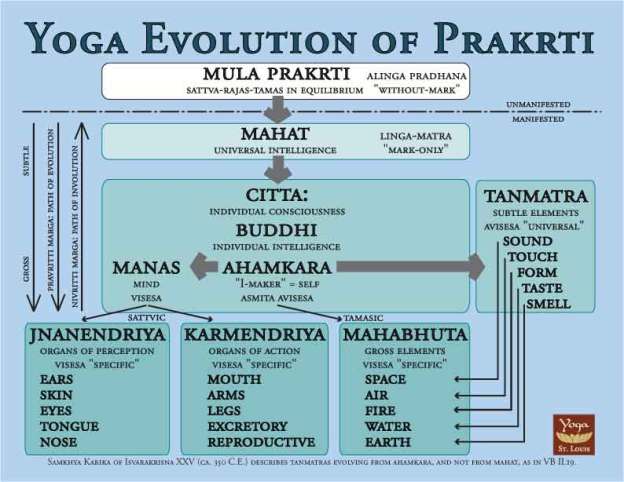
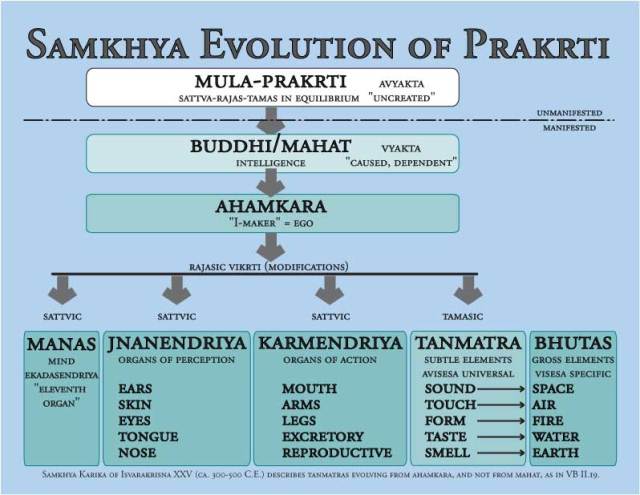
Prakṛti is the first cause of the manifest material universe — of everything except the puruṣa. Prakṛti accounts for whatever is physical, both mind and matter-cum-energy or force. Since it is the first principle (tattva) of the universe, it is called the pradhāna, but, as it is the unconscious and unintelligent principle, it is also called the jaDa. It is composed of three essential characteristics (trigunas). These are:
Sattva – poise, fineness, lightness, illumination, and joy;
Tamas – inertia, coarseness, heaviness, obstruction, and sloth. The unconscious primordial materiality, prakṛti, contains 23 components including intellect (buddhi,mahat), ego (ahamkara) and mind (manas); the intellect, mind and ego are all seen as forms of unconscious matter.
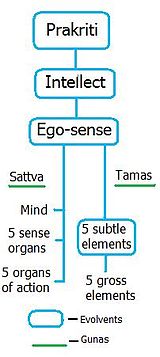
Some evolutes of prakṛti can cause further evolution and are labelled evolvents. For example, intellect while itself created out of prakṛti causes the evolution of ego-sense or ahamkara and is therefore an evolvent. While, other evolutes like the five elements do not cause further evolution. It is important to note that an evolvent is defined as a principle which behaves as the material cause for the evolution of another principle. So, in definition, while the five elements are the material cause of all living beings, they cannot be called evolvents because living beings are not separate from the five elements in essence.
prakṛti
Root evolvent Primordial matter
Internal instruments
Intellect (Buddhi or Mahat), Ego-sense (Ahamkāra), Mind (Manas)
Ether (Ākāsh), Air (Vāyu), Fire (Agni), Water (Jala), Earth (Prithvi)
Evolute
The intellect is the first evolute of prakṛti and is called mahat or the great one. It causes the evolution of ego-sense or self-consciousness. Evolution from self-consciousness is affected by the dominance of gunas. So dominance of sattva causes the evolution of the five organs of perception, five organs of action and the mind. Dominance of tamas triggers the evolution of five subtle elements– sound, touch, sight, taste, smell from self-consciousness. These five subtle elements are themselves evolvents and cause the creation of the five gross elements space, air, fire, water and earth. Rajas is cause of action in the evolutes.] Purusha is pure consciousness absolute, eternal and subject to no change. It is neither a product of evolution, nor the cause of any evolute.
Samkhya regards ignorance (avidyā) as the root cause of suffering and bondage (Samsara). Samkhya states that the way out of this suffering is through knowledge (viveka). Mokṣa (liberation), states Samkhya school, results from knowing the difference between prakṛti (avyakta-vyakta) and puruṣa (jña). Other forms of Samkhya teach that Mokṣa is attained by one’s own development of the higher faculties of discrimination achieved by meditation and other yogic practices. Moksha is described by Samkhya scholars as a state of liberation, where Sattvaguna predominates.
Classical Samkhya argues against the existence of God on metaphysical grounds. The following arguments were given by the Samkhya philosophers against the idea of an eternal, self-caused, creator God:
If the existence of karma is assumed, the proposition of God as a moral governor of the universe is unnecessary. For, if God enforces the consequences of actions then he can do so without karma. If however, he is assumed to be within the law of karma, then karma itself would be the giver of consequences and there would be no need of a God.
Even if karma is denied, God still cannot be the enforcer of consequences. Because the motives of an enforcer God would be either egoistic or altruistic. Now, God’s motives cannot be assumed to be altruistic because an altruistic God would not create a world so full of suffering. If his motives are assumed to be egoistic, then God must be thought to have desire, as agency or authority cannot be established in the absence of desire. However, assuming that God has desire would contradict God’s eternal freedom which necessitates no compulsion in actions. Moreover, desire, according to Samkhya, is an attribute of prakṛti and cannot be thought to grow in God. The testimony of the Vedas, according to Samkhya, also confirms this notion.
Despite arguments to the contrary, if God is still assumed to contain unfulfilled desires, this would cause him to suffer pain and other similar human experiences. Such a worldly God would be no better than Samkhya’s notion of higher self.
Furthermore, there is no proof of the existence of God. He is not the object of perception, there exists no general proposition that can prove him by inference and the testimony of the Vedas speak of prakṛti as the origin of the world, not God.
Therefore, Samkhya maintained that the various cosmological, ontological and teleological arguments could not prove God.
On behalf of Special Frontier Force, I extend hearty welcome to General Bipin Rawat, new Indian Army Chief. Also delighted to welcome new Indian Air Chief, Air Marshal Birender Singh Dhanoa.
India must prepared for war, more surgical strikes against Pakistan possible’
Dynamics of terrorism is constantly changing; Army must think ahead in that direction
Two-front war is a real scenario, says General Bipin Rawat
Lt Gen Bipin Rawat joined the Indian Army in December 1978.
Rawat won the Sword of Honour when he graduated from the Indian Military Academy in 1978.
He is second consecutive chief from the Gorkha Rifles.
Lt Gen Bipin Rawat has taken over as the head of the 1.3 million strong Indian Army, succeeding General Dalbir Singh Suhag. Rawat, whose appointment had kicked up a row, was designated as Army chief by the ruling NDA government ignoring protests from opposition including Congress.
Rawat, a Gurkha officer is the 27th Chief of the armed forces. He superseded two senior most Lt Generals, Praveen Bakshi and PM Hariz as the 26th Army Chief of India. Air Marshal Birender Singh Dhanoa also took charge as the next Air Force Chief replacing Anup Raha.
Rawat, who learnt his art in Kashmir and the northeast, headed the Indian brigade during the UN peacekeeping operation in the Democratic Republic of the Congo in 2008. Indian peacekeepers performed splendidly under his leadership. The general is credited with providing dynamic leadership under the UN banner. The Indian peacekeepers switched their approach from a velvet glove to an iron fist under his leadership.
Earlier in the day, outgoing Army Chief General Dalbir Singh and Air Force Chief Anup Raha paid tributes at Amar Jawan Jyoti in New Delhi’s India Gate and also inspected the guard of honour.
“I salute our martyrs who made supreme sacrifices in upholding honour of the nation,”Gen Dalbir Singh said while speaking to the media.
Good principle, “action must speak louder” is itself displaying his valour. Appreciate !ShashiKumar KB
He also thanked government and Prime Minister Narendra Modi for ‘their full support and giving free hand in conducting the operations’. He further thanked the government for ‘granting One Rank One Pension to armed forces’.
“Indian Army is fully prepared and well trained to tackle any challenges, be it external or internal. I strongly believe that actions must speak louder than words,” he said. India must prepared for war, more surgical strikes against Pakistan possible’
Army Chief Gen. Bipin Rawat In a major statement, Indian Army Chief Bipin Rawat on Tuesday said that further strikes against Pakistan can’t be ruled out. “Further surgical strikes against Pakistan can’t be ruled out; the strikes were meant to send out message,” Army Chief Bipin Rawat said in a conversation with NDTV. The statement by the new Army Chief comes two days after he said that the role of the force is to maintain peace and tranquillity at the border but it will not shy away from flexing its muscles, if the need be. Also, talking to news agency ANI, Rawat said, “Want to modernise operational logistics, ammunition depots being modernised, computerisation of ordnance inventory being done.” On OROP, Rawat said, “Demands till a certain extent fulfilled, would like to urge those veterans sitting at Jantar Mantar to return home.” Priorities “My 1st priority is to boost Indian Army’s moral and make every jawan believe that they empower our force,” Army chief Gen Bipin Rawat told ANI. “2nd priority is to technologically advance and modernise equipment and weapons, so that jawans protect borders even better,” Rawat added. Ready for wars “PM Narendra Modi had said that the wars in future will be brief and intense, we are ready for it; staying alert is important,” Rawat said. (PM ne bhi kaha tha jo aane waaley yudhh hongey, intense aur chhote honge, is ke liye hum tayyar hain…satark rehna zaroori hai) On war “We’re always ready for war, it’s our job but life of civilians in border areas will be badly affected by such things,” Army chief Gen Bipin Rawat said. “We are emphasising on army aviation, want to include armed, attack helicopters here,” Rawat added. Gen Rawat Rawat took over as the 27th Army chief on Saturday. General Rawat had superseded two senior most Lt Generals — Praveen Bakshi and P M Hariz.
Two-front war is a real scenario, says General Bipin Rawat
Gen Bipin Rawat has warned Pakistan that it should cease and desist from actively aiding and abetting cross-border infiltration and terrorism
The surgical strikes achieved good success, the aim and intention was fully achieved: Army chief
Army chief Gen Bipin Rawat New Army chief General Bipin Rawat has warned Pakistan that it should stop aiding and abetting cross-border infiltration and terrorism, saying that his 1.3-million strong force has the requisite will, intelligence and capability to destroy terror wherever it emanates.
Pointing to the “surgical strikes” conducted by the Army on terror launch pads in PoK on September 29, Rawat told TOI in an exclusive interview on Tuesday: “The operation’s unequivocal message was we have the capability, we are aware of the terror infrastructure that lies across the border and intelligence is forthcoming.”
“If the need arises… we can strike effectively. The surgical strikes achieved good success. The aim and intention was fully achieved. We are not a war mongering nation but there are certain thresholds that shouldn’t be crossed. Our response will vary,” he said.
Though there has been some de-escalation along the line of control (LoC) after massive retaliatory fire assaults by the Indian Army and Gen Qamar Javed Bajwa taking over the reins of the Pakistan army from Gen Raheel Sharif, there are still about 20 terror-training camps running at full capacity in PoK and Pakistan.
Apart from the different options available to take the battle to the terrorists and their handlers, the Army chief was also quite sanguine about the Indian armed forces being capable of handling a two front contingency in the backdrop of the collusive threat from Pakistan and China.
Gen Rawat, who took over as the 27th Army chief from Gen Dalbir Singh Suhag on December 31, said, “The two-front is a real scenario. Much has changed from before in terms of our capabilities…The Army, Navy and IAF are now jointly very much prepared for such an eventuality .”
Apart from the development of the Agni-V and Agni-IV nuclear-capable ballistic missiles, the forces have taken a series of steps to slowly but surely transform the “dissuasion” posture against China into “deterrence”, which in turn is now being upgraded to “credible deterrence”.
The Army is also raising the new 17 Mountain Strike Corps, which with 90,274 soldiers will have two high-altitude infantry divisions.
While India wants cooperation, not confrontation with China, the new corps will ensure “quick-reaction ground offensive capabilities” on the “northern borders” for the first time. “The raisings for the new corps are underway, while weapons and equipment are also being acquired. The infrastructure is also coming up. There is full support from the government. All adversaries respect strength, which comes from having the capability to strike across the border,” said Gen Rawat. we are in safe hands
The Army chief did, however, acknowledge the excruciating slow progress of infrastructure development in construction of 73 all-weather roads along the line of actual control with China as well as the 14 “strategic” railway lines on the two fronts. While the rail lines only exist on paper, only 22 of the 73 roads have been completed over a decade after they were first identified.
“But there is a renewed impetus now. The government has reorganized the BRO, including shifting it to the defence ministry from the ministry of road transport.Technology is also being increasingly used. Tunneling is also being examined for not only road connectivity , but also command and control centers and storage,” he said.
Dynamics of terrorism is constantly changing; Army must think ahead in that direction: Army Chief Bipin Rawat
Highlights
General Bipin Rawat said the country and the force want to maintain peace and tranquility at the border.
Indian Army will not shy away from a second surgical strike if peace in the region is disrupted, Gen Rawat said
Army Chief Bipin Rawat
Army Chief Bipin Rawat on Monday said that dynamics of terrorism is constantly changing, and that Army must think ahead in that direction.
“The fact that terrorists infiltrating from adversary’s side means that they are getting support from them (Pakistani forces),” the Army Chief said in an exclusive interview with the Times Now.
“We also have to think ahead, and ball has already rolling in that direction,” the new Army Chief said.
On surgical strikes, Rawat said that it was well thought through operation and India has sent across a message with the strikes that attacks won’t be tolerated.
He further said Indian Army will not shy away from a second surgical strike if peace in the region is disrupted.
The new Army chief also lauded the soldiers and officers who serve in the most challenging terrains, including those who have fought insurgency.
On superseding two of his seniors, General Rawat said he accepted the government’s decision to appoint him as the chief with all humility. He said he has tremendous support from two of his senior officers, and that in the Army they are taught to work for the organisation. General Rawat said his selection has come as a surprise for him.
One thing is clear this general means business….He was also involved in the planning of well executed surgical strike in September.Jitendra Chaturvedi
General Rawat had superseded two senior most Lt Generals –Praveen Bakshi and P M Hariz. General Bipin Rawat had yesterday taken over as the 27th chief of the 1.3 million strong Indian Army succeeding General Dalbir Singh Suhag, who retired after 42 years of service.
Indians are fascinated by the Blue color of the Sky. In the rest of the Universe, the color of the Sky is Black or Dark. The Sanskrit word Neela or Nila describes both Blue and Black or D…
The Sankhya Doctrine is described without applying Pure Reasoning or Rationalism. On one hand, the Sankhya Doctrine asserts Dualism or Division, or Separation of Man into three parts; 1. Perishable Body, 2. Seat of Intellect or Buddhi, and 3. Soul. This view does not explain as to how these three parts get united to generate the Singular Effect recognized as Man.
The Concept of ‘AKASA’ or Sky has to be very carefully interpreted. When we speak of Sky or Ether, its extent is defined by bounding limits of Earth’s Atmosphere. Sky is not limitless. It has limited boundaries. It extends to about 60, 000 feet above Earth’s surface.
To create Blue Sky, Earth needs ‘Atmosphere’, medium filled with Water Vapor and other particulate matter that scatters Sun’s Light Rays. Secondly, to describe the ‘Blue’ Color, we need Power of Perception called Color Vision. Some animals like Dogs may not recognize Blue Color. Plants have Photo Perception but is unlike Visual Perception.
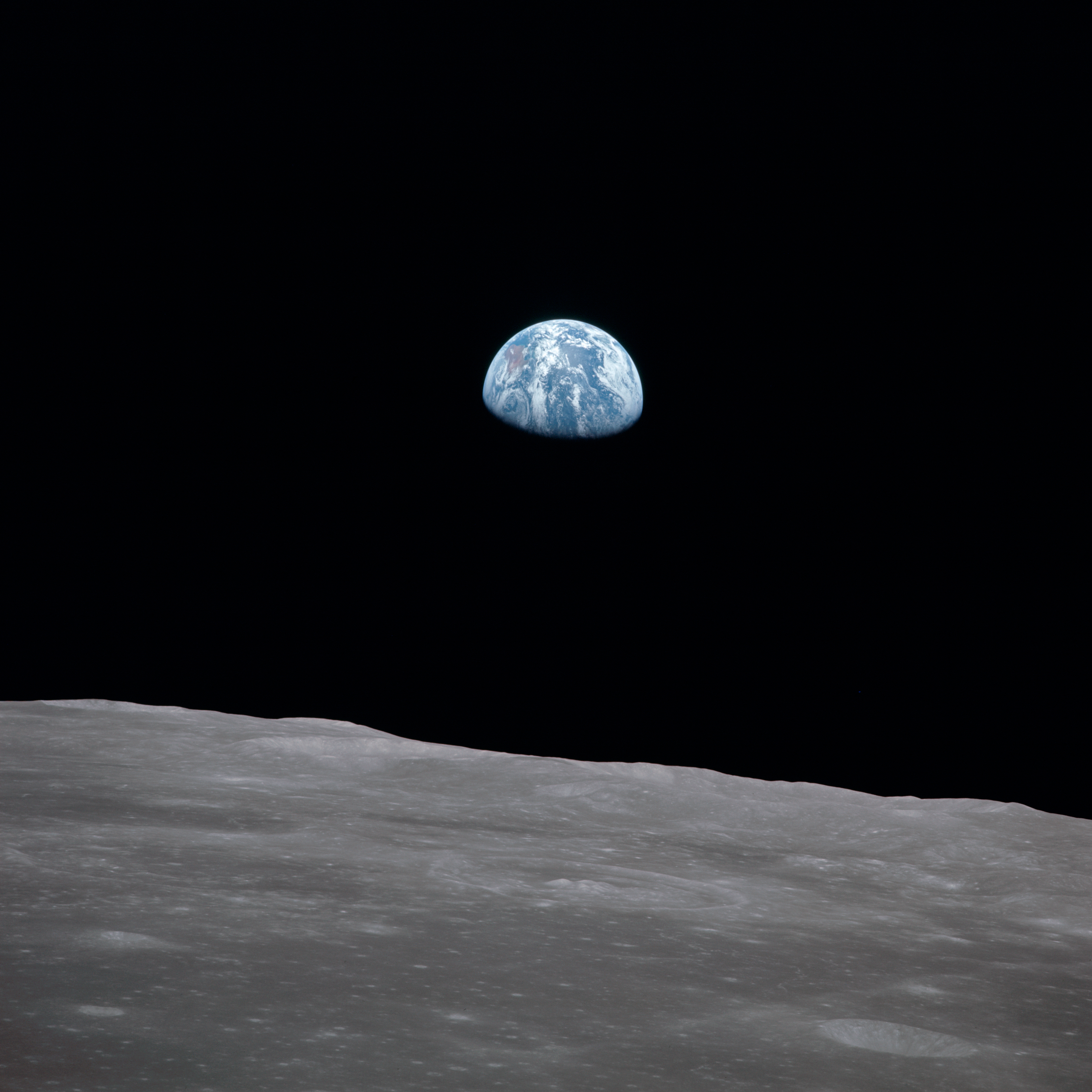
THE SKY IS BLUE – SAMKHYA DOCTRINE – INDIAN SCHOOL OF THOUGHT. EARTH RISE AS SEEN FROM LUNAR SURFACE.
Blue Sky is evidence for Creation as its presence is limited to planet Earth in this vast Universe of unknown dimensions. Earth is the only place where Sky exists in its natural Blue Color. Space exploration has not revealed existence of another celestial body where its Sky may appear Blue. For example, when visualized from Moon, the Sky will look Black.
In all monist systems creation proceeds from the creator’s own substance. Tanmatra is the basis of matter. In the Sankhya the basis is Pradhana (of Prakriti) out of which come Buddhi and everything else. In the Vedanta it is spiritual substance out of which all comes.
“…there are certain motions or forces (five in number) which produce solid matter, and which are ultimately reducible to ether (Akasa)…Akasa is one of the gross forces into which the Primordial Power (Prakrti Shakti) differentiates itself. Objectively considered it is a vibration in and of the substance of Prakriti of which it is a transformation in which the other forces are observed to be operating….At the back of both “matter” and mind, there is the creative energy (Shakti) of the Supreme who is the cause of the universe and Consciousness itself. Matter affects the Jiva (soul) in five different ways, giving rise in him to the sensations of smell, taste, sight, touch and feel, and hearing….
From the Sabda-Tanmatra and from the combinations of the latter with the other Tanmatras are produced the gross Bhutas (Mahabhuta), which as things of physical magnitude perceivable by the senses approach the Western definition of discrete sensible “matter”. These five Mahabhutas are Akasa (Ether), Vayu (Air), Tejas (Fire), Apas (Water) and Prithvi (Earth). Their development takes place from the Tanmatra, from one unit of that which is known in sensible matter as mass (Tamas), charged with energy (Rajas) by the gradual accretion of mass and redistribution of energy. The result of this is that each Bhuta is more gross than that which precedes it until “Earth” is reached. These five bhutas have no connection with the English “elements” so called, nor, indeed, are they elements at all, being derived from the Tanmatras. Dynamically and objectively considered they are (proceeding from Akasa) said to be five forms of motion, into which Prakriti differentiates itself:
Pancha-mahabhutas: the five subtle constituents of matter
If everything is consciousness (Brahman), then how does this conscious energy put on the appearance of material …
Gulati
FIVE REASONS TO CELEBRATE CREATION
Man recognizes the fact of his existence in Created World using his Five Organs of Sense Perception;
The Sky is Blue – Samkhya Doctrine – Indian School of Thought
1. The Sky is Blue.
The Sky is Blue – Samkhya Doctrine – Indian School of Thought. Water imparts Pure, Original Taste.
2. Water imparts Pure, Original Taste.
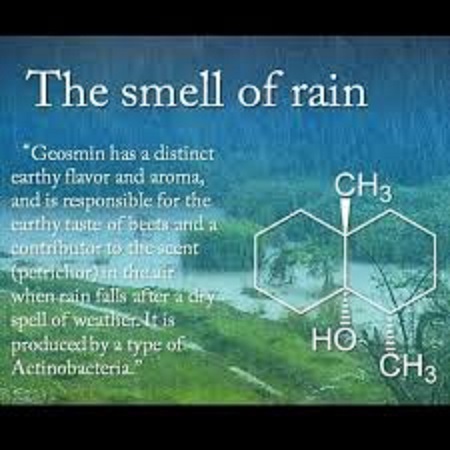
The Sky is Blue – Samkhya Doctrine – Indian School of Thought. Earth’s Fragrance called Geosmin.
3. The Earth has characteristic Fragrance of its own called Geosmin, Earthly Smell often perceived after Rain sprinkles.
4. The World is full of Sounds, sounds generated by organs of sound production to communicate with other things that have organs of sound perception.
The Sky is Blue – Samkhya Doctrine – Indian School of Thought. Mother Holding Baby experiences The Magic of Creation through perception of Tactile or Touch Sensation.
5. Touch or Tactile Sensation. Touch your own child or hold your child in embrace to experience the Magic of Creation.
Rudranarasimham Rebbapragada Ann Arbor, MI 48104-4162 USA
From: Devinder Singh Gulati
Sense experience has its limitation. Behind the gross Matter that our senses experience in the physical world, there exist subtle planes of matter as illustrated in the figure below. It is the existence of these subtle planes which explains occult phenomenon such as materialization and dematerialization of objects.
Subtle planes of Matter. Objects are created by Panchikarana (combination) from Tanmatras(subtle elements) as per Sankhya)
The hidden planes of Matter
Water, for instance, is not merely so much oxygen and hydrogen put together – the combination is simply a process or device for enabling the materialisation of a new thing called water; what that new thing really is, is quite another matter. In fact, there are different planes of substance, gross, subtle and more subtle going back to what is called causal (Karana) substance. What is more gross can be reduced to the subtle state and the subtle brought into the gross state; that accounts for dematerialisation and rematerialisation. The direct power of mind-force or life-force upon Matter can be extended to an almost illimitable degree. It must be remembered that Energy is fundamentally one in all the planes, only taking more and more dense forms, so there is nothing a priori impossible in mind-energy or life-energy acting directly on material energy and substance; if they do, they can make a material object do things or rather can do things with a material object which would be to that object in its ordinary poise or “law” unhabitual and therefore apparently impossible.
The twentieth century Russian philosopher P.D. Ouspensky posited that the three-dimensional world is a projection from a subtler fourth-dimension which is suprasensual but real and that each solid form corresponds to a subtler form in the fourth dimension. “Agni is the basis of forms as the Sankhya pointed out long ago, i.e. the fiery principle in the three powers radiant, electric and gaseous (the Vedic trinity of Agni) is the agent in producing liquid and solid forms of what is called Matter.” The latent Consciousness within Matter
The latent Consciousness within Matter
In the Taittiriya Upanishad, Bhrigu is asked by his Guru to (spiritually) realize : “Matter is Conscious!”. Th…
Earthly fragrance known as ‘GEOSMIN’ is the result of interaction of physical, chemical, and biotic factors a…
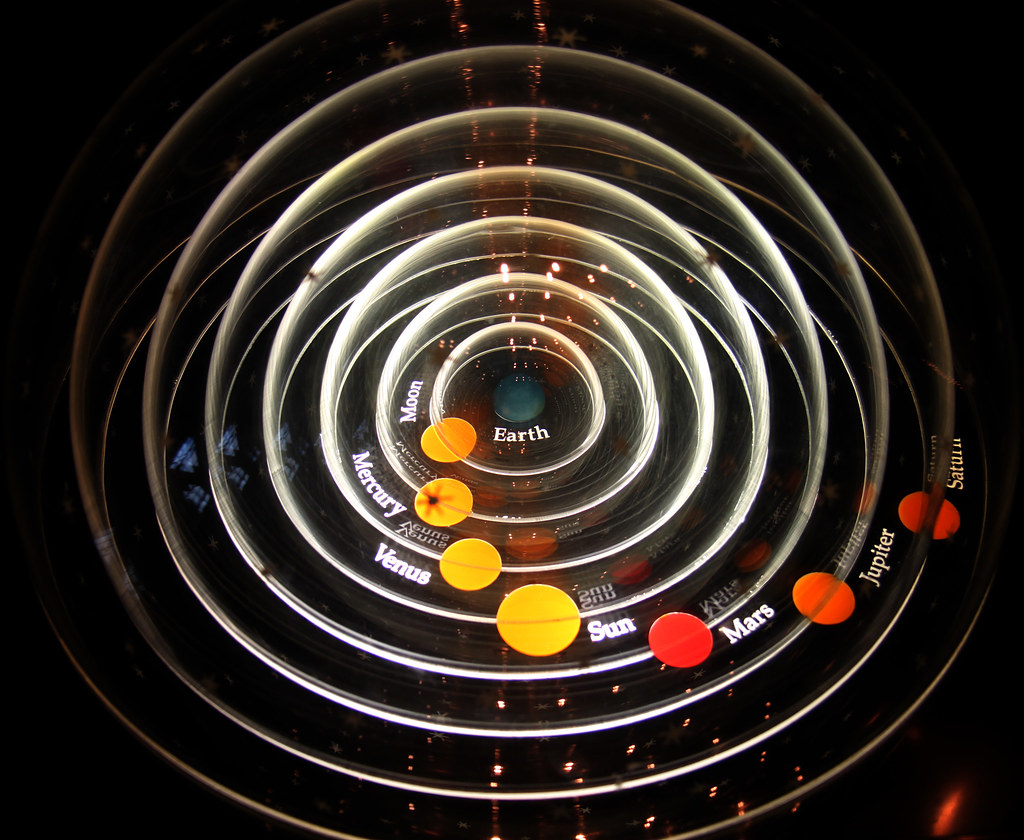
Empiricism is the doctrine that claims human knowledge arises from what is provided to the mind by the senses or by introspective awareness through experience. Science generally follows Empiricism for it gathers empirical data based upon observational experience. Science uses the method of induction to interpret data. In Empiricism, the methodology that we use would also set the limits of Knowledge. The purpose of Science is to describe and codify observations and experience. Science offers a distinct advantage for gathering sense experience. Science uses sophisticated, precise tools to collect information in very accurate, measurable values that can be independently verified by others. Science uses tools with which Man can see what his eyes cannot see, and Man can record Sound vibrations that his ears cannot hear. But, using the doctrine of Rationalism, I use Pure Reasoning to ignore data provided by Science and accept Sensory Information as relevant to account for Human Existence. For that reason, I claim Earth is a Flat Disc, and Earth is the Center of the Universe while the Sun and Moon move across Celestial Sky.
The Sky is Blue – Samkhya Doctrine – Indian School of Thought. What is Matter? Experience the Taste of Salt.
The taste of Salt cannot be known by studying its Chemical Elements, Sodium, and Chlorine. Only Chemical Compound Sodium Chloride can impart the flavor while the Chemical Bonds remain strong. The taste or flavor of Salt cannot be discovered by study of Atoms or Subatomic Particles.
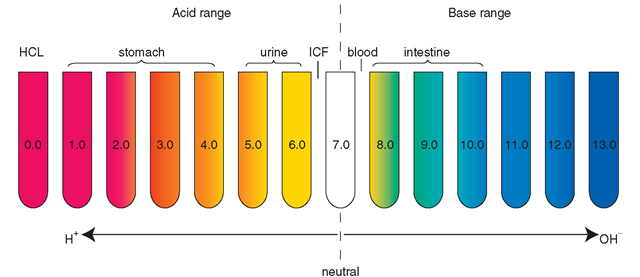
The Sky is Blue – Samkhya Doctrine – Indian School of Thought. Human Existence or Life involves maintaining H+ ion Concentration in a narrow zone. Acid vs Base Balance.The Sky is Blue – Samkhya Doctrine – The Indian School of Thought. H+ ion (ACID) vs OH ion (ALKALI or BASE) Concentration measured as pH Level.
Life is Complex for it involves structural and functional units that are complex. The Reality of Life’s Experience involves Molecules of Life and the Nature expressed by Matter with Molecular Configuration. For example, body uses Molecules of Oxygen and not Atoms of Oxygen. While Hydrogen is the most abundant Chemical Element of the Universe, on Earth it is seen only as Chemical Compound and not in Elemental Form. In essence, human life demands maintaining constant concentration levels of H+ Ion( Cation or Hydrogen Molecule with Positive Charge). No discussion of Quantum Mechanics helps to understand Life.
Human Existence is governed by Sensory Experience attributable to Human Organs of Sense Perception and not by data provided by instruments invented by Man.
Rudranarasimham Rebbapragada Ann Arbor, MI 48104-4162 USA
From: Devinder Singh Gulati
Science is the discipline which organizes our experimental communicable ‘public’ knowledge. It is rooted in experience (‘experiment’) and draws on all our linguistic and computational expertise. It is therefore not surprising that physical science takes on many points of view and many aspects. But amongst them we may distinguish two dominant themes: the materialistic, chemical, structural tradition inherited from chemistry: and the abstract, mathematical functional tradition inherited from mechanics.
In the first tradition we can ask what is matter made of? Studies in chemistry lead us to believe that all the myriad substances that are found on the earth can be composed from a few chemical elements combining with each other according to a set of (empirical) laws, some combine eagerly, some reluctantly: flourine, carbon, oxygen, chlorine, hydrogen all combine readily while gold, platinum, argon, helium, etc. combine only with great reluctance. Some elements like carbon, silicon, hydrogen, nitrogen and oxygen are plentiful on earth while some like gold and platinum are rare. (Some plentiful elements like carbon have special allotropic forms like diamond which are rare!) The multitude of chemical elements and their groupings into families like halogens, alkali atoms, alkaline earths etc. suggests that far from being indivisible they are composite objects and their qualities depend on the components and their qualities. The study of the composition of the atoms became the discipline of atomic physics, which began with spectroscopy. (Each atom emits its own characteristic spectrum which serves as its signature). It was soon found that electrons were constituents of every atom; and that most optical and chemical properties could be understood as aspects of the behaviour of electrons. This great unification had a price: we had to develop the strange discipline of quantum mechanics with noncommuting quantities being used for representing dynamical quantities like position, momentum or energy. At the same time quantum mechanics elevated the mystery of light emission and absorption by atoms. Light is not a constituent of atoms but is associated with its functioning; it is a vibhuti rather than an amsa. The atom shorn of its electrons is the (atomic) nucleus: and the various nuclei are themselves composed of neutrons and protons. This is the realm of nuclear physics: to understand the structure, properties and spontaneous reactions of various nuclei. While chemical forces could be traced to the electrical interactions between electrons there is a new force which must exist between the nuclear particles. This new kind of force was eventually understood to be the result of the spontaneous creation and absorption of particles called mesons. In the beginning one hoped for one meson (or one multiplet of similar mesons) but today we seem to need a great many! Such a multitude of ‘elementary’ particles suggest that these particles are themselves not elementary but composite. What are they composed of? The present picture is that they are composed of a family of quarks. Quarks have not been found experimentally despite diligent searches. So efforts are being pursued to construct a theory in which the elementary objects would not be observable at all! The odyssey thus ends in a curious place. The essential ingredients of all tangible concrete matter are ultimately unobservable in principle.
The other tradition in physics is that of abstract functional description of matter. We say ‘wind blows’ and are talking about wind, detect wind velocity and direction yet we also know that wind is but air in motion. Waves are water (or other fluids) in motion. We thus invent new categories because it is convenient to describe what is ‘observed’. It is a time honoured tradition: Newton’s laws of motion are about ‘bodies’ or ‘particles’. What are these? They are those that move. The process of motion is best viewed as the motion of something. Energy is that which is conserved: when energy of motion is converted into heat we talk of the conservation of energy and view energy as a permanent entity which only changes from one form to another much like chemical elements combine with, substitute, or dissociate from a chemical compound. The eternal verities are not directly observed but their manifestations are!
In the Indian tradition we find these two threads. In the Vaisesika system of philosophy we find the closest parallel to the chemical physics approach; to describe matter in its elementary and composite forms, the qualities (gunas) of the fundamental kanas (quanta) and the primary substance (dravya) of the universe. There are nine of them: Earth (prthivi), water (jalam), Air (vayu), substratum (Akasa), Time (kalam), Space (dik), Mind (manas), radiation (tejas), and self (atma) are these nine. Note the prophetic inclusion of space and time anticipating modern cosmology and the use of the substratum (akasa) as distinct from it. But Vaisesika system goes beyond it in including mind and the self as relational entities so that the world is treated as a perceptual discipline. The dravyas are but the raw material for the world-building: one must include the relationships: Quality (guna) was already mentioned; Action (karma) which are dynamical relationships including static stable situations; Universal (samanya) properties, ‘beingness’ Individuality (visesa), the distinguishing characteristics, necessary intimate relations (samavaya); and Negation (abhava). The first four dravyas: Prthivi, Jalam, Tejas, and Vayu are divisible and their elementary indivisible units are the paramanu or kana (quanta). These four dravyas together with Akasa constitute the five Bhutas (pancabhuta). The ultimate particles of the four dravyas are endowed with quality by virtue of which they can coalesce: either primary or secondary (molecules?) of the same elements or of distinct elements. When threads come together we have aggregation (samyoga); but when it is woven into a fabric we have the fabric itself as a new creation, non-existent until then; this new relationship is merging (samavaya). Spatial extensions of ponderable bodies arose from them being composed of secondary compounds and not due to the extension of the atoms. What is created can also dissolve. All creations are impermanent and the association of two or more dravyas will unravel eventually echoing Nagarjunas aphorism: All that is composed shall decompose! It is also noteworthy that self (atma) is plural and is a dravya. Sankhya system begins with two primary functionalities: Sentience (purusa) and Nature (prakrti). The Sentience is without specific qualities, discriminating (judgemental), alive (spontaneous), free of entanglements, beyond causality but plural; in contrast Nature both in its manifest (vyakta) and unmanifest (avyakta) aspects is non-discriminational (non-judgemental), universal, not spontaneous and entangled in transformations. Nature is also endowed with three fundamental qualities (guna): integrity (sattva), dynamism (rajas) and inertia (tamas). This Nature undergoes a sequence of modifications and the later stages include ego (ahamkara), mind (manas), subtle elements (tanmatra) and gross elements (bhuta). Nature in its state of dissolution (pralaya) has all the gunas in balance; by the very presence of the sentience (purusa) integrity (sattva) dominates and intelligence (mahat) arises, which in turn yields Ego (ahamkara). Mind (manas) is then born, and sensory organs, motor organs, subtle elements and gross elements. From vibration (sabda) arise the substratum (akasa), from vibration and contact (sparsa) arise air (vayu), from vibration, contact and colour (rupa) arise radiation (tejas); adding taste (rasa) yields fluid (ap); finally including smell (gandha) yields earth (prthivi). Sankhya system also has a novel way of dealing with causality; the effect is merely the gross manifestation of that which was subtly present in the material cause. Finally, according to Sankhya, sentience is not to be sought for in matter; nor do Intelligence (mahat) or Mind (manas) come from matter alone. Sentience is reflected in Nature to generate Intelligence and Mind, and even the sense and motor faculties. Nature and Function of Matter
Nature and Function of Matter
Gulati
From: Devinder Singh Gulati
You consider what is made of chemical elements as matter. According to Sankhya, tanmatras and bhutas are also matter. These are what you call energy. Energy is a product of the manifested world, of the universe and the creation. Guru Teg Bahadur says:
jio supanaa ar paekhanaa aisae jag ko jaan ||
Like a dream and a show, so is this world, you must know.
ein mai kashh saacho nehee naanak bin bhagavaan ||23|| None of this is true, O Nanak, without God. ||23||
jaisae jal thae budhabudhaa oupajai binasai neeth ||
As the bubbles in the water well up and disappear again,
jag rachanaa thaisae rachee kahu naanak sun meeth ||25|| so is the universe created; says Nanak, listen, O my friend! ||25||
According to Sankhya and Gurbani the world is impermanent. It is subject to decay and death. And since it is subject to decay it constantly changes. The “real” is what is beyond the universe, that is in the transcendence. The universe lies in the immanence.
Guru Teg Bahadur says:
jo oupajiou so binas hai paro aaj kai kaal ||
Whatever has been created shall be destroyed; everyone shall perish, today or tomorrow.
naanak thhir har bhagath hai thih raakho man maahi ||48||
O Nanak, only devotional worship of the Lord is permanent; enshrine this in your mind. ||48||
The “real” is unchanging. It is Purush, Akalpurkh. He can be reached through devotional worship. The state of being of Akalpurkh is pure existence. In this state of transcendence there is no energy (it is not yet born), only consciousness. See the chart again. It is the state where Naam is yet to make an appearance.
Gulati
From: Devinder Singh Gulati
Sankhya philosophy views anything that is subject to change, death, decay or decomposition as being “unreal” rather than “real.” This does not mean that the objects are not there in front of you. Rather, they are not ultimately “real” in that their form keeps morphing from this to that to the other. What is considered “real” is that final substratum which never changes, cannot die, and cannot possibly decay or decompose. It is the direct experience of that “absolute reality” which is being sought.http://swamij.com/prakriti- purusha-sankhya.htm
Guru Teg Bhadur is here expressing the Sankhya philosophy at page 1427 of SGGS:
jio supanaa ar paekhanaa aisae jag ko jaan || Like a dream and a show, so is this world, you must know.
ein mai kashh saacho nehee naanak bin bhagavaan ||23|| None of this is true, O Nanak, without God. ||23||
nis dhin maaeiaa kaaranae praanee ddolath neeth || Night and day, for the sake of Maya, the mortal wanders constantly.
kottan mai naanak kooo naaraaein jih cheeth ||24|| Among millions, O Nanak, there is scarcely anyone, who keeps the Lord in his consciousness. ||24||
jaisae jal thae budhabudhaa oupajai binasai neeth ||
As the bubbles in the water well up and disappear again,
jag rachanaa thaisae rachee kahu naanak sun meeth ||25|| so is the universe created; says Nanak, listen, O my friend! ||25||
Again at page 1429 he says:
nij kar dhaekhiou jagath mai ko kaahoo ko naahi || I had looked upon the world as my own, but no one belongs to anyone else.
naanak thhir har bhagath hai thih raakho man maahi ||48|| O Nanak, only devotional worship of the Lord is permanent; enshrine this in your mind. ||48||
jag rachanaa sabh jhooth hai jaan laehu rae meeth || The world and its affairs are totally false; know this well, my friend.
kehi naanak thhir naa rehai jio baaloo kee bheeth ||49|| Says Nanak, it is like a wall of sand; it shall not endure. ||49||
raam gaeiou raavan gaeiou jaa ko bahu paravaar || Raam Chand passed away, as did Raawan, even though he had lots of relatives.
kahu naanak thhir kashh nehee supanae jio sansaar ||50|| Says Nanak, nothing lasts forever; the world is like a dream. ||50||
chinthaa thaa kee keejeeai jo anehonee hoe || People become anxious, when something unexpected happens.
eihu maarag sansaar ko naanak thhir nehee koe ||51|| This is the way of the world, O Nanak; nothing is stable or permanent. ||51||
jo oupajiou so binas hai paro aaj kai kaal || Whatever has been created shall be destroyed; everyone shall perish, today or tomorrow.
naanak har gun gaae lae shhaadd sagal janjaal ||52|| O Nanak, sing the Glorious Praises of the Lord, and give up all other entanglements. ||52||
Gulati
From: Devinder Singh Gulati
Chapter 2 of the Bhagavad Gita is entitled “Sankhya Yoga” that is referred to as the Yoga of knowledge. Verses 39-53 of that chapter describe Karma Yoga or the Yoga of Selfless Action. Provided below is an English internet translation of Verses 11-30 pertaining to the Sankhya Yoga. It is a message that Gurbani readers are familiar with.
The Blessed Lord said: While speaking learned words, you are mourning for what is not worthy of grief. Those who are wise lament neither for the living nor the dead.
As the embodied soul continually passes, in this body, from boyhood to youth to old age, the soul similarly passes into another body at death. The self-realized soul is not bewildered by such a change.
O son of Kuntī, the nonpermanent appearance of happiness and distress, and their disappearance in due course, are like the appearance and disappearance of winter and summer seasons. They arise from sense perception, O scion of Bharata, and one must learn to tolerate them without being disturbed.
Those who are seers of the truth have concluded that of the nonexistent there is no endurance, and of the existent there is no cessation. This seers have concluded by studying the nature of both.
Only the material body of the indestructible, immeasurable and eternal living entity is subject to destruction; therefore, fight, O descendant of Bharata.
He who thinks that the living entity is the slayer or that he is slain, does not understand. One who is in knowledge knows that the self slays not nor is slain.
For the soul there is never birth nor death. Nor, having once been, does he ever cease to be. He is unborn, eternal, ever-existing, undying and primeval. He is not slain when the body is slain.
This individual soul is unbreakable and insoluble, and can be neither burned nor dried. He is everlasting, all-pervading, unchangeable, immovable and eternally the same.
For one who has taken his birth, death is certain; and for one who is dead, birth is certain. Therefore, in the unavoidable discharge of your duty, you should not lament.
All created beings are unmanifest in their beginning, manifest in their interim state, and unmanifest again when they are annihilated. So what need is there for lamentation?
Some look on the soul as amazing, some describe him as amazing, and some hear of him as amazing, while others, even after hearing about him, cannot understand him at all.
2017 NEW YEAR RESOLUTION – PERPLEXITY OF LIFE – HOLD ON – GOD KNOWS WHAT HE IS DOING
2017 NEW YEAR RESOLUTION – PERPLEXITY OF LIFE – HOLD ON – GOD KNOWS WHAT HE IS DOING. APART FROM GOD, YOU CAN DO NOTHING.
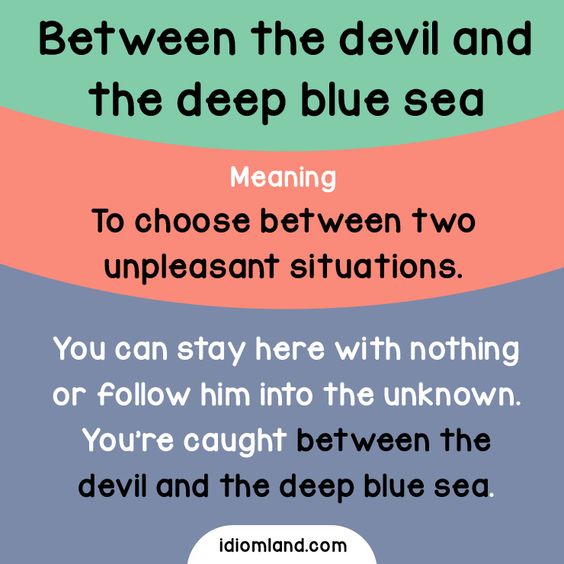
Happy New Year 2017. Time to make New Year Resolution. It’s not about acquiring or trying a New Form of Life. The Past determines types of Choices available for performing actions in Future. When caught up ‘Between The Devil and The Deep Blue Sea’, there is no right question.
2017 NEW YEAR RESOLUTION – PERPLEXITY OF LIFE – HOLD ON, GOD KNOWS WHAT HE IS DOING. APART FROM GOD, MAN CAN DO NOTHING.
‘To Be or Not to Be – That’s The Question’ if Man wants to choose where he wants to be at any given time. Like the Pendulum, Time swings from one extreme to another and if both ends are unfavorable, Man cannot choose place and external circumstances according to his taste. For making Choice is Difficult, for I do not know as to which Course of Action could be the Lesser Evil, I make my New Year Resolution; ‘Hold On, God Knows What He is Doing’. Apart from God, Man can do Nothing.
2017 NEW YEAR RESOLUTION – PERPLEXITY OF LIFE – HOLD ON – GOD KNOWS WHAT HE IS DOING. APART FROM GOD, YOU CAN DO NOTHING.
When living Life on ‘Tightrope’, finding Balance in Life will not be easy. My Life is in Balance between two extreme conditions; 1. Slavery in Free World, and 2. Prisonhood under Bamboo Curtain. Neither Choice is Pleasant. I cannot find Balance in Life for my Life is Caught Up ‘Between The Devil and The Deep Blue Sea’. I don’t know what to do. But, Hold On, God knows What He is Doing. Apart from God, Man can do Nothing (Book of JOHN, 15:5).
2017 NEW YEAR RESOLUTION – PERPLEXITY OF LIFE – HOLD ON – GOD KNOWS WHAT HE IS DOING. APART FROM HIM, MAN CAN DO NOTHING.
2017 NEW YEAR RESOLUTION – PERPLEXITY OF LIFE – HOLD ON – GOD KNOWS WHAT HE IS DOING – APART FROM HIM, MAN CAN DO NOTHING. 2017 NEW YEAR RESOLUTION – PERPLEXITY OF LIFE – HOLD ON – GOD KNOWS WHAT HE IS DOING. APART FROM HIM, MAN CAN DO NOTHING. 2017 New Year Resolution – Perplexity of Life – Hold On, God Knows What He is Doing. Apart From God, Man can do Nothing. 2017 NEW YEAR RESOLUTION – PERPLEXITY OF LIFE – HOLD ON, GOD KNOWS WHAT HE IS DOING. APART FROM GOD, MAN CAN DO NOTHING. 2017 NEW YEAR RESOLUTION. 2017 New Year Resolution. 2017 New Year Resolution. 2017 NEW YEAR RESOLUTION. 2017 NEW YEAR RESOLUTION. 2017 NEW YEAR RESOLUTION. LIFE IN BALANCE BETWEEN TWO EXTREME CONDITIONS; 1. SLAVERY IN FREE WORLD, AND 2. PRISONHOOD UNDER BAMBOO CURTAIN. 2017 NEW YEAR RESOLUTION. 2017 New Year Resolution. Finding Balance in Life while Caught up Between the Devil and the Deep Blue Sea.
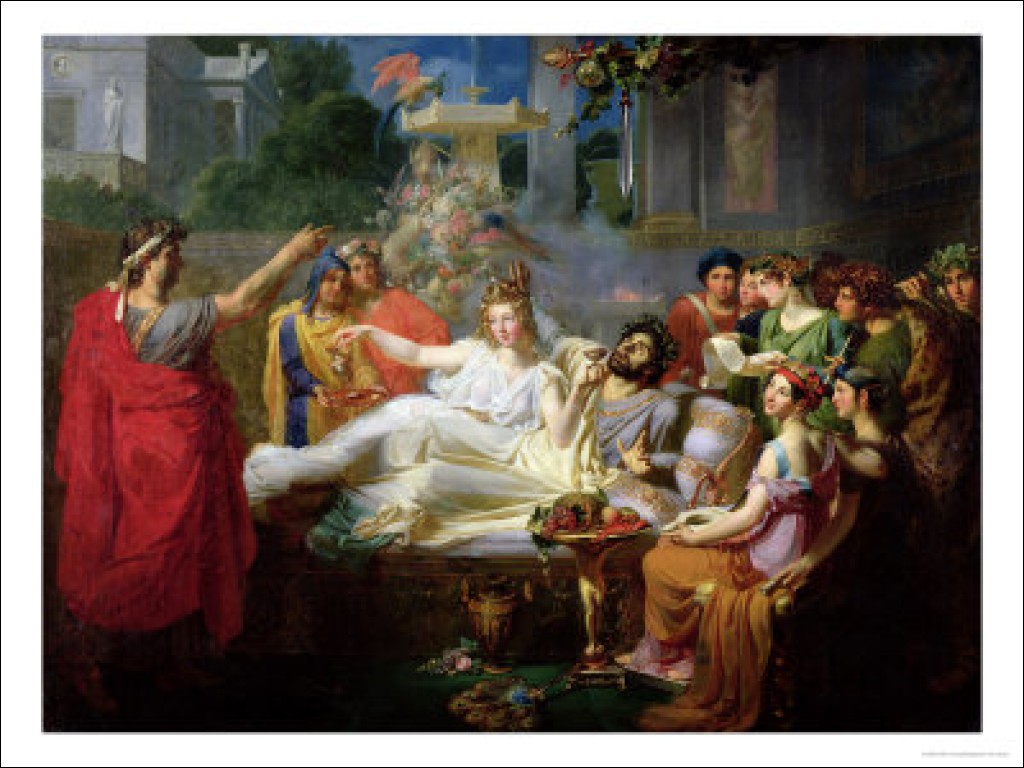
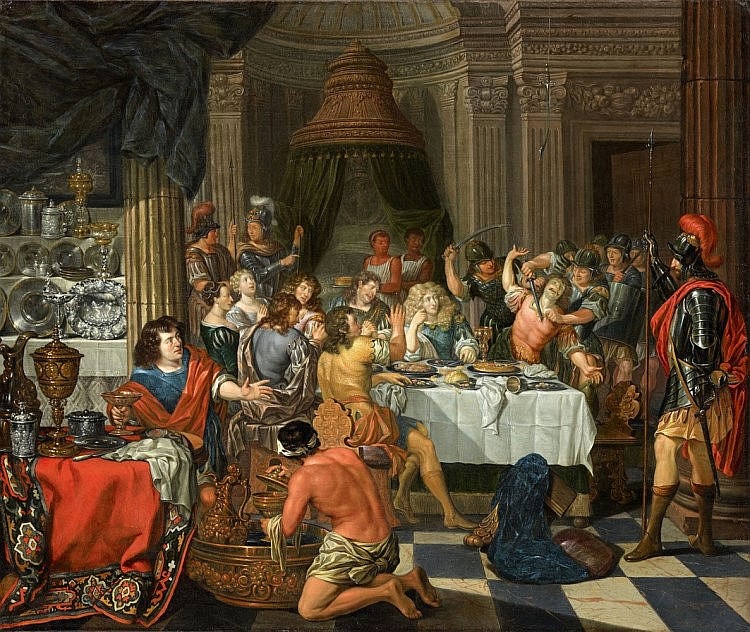
damocles sword senior alien
damocles sword senior alien past and future
life in balance senior alien
new year resolution 2017 senior alien things will change
swinging pendulum senior alien prison life
swinging pendulum senior alien freedom to slavery
the sword of damocles senior alien
the sword of damocles senior alien to be or not to be
the sword of damocles senior alien life in balance
to be or not to be senior alien slave vs prisoner
between the devil and the deep blue sea life on hold senior alien
between the devil and the deep blue sea senior alien
Man has to interpret information provided by Science to know Man’s Status in Nature. In Indian tradition, Man’s transient, ephemeral, conditioned existence is often compared to beads of water found on the surface of Lotus Leaf.
Man may desire Freedom or make claims of “Born Free” while Science suggests Dependent or Conditioned nature of Human Existence. There is no Religion, there is no Philosophy, and there is no Science that has Power to grant Freedom to Man.
Rudranarasimham Rebbapragada Ann Arbor, MI 48104-4162 USA BHAVANAJAGAT.ORG
FROM DEVINDER SINGH GULATI:
Sankara’s claim of absolute identity between man and God is identical with Nanak’s claim. Ramanuja’s claim that God is modified by his own actions is echoed by Guru Nanak when he says God becomes the universe, but the universe is not all of God. In the becoming, God stands modified. Madhava’s path of Surrender is commended by Guru Nanak who says:
Hukam Rajaaee Chalanaa Naanak Likhiaa Naal ||1||
O Nanak, it is written that you shall obey the Hukam of His Command, and walk in the Way of His Will. ||1||
All three; Sankara, Ramanuja and Madhava represent vedantic thought. It can be said then that Guru Nanak’s religion is Vedantic. In one respect it represents the thought of Yoga philosophy. Guru Nanak affirms that there is one purusha and all the rest are his brides. That is the Vaishnav affirmation of Mirabai too. One Purush is from Yoga. The Sankhya affirms many purusas. These many purusas are the Jeev of Nanak, but he gives them female identity. They have to merge back with the Purush.
LORD God Creator or Prabhu has separated Himself from His creation; He is Detached, Disinterested, or prefers to keep Distance. For that reason, I describe Constitutive vs Regulative Dualism. While Sankara claims absolute identity between Man and God, in practical terms, it is of no help as Man lacks Regulative Powers. Ramanuja claims that God is Modified on account of His own actions, just like Human Body modifies the indwelling Soul.
Man has no independent existence of his own. Man exists for he is Yoked, Joined, or United with the Divine Power. From God’s perspective, He keeps Himself aloof from His creation. But, from Man’s perspective, existence is about Bonding, Joining, Coming Together, Uniting, or Yoking with Divine Power.
For that reason, I recommend view shared by Madhva, the path of Surrender, or ‘Saranu’ as Devotion or Bhakti is not good enough while God remains Aloof.
Rudranarasimham Rebbapragada Ann Arbor, MI 48104-4162 USA BHAVANAJAGAT.ORG
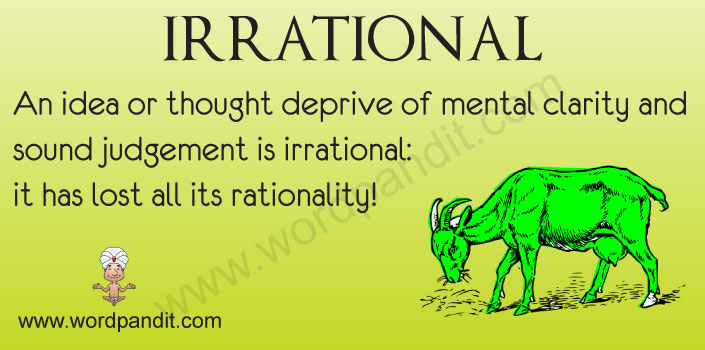
RATIONALISM vs IRRATIONALISM – IGNORANCE IS BLISS.
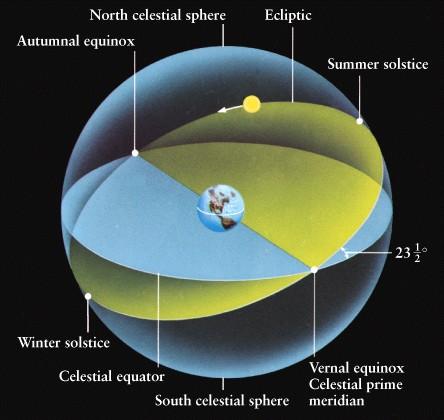
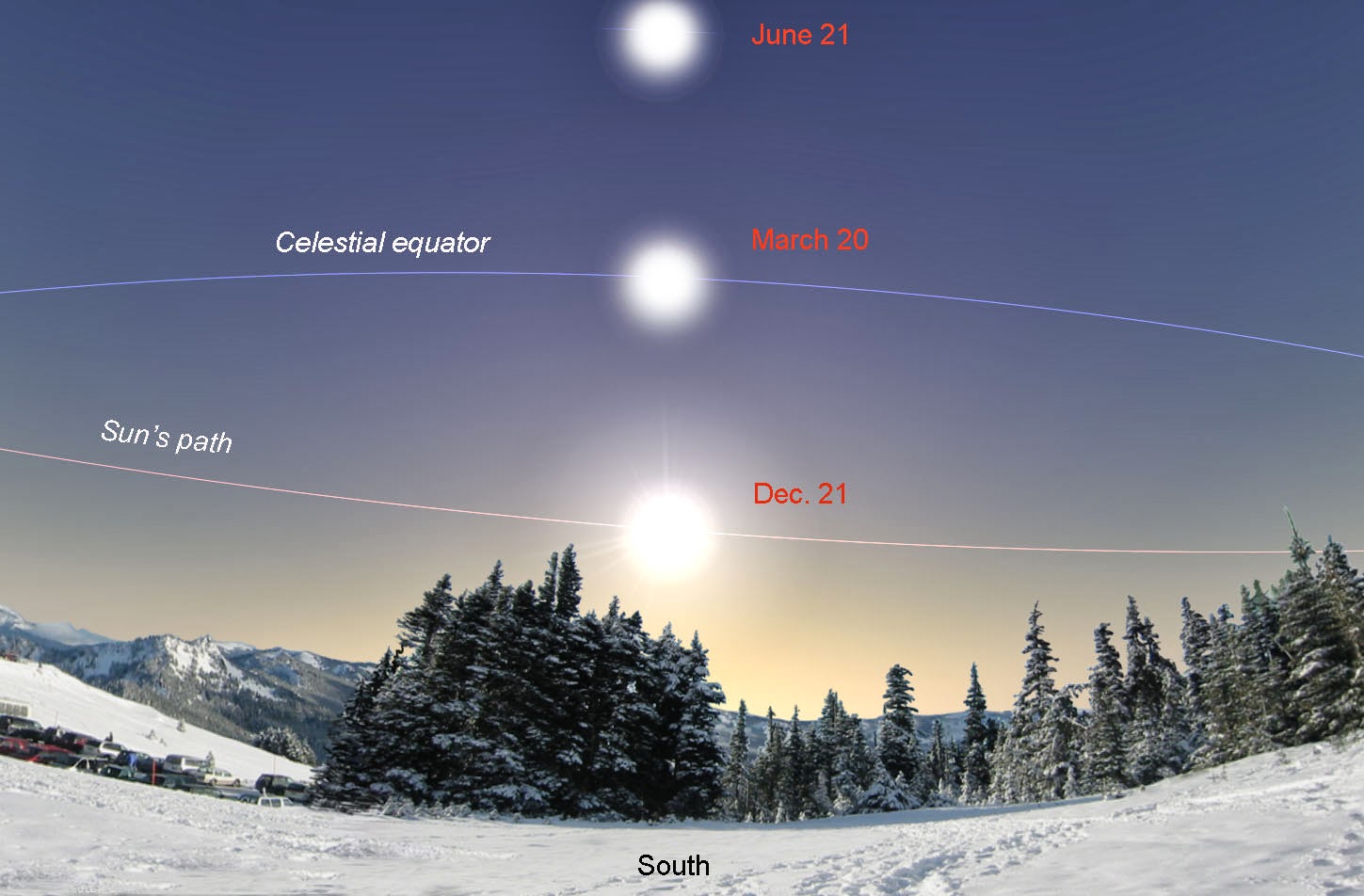
Man can describe the reality of the World and Universe as much as he likes. However, Man cannot impart that Knowledge to the Building Blocks of his own body. Man’s existence is not accounted by his mental concepts or philosophical doctrines. To support Man’s existence in Physical World and Universe, God imposed a permanent Barrier called Ignorance that separates Man from Reality of World and Universe. From human perspective, Sun’s Ecliptic is real giving Man opportunity to mark Days of his Life’s Journey on Earth.
Rationalism vs Irrationalism – Ignorance is Bliss. From Man’s perspective, Sun’s Ecliptic Path is Real.On wholedude.com
SYNCHRONIZATION OF BIOLOGICAL RHYTHMS WITH SUNRISE AND SUNSET
Rationalism vs Irrationalism – Ignorance is Bliss. From Man’s perspective, Sun’s apparent motions are Real while Man lives ignorant of Earth’s Motions.
Apparent motions of celestial bodies shape Man’s Journey on Earth’s Surface while Man lives Blissfully ignorant of Earth’s Motions. No Religion, No Science, No Philosophy can overcome this Ignorance to give Human Body direct sensory experience of Earth’s Real Motions.
Guru Nanak proclaimed that this universe is real, not an illusion as suggested by some other religions. “Real are Thy continents; Real is the universe; Real are these forms and material objects; Thy doings are Real, O Lord.” Guru Nanak calls the universe as His chamber when he writes, “Eh jag sache ki hai kothri. Sache ka vich vaas”(AGGS, M 2, p. 463).
Guru Teg Bahadur at page 1429 of the Guru Granth Saheb: inj kir dyiKE jgqu mY ko kwhU ko nwih ]
nij kar dhaekhiou jagath mai ko kaahoo ko naahi ||
I had looked upon the world as my own, but no one belongs to anyone else.
nwnk iQru hir Bgiq hY iqh rwKo mn mwih ]48] naanak thhir har bhagath hai thih raakho man maahi ||48|| O Nanak, only devotional worship of the Lord is permanent; enshrine this in your mind. ||48||
jg rcnw sB JUT hY jwin lyhu ry mIq ] jag rachanaa sabh jhooth hai jaan laehu rae meeth || The world and its affairs are totally false; know this well, my friend.
kih nwnk iQru nw rhY ijau bwlU kI BIiq ]49] kehi naanak thhir naa rehai jio baaloo kee bheeth ||49|| Says Nanak, it is like a wall of sand; it shall not endure. ||49||
There is nothing contradictory in these two statements. these are the two faces if the same reality; Guru Nanak mentions of the reality of created world which certainly is real. God created a real world. The second view relates to the principle of change. The entire universe is continuously changing and never remains the same. What is now will not be the same after sometime. Those who consider themselves ever-living or ever ruling the world are living in fool’s paradise. No one can survive beyond a time. The Change changes everyone continuously change one form changes into another.
Prof Dalvinder Singh Grewal,
1925, Basant Avenue Ludhiana
From: “Devindersingh Gulati
There are three modifications to Vedantic thought. Vedanta is one of the six Indian thought systems. The basic premise of Vedanta is: the world is different yet not different from the one sole reality. According to the Bhedābheda view, Brahman converts itself into the created, but yet maintains a distinct identity. Thus, the school holds that Brahman is both different (bheda) and not different (abheda) from creation and the individual jīva.
The first modification to this premise was brought by Shankara in the eight century that goes by the name Advaita. A second modification was brought by Ramanuja in the eleventh century that goes by the name Vishishtadvaita. Advaita says (like Guru Teg Bahadur) the world is an illusion, Visistadvaita says (like Guru Angad) the world is real. Advaita says (like Gurbani) Jivatma and Paramatma are the same, Visistadvaita says Jivatma and Paramatma have a body-soul relationship. Advaita says that the supreme Brahman is Nirguna, Visistadvaita says the supreme Brahman is Saguna.
A third modification was brought in by Madhva in the thirteenth century that is called Dvaita. On his account, Brahman is a personal God. According to Madhva, reality is characterized by a five fold difference: (i) jīvas (individual persons) are different from God; (ii) jīvas are also different from each other; (iii) inanimate objects are different from God; (iv) inanimate objects are different from other inanimate objects; (v) inanimate objects are different from jīvas (Mahābhāratatātparnirnayaḥ, I. 70-71).
Gurbani clearly differs from Madhva’s perspective.
The Vedanta also says like Gurbani that all is the one. Yet there are differing stances within Vedanta that are all valid schools of thought.
It appears to me that the differing perspectives come from the different angles of viewing the Divine. Guru Nanak affirms that God is unknowable. He has been known in some aspects by the various Bhagats and Gurus that are limited perspectives. To employ Rudranarsimham’s metaphor. if you view the sun from the sun itself, there is no sunrise or sunset as when you view it from earth. But when you view it from the moon, there is only daylight or only darkness, depending on where on the moon you are situated. So let us concede that the Gurbani’s perspective is also a viewpoint; a valid one, that does not invalidate other viewpoints.
On 24 Dec 2016 15:08, “R.Rudranarasimham” wrote:
UNCHANGING PRINCIPLE IN CHANGING WORLD
Rationalism vs Irrationalism – Ignorance is Bliss. Human Organism has no direct sensory perception of Motions of Earth or of Sun. On wholedude.com
Sun when viewed as part of vast Universe, Sun experiences no Sunrise and Sunset. The phenomenon of Sunrise and Sunset belong to World where man keeps his conditioned existence.
This Unchanging Reality of Sun has to be contrasted with man’s experience of Day and Night that measures man’s lifespan on earth or World. If Day and Night are products of Illusion, man’s mortality is the product of Illusion.
Rudranarasimham Rebbapragada Ann Arbor, MI 48104-4162 USA BHAVANAJAGAT.ORG
From: Devindersingh Gulati
Here is an excerpt from a paper by Daya Singh Sandhu.
Guru Nanak also proclaimed that this universe is real, not an illusion as suggested by some other religions. “Real are Thy continents; Real is the universe; Real are these forms and material objects; Thy doings are Real, O Lord.” Guru Nanak calls the universe as His chamber when he writes, “Eh jag sache ki hai kothri. Sache ka vich vaas”(AGGS, M 2, p. 463).
And here is an excerpt from Guru Teg Bahadur at page 1429 of the Guru Granth Saheb:
inj kir dyiKE jgqu mY ko kwhU ko nwih ]
nij kar dhaekhiou jagath mai ko kaahoo ko naahi ||
I had looked upon the world as my own, but no one belongs to anyone else.
nwnk iQru hir Bgiq hY iqh rwKo mn mwih ]48] naanak thhir har bhagath hai thih raakho man maahi ||48|| O Nanak, only devotional worship of the Lord is permanent; enshrine this in your mind. ||48||
jg rcnw sB JUT hY jwin lyhu ry mIq ] jag rachanaa sabh jhooth hai jaan laehu rae meeth || The world and its affairs are totally false; know this well, my friend.
kih nwnk iQru nw rhY ijau bwlU kI BIiq ]49] kehi naanak thhir naa rehai jio baaloo kee bheeth ||49|| Says Nanak, it is like a wall of sand; it shall not endure. ||49||
rwmu gieE rwvnu gieE jw kau bhu prvwru ] raam gaeiou raavan gaeiou jaa ko bahu paravaar || Raam Chand passed away, as did Raawan, even though he had lots of relatives.
khu nwnk iQru kCu nhI supny ijau sMswru ]50] kahu naanak thhir kashh nehee supanae jio sansaar ||50|| Says Nanak, nothing lasts forever; the world is like a dream. ||50||
Rationalism vs Irrationalism – Ignorance is Bliss. If Sunrise and Sunset are products of Illusion, Man’s Mortality is the product of Illusion. Man’s Flight at the end of Lifetime. On bhavanajagat.comRationalism vs Irrationalism – Ignorance is Bliss. Sun’s Ecliptic Path is Real for Man is ignorant of Earth’s Motions. On bhavanajagat.com
RATIONALISM vs IRRATIONALISM. MAN’S EXISTENCE IS SHAPED BY FLAT EARTH WITH ARCHED DOME EXPERIENCE.
“Earth is Flat.” This statement can be verified using Pure Reasoning, by a rational interpretation of scientific theories called the Geocentric Theory, and the Heliocentric Theory.
Rationalism vs Irrationalism – Earth is Flat.Rationalism vs Irrationalism – Earth is Flat. Heliocentric Model needs verification using method of Pure Reasoning. Rationalism vs Irrationalism. Earth is Flat. Pure Reasoning supports the Geocentric Model.
The man experiences the reality of Sun’s ‘apparent’ motion across the Sky. I verify this statement by attaching my reasoning. The man’s days of real, physical, observed, verified existence on Earth’s Surface is determined by “Apparent Motion” (or Ecliptic Path) of Sun and not by Sun’s “Real Motion” around the Milky Way Galactic Center.
Rationalism vs Irrationalism. Earth is Flat for Man recognizes Sun’s Path while standing on Flat Disc of Earth.Rationalism vs Irrationalism – Earth is Flat. Sun’s real motion in Milky Way Galaxy is unknown to Man who only experiences the Reality of Sun’s apparent motion across the Sky.On bhavanajagat.com
The man is able to live and is able to keep his existence for Earth provides the experience of Flat Surface or Flat Disc. No Scientific Information has Power to overcome this direct Sensory Experience that governs all Living Functions or Biological Rhythms. A ‘Rationalist’ will give attention to his own direct Sensory Experience as keeping one’s own Life is the most Reasonable Doctrine.
The rational interpretation of scientific information
Rationalism vs Irrationalism – Earth is Flat. Genesis 1:16.
The doctrine of Rationalism uses Pure Reasoning to discover truth.
We need a rational interpretation of scientific information. What does Science say about Sun? We need to comprehend Science and make a rational interpretation using reason, and empirical data if not by faith or belief in God.
The First Book of Moses, The Old Testament Book of Genesis claims that Sun and Moon are appointed as lamps in the sky to illuminate world during Day and Night.
Let me know as to which part of Science you do not understand.
Rudra Narasimham Rebbapragada Ann Arbor, MI 48104-4162 USA BHAVANAJAGAT
Rationalism vs Irrationalism – Earth is Flat. Genesis 1:16.Rationalism vs Irrationalism – Earth is Flat. Genesis 1:16.Rationalism vs Irrationalism – Earth is Flat.
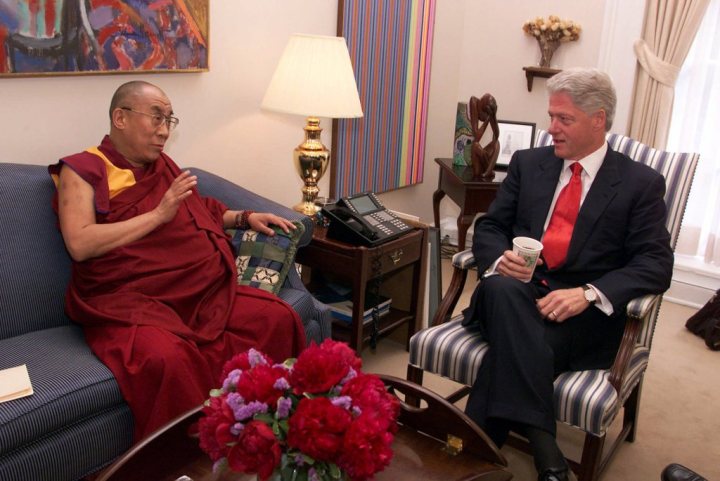
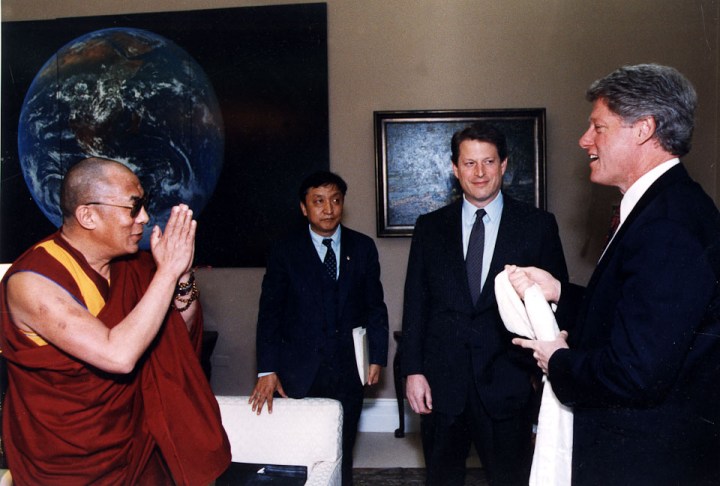
Doom Dooma Doomsayer welcomes the meeting between President Trump and Dalai Lama to reaffirm our commitment to foster friendly relations between Tibet, India, and the United States.
Hopeful of an early meeting between Trump, Dalai Lama: Lobsang Sangay | Central Tibetan Administration
Monday, December 19, 2016
11:26 PM
On bhavanajagat.com Hopeful of an early meeting between Trump, Dalai Lama: Lobsang Sangay
December 19, 2016
Lobsang Sangay (left), the Prime Minister of Tibet’s government in exile with Tibet’s spiritual leader, The Dalai Lama. Photo: PTI By Elizabeth Roche – Live Mint, 19 December 2016 Tibet’s PM-in-exile Lobsang Sangay says encouraged by Donald Trump’s stance on One China policy, remains hopeful of support to resolve Tibet issue peacefully New Delhi: Lobsang Sangay, ‘prime minister’ of the Tibetan government in exile in India, says he is encouraged by US president elect Donald Trump’s recent statement that his administration does not need to be bound by the One China policy. Sangay is also hopeful of an early meeting between Trump and the Tibetan spiritual leader, the Dalai Lama. Sangay was of the view India should also make Tibet as issue for talks with China given that China already considers it a “core” issue with India. On the reincarnation of the Dalai Lama, Sangay said the institution of the Dalai Lama would not end but continue after the eventual passing of the 14th Dalai Lama. Edited excerpts from an interview. The “Middle path” (autonomy for Tibet rather than independence) that the Dalai Lama and you have been advocating seems to be yielding no returns. Is there a chance of a rethink on this? No. I think, if China grows strong and it’s growing stronger, China needs to think. If they really want to be respected in the international community, you have to earn that respect. And with all the money and military power you cannot buy or force respect, you have to earn it by demonstrating an action and solving the issue of Tibet will earn that respect for them. There is an argument on the Chinese side that if you are weak and you give concession, others will take advantage. Now they are strong. If they give concessions, they will be giving concession from the space of strength. US president-elect Donald Trump recently said the new administration does not need to be bound by the One China policy. The context was with reference to Taiwan. But does this give you hope as well? That was a very bold commentary coming from president-elect Donald Trump. We do think that boldness with substance is the right approach with the Chinese government. It looks now that his team has done research on Taiwan, that what he said was deliberate, after substantive research. Similarly, we would appreciate if he would also do something similar for Tibetan people. US presidents George W Bush and Barrack Obama have met his Holiness the Dalai Lama four times each. We remain hopeful that Donald Trump will support the Middle Way approach and meet His Holiness and strongly encourage that the envoys of His Holiness meet with Chinese envoys to resolve this issue of Tibet peacefully. There have been no talks between the Tibetan envoys and China for six years now. What is it that you think will give an impetus to restart dialogue? The Trump administration, the European Union, India, Japan, Australia—all governments must have a coordinated effort to press the Chinese government to solve the issue of Tibet peacefully. It should be a coordinated effort and consistent effort. You were invited to Prime Minister Narendra Modi’s swearing in ceremony (in May 2014). That was seen as a message to China. But then, the Modi government seemed to be making efforts to build a relationship with China. Now, irritants in the relationship have surfaced—China’s objections to India’s Nuclear Suppliers Group (NSG) membership being one. We now see clearance for His Holiness to visit Arunachal Pradesh in 2017. Do you see a consistent policy towards Tibet from the Indian government? Recently, President of India, Pranab Mukherjee hosted the Dalai Lama. This is a bold gesture from the government of India which we really appreciate. The Indian government is formulating its policy towards China which is showing all the right trends. India has done the most for Tibet. The largest number of Tibetans are in India. The Tibetan government in exile is based in India. I can’t think of any other place where this could be based. But we always request and appeal that Tibet be treated as one of the core issues (of India with China). China already does that. India has the moral high ground to speak for Tibet. His Holiness has said the institution of the Dalai Lama might end with him because of fears that the Chinese government will foist its own Dalai Lama onto the Tibetan people. At the same time, he has also said that the next Dalai Lama could be born outside Tibet—among the populations in exile. How do you see the future? The institution of the Dalai Lama will not end. He is the 14th Dalai Lama. For 14 times the Tibetan people have asked him to come back and we will ask him again for the 15th time. When Tibetans asked him to come for 14 times, we had an independent country. Now when we are in exile and we are leading this freedom struggle, all the more reason that we have to ask him to come back. So he will come back.
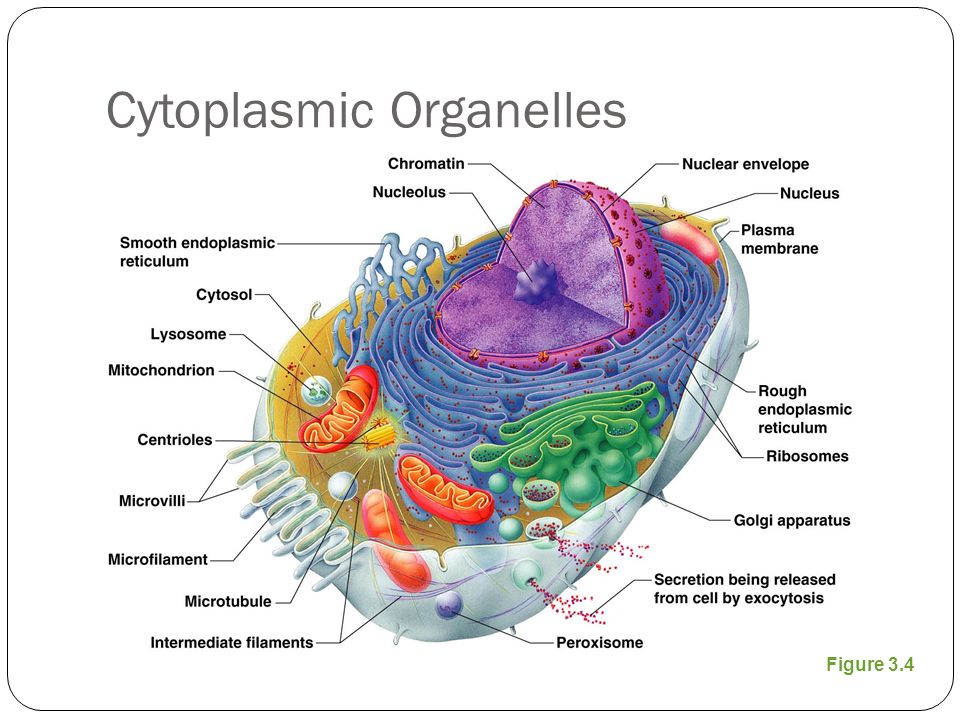
Life and Death – Knowledge in Action. Three Components of Cell, 1. Cytoplasm, 2. Nucleus, and 3. Cell Membrane. Life and Death demand State of Knowing, Fact of Knowing, and Condition of Knowing Range of Information.
Life and Death, Creation and Dissolution demand performance of guided, sequential, goal-oriented, purposive actions that involve application of Knowledge. Life and Death demand State of Knowing, Fact of Knowing, and Condition of Knowing Range of Information.
Cells are building blocks of Life. In the context of study of Human Life, all Cells of Man are derived from a previously existing Fertilized Egg Cell that is essentially made up of three parts, 1. Cytoplasm, 2. Nucleus, and 3. Plasma Membrane.
LIFE AND DEATH – KNOWLEDGE IN ACTION. MEMBRANE PERFORMS SEVERAL COGNITIVE FUNCTIONS TO ESTABLISH LIVING CELL AS AN INDEPENDENT, INDIVIDUAL ENTITY.
Cells perform a variety of functions to make, repair, or degrade Molecules of Life. Not all of the Information is derived from Nucleus which stores ‘genetic information’ in structures called Chromosomes. Apart from ‘Genetic Inheritance’, Life demands ‘Maternal Inheritance’ or Cytoplasmic Inheritance which includes various Cytoplasmic Organelles, and Membrane System which enables Cell to perform its activities by creating isolated compartments within the Cell. Plasma Membrane and Membrane System of Cell perform several Cognitive Functions to establish Living Cell as an Independent, Individual Entity.
LIFE AND DEATH – KNOWLEDGE IN ACTION. COGNITIVE ABILITY OF MEMBRANE. STRUCTURE OF MITOCHONDRION.
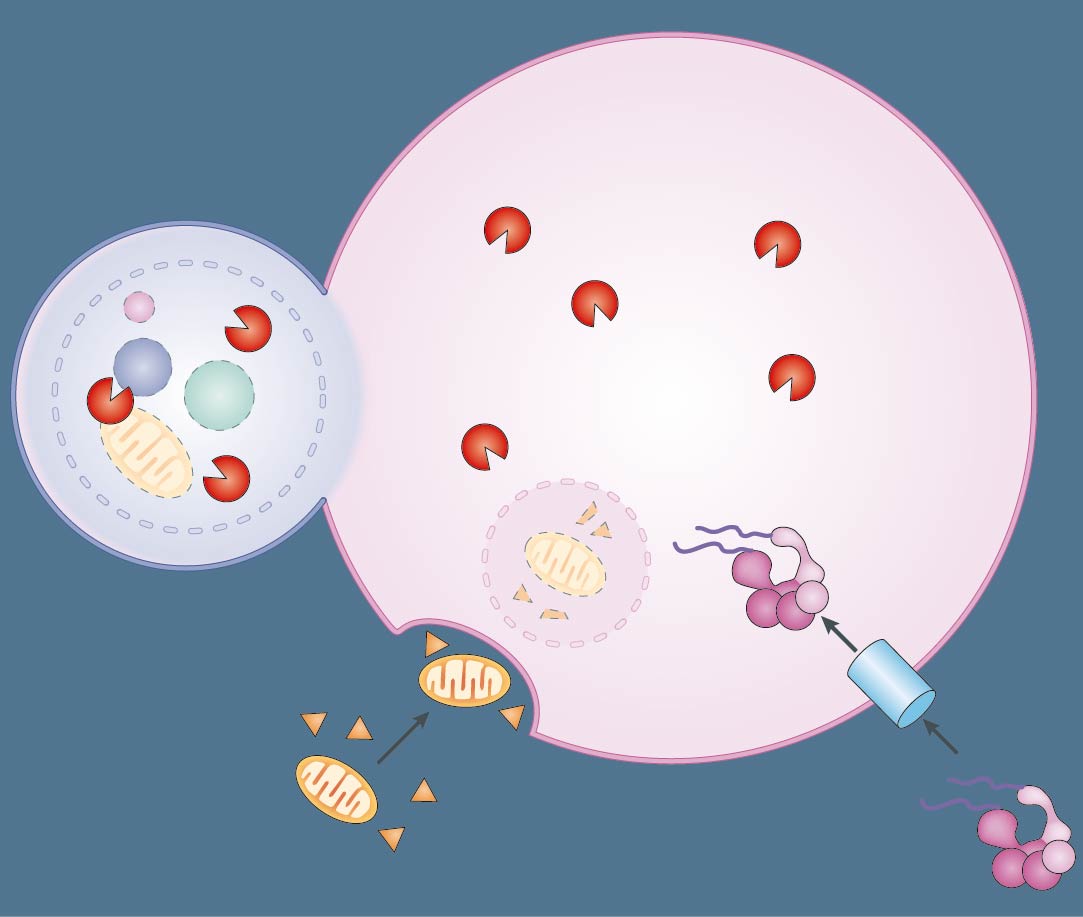
I ask my readers to give attention to ‘COGNITIVE’ abilities of Cell Membrane, the part of Cytoplasm which not only acts as Physical Barrier to segregate Cell Activity but also ‘Knows’ or recognizes specific Molecules to allow, to regulate, or to facilitate their entry or exit. For example, Membrane of Mitochondria has ‘Cognitive’ ability to recognize thousands of varied peptide molecules they routinely process to perform metabolic functions.
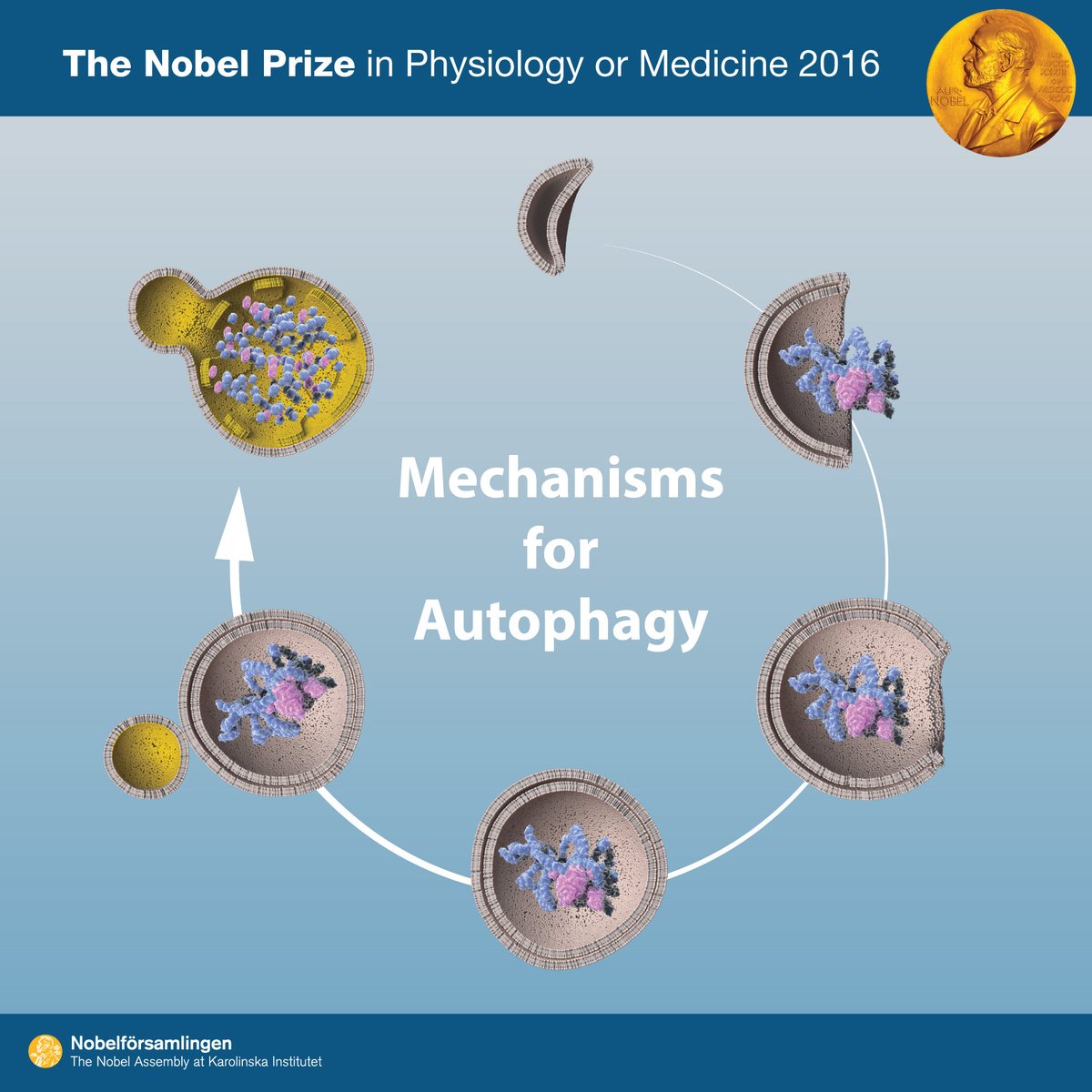
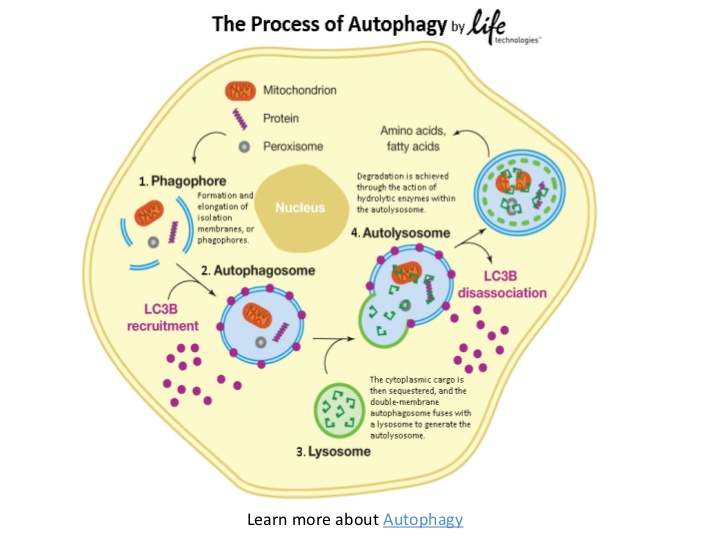
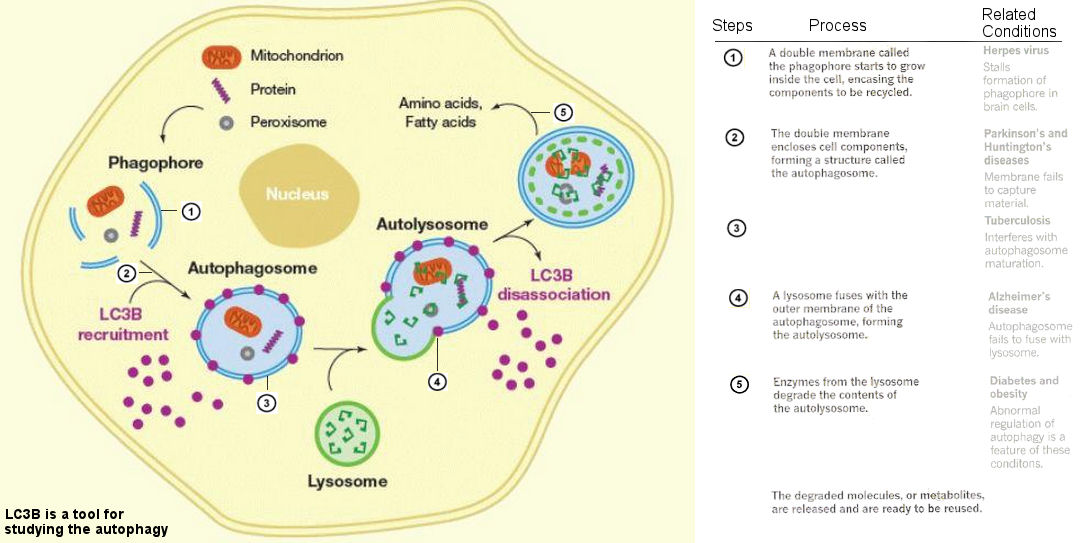
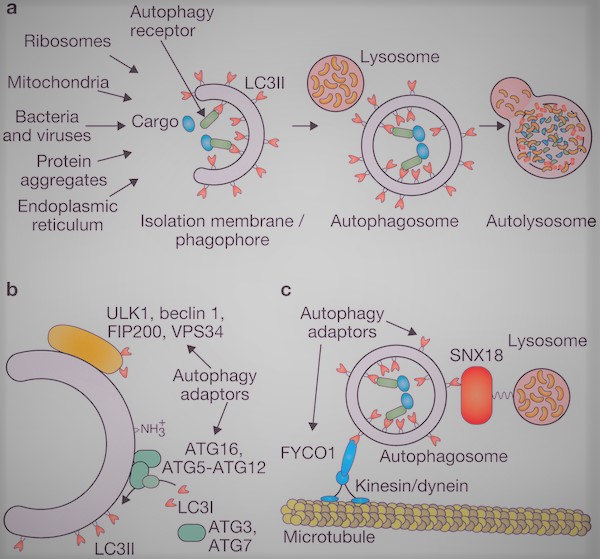
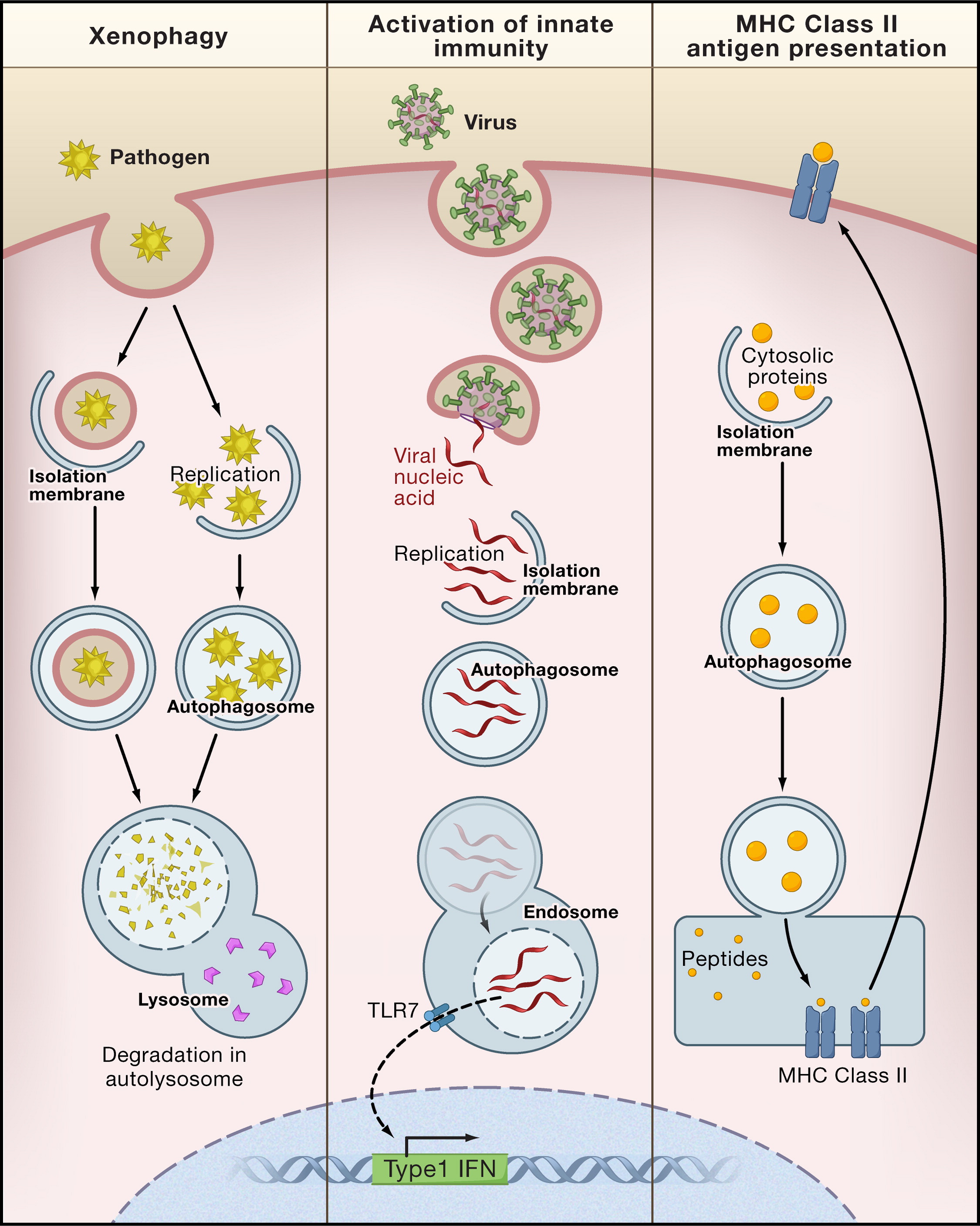
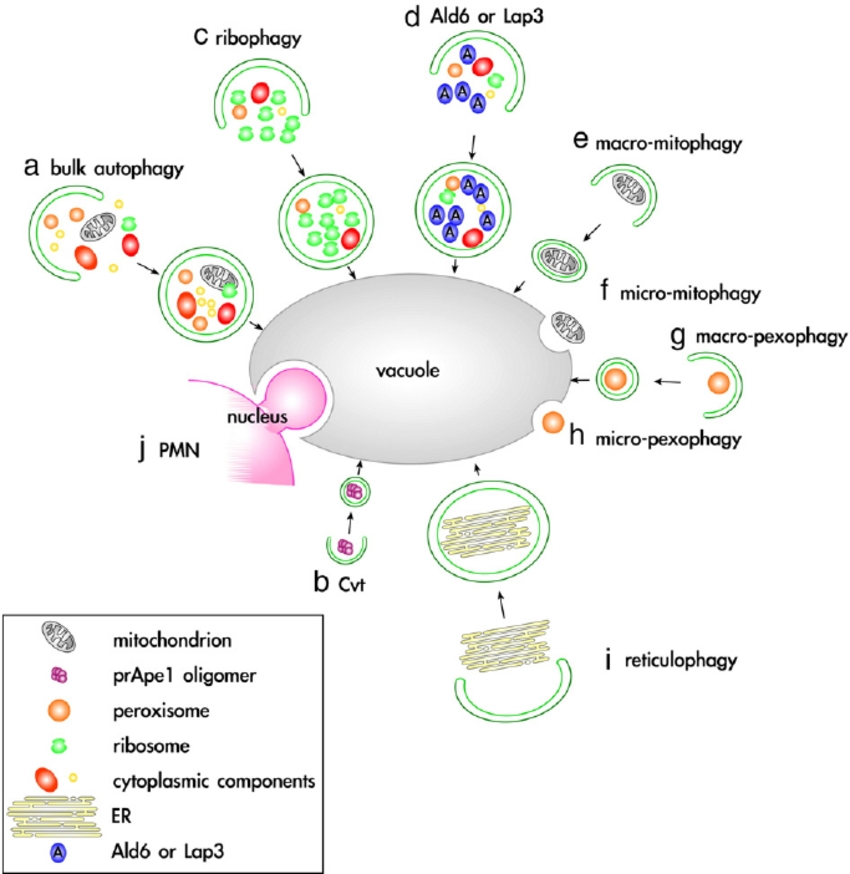
Like all other Cellular functions and activities, the process described as “AUTOPHAGY” represents Cognitive Ability of Cell Membrane System.
Rudranarasimham Rebbapragada Ann Arbor, MI 48104-4162 USA BHAVANAJAGAT.ORG
YOSHINORI OHSUMI WINS NOBEL PRIZE FOR MEDICAL RESEARCH ON CELLS
LIFE AND DEATH – KNOWLEDGE IN ACTION. 2016 NOBEL PRIZE IN PHYSIOLOGY OR MEDICINE.
Monday, October 03, 2016
By Sheena McKenzie, CNN
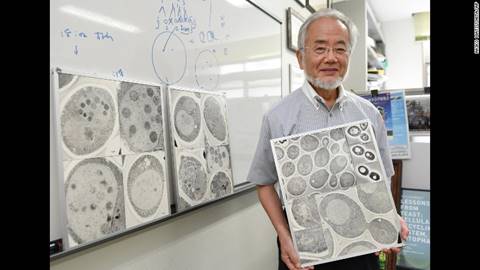
LIFE AND DEATH – KNOWLEDGE IN ACTION. DR. YOSHINORI OHSUMI.
[Japanese scientist Yoshinori Ohsumi pictured at the Tokyo Institute of Technology campus in Yokohama]
(CNN)The first of this year’s Nobel Prizes has been revealed, kicking off with the award for Physiology or Medicine.
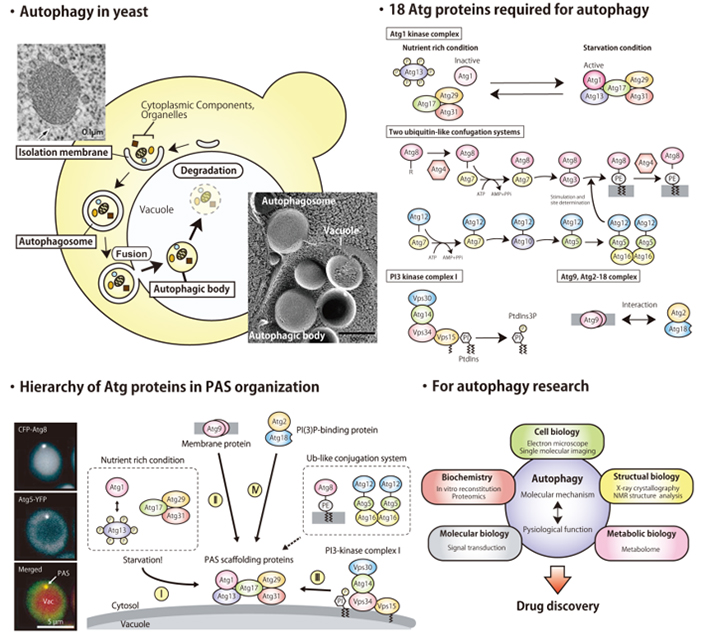
Biologist Yoshinori Ohsumi, of the Tokyo Institute of Technology, was awarded the medicine prize for his discoveries in autophagy — the process whereby a cell recycles part of its own contents.
Scientists had been aware of autophagy since around the 1960s, but knew little about how it worked — until Ohsumi’s pioneering experiments with baker’s yeast in the 1990s.
It’s important because autophagy can eliminate invading intracellular bacteria, and disrupted autophagy has been linked to Parkinson’s disease, type 2 diabetes and other disorders that particularly affect the elderly.
What does autophagy mean?
The term “autophagy” can be translated as “self-eating,” and was first coined by scientists studying cell behavior in the 1960s.
At the time, researchers found a cell could destroy part of its own contents by transporting it to another compartment — called the lysosome — for degradation.
But as Nobel Committee member Juleen Zierath explained, Ohsumi showed that the lysosome “wasn’t a waste dump — it was a recycling plant.”
The Nobel Prize winner’s experiments in the 1990s used baker’s yeast to identify genes essential for autophagy.
“He then went on to elucidate the underlying mechanisms for autophagy in yeast, and showed that similar sophisticated machinery is used in our cells,” explained the Nobel Foundation in a statement.
What does it mean for us?
“Thanks to Ohsumi and others following in his footsteps, we now know that autophagy controls important physiological functions where cellular components need to be degraded and recycled,” it said.
“Autophagy can rapidly provide fuel for energy and building blocks for renewal of cellular components, and is therefore essential for the cellular response to starvation and other types of stress. After infection, autophagy can eliminate invading intracellular bacteria and viruses.”
“The foundation also explains that disrupted autophagy has been linked to Parkinson’s disease, type 2 diabetes and other disorders that appear in the elderly.
“Mutations in autophagy genes can cause genetic disease. Disturbances in the autophagic machinery have also been linked to cancer. Intense research is now ongoing to develop drugs that can target autophagy in various diseases.
From the vault
In 2015, the prize was divided — one half jointly going to Ireland’s William C. Campbell and Japan’s Satoshi Omura for “their discoveries concerning a novel therapy against infections caused by roundworm parasites.”
And the other half awarded to China’s Youyou Tu for “her discoveries concerning a novel therapy against Malaria.”
Back in 2012 Britain’s John B. Gurdon and Japan’s Shinya Yamanaka won the prize for discovering that mature cells can be reprogrammed to become immature cells capable of developing into all tissues of the body.
“Since the method we’ve developed doesn’t require embryos, it could technically allow anybody with a slight knowledge of chemistry to transform skin cells, and even possibly down the road produce a human being from skin cells,” said Yamanaka at the time.
Life and Death – Knowledge in Action. 2016 Nobel Prize in Medicine. Dr. Yoshinori Ohsumi, Tokyo Institute of Technology, Japan.
Life and Death – Knowledge in Action. Autophagosome represents Creative Mechanism to regulate Living and Dying Functions to accomplish Specific Purpose.
Life and Death – Knowledge in Action. Cell Functions Shape Living Experience.
Life and Death – Knowledge in Action. Mechanisms of Autophagy.
Life and Death – Knowledge in Action. Cellular Events involve Act of Knowing.
Life and Death – Knowledge in Action. Autophagy, complex guided event.
Life and Death – Knowledge in Action. Membrane has crucial role in Cellular Functions because of its Cognitive Ability.
Life and Death – Knowledge in Action. Molecular Mechanisms of Autophagy provide better understanding of Life, Disease, and Death.
Life and Death – Knowledge in Action. Autophagy – Cellular Mechanisms.
Life and Death – Knowledge in Action. Cell Membrane creates Cell Compartments to isolate Cellular Events.
Life and Death – Knowledge in Action. Autophagy Deregulation and Neurodegenerative Disease – Parkinson’s Disease(PD).
Life and Death – Knowledge in Action. Autophagy Receptors and Adaptors.
Life and Death – Knowledge in Action. Cell Death and Autophagy.
Life and Death – Knowledge in Action. Autophagy and Pathogenesis. Factors involved in causing Disease or Dysfunction.
Life and Death – Knowledge in Action. Autophagy Mechanism.
Life and Death – Knowledge in Action. Selective Autophagy.
Life and Death – Knowledge in Action. Selective and Non-Selective Autophagy.
Life and Death – Knowledge in Action. Cell Membrane imposes Physical Barrier between Cell and its immediate External Environment. In addition, Cell Membrane creates numerous Compartments to segregate or isolate Chemical Reactions and Events within the Cell. Membrane has remarkable Cognitive Abilities.
TIBET OCCUPATION – UNFORGOTTEN MEMORY – GREATEST CRIME AGAINST HUMANITY
Tibet Occupation – Unforgotten Memory – Greatest Crime Against Humanity. Thank You Tsering Woeser.
Evil Red Empire’s Tibet Occupation ranks as World History’s Worst Crime Against Humanity. I seek the appointment of an International War Crimes Tribunal to fully investigate Red China’s Tibet Occupation and the atrocities of ‘Cultural Revolution’ as Crimes Against Humanity. I warmly appreciate Ms. Tsering Woeser’s efforts to expose these Crimes.
The Cultural Revolution in Tibet: A Photographic Record
SINOSPHERE
By LUO SILING OCT. 3, 2016
Tibet Occupation – Unforgotten Memory – World History’s Worst Crime Against Humanity.
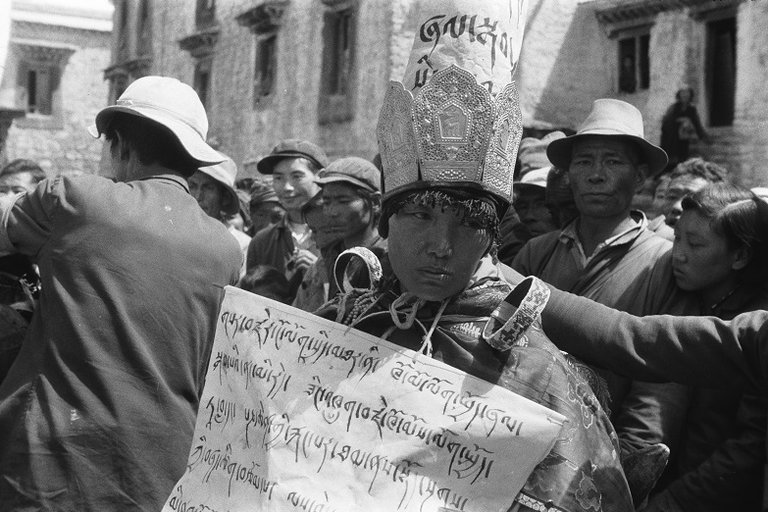
Tsering Woeser’s father, an officer in the People’s Liberation Army in Lhasa when the Cultural Revolution broke out in 1966, photographed many public attacks on Tibet’s old ruling class and religious leaders. Here, a Buddhist nun wears a sign labeling her as a counterrevolutionary. Credit Tsering Dorje
In 1999, the Tibetan writer Tsering Woeser came across Wang Lixiong’s book “Sky Burial: The Fate of Tibet.” On finishing it, she sent Mr. Wang photographs taken by her father, who was with the People’s Liberation Army when it entered Tibet in the 1950s and documented the early years of the Cultural Revolution in Lhasa in the 1960s. Mr. Wang wrote back, saying, “It’s not for me, as a non-Tibetan, to use these photos to reveal history. That task can only be yours.”
Ms. Woeser began tracking down and interviewing people who appeared in the photos. This resulted in two books published by Locus in Taiwan in 2006: “Forbidden Memory: Tibet During the Cultural Revolution,” based on her father’s photographs, and “Tibet Remembered,” an oral history narrated by 23 people who appear in them. Meanwhile, Ms. Woeser had begun taking her own photos, using her father’s camera, of the places he photographed. Many were included in a new edition of “Forbidden Memory,” published this year on the 50th anniversary of the start the Cultural Revolution.
Tibet Occupation – Unforgotten Memory – World History’s Worst Crime Against Humanity. Tsering Dorje before the Potala Palace in 1969.
Tsering Dorje standing before the Potala Palace in Lhasa in 1969, in a photograph provided by his daughter, Tsering Woeser.
Ms. Woeser was born in Lhasa in 1966 to a Tibetan mother and her father, Tsering Dorje, who was half Tibetan and half Han, the dominant ethnicity in China. But in 1970, her father, who had served as deputy commander of the Lhasa military district, was transferred to Sichuan Province. It wasn’t until 1990 that Ms. Woeser returned to Lhasa, where she became editor of the journal “Tibetan Literature.” In 2003, she published “Notes on Tibet,” a collection of essays and short stories that was soon banned by the Chinese government. She is now a freelance writer and poet based in Beijing with Mr. Wang, whom she married in 2004. In an interview, she discussed what she learned from her father’s photographs of Tibet’s experience of the Cultural Revolution.
How did your father manage to take these photos?
In 1950, Mao Zedong ordered the People’s Liberation Army into Tibet, and on the way it passed through my father’s hometown, Derge, which is in the present-day Garze Tibetan Autonomous Prefecture in Sichuan. At the time my father, who was only 13, was sent away by his Han father to enlist in the P.L.A. His mother was a local Tibetan. During the Cultural Revolution, my father served as an officer in the political department of the Tibet Military District. I suppose he was able to take photos because of his privileges as a P.L.A. officer.
It’s curious, however, that for all the photos that my father took, he was able to keep the photos and negatives. This certainly could not have happened if the army had assigned him to take the photos. This indicates that my father’s activity was not commissioned by the military.
Tibet Occupation – Unforgotten Memory – World History’s Worst Crime Against Humanity
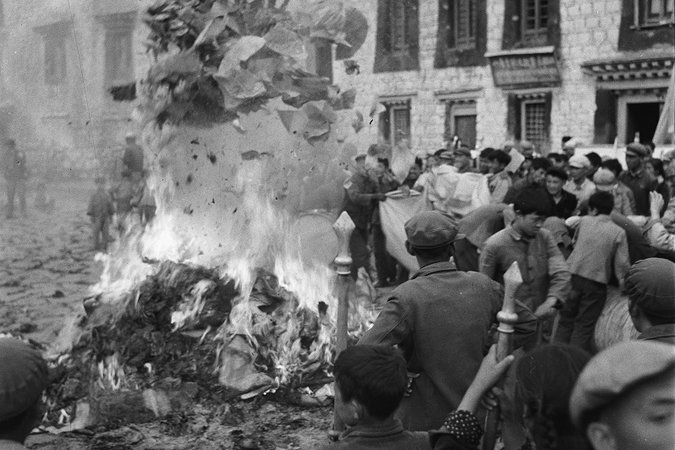
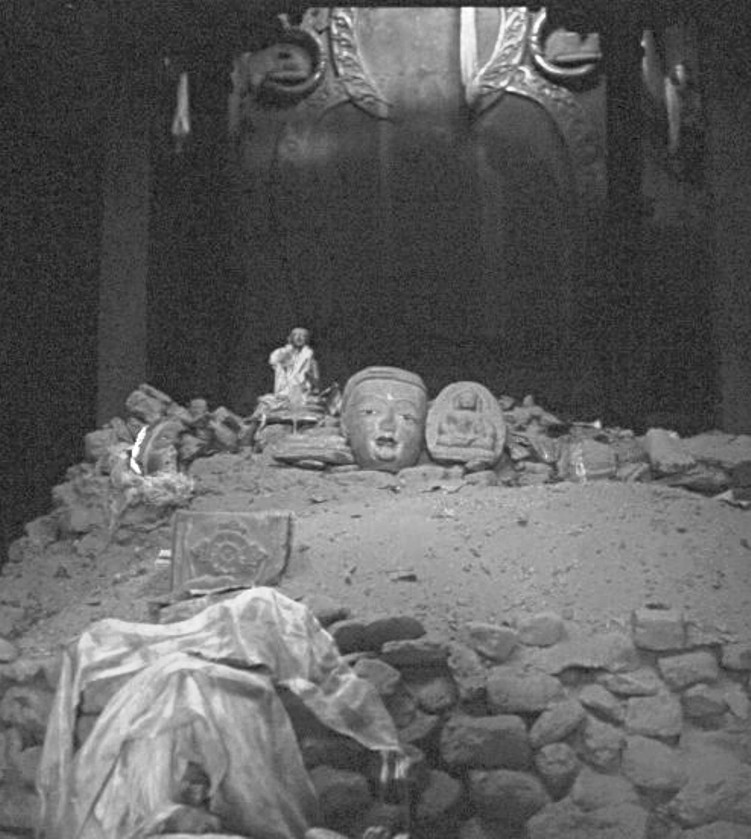
On Aug. 24, 1966, in Lhasa, Buddhist scriptures were burned as part of the campaign against the “Four Olds” – old customs, old culture, old habits, old ideas. Credit Tsering Dorje
Very few people had cameras then, and even fewer had the chance to take photos of public events. There were several media agencies active in Tibet then. They produced lots of documentaries, photos and reports. And yet in the newspapers and posters from then you can’t find any photos of ruined temples or “struggle sessions” against “counterrevolutionary monsters and demons.” I’ve looked at all the issues of Tibet Daily from 1966 to 1970 but can find no such photos.
What do your father’s photos show?
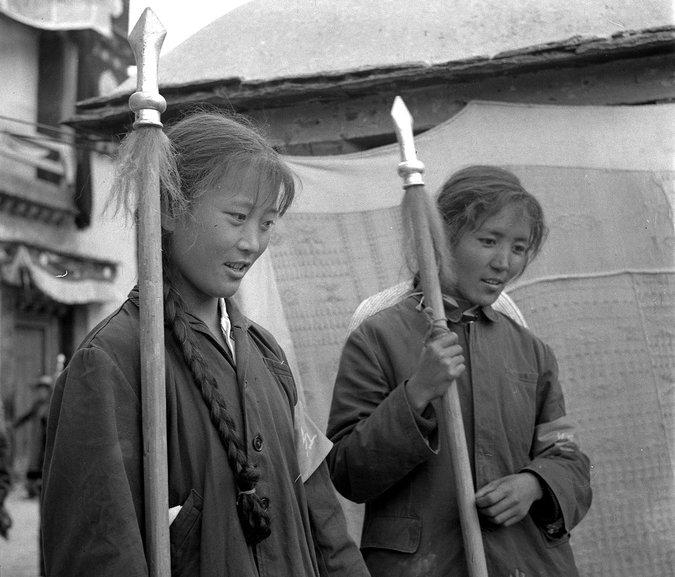
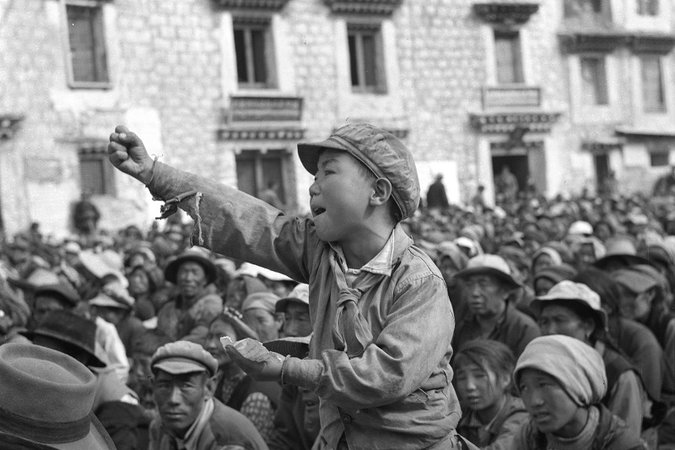
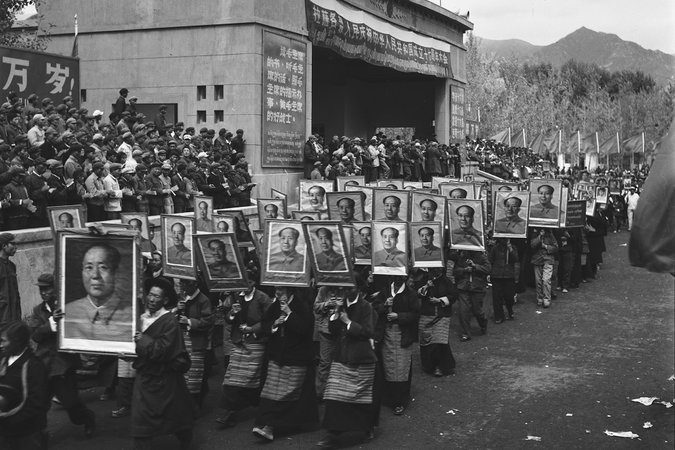
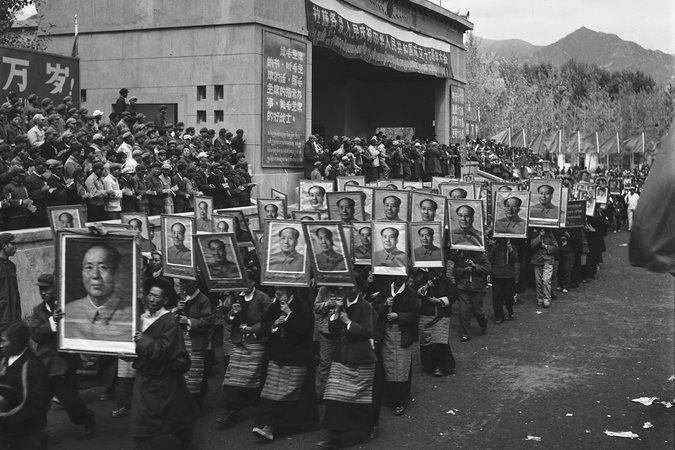
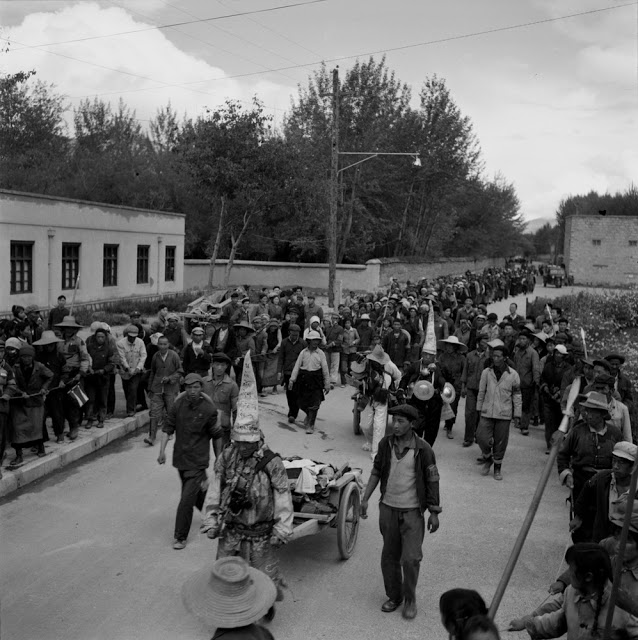
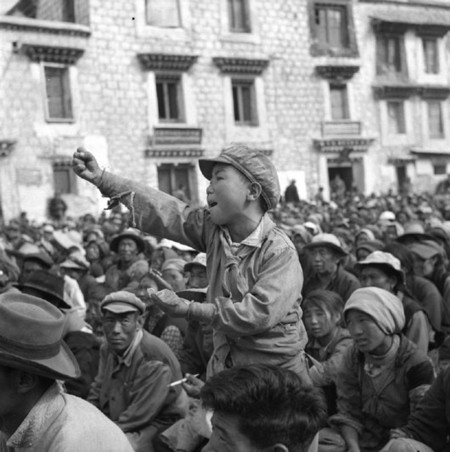
Mostly mass meetings and “incidents.” By mass meetings I mean large-scale gatherings such as the celebration by tens of thousands of Chairman Mao’s launching of the Cultural Revolution. Incidents include the destruction of temples and struggles against “monsters and demons.” The photos contain many identifiable figures including the Communist leaders of Tibet, the founder of the Tibetan Red Guards, individual Red Guards, as well as nobles, clergy and officials of the old Tibet society who were targeted in “struggle sessions.” In my investigations most of my efforts were focused on these people, because it’s through them that the photos have their greatest value. Over six years, I interviewed about 70 people in the photos.
How do your photographs and your father’s, taken in the same locations, differ?
In 1966 and 1967, my father took photos of mass meetings and rallies of Red Guards and the P.L.A. in front of the Potala Palace. In 2012, when I went to the same place to take photos, two self-immolations by Tibetans had taken place in Lhasa that May. As a result, the government tightened its policy of ethnic segregation and took more security measures against Tibetans, especially those from outside Lhasa. The measures were first implemented in March 2008, when protests broke out across the Tibetan region, and became more severe in 2012. As I took my photos, I noticed a curious phenomenon: the palace square was filled with men in black. They had umbrellas on their backs, which they would use to block people from taking pictures if an incident broke out. They lined up in rows and monitored the people passing by. They prohibited anyone from sitting in the square.
Tibet Occupation – Unforgotten Memory – World History’s Worst Crime Against Humanity. Tsering Woeser in Lhasa with her father’s camera.
Tsering Woeser, with her father’s camera, in Lhasa in 2013. Credit Pazu Kong
Another example: In 2014, I was standing where my father had taken photos in front of the Jokhang Temple. What did he see back then? Red Guards trying to hang Chairman Mao’s portrait on the roof of the temple, where the Chinese flag was also planted. Though I didn’t see any Mao portraits there, the flag was waving in the same place. Also, there were quite a few believers kneeling and praying, as well as a crowd of tourists fascinated by their actions. On the roof of a house diagonally across from the temple there were sharpshooters from the armed police. Ever since 2008, sharpshooters have been deployed on the roofs of buildings around the temple.
Comparing today with the Cultural Revolution, there were no believers kneeling back then, and the temple was ruined, while today the temple offers a bustling scene where believers may freely worship. But these are only superficial differences. Religious worship is still strictly controlled. Furthermore, there is now commercialized tourism, with gawking tourists who treat Tibetans like exotic decorations and Lhasa as a theme park.
Who was the founder of the Lhasa Red Guards?
Tao Changsong, born in Yangzhou, Jiangsu Province. In 1960, he graduated from East China Normal University and volunteered to move to Tibet, where he became a teacher of Chinese at Lhasa Middle School. During the Cultural Revolution he was the main force behind the creation of the Lhasa Red Guards, as well as commander of the Lhasa Revolutionary Rebels Headquarters. When the Revolutionary Committee of the Tibet Autonomous Region was formed, he became its deputy director, a position equivalent to vice chairman of the Tibet Autonomous Region today. He also went to Beijing many times and met with Zhou Enlai, Jiang Qing and other key members of the Central Revolutionary Committee. In 2001, I interviewed him twice. I didn’t show him my father’s photos, assuming he might not tell me the story if he saw them, since he appears in one. It shows him at the Dalai Lama’s summer palace, the Norbulingka, leading a team of Red Guards hanging up a poster on which is written “People’s Park.”
Tibet Occupation – Unforgotten Memory – World History’s Worst Crime Against Humanity.
A public rally in Lhasa to force “monsters and demons” to confess their failings. Credit Tsering Dorje
There were two “rebel factions” in Lhasa during the Cultural Revolution. One was the Revolutionary Rebels Headquarters. The other was the Great Alliance of Proletarian Revolutionaries Command, or Great Alliance Command for short. The two fought each other for power. In the later period of the Cultural Revolution, the Headquarters faction lost ground, while the other faction achieved total control, and retained it even after the Cultural Revolution [which ended in 1976]. Headquarters members were purged from the party. Tao Changsong was investigated on suspicion of belonging to the “three types of people” – “people who followed the Lin Biao-Jiang Qing counterrevolutionary faction,” “people with a strong factionalist bent” and “people who engaged in looting and robbery.” After the mid-1980s, he worked at the Tibetan Academy of Social Sciences and served as assistant editor of the journal “Tibet Studies” and as deputy director of the Modern Tibetan Research Institute. Now he’s retired and lives in Chengdu and Lhasa, where he is in good standing with the government.
Mr. Tao is a lively talker with a sharp memory. He also showed his cautious side when he began having difficulty answering my questions about the Red Guards’ campaign against the “Four Olds” at the Jokhang Temple. The statement in his account that left the deepest impression on me concerned the P.L.A.’s crackdown on “second rebels” [Tibetans who revolted in 1969]. He said: “The Tibetans are too simple-minded. If you execute them they say, ‘Thank you.’ If you give them 200 renminbi they also say, ‘Thank you.’ “
Tibet was an exception to the general practice of purging the “three types of people” after the Cultural Revolution. In Tibet there were few purges of that kind. When Hu Yaobang came to Lhasa in 1980, he put an end to the purging of the “three types.” Why? Because there were many Tibetans among them. Hu thought if you purged them, the party wouldn’t be able to find reliable agents among local Tibetans. So the party couldn’t purge them. And some of them not only were shielded from purges but even received promotions. As a result, the people who rose in power during the Cultural Revolution still dominate Tibet, whether Tibetan or Han.
Tibet Occupation – Unforgotten Memory – World History’s Worst Crime Against Humanity.
Two Red Guards in Lhasa in 1966. Credit Tsering Dorje
Tell us about the people in the photographs who were victims of the struggle sessions.
There were about 40 of them. They belonged to a variety of professions in the old Tibet: monks, officials, merchants, physicians, officers, estate overlords and so on. The settings included struggle sessions at mass assemblies, in the streets and at local neighborhood committees that methodically conducted their sessions by turns. The time frame was from August to September 1966. After that, the division between the factions led each to conduct its own separate struggle sessions. The people attacked in these sessions were incorporated into the “monsters and demons” unit, where they were ordered to attend long-term labor and study sessions at their assigned neighborhood committee.
What’s most interesting about these victims is that most were members of the upper class whom the Communist Party from the 1950s to the eve of the Cultural Revolution had designated as “targets to be won over.” And since they did not follow the Dalai Lama and flee the country during the 1959 uprising, the party rewarded them with many privileges. In other words, they were partners of the party. One of them, a monk, even served as an informant for the military.
But after the Cultural Revolution began they were labeled “monsters and demons” and suffered humiliating attacks. In the end they were overtaken by madness, illness and death. Some died during the Cultural Revolution, others afterward. Most of the victims died. Of the few who survived, some went abroad. Some, however, remained in Tibet, where they took up the party’s offer and joined the system to regain their high status. Today these people are found in the Chinese People’s Political Consultative Conference, the National People’s Congress and the Buddhist Association, where they fulfill ceremonial functions needed by the party.
Tibet Occupation – Unforgotten Memory – World History’s Worst Crime Against Humanity.
A National Day celebration on Oct. 1, 1966, in Lhasa marking the anniversary of the founding of the People’s Republic of China. Credit Tsering Dorje
Given the fate of most of the victims, the people I interviewed were mostly their relatives, or in some cases the disciples of victimized monks. They told me so many stories.
Such as?
Tibet Occupation – Unforgotten Memory – World History’s Worst Crime Against Humanity.
Sampho Tsewang Rinzin, from one of the most renowned noble families in Tibet. Sampho began working with the Party in the 1950s and benefited from that. But he was cruelly struggled against during the Cultural Revolution, as you can see in the photos. The Red Guards who were beating him made him wear the uniform of a Senior Minister in the Tibetan Government, which as much as it made him look splendid, brought him so much humiliation and stripped him of all dignity, so that in the end he was sobbing in front of everyone. He died soon after this. Then there was the “female living Buddha” – an erroneous term; we call them rinpoche – Samding Dorje Phagmo Dechen Chodron. Historically there have been very few female living Buddhas in Tibet. She was the most famous. In 1959 she followed the Dalai Lama and escaped to India. But she was persuaded by party cadres to return to Tibet and was held up as a patriot who had “resolved to shun the darkness and embrace the light.” She even met with Mao. After the Cultural Revolution started she was labeled a “monster and demon” and humiliated at struggle sessions.
Tibet Occupation – Unforgotten Memory – World History’s Worst Crime Against Humanity.
Ngawang Gelek, a member of the Little Red Guards, which replaced the Young Pioneers children’s organization during the Cultural Revolution, at a rally in Lhasa. He later became a militia commander and eventually a devout Buddhist. Credit Tsering Dorje.
In the photo where she is shown being beaten, she was only 24. She was weak then, because she had recently given birth to her third child. Her husband was the son of the great Lhasa nobleman Kashopa. The couple eventually divorced. It was her ex-husband who told me about her experiences as well as those of her parents after I showed him the photos.
Today, Dorje Phagmo is vice chairwoman of the Tibetan Autonomous Region and a member of the Chinese People’s Political Consultative Conference Standing Committee. She often appears on television attending various conferences.
Did you interview the Red Guards in the photos?
In one of my father’s photos there is a female activist, a quite vicious one during the Cultural Revolution. She once led a team to ransack a house where she not only seized the owner’s property but set fire to manuscripts bequeathed to the owner by the great Tibetan scholar Gendun Choephel. A Tibetan scholar called this a major crime against Tibetan history and culture. Later this woman became party secretary at the Wabaling neighborhood committee. When I found her there, she looked quite insignificant. As soon as I brought up the Cultural Revolution, her facial expression immediately changed. She refused to give an interview or let me take her photo.
There was also a former monk I interviewed who had smashed Buddhist stupas and burned scriptures during the Cultural Revolution. Afterward, he volunteered to be a janitor at the Jokhang Temple and worked there for 17 years. He told me: “If it weren’t for the Cultural Revolution, I think I would have lived my entire life as a good monk. I would have worn monk’s robes. The temples would still be there. Inside the temples I would have devotedly read scriptures. But the Cultural Revolution came. The robes could no longer be worn. Though I have never looked for a woman or abandoned monastic life, I am not fit to wear the robes again. This is the most painful thing in my life.”
Follow Luo Siling on Twitter @luosiling.
This article was adapted from a three-part interview in the Chinese-language site of The New York Times.
Tibet Occupation – Unforgotten Memory – World History’s Worst Crime Against Humanity.
TIBET OCCUPATION – UNFORGOTTEN MEMORY – WORLD HISTORY’S WORST CRIME AGAINST HUMANITY. AUTHOR OF FORBIDDEN MEMORY – CULTURAL REVOLUTION IN TIBET Ms. TSERING WOESER.
TIBET OCCUPATION – UNFORGOTTEN MEMORY – WORLD HISTORY’S WORST CRIME AGAINST HUMANITY
TIBET OCCUPATION – UNFORGOTTEN MEMORY – WORLD HISTORY’S WORST CRIME AGAINST HUMANITY
The Female Living Buddha and her parents were “criticised and struggled against”.