On behalf of Special Frontier Force I am pleased to share an article published by ‘The Tibet Post’ which categorically asserts that “Tibet Was Never Part of China.” I thank Central Tibetan Administration(CTA) for releasing their 21-page document which debunks Red China’s claims about Tibet’s status. Red China is a Liar for she deliberately distorts historical information and reinvents history to justify her evil actions.
HISTORY IS AGAINST CHINA; CTA SAYS TIBET WAS NEVER PART OF CHINA
Monday, 07 September 2015 12:32 Molly Lortie, Tibet Post International
Dharamshala — In response to the most recent white paper regarding Tibet issued by the Chinese Communist Party in August, the India based Central Tibetan Administration has released a 21-page document attempting to set the record straight regarding the historical timeline China has claimed.
While China observed its 50th anniversary of the establishment of the ‘Tibet Autonomous Region,’ the 21-page document entitled “TIBET WAS NOT A PART OF CHINA BUT MIDDLE WAY REMAINS A VIABLE SOLUTION,” was released by Sikyong Dr Lobsang Sangay, accompanied by DIIR Secretary Sonam Norbu Dagpo, DIIR Secretary Tashi Phuntsok and Tibet Policy director, Thubten Samphel.
The CTA revisits the elongating historical claims that China stakes over Tibet. Reminding us that, “the white paper on Tibet in 2004 claims that ‘Tibet became part of the territory of China in the 13th century.’ On the other hand, the Chinese Republican-era scholars assert that Tibet became a vassal state of China during the Qing period (1644-1911). Now, with its latest white paper, China has again shifted the goal post and states that Tibet has been an integral part of China since ‘antiquity’.”
The CTA goes on to refute each of China’s claims, revisiting the history of the region. In terms of the vague ‘antiquity’ that China most recently claims, the rise of the Tibetan Empire was in the seventh century CE, when both the King of Nepal and Emperor of China courted the Tibetan Empire and each offered their daughters to the Tibetan Emperor for marriage.
The first to suggest that this claim to Tibet holds no weight was the former Vice-chairman, of the standing committee of the National People’s Congress of China, who refuted his own government’s claim in 1989, saying, “some historians claim that Tibet had been a part of China from antiquity, some others claim since the time of Tibetan king Songtsen Gampo through his marriage to the Chinese princess. I do not agree with both these views. When you talk about antiquity, there is no time line or if it is from the time of Songtsen Gampo’s marriage, we all know that the first queen of Songtsen Gampo was Nepal’s princess in which case Tibet should be part of Nepal. How can we explain this?”
Going on to counter the claim that Tibet became a part of China during the 13th century, the CTA revisits Tibet’s history with Mongolia at the time. “The Yuan dynasty was a Mongol empire and its ruler Genghis Khan and his successors conquered vast territories in Europe and Asia, including China. By 1279, the Chinese Song dynasty in southern China fell before the advancing Mongols. The Mongols’ conquest of China was complete. Today, China claims the Yuan Dynasty to be its own dynasty and, by doing so, it lays claim to all Mongol conquests, at least in the eastern half of the Mongol Empire.”
However, a Tibeto-Mongol relationship was established in 1240, when a Mongol expedition was launched to Tibet, thus leading to a religious relationship between the Mongol leaders and Tibetan religious hierarchs. It is well known that Kublai Khan embraced Tibetan Buddhism, adopting it as the official religion of his empire. “In gratitude, Kublai Khan offered his Tibetan lama political authority over all Tibet in 1254, conferring various titles on him. This Tibeto-Mongol relationship continued to exist even after the fall of the Yuan Dynasty.”
The dates of these expeditions, relations and invasions fail to match the timeline that the Chinese government claims. “The year of Mongol military expedition to Tibet in 1240 preceded the Mongol invasion of China’s Song Empire in 1279 by 39 years. This debunks China’s claim over Tibet based on the relations between Mongol Empire and Tibet’s Sakya Lamas.” The CTA concludes that even if by transitive property all Mongol conquests were in fact Chinese conquests, the Tibeto-Mongol relationship predated the fall of the Chinese Song Empire.
Finally, in opposition to China’s final claim that Tibet was acquired during the Qing Dynasty, the CTA’s response uses a statement made by the imperial envoy and commander of the Manchu army, General Fu K’angan, to the Eighth Dalai Lama in 1792, showing the nature of the ‘regulations’ imparted by the Manchu emperor after he assisted the Tibetans in expelling the Gorkhas from Tibet. The statement clearly exudes the Emperor’s context as a protector or assister, rather than a ruler ordering his subjects, as the statement ends with, “The Tibetans may, therefore, decide for themselves as to what is in their favour and what is not or what is heavy and what is light, and make a choice on their own.”
Furthermore, after the conclusion of all the history that China claims made Tibet a part of China, it was in 1914 that Tibet signed a bilateral treaty with British India called the Simla Agreement, legitimizing Tibet’s independent status. Mao Zedong himself remarked after the long march that China’s only foreign debt was to the Tibetans for the provisions we owe them.
The CTA succeeded in using the history against China to refute their broken record that Tibet was at any point in history, part of China. The CTA suggests that the recent most intrusion into Tibet’s history is a blatant attempt of the Communist party to doctor history, to literally stretch the truth, in attempt to legitimize their continued occupation of the region, when in reality the history is against them.
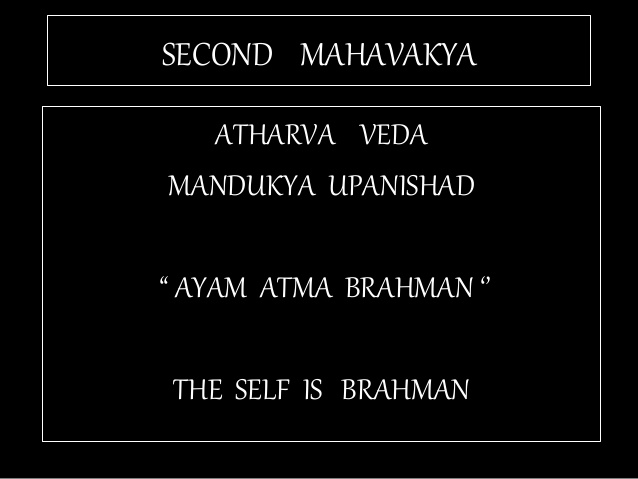
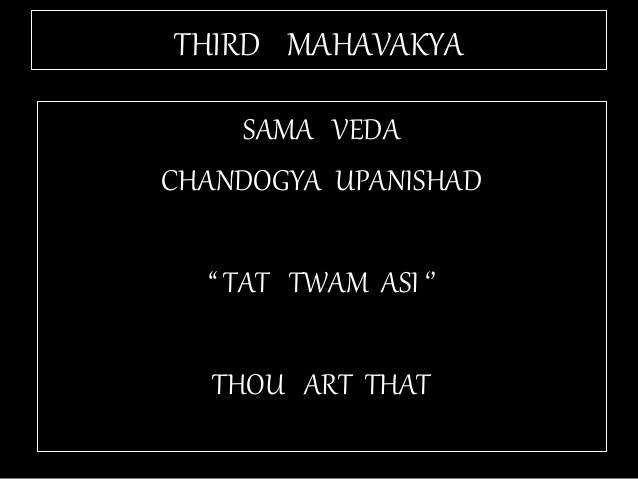
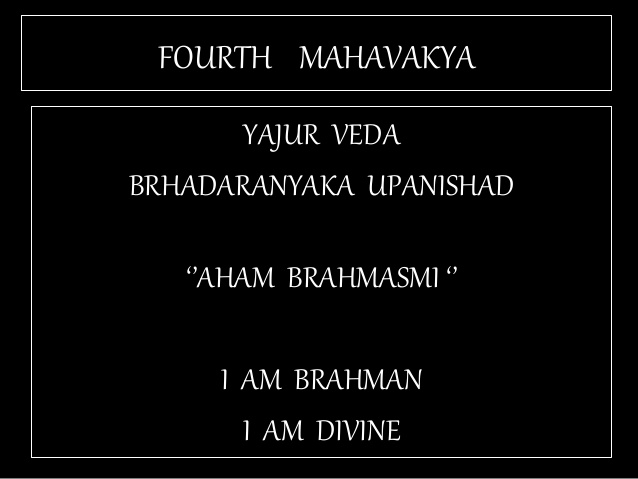
FIFTH MAHAVAKYA – TAT ASMI PRABHO – FUNDAMENTAL DUALISM: The Fifth MahaVakya emerges from an analysis of Four Great Upanishadic Aphorisms (MahaVakya Chatushtaya).
Aphorism refers to a short, concise statement of principle. The ‘Upanishads’ are commentaries on texts called Rig Veda, Sama Veda, Yajur Veda, and Atharva Veda. The Upanishads include four short, pointed sentences expressing a general truth. These Upanishadic Aphorisms are popularly known as ‘MahaVakya Chatushtaya’ or Four MahaVakyas. These four statements are primarily concerned with man’s true or real identity or ‘ESSENCE’ and relate that identity to God’s true or real identity. If man and God have the same identity, we have to reconcile that identity to account for the man’s existence in the real world as a mortal, physical being. We need to explore the possibility of separation, distinction, or differentiation of two identical entities on the basis of things they do for their ‘EXISTENCE’. The term ‘essence’ accounts for what you are, and the term ‘existence’ accounts for what you do. Existence always precedes Essence, and if there is no Existence, the Essence of entities will not be known. The Fifth MahaVakya, “Tat Asmi PrabhO” is attributed to great Indian teacher known as Adi Shankaracharya, the founder of Indian School of Thought called “ADVAITA” or Non-Dualism. While man and God are of the same kind, the distinction, or differentiation between the two entities is that of degree. Man-God Dualism may account for two different types of existence; man’s conditioned existence, and God’s unconditioned existence.
FOUR MAHAVAKYAS – MAHAVAKYA CHATUSHTAYA – UPANISHADIC APHORISMS:
FIFTH MAHAVAKYA – “TAT ASMI PRABHO” – FUNDAMENTAL DUALISM: MAN-GOD DUALISM. MAN IS A CONSCIOUS BEING. THERE IS DISTINCTION BETWEEN INDIVIDUAL CONSCIOUSNESS AND THE DIVINE CONSCIOUSNESS IN TERMS OF THE CONTENTS OF THE CONSCIOUSNESS.
Man is a conscious living entity. Life can be defined as ‘Knowledge in Action’ as all living functions involve the application of knowledge to perform sequential, purposeful, goal-oriented, guided, predictable actions to provide benefit to the Individual who lives because of those actions. God is the Source of Knowledge and there is a distinction between Individual Consciousness and Universal Consciousness.
FIFTH MAHAVAKYA – “TAT ASMI PRABHO” – FUNDAMENTAL DUALISM: ATMAN IS EMBODIED, SOUL. ATMAN IS MODIFIED BY THE BODY IN WHICH IT RESIDES. IN TERMS OF NATURE, INDIVIDUAL SOUL IS IDENTICAL TO GOD, FOR BOTH SHARE THE SAME ATTRIBUTES LIKE IMMUTABILITY, IMPERISHABILITY, IMMORTALITY. AND YET ATMAN IS GOVERNED BY RULES FOR ITS EXISTENCE.
There is a fundamental distinction between Individual Soul (Atman or Jeevatma) and Supersoul or Paramatma. In terms of nature, Individual Soul is identical to Supersoul or Paramatma or God for both share same attributes like Immutability, Imperishability, and Immortality. Atman exists as an embodied soul. Atman is modified by the body in which it resides. The difference between Atman and Brahman is that of variations of existence as Atman is governed by rules for its existence.
FIFTH MAHAVAKYA – “TAT ASMI PRABHO” – FUNDAMENTAL DUALISM: MAN-GOD DUALISM IS TRANSCENDED BY MAN – GOD CONNECTION, PARTNERSHIP, RELATIONSHIP, ASSOCIATION, BONDING, OR YOKING THAT BRINGS THEM TOGETHER TO GIVE A SINGLE, HARMONIOUS EFFECT.
Man-God Dualism, Atman-Brahman Dualism is transcended by man-God connection, partnership, relationship, association, bonding, or yoking that brings them together to give a single, harmonious effect. This statement, “Tat Twam Asi” or ‘Thou Art That’ is a truth that derives its reality from fundamental Unity, an operating principle that makes the man-God Connection. For all practical purposes, the division, distinction, or differentiation into two separate identities becomes redundant for man-God Connection works like the animals yoked by a harness to perform actions in the field of activity called the Human Body or “Kshetra.”
FIFTH MAHAVAKYA – “TAT ASMI PRABHO” – FUNDAMENTAL DUALISM: THE SUBJECT CALLED “I” IS THE SAME AS THE OBJECT CALLED “BRAHMAN” IF BOTH ARE UNITED, JOINED, AND COME TOGETHER AS ESTABLISHED BY SPECIFIC TERM OF VOCABULARY OR SHABDA CALLED “ASMI.”
Atman-Brahman, man-God Dualism or separation, or division is removed when the Subject called “I” is united with the Object called Brahman. Atman is Divine and the original source of this Divinity is Brahman. Their Unity, the Unity with an Everlasting Principle is specified by a term of vocabulary or “SHABDA” called “ASMI.”
FIFTH MAHAVAKYA – “TAT ASMI PRABHO” – FUNDAMENTAL DUALISM: THE INDIAN TRADITION RECOGNIZES OTHER MAHAVAKYAS AND NONE OF THEM, INCLUDING THE FIRST FOUR, GIVE A FULL DESCRIPTION OF LORD GOD CREATOR. THEY DESCRIBE ONE FACE OF A COIN WITH TWO-FACES.
The Indian tradition recognizes several other ‘MahaVakyas’ and none of them, including the first four (‘MahaVakya Chatushtaya’), give a full description of LORD GOD CREATOR. Upanishadic Aphorisms describe one face of a coin with two-faces. Identity and Essence is one face of a coin and Existence is the second face of the same coin. We have to learn about both faces of the coin.
FIFTH MAHAVAKYA – “TAT ASMI PRABHO” – FUNDAMENTAL DUALISM: MAN – GOD DUALISM. MOON SHINES IN THE NIGHT SKY AND SUN IS THE ORIGINAL SOURCE OF MOONLIGHT. GOD OR BRAHMAN IS THE ORIGINAL SOURCE OF LIGHT AND ILLUMINATION.
Man-God Dualism can be recognized by noting the difference between Moon Light and Sunshine. There is an Original Source of Light and Illumination which is not illumined by any other luminous object.
FIFTH MAHAVAKYA – “TAT ASMI PRABHO” – FUNDAMENTAL DUALISM: ATMAN IS BRAHMAN AND YET THEY ARE DIFFERENT FOR GOD HAS NOT ATTACHED HIMSELF TO THINGS THAT HE CREATED. THERE IS CONSTITUTIVE UNITY BETWEEN ATMAN AND BRAHMAN. BUT THERE IS REGULATIVE DUALISM BETWEEN THEM AS GOD IS THE ULTIMATE CONTROLLER, SUSTAINER, AND MAINTAINER OF ALL THINGS.
Atman-Brahman or man-God Dualism is the result of Constitutive – Regulative Dualism. Atman is Brahman for there is Constitutive Unity between the two entities. Between the man and God, there is Regulative Dualism for God is the Ultimate Controller, Sustainer, and Maintainer of entire Universe.
FIFTH MAHAVAKYA – “TAT ASMI PRABHO” – FUNDAMENTAL DUALISM: ALL CHEMICAL ELEMENTS FOUND IN MATERIAL UNIVERSE CAN BE DESCRIBED AS UNBORN, ETERNAL, IMMORTAL, AND EVERLASTING AS PER THE FUNDAMENTAL LAWS OF CONSERVATION OF MASS AND ENERGY DESCRIBED IN CLASSICAL PHYSICS.
Atman is described as imperishable, immutable, immortal, everlasting, eternal, and even unborn. These attributes can be applied to all Chemical Elements found in the material universe as per the Fundamental Laws of Conservation of Mass and Energy described in classical Physics.
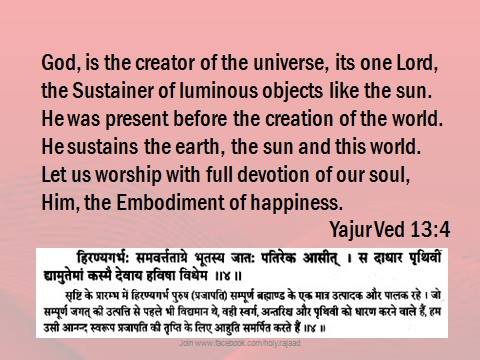
FIFTH MAHAVAKYA – “TAT ASMI PRABHO” – FUNDAMENTAL DUALISM: THE SUBJECT AND THE OBJECT SHARE PERFECT IDENTITY. MAN – GOD DUALISM IS ABOUT THE DEGREE, THE DIFFERENCE IN POWER, OR THE EFFECTS OF SUCH POWER.
Atman or Jeevatma, or Individual Soul may share the perfect identity of Supersoul or Paramatma or Supersoul. Man-God Dualism is about the ‘degree’, the difference in power, or the effects of such Power. God is different from the man while God created the man in His own image. God is different for He is the Supreme Being, Omnipotent, and His Power can reach all places.
FIFTH MAHAVAKYA – “TAT ASMI PRABHO” – FUNDAMENTAL DUALISM: MAN-GOD DUALISM CAN BE ACCOUNTED BY GOD’S REGULATIVE POWERS. ALL CREATED THINGS EXIST DEPENDING UPON GOD’S POWER, AND GOD EXISTS FULLY INDEPENDENT OF POWER USED BY ALL CREATED THINGS.
Man-God Dualism can be described as the separation of Regulative Power. All created things exist depending upon God’s power, or they live in God’s domain and God exists fully independent of power used by all created things. God seems to be telling, ” I am everywhere, and everything is in Me, but still I am aloof.” Lord Krishna, in the Divine Song, called The Bhagavad Gita, Chapter IX, Raja Vidya, Raja Guhya Yoga, Most Confidential Knowledge of the Ultimate Truth, verse # 4 clarifies, ” I pervade all this creation. All things are resting in me, but I am not in them.” This separation of Regulative Power is further explained in Bhagavad Gita, Chapter XIII, Kshetra – Kshetrajna Vibhaga Yoga in verses 12 to 15: “It is called Brahman, the Spirit, and it lies beyond the cause and effect of this material world. The Supersoul is the original source of all senses, and yet He is without senses. He is unattached or detached and disinterested (“UDASIN” in the Sanskrit language), although He is the Maintainer of all living beings. He transcends the modes of Nature, and at the same time is the Master of all modes of material Nature. God is the Controller, the Master, the Sustainer, the Maintainer, the Preserver, the Observer, the Sanctioner, and finally the Enjoyer of His creation.
FIFTH MAHAVAKYA – “TAT ASMI PRABHO” – FUNDAMENTAL DUALISM: GOD HAS NOT SHARED HIS REGULATIVE POWER WITH MAN. MAN CANNOT RULE OR GOVERN HIS OWN BODY WHILE HE USES POWER SANCTIONED BY GOD. THE RECOGNITION OF GOD’S HIGHER POWERS WILL DIRECT MAN TO SUBMIT TO GOD’S SUPERIOR AUTHORITY.
God has shared His nature and identity with the man and may not have shared His higher Regulative Powers with which He controls all that He created. Man cannot rule or govern his own body while he uses power sanctioned by God to perform actions in the material world. The recognition of God’s higher powers will direct the man to submit to God’s superior authority.
FIFTH MAHAVAKYA – “TAT ASMI PRABHO” – FUNDAMENTAL DUALISM: MAN-GOD DUALISM. A DROP OF SEAWATER HAS THE SAME CHEMICAL IDENTITY AS COMPARED TO THE SEA TO WHICH IT BELONGS. BUT, THERE IS NO COMPARISON BETWEEN THE TWO IF THE CRITERION IS ABOUT POWER.
Man-God Dualism can be explained in terms of the chemical identity of a drop of Seawater as compared to the Sea to which it belongs. There is no comparison if the discussion is about the power wielded by Sea.
FIFTH MAHAVAKYA – “TAT ASMI PRABHO” – FUNDAMENTAL DUALISM: TWO CHEMICAL ELEMENTS, SODIUM AND CHLORINE COME TOGETHER TO FORM A CHEMICAL COMPOUND CALLED SALT. WHILE ATMAN AND BRAHMAN ARE ALIKE, THERE IS A DIFFERENCE IN DEGREE THAT CAN BE ESTIMATED BY MEASURING SALT NEEDED TO IMPART THE TASTE CALLED SALTINESS.
Man-God Dualism can be explained as a difference in degree that can be estimated by measuring salt needed to impart the taste called saltiness. A teaspoonful of salt is sufficient to impart the salty taste to a cup of water. To make Seawater salty, the amount of salt required is enormous and the issue is about quantity as the volume of water involved is different. Brahman and Atman are identical, share the same nature or “TATVA”, and the difference arises from the amount of salt needed if their nature is that of saltiness.
FIFTH MAHAVAKYA – “TAT ASMI PRABHO” – FUNDAMENTAL DUALISM: MAN-GOD DUALISM. UPANISHADIC APHORISMS ARE PRINCIPLES OF TRUTH ABOUT IDENTITY OR ESSENCE. EXISTENCE DEMANDS A VITAL FUNCTION CALLED BREATHING OR RESPIRATION.
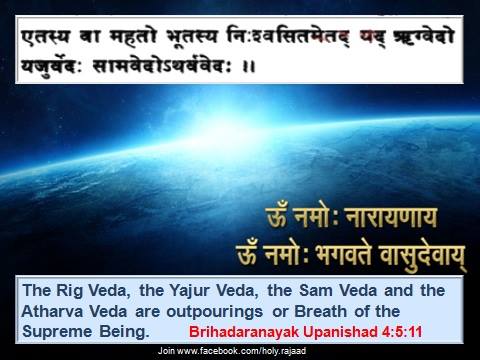
The Upanishads are outpourings of Knowledge and Truth revealed by God and the man has obtained this Knowledge and Truth. Yet the problem of the man – God Dualism persists for the man needs Divine Providence to perform a vital function called Breathing or Respiration. While the man has access to Knowledge that accounts for his Essence, his Existence still demands God’s Mercy, Grace, and Compassion to make the distinction between life and death.
FIFTH MAHAVAKYA – “TAT ASMI PRABHO” – FUNDAMENTAL DUALISM: SHANKARA, GREAT TEACHER OF INDIA RECOGNIZED THE DISTINCTION BETWEEN TEACHER AND HIS STUDENT OR THE BASIS FOR GURU-SHISHYA RELATIONSHIP. Similarly, THERE IS DIFFERENCE BETWEEN GOD AND HIS DEVOTEE.
Shankara, India’s great teacher, founder of ‘Advaita’ School of Thought recognized the distinction between the teacher and his student. The teacher is the Source of Knowledge. The student is the seeker of Knowledge. The teacher imparts Knowledge and the student imbibes that Knowledge. On completion of the learning process, the teacher and the student are identical in terms of learned Knowledge. That identity in terms of ‘Essence’ does not change the reality of the Teacher-Student or Guru-Shishya relationship. Their relationship is formulated on the basis of devotion, the seeker of knowledge and wisdom using an attitude of respect and obedience submits to the authority of the teacher, who is the source of information shared in the learning process. In ‘Eka Sloki’ composed by Shankara, the Disciple or Shishya, or Student finally acknowledges his successful learning of the lesson by addressing his Guru as “PRABHU” or LORD. For God is the ultimate source of Knowledge, the term ‘Prabhu’ or Lord can be interpreted as that of recognition of God’s honor, dignity, and majesty that makes Him as an Exalted One. The statement, “TAT ASMI PRABHO” not only describes Identity or Essence shared by man and God for both have Unity (signified by the term “ASMI”), but also it addresses God with submissiveness and reverence. It transcends man – God Dualism by formulating a relationship using Devotion as an operating principle.
MAN – GOD DUALISM – HOW TO TRANSCEND THE BARRIER?
FIFTH MAHAVAKYA – “TAT ASMI PRABHO” – FUNDAMENTAL DUALISM: MAN – GOD DUALISM. LORD KRISHNA ACTING AS A TEACHER, MASTER, OR GURU IMPARTED KNOWLEDGE TO PRINCE ARJUNA. BUT, TO TRANSCEND THE BARRIER IMPOSED BY DUALISM, HE RECOMMENDED USING AN OPERATING PRINCIPLE CALLED ‘DEVOTION’ TO FORMULATE A RELATIONSHIP WHILE THERE IS UNITY BETWEEN MAN AND GOD IN TERMS OF ESSENCE OR IDENTITY.
Does Truth lie beyond man’s reasoning power? Man can acquire true or real knowledge about his ‘essence’ and identity from reading holy scriptures like Upanishads. But, man’s reasoning power is not adequate to know the Ultimate Reality as there is fundamental dualism or separation of man and God. While Soul, Spirit, or Atman is an important operating principle to make the distinction between living and non-living or animate and inanimate things, its knowledge will not help man to transcend the difference imposed by God’s Regulative Power. In Bhagavad Gita, Chapter X, The Infinite Glories of the Ultimate Truth or Vibhuti Vistara Yoga, verse # 10 Lord Krishna explained the operating principle called ‘DEVOTION’ that will bring the man and God together for the man cannot know God using his reasoning power.
“tesam satata yuktanam bhajatam priti purvakam
dadami buddhi yogam tam yena mam upayanti te.”
To those devotees who are constantly devoted and worship Me with love, I bestow the intelligence, insight, and understanding by which they can come unto Me (which means merging of Individual Consciousness with the Ultimate Divine Consciousness).
The Fifth MahaVakya, “Tat Asmi PrabhO” reveals a new principle, a new truth, a new operative mechanism not shared by Four MahaVakyas or MahaVakya Chatushtaya. It acknowledges God as the Supreme Being and addresses God with reverence displaying an attitude called submissiveness formulated by a guiding principle called Detached Devotion. The fact of connection to the LORD does not grant the right to attachment to the LORD.
FIFTH MAHAVAKYA – “TAT ASMI PRABHO” – FUNDAMENTAL DUALISM: ACKNOWLEDGES GOD AS SUPREME BEING WITH SUBMISSIVENESS AND REVERENCE. FORMULATES MAN-GOD RELATIONSHIP USING OPERATING PRINCIPLE CALLED DEVOTION.
THE SEARCH FOR SIMPLER HUMAN LINEAGE. HOMINID FOSSIL SKULL DISCOVERED IN DMANISI, REPUBLIC OF GEORGIA IS IDENTIFIED AS HOMO DMANISI, A VARIANT OF HOMO ERECTUS SPECIES.
The search for human lineage continues to bring us new evidence in the form of fossil discovery. Evolutionary biologists and palaeoanthropologists tend to describe their findings either as a new species or as a member of a known species. As more and more new species are discovered, the issue of human lineage gets very complex if man’s arrival on Earth has to be explained. A team of scientists involved in the study of hominid fossils discovered in Dmanisi, Republic of Georgia have noticed variations among the hominid fossils and yet concluded that they represent a single species for such individualistic variations are common even among anatomically modern humans.
In my view, individualistic variation is the rule or dictum that operates production of all kinds of living things. Identification of ‘Species’ based upon shared traits is useful for a ‘Species’ always breeds with another member of the same ‘Species’ to produce a new organism that may vary in appearance but shares several of hereditary traits of its biological parents. In other words, a creative mechanism, a creative operation, a creative principle and a creative process always ensures production of new, original, distinct, one of its own kind of Individual with Individuality using ‘The Law of Biogenesis’. Biodiversity may not be explained as consequence of ‘evolution’ in which an organism over period of time descends into a new organism or new ‘Species’.
THE SEARCH FOR SIMPLER HUMAN LINEAGE: ALL ORGANISMS INCLUDING MEMBERS OF THE SAME SPECIES DISPLAY INDIVIDUALISTIC VARIATIONS. BUT, AN ACCOUNT OF SIMPLER HUMAN LINEAGE WILL POSE PRACTICAL DIFFICULTIES AS “LUCY” MAY NOT HAVE A PELVIS DESIGNED TO DELIVER A SKULL OF SIZE AND SHAPE CHARACTERISTIC OF ANATOMICALLY MODERN HUMAN.
While individualistic variation is the rule, it will not help us to simplify human lineage and suggest that anatomically modern human is delivered from the pelvis of “LUCY”(Australopithecus afarensis). Man can only be explained as a ‘new arrival’ for no other female ‘Hominid’ species had a pelvis designed for delivering a skull of size and shape that is characteristic of modern man.
Rudranarasimham Rebbapragada Ann Arbor, MI 48104-4162, USA BHAVANAJAGAT.ORG
THE NEW YORK TIMES
Skull Fossil Suggests Simpler Human Lineage
By JOHN NOBLE WILFORD OCT. 17, 2013
The 1.8-million-year-old skull was found during a dig in the Republic of Georgia. Credit Georgian National Museum
After eight years spent studying a 1.8-million-year-old skull uncovered in the Republic of Georgia, scientists have made a discovery that may rewrite the evolutionary history of our human genus Homo.
It would be a simpler story with fewer ancestral species. Early, diverse fossils those currently recognized as coming from distinct species like Homo habilis, Homo erectus and others may actually represent variation among members of a single, evolving lineage.
In other words, just as people look different from one another today, so did early hominids look different from one another, and the dissimilarity of the bones they left behind may have fooled scientists into thinking they came from different species.
This was the conclusion reached by an international team of scientists led by David Lordkipanidze, a paleoanthropologist at the Georgian National Museum in Tbilisi, as reported Thursday in the journal Science.
A SIMPLER FAMILY TREE?
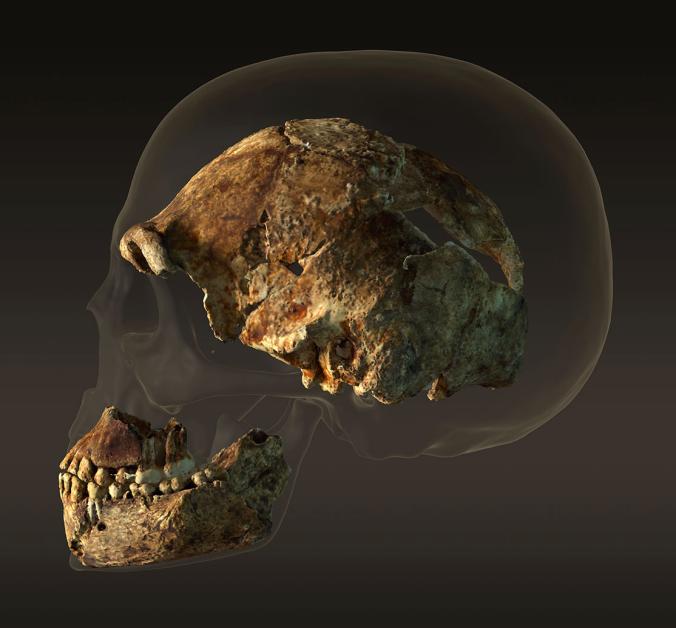
The key to this revelation was a cranium excavated in 2005 and known simply as Skull 5, which scientists described as the world’s first completely preserved adult hominid skull of such antiquity. Unlike other Homo fossils, it had a number of primitive features: a long, apelike face, large teeth and a tiny braincase, about one-third the size of that of a modern human being. This confirmed that, contrary to some conjecture, early hominids did not need big brains to make their way out of Africa.
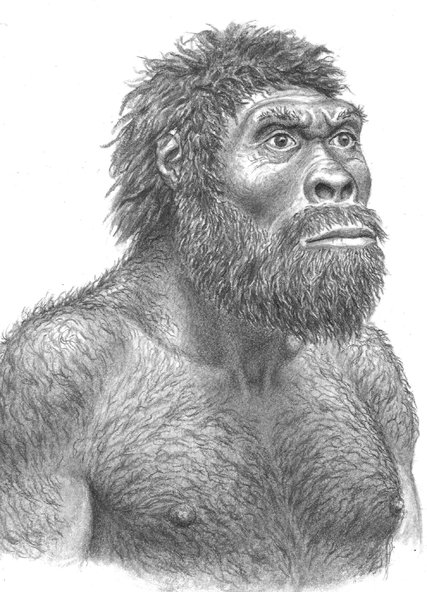
An artist’s rendition of what the original owner of Skull 5 may have looked like. Credit J.H. Matternes
The discovery of Skull 5 alongside the remains of four other hominids at Dmanisi, a site in Georgia rich in material of the earliest hominid travels into Eurasia, gave the scientists an opportunity to compare and contrast the physical traits of ancestors that apparently lived at the same location and around the same time.
Dr. Lordkipanidze and his colleagues said the differences between these fossils were no more pronounced than those between any given five modern humans or five chimpanzees. The hominids who left the fossils, they noted, were quite different from one another but still members of one species.
Credit The New York Times
Had the braincase and the face of Skull 5 been found as separate fossils at different sites in Africa, they might have been attributed to different species, a co-author of the journal report, Christoph Zollikofer of the University of Zurich, said in a statement. Such was often the practice of researchers, using variations in traits to define new species.
Although the Dmanisi finds look quite different from one another, Dr. Zollikofer said, the hominids who left them were living at the same time and place, and so could, in principle, represent a single population of a single species. He and his Zurich colleague, Marcia Ponce de Lean, conducted the comparative analysis of the Dmanisi specimens.
Skull 5, which was discovered alongside the remains of four other hominids in Dmanisi, Georgia. Credit Courtesy of Guram Bumbiashvili, Georgian National Museum
Since we see a similar pattern and range of variation in the African fossil record, Dr. Zollikofer continued, it is sensible to assume that there was a single Homo species at that time in Africa. Moreover, he added, since the Dmanisi hominids are so similar to the African ones, we further assume that they both represent the same species.
But what species? Some team members simply call their finds early Homo.Others emphasized the strong similarities to Homo erectus, which lived between two million and less than one million years ago. Tim D. White, a paleoanthropologist at the University of California, Berkeley, called it the most primitive H. erectus yet known, noting that it is more similar than any other yet found to early Homo from eastern Africa, a group of hominids estimated to have lived 2.3 million years ago.
An aerial view of the Dmanisi excavation site (foreground) and a medieval town. Credit Fernando Javier Urquijo
All five of the skulls and skeletal bones were found in underground dens, suggesting grisly scenes from the perilous lives these early Homos led. They resided among carnivores, including saber-toothed cats and an extinct giant cheetah. All five of the individuals had probably been attacked and killed by the carnivores, their carcasses dragged into the dens for the after-hunt feast, with nothing left but dinner scraps for curious fossil hunters.
Dr. White and other scientists not involved in the research hailed the importance of the skull discovery and its implications for understanding early Homo evolution. In an article analyzing the report, Science quoted Ian Tattersall of the American Museum of Natural History in New York as saying that the skull is undoubtedly one of the most important ever discovered. A few scientists quibbled that the skull looks more like Homo habilis or questioned the idea that fossils in Africa all belong to Homo erectus, but there was broad recognition that the new findings were a watershed in the study of evolution. As the most complete early Homo skull ever found, Dr. White wrote in an e-mail, it will become iconic for Dmanisi, for earliest Homo erectus and more broadly for how we became human.
Dr. White who has excavated hominid fossils in Ethiopia for years, said he was impressed with the total evidentiary package from the site that is the really good news story here. Further, he said, he hoped the discovery would now focus the debate on evolutionary biology beyond the boring lumpers vs splitters, a reference to the tendencies of fossil hunters to either lump new finds into existing species or split them off into new species.
In their report, the Dmanisi researchers said the Skull 5 individual “provides the first evidence that early Homo comprised adult individuals with small brains but body mass, stature and limb proportions reaching the lower range limit of modern variation.
Skeletal bones associated with the five Dmanisi skulls show that these hominids were short in stature, but that their limbs enabled them to walk long distances as fully upright bipeds. The shape of the small braincase distinguished them from the more primitive Australopithecus genus, which preceded Homo and lived for many centuries with Homo in Africa.
A version of this article appears in print on October 18, 2013, on page A8 of the New York edition with the headline: Fossil May Rewrite Human Evolutionary History.
THE DISCOVERY OF HOMO NALEDI – EXPLANATION FOR MAN’S ARRIVAL ON EARTH
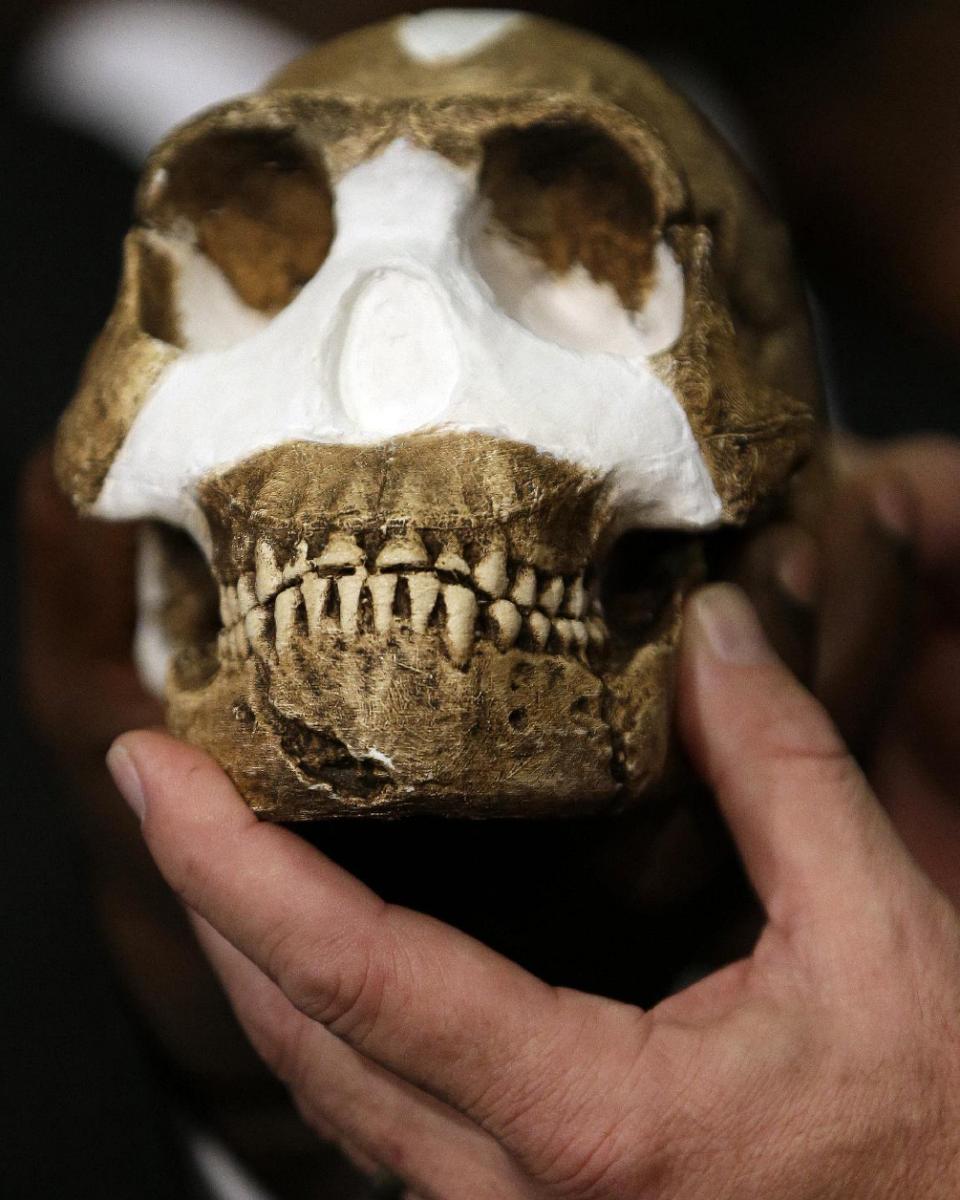
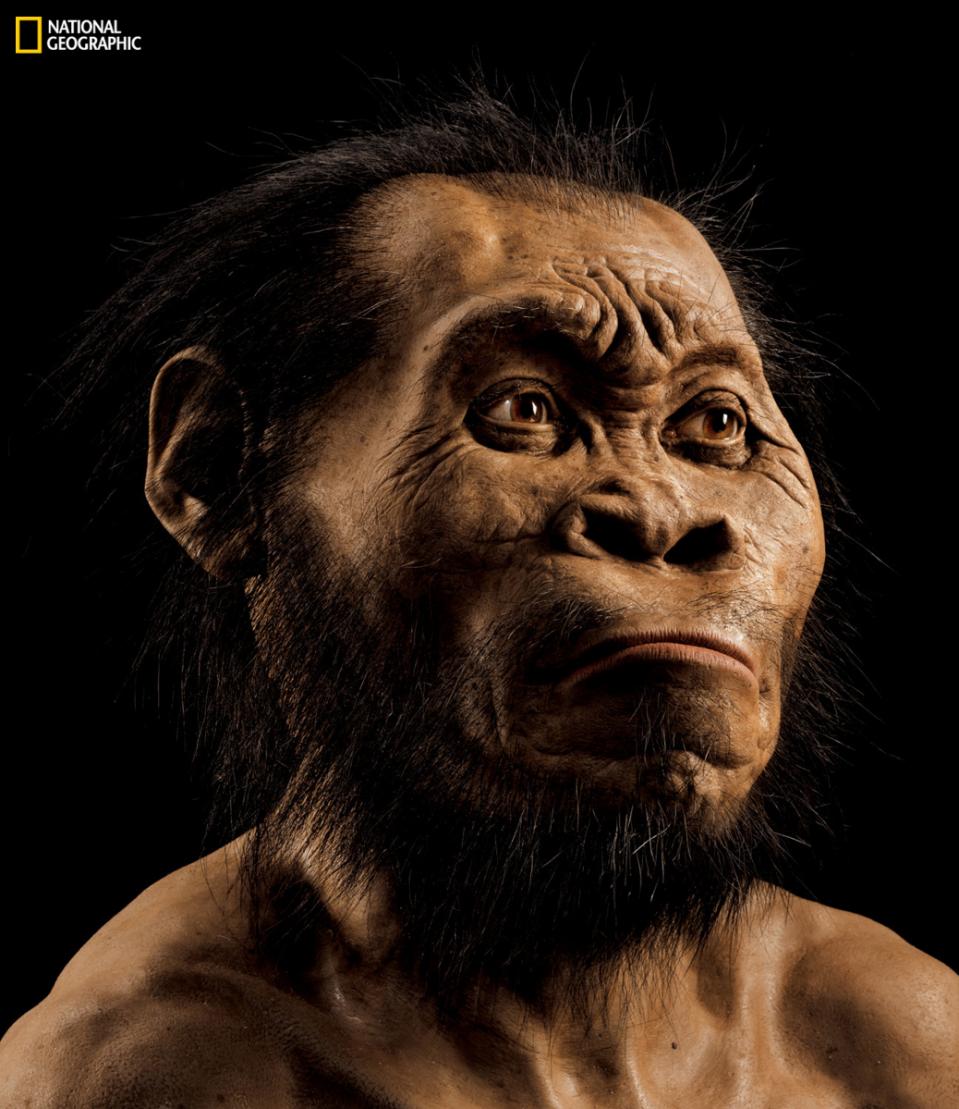
This March 2015 photo provided by National Geographic from their October 2015 issue shows a reconstruction of Homo naledi’s face by paleoartist John Gurche at his studio in Trumansburg, N.Y. In an announcement made Thursday, Sept. 10, 2015, scientists say fossils found deep in a South African cave revealed the new member of the human family tree. (Mark Thiessen/National Geographic via AP) IMAGE MUST INCLUDE NATIONAL GEOGRAPHIC LOGO; CROPPING NOT PERMITTED; MANDATORY CREDIT: “MARK THIESSEN/NATIONAL GEOGRAPHIC”
The discovery of a new hominin species in South Africa renews our interest in exploring origin of man. Each species breeds true to its own species and propagates genetic characteristics as per Mendel’s Laws of Inheritance. Our ability to identify a given species is possible because of reproductive history of each species. None of the members of prehuman family can descend into anatomically modern human species as there is no natural cause, there is no natural mechanism, there is no natural factor, there is no natural condition and there is no natural process that can account for such transformation of one species into a different kind of species.
A reconstruction of Homo naledi presented during the announcement made in Magaliesburg, South Africa, Thursday, Sept. 10, 2015. Scientists say theyve discovered a new member of the human family tree, revealed by a huge trove of bones in a barely accessible, pitch dark chamber of a cave in South Africa, showing a surprising mix of human like and more primitive characteristics. (AP Photo/Themba Hadebe)
Man’s arrival on planet Earth may have to be explained as a creative event until we can discover a natural operation that can change one species into another species.
THE DISCOVERY OF HOMO NALEDI – RISING STAR CAVE HOMININ IN SOUTH AFRICA. A COMPARISON OF HOMININ CRANIUM WITH THAT OF ANATOMICALLY MODERN HUMAN SKULL EXPLAINS THE DISBELIEF IN THEORY OF EVOLUTION.
Rudra Narasimham Rebbapragada Ann Arbor, MI 48104-4162, USA BHAVANAJAGAT.ORG
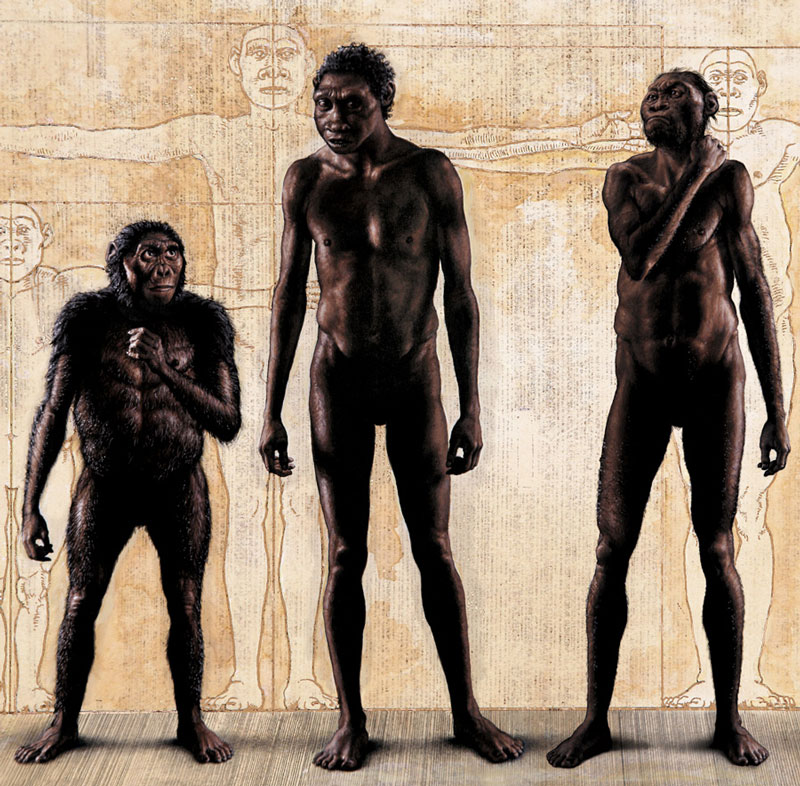
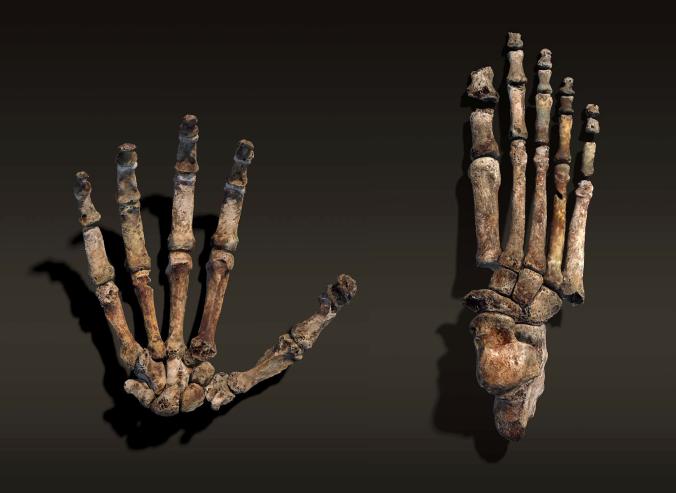
THE DISCOVERY OF HOMO NALEDI IN RISING STAR CAVE NEAR JOHANNESBURG, SOUTH AFRICA.THE DISCOVERY OF HOMO NALEDI IN SOUTH AFRICA. ARTISTIC RENDITION OF RISING STAR CAVE AND DINALEDI CHAMBER WHERE THE FOSSILS ARE DISCOVERED.THE DISCOVERY OF HOMO NALEDI. ARTISTIC DEPICTION OF HOMININS BURYING THEIR DEAD.THE DISCOVERY OF HOMO NALEDI, A NEW HOMININ SPECIES IN RISING STAR CAVE. CHART SHOWS A PLACE IN TIME FOR THIS RECENT DISCOVERY.THE DISCOVERY OF HOMO NALEDI. COMPARISON WITH OTHER SPECIES. 1. LUCY: Australopithecus afarensis, lived 3.2 million years ago, adult female, height 3 ft 8 in, weight 60-65 Lbs; TURKANA BOY: Homo erectus, lived 1.6 million years ago, adolescent male, height 5 ft, weight 110 – 115 Lbs; Homo naledi:Rising Star Hominin, male adult, height 4 ft 10 in, weight 100 – 110 Lbs.THE DISCOVERY OF HOMO NALEDI, A NEW HOMININ SPECIES. HANDS ASSEMBLED FROM IMAGES OF INDIVIDUAL FOSSIL BONES. HOMININ SHOWS ABILITY TO CLIMB WITH LONG, SLENDER FINGERS.
NEW SPECIES IN HUMAN LINEAGE IS FOUND IN A SOUTH AFRICAN CAVE
THE NEW YORK TIMES
By JOHN NOBLE WILFORD 14 hrs ago
A reconstruction of Homo naledi presented during the announcement made in Magaliesburg, South Africa, Thursday, Sept. 10, 2015. Scientists say theyve discovered a new member of the human family tree, revealed by a huge trove of bones in a barely accessible, pitch-dark chamber of a cave in South Africa, showing a surprising mix of human-like and more primitive characteristics. (AP Photo/Themba Hadebe)
The remains covered the earthen floor beyond the narrow opening. This was, the scientists concluded, a large, dark chamber for the dead of a previously unidentified species of the early human lineage — Homo naledi.
The new hominin species was announced on Thursday by an international team of more than 60 scientists led by Lee R. Berger, an American paleoanthropologist who is a professor of human evolution studies at the University of the Witwatersrand in Johannesburg. The species name, H. naledi, refers to the cave where the bones lay undisturbed for so long; “naledi” means “star” in the local Sesotho language.
In two papers published this week in the open-access journal eLife, the researchers said that the more than 1,550 fossil elements documenting the discovery constituted the largest sample for any hominin species in a single African site, and one of the largest anywhere in the world. Further, the scientists said, that sample is probably a small fraction of the fossils yet to be recovered from the chamber. So far the team has recovered parts of at least 15 individuals. “With almost every bone in the body represented multiple times, Homo naledi is already practically the best-known fossil member of our lineage,” Dr. Berger said.
Besides introducing a new member of the prehuman family, the discovery suggests that some early hominins intentionally deposited bodies of their dead in a remote and largely inaccessible cave chamber, a behavior previously considered limited to modern humans. Some of the scientists referred to the practice as a ritualized treatment of their dead, but by “ritual” they said they meant a deliberate and repeated practice, not necessarily a kind of religious rite.
“It’s very, very fascinating,” said Ian Tattersall, an authority on human evolution at the American Museum of Natural History in New York, who was not involved in the research. “No question there’s at least one new species here,” he added, “but there may be debate over the Homo designation, though the species is quite different from anything else we have seen.” A colleague of Dr. Tattersall’s at the museum, Eric Delson, who also is a professor at Lehman College of the City University of New York, was also impressed, saying, “Berger does it again!”
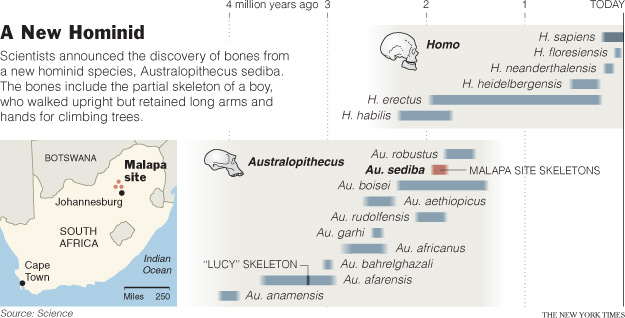
Dr. Delson was referring to Dr. Berger’s previous headline discovery, published in 2010, also involving cave deposits at the Cradle of Humankind site, 30 miles northwest of Johannesburg. He found many fewer fossils that time, but enough to conclude he was looking at a new species, which he named Australopithecus sediba. Geologists said the individuals lived 1.78 million to 1.95 million years ago, when australopithecines and early species of Homo were contemporaries.
Researchers analyzing the H. naledi fossils have not yet nailed down their age, which is difficult to measure because of the muddled chamber sediments and the absence of other fauna remains nearby. Some of its primitive anatomy, like a brain no larger than an average orange, Dr. Berger said, indicated that the species evolved near or at the root of the Homo genus, meaning it must be in excess of 2.5 million to 2.8 million years old. Geologists think the cave is no older than three million years.
The field work and two years of analysis for Dr. Berger’s latest discovery were supported by the University of the Witwatersrand, the National Geographic Society and the South African Department of Science and Technology/National Research Foundation. In addition to the journal articles, the findings will be featured in the October issue of National Geographic Magazine and in a two-hour NOVA/National Geographic documentary to air Wednesday on PBS.
Scientists on the discovery team and those not involved in the research noted the mosaic of contrasting anatomical features, including more modern-looking jaws and teeth and feet, that warrant the hominin’s placement as a species in the genus Homo, not Australopithecus, the genus that includes the famous Lucy species that lived 3.2 million years ago. The hands of the newly discovered specimens reminded some scientists of the earliest previously identified specimens of Homo habilis, who were apparently among the first tool makers.
At a news conference on Wednesday, John Hawks of the University of Wisconsin, Madison, a senior author of the paper describing the new species, said it was “unlike any other species seen before,” noting that a small skull with a brain one-third the size of modern human braincases was perched atop a very slender body. An average H. naledi was about five feet tall and weighed almost 100 pounds, he said.
Tracy Kivell of the University of Kent, in England, an associate of Dr. Berger’s team, was struck by H. naledi’s “extremely curved fingers, more curved than almost any other species of early hominin, which clearly demonstrates climbing capabilities.”
William Harcourt-Smith of Lehman College of the City University of New York, a researcher at the American Museum of Natural History, led the analysis of the feet of the new species, which he said are “virtually indistinguishable from those of modern humans.” These feet, combined with its long legs, suggest that H. naledi was well suited for upright long-distance walking, Dr. Harcourt-Smith said.
In an accompanying commentary in the journal, Chris Stringer, a paleoanthropologist at the Natural History Museum in London, found overall similarities between the new species and fossils from Dmanisi, in the former Soviet republic of Georgia, dated to about 1.8 million years ago. The Georgian specimens are usually assigned to an early variety of Homo erectus.
THE DISCOVERY OF HOMO NALEDI BY PALEOANTHROPOLOGIST LEE R BERGER. HE IS SEEN WITH HIS SON MATTHEW AT MALAPA SITE WHERE HE DISCOVERED AUSTRALOPITHECUS SEDIBA.THE SKULL OF RECENTLY DISCOVERED AUSTRALOPITHECUS SEDIBA AT MALAPA SITE IN SOUTH AFRICA.A NEW HOMINID SPECIES DISCOVERED IN SOUTH AFRICA. THE PLACE OF AUSTRALOPITHECUS SEDIBA IN TIME.
The discovery of new hominid species in South Africa. Homo.naledi.
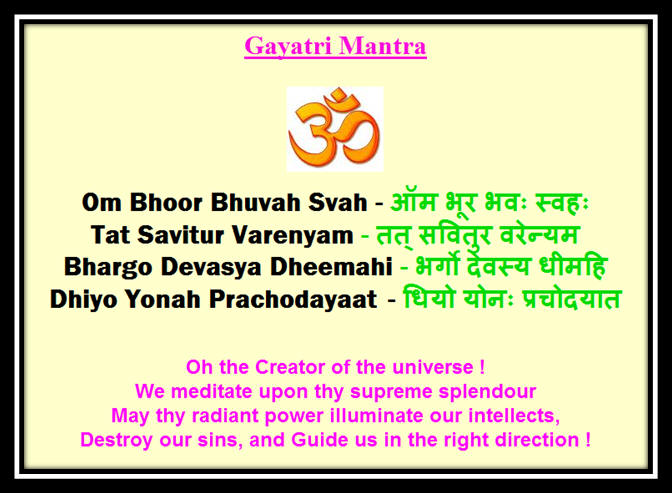
BHARAT DARSHAN – ILLUMINATION OF INTELLECT – GAYATRI MAHA MANTRA: DIVINE MOTHER GAYATRI. MOTHER OF MATTER, ENERGY, LIFE, CONSCIOUSNESS, INTELLIGENCE, AND KNOWLEDGE.
What is Intelligence?
Intelligence is the cognitive or knowing component that is distinct from affective (emotional), or motivational (drive) components of human behavior. Intelligence includes over 120 specific abilities, highly varied although overlapping skills, and does not describe a single faculty. Many people view Intelligence as a faculty possessed by higher organisms that have abilities of perception, cognition, responsiveness, communication, awareness, and consciousness for they associate intelligence with specialized functions performed by nervous system and organs like brain. However, such a view of intelligence as a mental function or neurological function is not a comprehensive view. Biology is about studying cells as blocks of life and knowing life at the molecular level. Cognitive Science is giving attention to cognitive abilities of living cells, and cells use molecules to identify other living cells, use the cognitive ability to identify molecules with which they interact. Viruses, bacteria, and protozoa (unicellular organisms like the Malarial parasite) have cognitive abilities, have memory power, acquire knowledge, possess knowledge, and use knowledge to adapt to changing external environmental conditions. In other words, they behave like ‘intelligent’ living entities. We cannot ignore their ‘intelligence’ as it poses a direct challenge to human existence. Millions of human beings lost their lives prematurely because of these simple organisms that use knowledge and information to evade detection and to defeat immunological system that keeps body under constant surveillance to defend it from foreign pathogens or disease-causing agents. While ‘AIDS’ virus alone killed millions of people all over the world, man is still trying his best to fight this virus making a huge effort that involves both time, money, and careful research. Viruses, bacteria, and parasites causing diseases like Malaria acquire drug resistance for they have the ability to recognize these chemical molecules that block their living functions or metabolic pathways. Millions have perished in epidemics caused by influenza and others while vaccines or immunization may provide some relief. Even in the best of hospitals all over the world, patients are dying on account of drug-resistant pathogens or infections which have no easy treatment as they overwhelm body’s protective mechanisms.
Non-living matter has no intelligence. Intelligence exists in all living entities. Physical systems do not apply intelligence in their own operations unless the system is designed by an intelligent entity. For that reason, intelligence has to be viewed as ability to exploit Laws of Natural Science for material benefit of the living, intelligent entity.
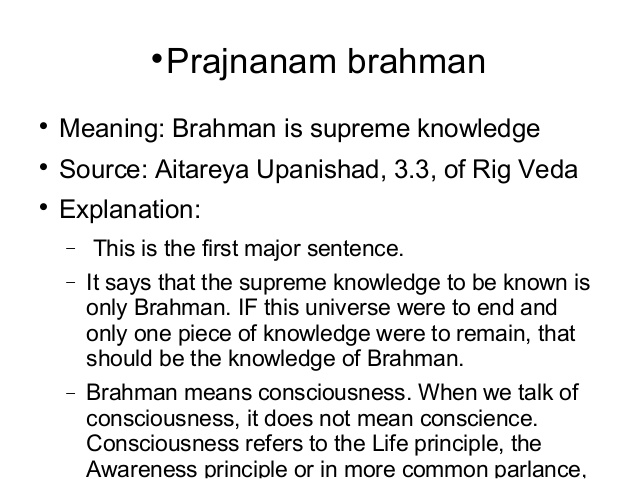
BHARAT DARSHAN – ILLUMINATION OF INTELLECT – GAYATRI MAHA MANTRA. AITAREYA UPANISHAD. SOURCE OF SUPREME KNOWLEDGE. PRAJNANAM.
Indian tradition guides us to think of ‘intelligence’ as a special ability imparted by God to help the living entities to exist by exploiting matter, energy, and other living things present in external environment. The concern is about the ‘source’ or ’cause’ of this intelligence. All of us can view these viruses, bacteria, and protozoa using instruments like microscopes. When you view and obtain photo images, you cannot find any kind of material evidence to suggest that they may have intelligence. But, we have to realize that the most common cause of death in old age is not that of deterioration caused by the aging process. Most elderly simply die on account of infections like pneumonia that compromises vital function like respiration.
BHARAT DARSHAN – ILLUMINATION OF INTELLECT – GAYATRI MAHA MANTRA. DIVINE SOURCE OF LIFE, MATTER, ENERGY, CONSCIOUSNESS, INTELLECT, KNOWLEDGE, AND WISDOM. MAN’S INHERITANCE FROM DIVINE MOTHER.
In my understanding, Gayatri Maha Mantra invokes the blessings of LORD GOD Creator (“SAVITA”), the source of Knowledge and Intelligence implanted or innate to the living entities. Gayatri Mantra can be used day and night, at any time, as man’s existence faces constant challenges from both known and unknown directions at any given instant. A healthy brain, healthy neurological system boosts up man’s immune system and keeps it vigilant and energetic at all times. I would recommend seeking the blessings of Gayatri Mantra before going to sleep as man cannot avoid night and the activity called resting period. As you all know, there is no Sunrise, there is no Sunset, and Sun or “Savitur” shines at all times with about the same intensity. Sunrise and Sunset are phenomena caused by a powerful influence called ‘grand illusion’ or ‘MAYA’. Reflecting, meditating, remembering, or chanting of Gayatri Mantra transcends the influence of illusion that obstructs man’s perception of his source of Knowledge and Intelligence.
WHAT IS INNATE KNOWLEDGE?
BHARAT DARSHAN – ILLUMINATION OF INTELLECT – GAYATRI MAHA MANTRA. VIEW OF AITAREYA UPANISHAD.
Knowledge is of two kinds; 1. Innate Knowledge, and 2. Acquired or Learned Knowledge. Our concern is not about acquired or learned knowledge which involves a learning process, a knowing process, a cognitive process to process new information. In Science, biological information or genetic information is thought of ‘Innate Knowledge’ as living things primarily depend upon this source of information to perform guided, sequential, goal-oriented, and purposeful actions. Similarly all actions or behavior exhibited by living things are of two kinds; 1. Innate Behavior, and 2. Acquired Behavior.
BHARAT DARSHAN – ILLUMINATION OF INTELLECT – GAYATRI MAHA MANTRA – CONSCIOUSNESS IS OPERATION OF INNATE KNOWLEDGE.
The most important characteristic that helps to make distinction between living and non-living, or between animate and inanimate is called ‘consciousness’ or ‘chetana in Sanskrit language. There is a fundamental dualism as matter can be sensible or insensible. Consciousness is a biological function, a living function by which a living entity knows the fact of its own living condition separated from an external environment. The knowledge that imparts ‘consciousness’ is not the same as genetic information inherited by transmission of hereditary characteristics. Genetic or biological information is species-specific and during reproduction, each species breeds true to its own species as per the Law of Biogenesis. Consciousness is a characteristic shared by all living things or is common to all living beings. Consciousness originates because of ‘implanted knowledge’ and it can be described as, maternal inheritance or cytoplasmic inheritance that is not related to genes or chromosomes.
BHARAT DARSHAN – ILLUMINATION OF INTELLECT – GAYATRI MAHA MANTRA. AITAREYA UPANISHAD MAHAVAKYA OR UPANISHADIC STATEMENT ABOUT SOURCE OF KNOWLEDGE.
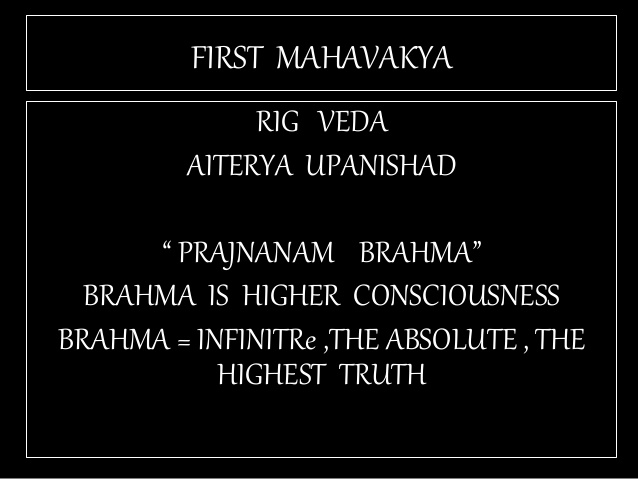
Kindly reflect on these two verses from ‘Aitareya Upanishad'( Commentary on Rig Veda) and its statement, “PRAJNANAM BRAHMA.”
Ye nekshate sruno teedam, jighrati vyakaroti ca Swadva Swadu vijaanati, tat Prajnana mudeeritam.
Chaturmukhendra Deveshu, Manushya asva gava deshuh Chaitanya me ekam Brahma tah, Prajnanam Brahma mayyapi.
‘Atman’, Spirit, or Soul is associated with this biological function called ‘consciousness’ or ‘CHETANA’ and makes the difference between life and death. In common practice, we announce the fact of physical death as ‘soul departed’. When a man or a living entity dies, we can always diagnose the fact of death by scientific observation and tests and issue death certificate without any doubt. Even when a person is unconscious or in deep coma, still we can recognize the difference between life and death by conducting tests and eliciting conscious, reflex actions.
Gayatri Maha Mantra gives an opportunity to explore the Divine Source of Energy, Force, or Power that is manifested as Life, Consciousness, Intelligence and Knowledge, characteristic possessions of Living entities.
Rudra Narasimham Rebbapragada, Ann Arbor, MI, USA 48104-4162. BHAVANAJAGAT.ORG
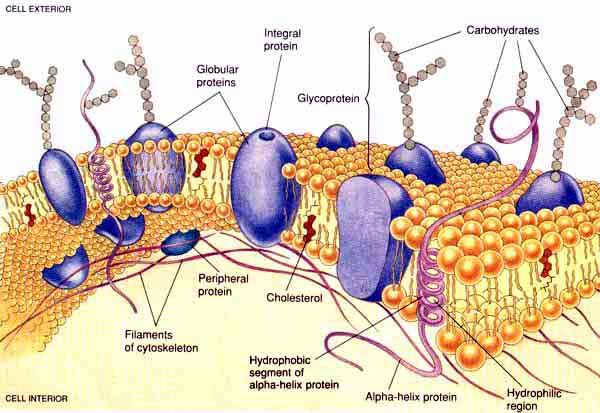
Bharat Darshan – Illumination of Intellect – Gayatri Maha Mantra – Divine Providence – Divine Blessings.Bharat Darshan – Illumination of Intellect – Gayatri Maha Mantra. Source of Life.Bharat Darshan – Illumination of Intellect – Gayatri Maha Mantra – Source of Intelligence.Bharat Darshan – Illumination of Intellect – Gayatri Maha Mantra – Source of Knowledge.BHARAT DARSHAN – ILLUMINATION OF INTELLECT – GAYATRI MAHA MANTRA.Bharat Darshan – Illumination of Intellect – Gayatri Maha Mantra – Time for MeditationLiving cells have a corporeal substance called Protoplasm that has the ability of Spiritual Biotic Interactions. The Biological Membrane or Cell Membrane separates the cell from its environment and other living cells present in the environment. Cells use unique proteins, biological molecules and receptor sites to recognize the other living cells and use chemical signals to facilitate the interactions. Such interactions between living cells have the characteristics of consciousness or awareness.
यो मां पश्यती सर्वत्र सर्वं च: मयि पश्यती तस्याहम न प्रणश्यामी स: च मे न प्रणश्यति
“He who sees me everywhere, and sees everything in Me, he never gets separated from Me, nor do I get separated from him” -Bhagwat Geetha Ch. VI verse 30
7 IAS Officers Who Paid A Tough Price For Being Honest & Fighting Corruption
Shubhi DixitAug 31 “Honesty is the best policy.” We have grown up learning this from our elders. Moral science, if you may. However, in the present world, picking one side from black and white is not feasible. Most of us live in the shades of grey. Why? Because we are practical people who would not risk our lives going in the extremes. Unlike most of us, the ones who decide to tread the path of honesty saw a tough time. They are smart, intelligent, and educated people. Yet in the real world, it takes more than that to be able to bring a change. Especially when the ones you are fighting are the ones who are supposed to be on your side. Here’s a story of 7 IAS officers, stood for a cause, fought the system, and ended up paying a tough price themselves:
1. Durga Shakti Nagpal
BHARAT DARSHAN – SONS AND DAUGHTERS OF INDIA: DURGA SHAKTI NAGPAL, IAS.,
DURGA SHAKTI NAGPAL, IAS.,
This 28-year-old’s name made a frequent appearance in the news channels in the year 2013. Sadly it was not for the good work that she was doing as a Sub-divisional Magistrate in Uttar Pradesh, but for her stern actions taken against sand mining in the banks of river Yamuna. According to a news report by Mid-day, her crackdown on sand mining was a setback for some political leaders in UP. As a result she was suspended on the grounds that she demolished a mosque wall leading to communal violence. However, no violence was reported in the region. Later, as reported by TOI, her husband Abhishek Singh, who was the SDM in Mathura district, was suspended for inhuman treatment of a subordinate. No details were given in the case. After a series of nation-wide protests and criticization of Akhilesh Yadav government, Durga’s suspension was revoked. She has no been given a ‘harmless’ position as a ‘Officer on Special Duty’ in the agriculture department.
2. DK Ravi
BHARAT DARSHAN – SONS AND DAUGHTERS OF MOTHER INDIA: D K RAVI, IAS.,
D K RAVI, IAS.,
This IAS officer lived the life Bollywood base their heroes on. Firstpost reports that while he was stationed at Kolar in Karnataka, he was widely popular among the people for being available for them 24×7. He helped them resolve their problems and even participated in their folk festivals. He put a curb on the illegal sand mining that happened in the area and very soon he was transferred to Bengaluru. Since he was more popular in Kolar than many local politicians there, appeals were made to cancel his transfer. While being stationed in Bengaluru, he detected service tax evasion worth Rs 120 crores by many renowned firms. As soon as the news broke out, it is said that he committed suicide. Since there was no motive for this happy-go-lucky officer to end his life, it is being questioned that he was murdered. But who was behind it is still a mystery?
3. Ashok Khemka
BHARAT DARSHAN – SONS AND DAUGHTERS OF INDIA: ASHOK KHEMKA, IAS.,
ASHOK KHEMKA, IAS.,
His good work has earned him the title of a whistleblower officer. You decide if it is a compliment or an insult. His name became a favorite with the news channels after he his efforts lead to cancellation of an illegal deal between Sonia Gandhi’s son-in-law, Robert Vadra and DLF. Firstpost reports that soon after the fishy activities were brought into the news, he was transferred from his department to the transport department. Recently in April, he has again been transferred from the transport department to the department of archaeology and museums. Even though he was transferred in just 128 days, the officials called it a ‘routine exercise.’ Till date, he has been transferred 45 times in 23 years. He was supported by politicians from various political parties such as Anil Vij from BJP and Dushyant Chautala from INLD though later it became clear that they were just making him a pawn in their political games. Ashok Khemka tweeted after his last transfer saying, “tried hard to address corruption and bring reforms in transport despite severe limitations and entrenched interests. Moment is truly painful.”
4. Yashwanth Sonwane
BHARAT DARSHAN – SONS AND DAUGHTERS OF MOTHER INDIA: YASHWANTH SONWANE, IAS.,
YASHWANTH SONWANE, IAS.,
Being posted as the Additional District Collector in Malegaon, Maharashtra, Yashwanth Sonwane did his level best curb illegal activities and corruption. Conducting 200 raids in under a week, he counterfeited 180 cases of oil smuggling and adulteration. NDTV reports that he was burnt alive by an oil mafia ally named Popat Shinde in Manmad, Maharashtra. Shinde was reportedly working with the oil mafia for over 30 years and Sonwane’s action were causing him and his allies major losses. Before his death, Sonwane had seized 4,000 litres of kerosene and 3,000 litres of petrol from Shinde’s dhaba. Sadly, the price that he had to pay for his honesty and good work was his own life.
5. Shanmugan Manjunath
BHARAT DARSHAN – SONS AND DAUGHTERS OF INDIA: SHANMUGAM MANJUNATH, IAS.,
SHANMUGAM MANJUNATH, IAS.,
Like Yashwant, Manjunath who was an IIM graduate also had to face death in his fight against the corrupt. He was an officer with Indian Oil Corporation (IOC) and was stationed in Lucknow, UP. He had sealed a petrol pump in Lakhimpur Kheri in UP for selling adulterated petrol. After a month when the pump was functional again, he paid a surprise visit to the pump and was shot dead on the spot with 6 bullets. The Hindu reports that the main culprit Monu Mittal was given the death penalty while 7 others who were involved were punished with a life sentence. A trust was also set up in his name by the IIM students and IOC compensated his family with Rs 2.6 millions. However, no amount of money or punishment can bring back an honest officer who lost his life for just doing his job.
6. Muggdha Sinha
BHARAT DARSHAN – SONS AND DAUGHTERS OF MOTHER INDIA: MUGGDHA SINHA, IAS.,
MUGGDHA SINHA, IAS.,
India Today reports that Muggdha Sinha, who was the first woman collector of Jhunjhunu district in Rajasthan, was transferred because of the actions she took against the local mafia. During her tenure in Rajasthan which only lasted till September 2010, she soon became a favorite among the locals. She was like a saviour for them. After her transfer people came out in huge support to revoke her transfer but it did not happen. She later joined as Ganganagar collector. While departing, she left with the statement, “I had not come to the district for serving a select few, but the common man. If this had annoyed the powers that be, I couldn’t help it.”
7. Samit Sharma
BHARAT DARSHAN – SONS AND DAUGHTERS OF MOTHER INDIA:SAMIT SHARMA, IAS.,
SAMIT SHARMA, IAS.,
Samit Sharma is a well-respected man in Rajasthan. He is known as an honest officer among his colleagues and the public. India Today reports that in spite of his good image, he was shunted out in from the post of collector of Chittorgarh in 2010 over a trivial issue. He was asked to fire his clerk who failed to stand up when a Congress MLA entered the office. As a result, he was asked to fire the clerk which he refused to do. As many as 12,000 people went on a mass leave to protest against this government action but the government was callous over the issue and nothing changed. Later in a shuffling that took place in 2014, he was appointed as Commissioner in Invest Bureau, in Rajasthan. Just because their journeys were tough, doesn’t mean we lose hope and leave the cause. If we all give up, nothing is ever going to improve. If you want to bring about a change, learn from their mistakes, and make them proud by doing something they fought for.
As they say, “be the change you want to be.” Geetha Ch. VI verse 30
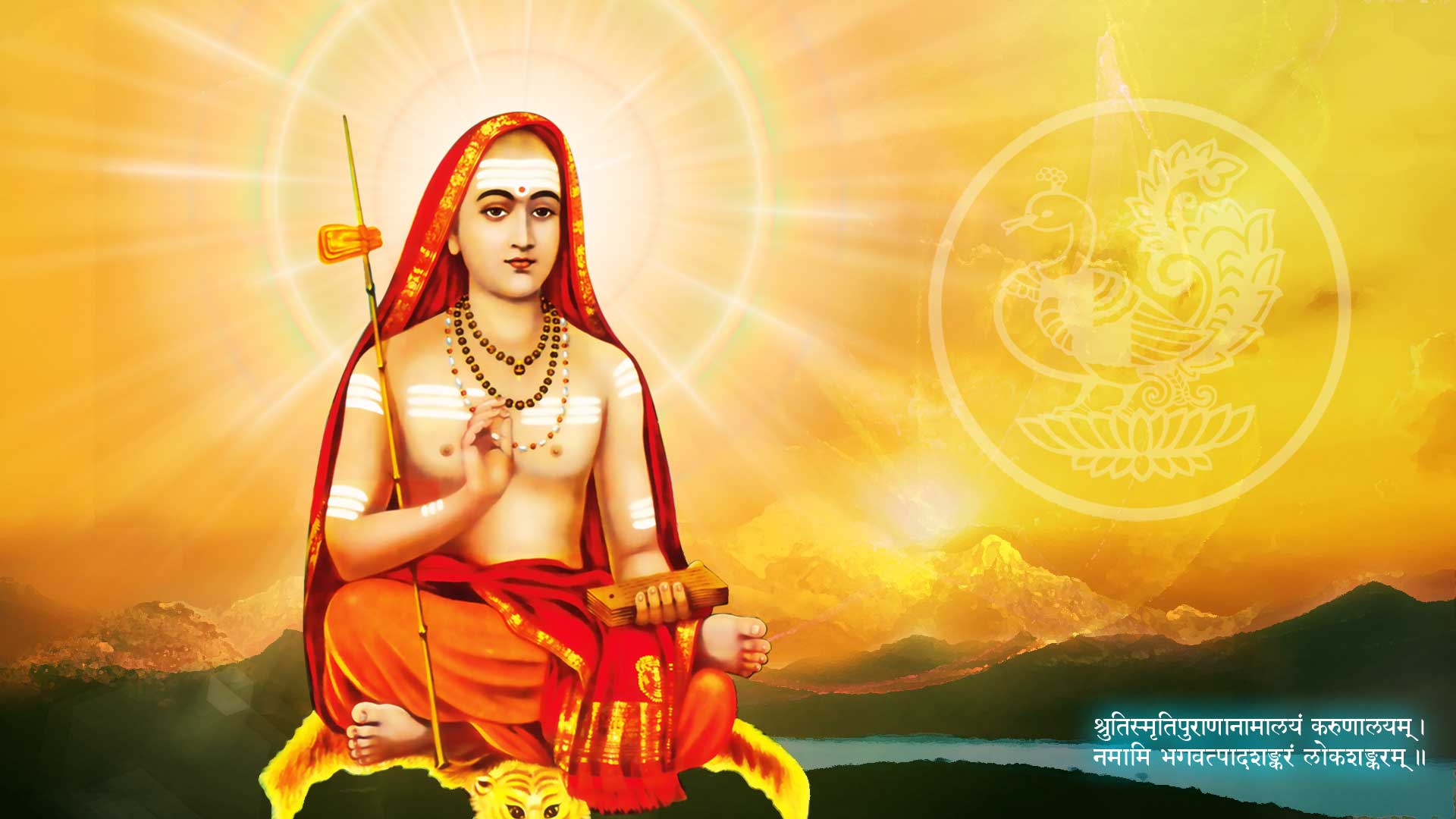
BHARAT DARSHAN – THREE GREAT TEACHERS OF INDIA: ADI SHANKARACHARYA(c.788 – c.820), EXPONENT OF ‘ADVAITA’ OR NON-DUALISM. MAN EXISTS ON EARTH UNDER POWERFUL INFLUENCE CALLED MAYA OR GRAND ILLUSION.
There are three Indian Schools of Thought that share Vedic Wisdom and its practical applications in daily life. Adi Shankaracharya(c.788 – c.820), Ramanujacharya(c.1017 – c.1137), and Madhvacharya(c.1199 – c.1278) shared these Vedic truths derived from studying the same source materials like Vedas, Upanishads, Gita, and others. Shankara, exponent of ‘Advaita’ or Non-Dualism described The Theory of Maya or Grand Illusion, giving attention to true or real identity of man; an unchanging, immutable, immortal, eternal, and unborn reality that establishes human existence while the human being leads a mortal, transient existence depending on a body that undergoes change in appearance almost every day but for purposes of convenience is divided into three stages like childhood, adulthood, and old age. Shankara claims, in a changing world with natural phenomena, there is an unchanging principle governing all changing phenomena. Shankara describes the truth called “Grand Illusion” and explained the problem of transcending that illusion while man is afraid of his mortal existence and clings to illusion for reality seems to be overwhelming.
BHARAT DARSHAN – THREE GREAT TEACHERS OF INDIA: RAMANUJACHARYA(c.1017 – c.1137), EXPONENT OF ‘VISISHTADVAITA’ OR MODIFIED NON-DUALISM FORMULATED RATIONAL BASIS TO WORSHIP ‘PERSONAL GOD’ WITH DEVOTION. GOD CREATED MAN AS AN INDIVIDUAL WITH INDIVIDUALITY AND MAN CAN NEVER CEASE TO BE AN INDIVIDUAL.
Ramanuja, exponent of ‘Visishtadvaita’ or Qualified Non-Dualism, while accepting man’s true identity as described by Shankara, he shows a path to transcend the barrier imposed by grand illusion; the path of devotion to seek union with a personal God. In his analysis, Ramanuja says, God is modified by the orders of Matter and Soul, just like the Soul or Spirit that gets modified because of its association with a living body. For man always exists as a specific Individual with Individuality with no other choice, and for man has no ability to get away from being an Individual with Individuality, God becomes modified into a Personal God. Even if six or more billion human beings choose to worship the same God, that God can only be known or experienced as personal God for man has only subjective experience of his existence while the objective experience of his existence is constantly changing under the external influences of time and space.
BHARAT DARSHAN – THREE GREAT TEACHERS OF INDIA: MADHVACHARYA(c.1199 – c.1278), EXPONENT OF ‘DVAITA’ OR DUALISM. MAN’S CONDITIONED EXISTENCE LEAVES NO ALTERNATIVES. MAN IS FREE TO SURRENDER HIMSELF TO SEEK GOD’S REFUGE.
Madhva, exponent of ‘Dvaita’ or Dualism describes the five fundamental distinctions required for maintaining any existence. Every living entity has to separate itself from its surrounding matter and environment to perform its own living functions. There is no existence without this separation between animate and animate, and between animate and inanimate. At the same time Madhva maintains that transient and changing things are real. He goes further giving detailed reasoning as to why man has to surrender to the Supreme Being with no concern for finding or exploring some ultimate Truth. Man cannot save himself by discovering truth or reality, rather the truth and reality of man’s conditioned existence and world direct man to seek divine refuge or protection. Neither Coherence Theory of Truth, or Correspondence Theory of Truth formulate fundamental basis for human existence that gives man his subjective and objective experience of his living condition called “BEING.” Man literally has no choice other than surrendering himself and ask for protection, shelter, or take refuge described in Sanskrit as “SARANU.”
BHARAT DARSHAN – THREE GREAT TEACHERS OF INDIA: AGING IS AN ETERNAL LAW. MAN EXISTS AS IF THE BODILY FUNCTIONS ARE OPERATED BY A VERY PRECISE TIMING MECHANISM. THE BIOLOGICAL CLOCK OPERATES THE BIO OR BIOLOGICAL RHYTHM THAT OSCILLATES WITH A PERIOD OF ABOUT 24 HOURS.
The truths or facts shared by man’s scientific discoveries cannot overcome the problem of man’s mortal existence. My essence, my ideas, my thoughts, my feelings, my imagination, and my knowing any kind of truth will be possible if and only if “I” exists as “I AM” and not as “I WAS” an entity that ceased its existence.
BHARAT DARSHAN – THREE GREAT TEACHERS OF INDIA: PENCIL IN WATER ILLUSION. MAN CAN NEVER OVERCOME THE POWERFUL INFLUENCE CALLED MAYA OR GRAND ILLUSION THAT OPERATES SUBJECTIVE AND OBJECTIVE EXPERIENCE OF PHYSICAL EXISTENCE.
Science uses precise instruments to gather data, to make observations, and to verify information using experimental models. We are able to use this scientific method of inquiry as our tools, our instruments, and the scientific observer do not experience reality of Earth’s angular, or linear velocity. As such, man and instruments placed on planet Earth do not have ability to overcome the power of Fundamental Force called Gravitation. Man is able to think, imagine, and explore himself and this world and universe for he has unknowingly submitted himself to an authority that governs his physical existence at any given instant in time and space. This nature of man’s conditioned experience can be experimentally verified by conducting a simple experiment in Physics called ‘Pencil in Water’ optical illusion. The pencil appears bent at the interphase of air and water as man cannot overcome power of fundamental force called ‘LIGHT'(or electromagnetic radiation). While man has ability to manipulate the conditioned existence of pencil, remove it from water and verify truth about that pencil, he has no such ability to remove himself from his conditioned existence. Kindly tell me as to what will you do with truth if you know the truth. It is nice to know the rules of grammar, but it will not save man from predicament of mortal existence and Shankara aptly observed, “Nahi Nahi Rakshati Drukun karane.” Nothing can save man as scientific knowledge confirms that man cannot rule or govern cells of his own body for they are independent and enjoy functional autonomy.
BHARAT DARSHAN – THREE GREAT TEACHERS OF INDIA: IN SHANKARA’S ANALYSIS, MAN IS NOT SAVED BY ACQUIRED KNOWLEDGE. MAN CANNOT DIRECTLY RULE OR GOVERN HIS OWN BODY FOR CELLS ARE INDEPENDENT AND ENJOY CELLULAR AUTONOMY.
Rudranarasimham Rebbapragada Ann Arbor, MI 48104-4162, USA BHAVANAJAGAT.ORG
BHARAT DARSHAN – INDIA’S FIRST COMPUTER DEVELOPED AT TATA INSTITUTE OF FUNDAMENTAL RESEARCH, BOMBAY, MUMBAI. A TRIBUTE TO DR HOMI JEHANGIR BHABHA AND HIS TEAM.
I am pleased to share a very brief story about the development of Computer Technology in India and use this opportunity to pay my very respectful tribute to Dr. Homi Jehangir Bhabha who provided leadership in developing India’s capability in Nuclear Science, Electronics Technology, and a variety of allied fields. Under Dr. Bhabha’s eminent leadership, Tata Institute of Fundamental Research (TIFR) added Computer Section as part of its Electronics Instrumentation Group by 1955.
BHARAT DARSHAN – INDIA’S FIRST COMPUTER : INDIA’S FIRST ELECTRONIC, DIGITAL COMPUTER WAS DESIGNED AND BUILT BY A TEAM HEADED BY PROFESSOR R. NARASIMHAN, AND DR. PVS RAO AND OTHERS WORKING AT TATA INSTITUTE OF FUNDAMENTAL RESEARCH (TIFR).
Professor PVS Rao shared with me the story about designing and building India’s first electronic, and digital computer by a team headed by Professor. R. Narasimhan at TIFR’s Electronics Instrumentation Group. The building of India’s first computer is a very significant milestone in India’s development in the field of Electronics to make the country self-reliant. The team initiated work during 1955 putting together several tens of thousands of individual components such as resistors, capacitors, vacuum tubes, and making wire connections. India’s first Prime Minister Jawaharlal Nehru visited TIFR during 1960 and named the computer as ‘Tata Institute of Fundamental Research Automatic Calculator (TIFRAC).
BHARAT DARSHAN – INDIA’S FIRST COMPUTER. INDIA’S FIRST PRIME MINISTER JAWAHARLAL NEHRU DURING 1960 VISITED TIFR AND NAMED INDIA’S FIRST COMPUTER AS “TIFRAC.”
At TIFR, under Director Professor. B V Sreekantan, a team headed by Professor PVS Rao developed India’s Air Defence Data Handling System (Air Defence Ground Environment System or ADGES) under a plan initiated by Prime Minister Indira Gandhi who insisted upon India’s self-reliance in this aspect of using technology to defend India. In this monumental task, 50 scientists, engineers and 70 Air Force Officers worked together. While TIFR played the lead role, work was carried out by Bhabha Atomic Research Center (BARC), Air Force Simulation Center, Electronics Corporation of India Ltd (ECIL), Electronics and Radar Development Establishment (LRDE), and Tata Electric Companies (TEC). I am pleased to post some photo images of events at TIFR associated with the development of India’s Air Defence Ground Environment System or ADGES.
BHARAT DARSHAN – INDIA’S FIRST COMPUTER. AT ‘TIFR’, PROFESSOR PVS RAO WELCOMED INDIAN AIR CHIEF MEHTA WHO CAME TO DISCUSS THE DEVELOPMENT OF AIR DEFENCE DATA HANDLING SYSTEM (Air Defence Ground Environment System or ADGES).BHARAT DARSHAN – INDIA’S FIRST COMPUTER. AT ‘TIFR’, DR. PVS RAO ( SECOND FROM LEFT, SEATED ON A SOFA FACING THE CAMERA) HELD DISCUSSIONS WITH INDIAN AIR CHIEF MEHTA TO DEVELOP INDIA’S AIR DEFENCE DATA HANDLING SYSTEM (Air Defence Ground Environment System or ADGES).
I am pleased to add a few photo images of staff members who worked at Tata Institute of Fundamental Research (TIFR) as part of a team that developed India’s Air Defence Data Handling System (Air Defence Ground Environment System or ADGES). My hearty congratulations to Professor PVS Rao and all others who developed India’s Air Defence Data Handling System ‘ADGES’ at TIFR.
BHARAT DARSHAN – INDIA’S FIRST COMPUTER “TIFRAC” DESIGNED AND DEVELOPED AT TIFR. INDIA’S EDUCATION MINISTER M C CHAGLA VISITED TIFR. PROFESSOR PVS RAO, DEPUTY DIRECTOR MENON GK AND OTHERS ARE SEEN IN THIS PHOTO.BHARAT DARSHAN – INDIA’S FIRST COMPUTER DEVELOPED AT ‘TIFR’. THIS GROUP IS IDENTIFIED AS TIFR ‘ADGES’ (AIR DEFENCE GROUND ENVIRONMENT SYSTEM) CONSOLES TEAM. MY HEARTY CONGRATULATIONS TO ALL OF THEM WHO HELPED DEVELOPMENT OF AIR DEFENCE SYSTEM.BHARAT DARSHAN – INDIA’S FIRST COMPUTER DEVELOPED AT ‘TIFR’. THIS TEAM IS IDENTIFIED AS TIFR ADGES (AIR DEFENCE GROUND ENVIRONMENT SYSTEM) SELENIA CONSOLE TEAM. MY HEARTY CONGRATULATIONS TO ALL OF THEM.
At Bhavanajagat.Org, I define Life as Knowledge in Action. The essence of life is about using information in performance of living functions. Human organism is a complex system that receives information, processes information, stores information, retrieves information to perform guided, goal-oriented, purposive, sequential actions. Even if spend my lifetime, I will not be able to list all the functions my human body performs to keep me alive. I appreciate the development of Computer Technology for it helps us to use and handle information with great efficiency.
WHAT IS CREATION? THE RECENT DISCOVERY OF EXOPLANET KEPLER – 452b STIMULATES INTEREST ABOUT KNOWING ORIGIN OF PLANETS AND THE BEGINNING OF THIS UNIVERSE.
The search for another planet that is similar to planet Earth calls for understanding the term ‘creation’. In my view, a created object is original, unique, distinctive, and one of its own kind of object that may not be replicated either using a spontaneous process, or by a deliberate, purposive action. Planet Earth qualifies as a created, original, unique, distinctive, and one of its own kind of object and there is no second celestial object similar to Earth. The recent discovery of Kepler – 452b exoplanet has stimulated interest in possibility of finding a second Earth-like planet in our vast universe. Earth is the fifth largest planet of the Solar System and the only one known to support life. Earth is surrounded by an envelope of gases, mostly oxygen, nitrogen, and water vapor, called the atmosphere. Gravitational forces have molded Earth into a spherical shape that bulges at the equator. Earth’s equatorial diameter is 7,926 miles or 12,760 Km; polar diameter is 7,900 miles or 12,720 Km. Earth is unique for its inhabitants experience the change of seasons caused by tilt(23.5 degrees) of Earth’s equator to the plane of its orbit.
WHAT IS CREATION? PLANET EARTH IS A CREATED, CELESTIAL OBJECT FOR ITS PERIOD OF ROTATION, AND PERIOD OF REVOLUTION ARE ITS ORIGINAL CHARACTERISTICS NOT SHARED BY ANY OTHER PLANET.
Among celestial objects, stars are luminous and planets such as Mercury, Venus, Earth, Mars, Jupiter, Saturn, Uranus, Neptune, and Pluto are nonluminous and revolve around Sun or around another star. The other terrestrial planets of Solar System, Mercury, Venus, Mars, and Pluto resemble Earth in size, chemical composition, and density. The ‘Jovian’ planets of Solar System, Jupiter, Saturn, Uranus, and Neptune are much larger in size and have thick gaseous atmospheres and low densities.
WHAT IS CREATION? PLANETS OF OUR SOLAR SYSTEM BEHAVE AS INDIVIDUALS WITH INDIVIDUALITY. NO TWO PLANETS ARE ALIKE WHILE THEY MAY SHARE A COMMON BEGINNING.
WHAT IS CREATION? THE MOTIONS OF PLANETS DESCRIBE THEIR INDIVIDUALISTIC BEHAVIORS. I INVITE READERS’ ATTENTION TO ORBITAL PERIOD AND ROTATIONAL PERIOD OF PLANETS OF SOLAR SYSTEM.
Individuality of each celestial object becomes discernible while studying period of revolution and period of rotation. The planets of Solar System may have shared their births from a same source called ‘gaseous nebula’ and yet they display individualistic variations in the characteristics of motions performed. Man’s life and experience of life is synchronized with Earth’s period of rotation around its own axis, and Earth’s revolution around Sun.
What is Creation? Man’s lifetime or lifespan reflects operation of a precise Biological Clock that operates various living functions and synchronizing them with variations in external environment such as Day, and Night.
Man exists as a mortal being with lifespan or lifetime as his living functions are operated and are regulated by a precise timing device called ‘Biological Clock’ which may be responsive to changes in external environment such as day, and night. For each planet has its own period of rotation and revolution, the living experience of man can never be the same on different planets even if they have some ability to support some forms of life. Man is a created being for his existence require Earth’s rotational speed, and revolutionary speed to operate changes of intensity of external environmental light illumination while Sun shines all the time.
Rudranarasimham Rebbapragada Ann Arbor, MI 48104-4162, USA Bhavanajagat.org
Bhavanajagat.orgBhavanaJagat is a private organization devoted to the study of man’s status in Nature. The purpose…
Kepler-452b may be Earth’s close cousin, but living on the newfound world would still be an alien experience. A group of pioneers magically transported to the surface of Kepler – 452b — which is the closest thing to an “Earth twin” yet discovered, researchers announced yesterday (July 23) — would instantly realize they weren’t on their home planet anymore. (And magic, or some sort of warp drive, must be invoked for such a journey, since Kepler-452b lies 1,400 light-years away.)
Kepler-452 is 60 percent wider than Earth and probably about five times more massive, so its surface gravity is considerably stronger than the pull people are used to here. Any hypothetical explorers would thus feel about twice as heavy on the alien world as they do on Earth, researchers said. “It might be quite challenging at first,” Jon Jenkins, of NASA’s Ames Research Center in Moffett Field, California, said during a news conference yesterday. Jenkins is data analysis lead for the space agency’s Kepler spacecraft, which discovered Kepler-452b.
But visitors to the exoplanet would probably be able to meet that challenge, said former astronaut John Grunsfeld, associate administrator of NASA’s Science Mission Directorate. After all, he said, firefighters and backpackers routinely carry heavy loads, mimicking (albeit temporarily) the effect of increased surface gravity. “If we were there, we’d get stronger,” Grunsfeld said. “Our bones would actually get stronger. It would be like a workout every day.”
The high-gravity environment would probably lead to significant changes in the bodies of Kepler-452b colonists over longer time spans, he and Jenkins said. “I suspect that, over time, we would adapt to the conditions, and perhaps become stockier over a long period of many generations,” Jenkins said. Other features of life on Kepler-452b would be more familiar. For example, the exoplanet orbits a solar-type star at about the same distance at which Earth circles the sun.
“It would feel a lot like home, from the standpoint of the sunshine that you would experience,” Jenkins said. Earth plants “would photosynthesize, just perfectly fine,” he added. Imagining other aspects of life on Kepler-452b requires much more speculation, since it’s too far away to get a good look at. Researchers suspect that the planet is rocky, like Earth, but they don’t know for sure. Kepler-452b probably has a thick atmosphere, liquid water and active volcanoes, but these are best guesses based on modeling work.
Models also suggest that Kepler-452b might soon experience a runaway greenhouse effect, similar to the one that changed VENUS from a potentially habitable world billions of years ago to the sweltering hothouse it is today, researchers said.
Kepler-452b’s star is apparently older than the sun — 6 billion years, compared to 4.5 billion years. It’s thus in a more energetic phase of its life cycle than the sun is; indeed, the star is about 10 percent larger and 20 percent brighter than Earth’s sun. (That means the sunlight on Kepler-452b, while familiar to explorers from Earth, would not be exactly equivalent.) The increased energy output of its sun might currently be causing Kepler-452b to heat up and lose its oceans — if the planet does indeed harbor oceans — to evaporation, subsequent breakup by ultraviolet light and atmospheric escape.
Such a scenario likely won’t occur on Kepler-452b for another 500 million years or so, assuming estimates for the planet’s size and the star’s age are accurate, Jenkins said. (The stronger gravity of larger planets allows them to hang on to their surface water for longer periods of time in such situations than smaller worlds can.) “But, you know, we don’t know exactly,” Jenkins said.
So he and other members of the discovery team helped devise an artist’s concept that imagines how Kepler-452b would look if a runaway greenhouse effect were beginning to unfold. The illustration shows “not oceans, but residual bodies of water that are highly concentrated in minerals after the oceans are largely gone, and you have lakes and pools and rivers left,” Jenkins said.
“It’s a fascinating thing to think about, and I think it gives us an opportunity to take a pause and reflect on our own environment that we find ourselves in,” he added. “We’ve been lucky and fortunate to live in a habitable zone for the last several billion years, and we’d like that to continue on.”
Follow Mike Wall on Twitter @michaeldwall and Google+. Follow us @Spacedot.com, Facebook, or Google+. Originally published on Space.com.
Copyright 2015 SPACE.com, a Purch company. All rights reserved. This material may not be published, broadcast, rewritten or redistributed.
What is Creation? Kepler 452 system – Kepler 452b Exoplanet.
What is Creation? Kepler 452b – Comparison of planet Earth and Kepler-452b
What is Creation? Kepler 452b. The exploration for extraterrestrial life.
What is Creation? Kepler-452b. Speculations about life on exoplanets.
What is Creation? Kepler-452b next to Earth.
WHAT IS CREATION? THE RECENT DISCOVERY OF EXOPLANET KEPLER – 452b STIMULATES INTEREST ABOUT KNOWING ORIGIN OF PLANETS AND THE BEGINNING OF THIS UNIVERSE.
What is Creation? Kepler-452b. Planet Earth is created to support Life.
WHAT IS CREATION?ARTISTIC INTERPRETATION OF KEPLER-452b AND OF ITS ABILITY TO SUPPORT LIFE.
What is Creation? Kepler-452b. There could be a very special reason if planet Earth can account for existence of Life while other planets fail to do so.
What is Creation? What are the Forces operating in Nature that can fully account for variations observed in planetary motions?
WHAT IS CREATION? PLANET EARTH IS A CREATED, CELESTIAL OBJECT FOR ITS ROTATIONAL PERIOD, AND REVOLUTION PERIOD ARE ITS ORIGINAL CHARACTERISTICS NOT SHARED BY ANYOTHER PLANET.
What is Creation? whole revolutionary concept of individualistic behavior of planets. Earth’s Rotation Axis
WHAT IS CREATION? PLANETS OF OUR SOLAR SYSTEM BEHAVE AS INDIVIDUALS WITH INDIVIDUALITY. NO TWO PLANETS ARE ALIKE WHILE THEY MAY SHARE A COMMON BEGINNING.
What is Creation? Orbital Periods of planets of Solar System exhibit individualistic variations.
WHAT IS CREATION? THE MOTIONS OF PLANETS DESCRIBE THEIR INDIVIDUALISTIC BEHAVIORS. I INVITE READERS’ ATTENTION TO ORBITAL PERIOD AND ROTATIONAL PERIOD OF PLANETS OF SOLAR SYSTEM.
TWINKLE TWINKLE LITTLE STAR – THE MYSTERY CALLED LIFE
twinkle twinkle little star universe initiatives-the mystery called life.
Stephen Hawking announced ‘biggest ever’ probe into alien or extraterrestrial life. The possibility of existence of ‘intelligent’ life in our vast universe of unknown dimensions tickles imagination of man and yet chances of such discovery are very slim. Time and Space are two immaterial dimensions that impose restrictions on man’s ability to interact with ‘intelligent’ life that may or may not exist in rest of our universe, or ‘JAGAT’ which keeps moving at a great speed that cannot be captured by human imagination.
In my view, the man’s relationship with Sun, planets, Moon, and the billions of Stars require an analytical approach that makes a fundamental distinction between the Mechanistic Actions described by Physics and the Purposive Actions described by Biology. For all practical purposes the myriad of Stars seen in the man’s night sky remain “Twinkle, Twinkle, Little Star” and the man has no option other than singing, “How, I Wonder What You Are?”
Rudra Narasimham Rebbapragada Ann Arbor, MI 48104-4162, USA Bhavanajagat.org
STEPHEN HAWKING ANNOUNCES ‘BIGGEST EVER’ PROBE INTO ALIEN LIFE
LONDON — World renowned scientist Stephen Hawking and entrepreneur Yuri Milner announced what is described as the biggest ever investigation into whether intelligent life exists elsewhere in the universe here Monday.
JANE ONYANGA-OMARA, USA TODAY JULY 20, 2015
Twinkle, Twinkle little star-The Mystery called Life.
Left to right: Yuri Milner, Stephen Hawking, Martin Rees, Frank Drake, Ann Druyan and Geoff Marcy attend a press conference on the Breakthrough Life in the Universe Initiatives, hosted by Yuri Milner and Stephen Hawking, at The Royal Society on July 20, 2015 in London, England. (Photo: Stuart C. Wilson, Getty Images for Breakthrough Initiatives)
LONDON — World renowned scientist Stephen Hawking and entrepreneur Yuri Milner announced what is described as the biggest ever investigation into whether intelligent life exists elsewhere in the universe.
Announcing the $100 million project Monday, the Breakthough Initiatives division at the Royal Society — the U.K’s national academy of science — said it would be “the most powerful, comprehensive and intensive” such search ever to be conducted.
The 10-year project, which will include access to the powerful Green Bank Telescope in West Virginia and the Parkes Telescope in New South Wales, Australia, will include surveying the million stars closest to Earth, and will cover 10 times more sky than previous projects, the investigators said. In a statement, Milner said the scientists wanted to bring “the Silicon Valley approach” to the search for intelligent life.
At the launch event, Hawking said: “Somewhere in the cosmos, perhaps, intelligent life may be watching these lights of ours, aware of what they mean,” according to the BBC. “Or do our lights wander a lifeless cosmos — unseen beacons, announcing that here, on one rock, the Universe discovered its existence. Either way, there is no bigger question. It’s time to commit to finding the answer — to search for life beyond Earth.
“We are alive. We are intelligent. We must know.”
Breakthrough Initiatives said that all data from the project will be available to the public, who will be able to add to it and develop their own applications to analyze the material.