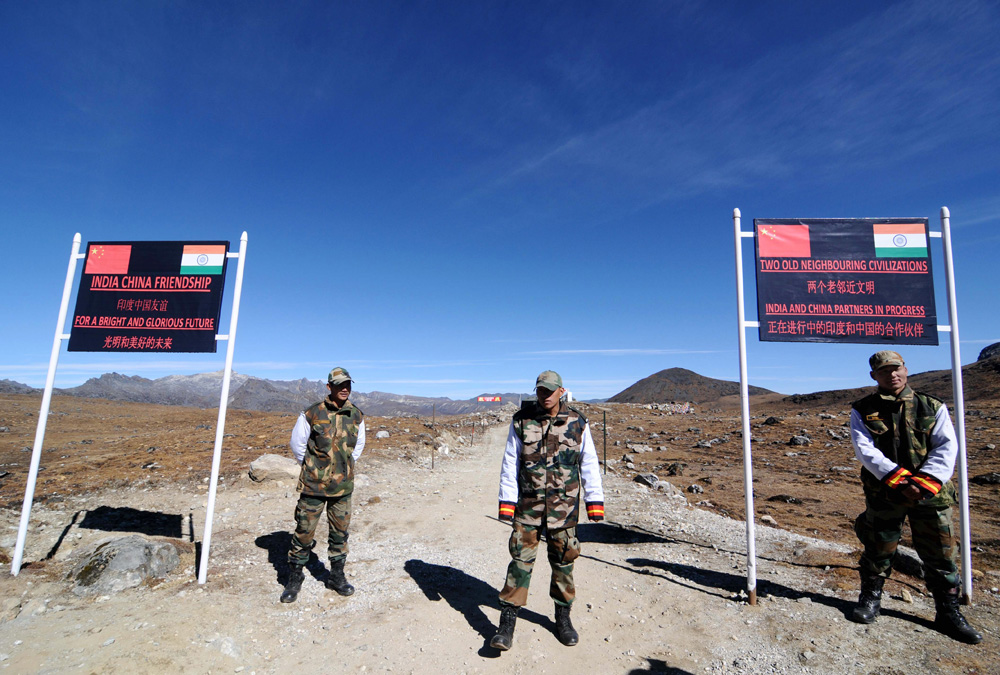
Special Frontier Force – The War on Communism: Chinese military incursion into India demands a response. Expel Chinese nationals visiting India.Special Frontier Force-The War on Communism: There can be no friendship between India, and China without Freedom and Democracy in Tibet.(Bumla Pass-Arunachal Pradesh)Special Frontier Force-The War on Communism: Chinese incursion into Ladakh is a symptom of the military occupation of Tibet. The cure of this disease demands establishment of Freedom and Democracy in Tibet.
Special Frontier Force-The War on Communism: Chinese presence in Ladakh must not be tolerated.Special Frontier Force-The War on Communism: Chinese attack on Ladakh demands a military, diplomatic, trade, and commerce retaliation.Special Frontier Force-The War on Communism: Evidence of Red Dragon’s military attack inside Ladakh-India.
Special Frontier Force also known as Establishment No. 22 is a military alliance/pact between the United States, India, and Tibet. Its primary mission is that of using military force and tactics to fight the threat posed by the Communist Expansion in Southeast Asia. This multinational military organization intends to defend Freedom, Democracy, and Justice in the occupied Land of Tibet and resist the Communist Expansion into India. It is not a relic of Cold War era. The military threat posed by Communist China is well-recognized and there is no choice other than that of meeting this challenge. To respond to the challenge posed by Communist China’s military incursion into the Ladakh area of India, I would recommend the following actions:
1. Expel all Chinese nationals who are currently in India for travel, and business.
2. Cancel all planned official meetings, visits, and exchanges.
3. Reduce the size of diplomatic staff and other support personnel at all Chinese diplomatic missions and posts in India.
4. Review all trade and commerce agreements and place immediate restrictions on further expansion of these business activities.
5. Hold joint military training exercises in Ladakh region with members drawn from the United States, India, and Tibet.
R. Rudra Narasimham, B.Sc., M.B.B.S., Personal Numbers:MS-8466/MR-03277K. Rank:Lieutenant/Captain/Major. Branch:Army Medical Corps/Short Service Regular Commission(1969-1972); Direct Permanent Commission(1973-1984). Designation:Medical Officer. Unit:Establishment No.22(1971-1974)/South Column,Operation Eagle(1971-1972). Organization: Special Frontier Force.
SPECIAL FRONTIER FORCE – US-INDIA-TIBET MILITARY ALLIANCE:
SPECIAL FRONTIER FORCE – THE US-INDIA-TIBET MILITARY ALLIANCE MUST RESPOND TO CHINESE INTRUSION BY CONDUCTING JOINT MILITARY TRAINING EXERCISES IN THIS AREA. Chinese Communists are trying to depict their military intrusion as an innocent play of cricket deep inside Indian territory. These Chinese soldiers are not in uniform and are not holding weapons and yet this is a clear military challenge that the Alliance must accept and respond with vigor.
India must firmly respond to Chinese intrusion in the Ladakh Sector and must hold joint military training exercises with US Army to defend peace and security in Southeast Asia. Major General Vinod Saighal(Retd) has shared his view and is of the opinion that waiting may irreversibly compromise India’s Security Interests.
R. Rudra Narasimham, B.Sc., M.B.B.S., Personal Numbers:MS-8466/MR-03277K. Rank:Lieutenant/Captain/Major. Branch:Army Medical Corps/Short Service Regular Commission(1969-1972); Direct Permanent Commission(1973-1984). Designation:Medical Officer. Unit:Establishment No.22(1971-1974)/South Column,Operation Eagle(1971-1972). Organization: Special Frontier Force.
Waiting for the long haul may irreversibly compromise India’s Security Interests It is amazing that while a potentially strategic vulnerability is being created with each passing day on the DBO front in Ladakh and possibly elsewhere as well the Foreign Minister of India in his wisdom chooses to call it a minor blip, an acne that will soon disappear. Disappear it will not and by the time the Foreign Minister returns from Beijing an element of irreversibility and potential future untenability of positions in Siachen could conceivably have been created. It would hardly be an exaggeration to say that every hour that a well-thought out military response by top commanders on the ground is delayed the situation becomes more and more difficult. In the process the government through its vacillation is leaving everybody confused. Leaving senior military commanders tasked with the defence of Ladakh or for that matter any other sector bereft of initiative is an invitation to disaster; minute-to-minute micro-management from the top not being the answer. That the present incursion does not fall into the category of routine Chinese incursions is clear to all military commanders and defence analysts. It is a given that Chinese incursions have been increasing, sometime on a daily basis, in direct proportion to the government’s response of playing them down or denying that they have taken place. Lack of condemnation and allowing even minimal freedom of action to military commanders only emboldens the other side who have taken the full measure of the government and its functioning. It is nobody’s contention that an asymmetrically enfeebled army should not exercise extreme caution; the army commanders being more than aware of their vulnerability due to gaps in infrastructure and the delay in critical military acquisitions that should have been in place by now or even the lack of a riposte capability that should have been in place ages ago. More importantly, what the government and its strategic planners do not appreciate is the impression that is being made on the rest of the world by its flip-flop policies in the face of continued Chinese aggravations. They have seen that India has already ceded control on its periphery on the subcontinent in several countries of SAARC. A few years earlier under pressure from the US and the West it had jeopardized its most advantageous relationship with Iran by unnecessarily and unprovoked voting against it in Vienna. Other decisions that indicated to the world that the government may not be in control of its foreign policy followed. Having ceded strategic space to China on its West, what exactly is the government’s response to the latest provocation by China indicating to its strategic partners in East Asia; with whom strategic defence agreements should have been taken to greater heights by now. A policy of keeping all options open simply means that when the crunch comes no option is available to be exercised. Specifically, Japan, Vietnam and several other potential strategic partners to India’s east are watching and waiting; wondering whether it has the resolve to protect its own interest in the first instance, before calculating its ability to come to their assistance should the need arise. From day one instead of dithering and hamstringing military commanders on the ground the incursion in DBO to a depth of 19 kms demanded an immediate and robust response. It is akin to fire fighting. A blaze can be put out by the effort of a single man or few people in the first few minutes; after more than 10 to 15 minutes it would require far greater fire fighting resources to get it under control; and after about thirty minutes or so it can often become completely uncontrollable. The government cannot be pardoned for disallowing the immediate fire fighting actions to remove the Chinese incursion. Instead of leaving it to the military commanders to deal with the situation it took it upon itself to show its diplomatic consummate-ness. It will send its foreign minister who has actually pushed off in the reverse direction for the time being to Beijing after another 10 or 12 days, thereby allowing the aggressors time to consolidate their incursion and dig in deeper. Meanwhile asking the army to take up positions opposite them in its own territory and do nothing to evict them while it would be possible to do so with minimal force. To the armed forces, to the people of India, and to the world the foreign minister of India is not going to the Chinese capital to demand a pull-back. He is seen to be going to Beijing as a supplicant. As in the days of yore the imperial power may graciously oblige its vassal. The country will not know as to what concessions the minister would have been authorised to concede that would further undermine India’s capability in the future. Flowing from it, it could be well on the cards that during the Chinese Prime Minister’s visit some public pronouncements that the country can live with would be made. Nobody would be deceived that once again India would have been humiliated. India still has a range of options to make China see reason without losing face. It hardly matters that India loses face, the country having been inured to it, used to it and reconciled to it by now. If these options are not exercised early enough – timing always being of the essence – India’s humiliation would have been compounded and its military position further degraded. What is worse the status quo might conceivably turn out to be freezing of positions as obtaining on the date of the agreement; meaning thereby the new LAC on the DBO sector would be 19 kms within Indian Territory. Major General Vinod Saighal (Retd) is the author of Revitalising Indian Democracy, Restructuring Pakistan and Third millenium Equipoise. This article first appeared in The Statesman of Apr 28.
SPECIAL FRONTIER FORCE – MILITARY CONFLICT WITH CHINA:
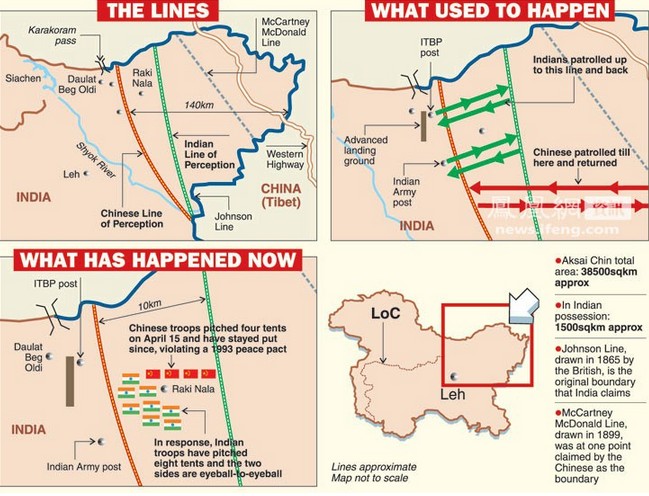
SPECIAL FRONTIER FORCE – THE MILITARY CONFLICT WITH CHINA: India cannot reconcile with People’s Republic of China’s military occupation of Tibet. On April 15, 2013 Indians have discovered evidence of China’s military expansionism in the sector called Daulat Beg Oldi of India’s Ladakh region.
India has no official boundary with People’s Republic of China. The Red Dragon wants to legalize its military occupation of Tibet and other territories taking full advantage of its military and economic strength. China’s military expansionism is a bubble and it will burst as China attempts to further increase its size.
I am pleased to share the essay,’Lesson from an Unsettled Boundary’, written by Manoj Joshi (a Distinguished Fellow at the Observer Research Foundation, New Delhi) that is published in India’s national newspaper ‘The Hindu’ in its edition dated April 27, 2013 with my readers. It is not a big surprise that the boundary between India and China is not settled. It should remain undecided as India cannot reconcile with People’s Republic of China’s military occupation of Tibet. India has no border with China. There is a border dispute between Tibet and China and that is an issue that could be resolved when Special Frontier Force, the military alliance/pact between the United States, India, and Tibet accomplishes its primary mission of evicting the occupier from the Land and territories of Tibet.
R. Rudra Narasimham, B.Sc., M.B.B.S., Personal Numbers:MS-8466/MR-03277K. Rank:Lieutenant/Captain/Major. Branch:Army Medical Corps/Short Service Regular Commission(1969-1972); Direct Permanent Commission(1973-1984). Designation:Medical Officer. Unit:Establishment No.22(1971-1974)/South Column,Operation Eagle(1971-1972). Organization: Special Frontier Force
Lesson from an unsettled boundary
Manoj Joshi – The Hindu April 27, 2013
The reality is that the Line of Actual Control between India and China is notional and has not been put down on any mutually agreed map (The writer is a Distinguished Fellow at the Observer Research Foundation, New Delhi) In 1950, the Survey of India issued a map of India showing the political divisions of the new republic. While the border with Pakistan was defined as it is now, including the Pakistan-occupied Kashmir area, the borders with China were depicted differently. In the east, the McMahon Line was shown as the border, except in its eastern extremity, the Tirap subdivision, where the border was shown as “undefined.” In the Central sector of what is now Uttarakhand and Himachal Pradesh and the eastern part of Jammu & Kashmir, including Aksai Chin, the boundary was depicted merely by a colour wash and denoted as “boundary undefined.” Unilateral act In March 1954, the Union Cabinet met and decided to unilaterally define the border of India with China. The colour wash was replaced by a hard-line, and the Survey of India issued a new map, which depicts the borders as we know them today. All the old maps were withdrawn and the depiction of Indian boundaries in the old way became illegal. Indeed, if you seek out the White Paper on Indian States of 1948 and 1950 in the Parliament library, you will find that the maps have been removed because they too showed the border as being “undefined” in the Central and Western sectors. What was the government up to? Did it seriously think it could get away with such a sleight of hand? Or was there a design that will become apparent when the papers of the period are declassified? Not surprisingly, the other party, the People’s Republic of China, was not amused and, in any case, there are enough copies of the old documents and maps across the world today to bring out the uncomfortable truth that the boundaries of India in these regions were unilaterally defined by the Government of India, rather than through negotiation and discussions with China. It is not as though the Chinese have a particularly good case when it comes to their western boundary in Tibet. The record shows that the Chinese empire was unclear as to its western extremities, and rejected repeated British attempts to settle the border. The problem in the Aksai Chin region was further compounded by the fact that this was an uninhabited high-altitude desert, with few markers that could decide the case in favour of one country or the other. But there was cause for the two countries to sit down and negotiate a mutually acceptable boundary. This as we know was not to be and, since then, the process has gone through needless tension and conflict. In the initial period, India’s focus was on the McMahon Line which defines the boundary with China in what is now Arunachal Pradesh. It tended to play down the issue of Aksai Chin because it was a remote area and of little strategic interest to India. But for China, the area was vital. Indeed, according to John W. Garver, it was “essential to Chinese control of western Tibet and very important to its control of all of Tibet.” In other words, in contrast to India’s legalistic and nationalistic claims over the region, for China, control over Aksai Chin had a geopolitical imperative. For this reason, it entered the area, built a road through it and undertook a policy to expand westward to ensure that the road was secure. India woke up to the issue late and when it sought to confront the Chinese through its forward policy in 1961, it was already too late. And the 1962 war only saw a further Chinese advance westward which led to almost the entire Galwan River coming under the Chinese control. We can only speculate on the causes of their present westward shift in the Daulat Beg Oldi area. But one thing is clear: the central locomotive of Chinese policy remains Tibet. Despite massive investments in the region, large numbers of Tibetans remain disaffected. No country in the world, including India, recognises Tibet as being a disputed territory yet, for two reasons. The Chinese constantly seek reassurance from New Delhi about its intentions. First, because of the past support that Tibetan separatist guerrillas got from the U.S. and India, and second, because of the presence of the Dalai Lama and the Tibetan government-in-exile in India. Despite the massive growth of Chinese power, their insecurities remain high. In great measure, they are due to Beijing’s own heavy-handed policies and only China can resolve the issues through accommodation and compromise with its own people. But typical of governments, Beijing seeks to deflect the blame of its own shortcomings on outsiders. There could be other drivers of the tension as well. In the past five years, the Chinese have been generally assertive across their periphery and this could well be an outcome of policy decisions taken by the top military and political leadership of the country or, as some speculate, because of an inner-party conflict. Exaggerated Chinese maritime boundary claims have brought them into conflict with the ASEAN countries, principally the Philippines, Vietnam and Malaysia. A separate order of tension has arisen with Japan over the Senkaku islands in the East China Sea. In the case of India, an important initiative to resolve the border dispute through Special Representatives has been allowed to run aground. Another possible explanation for the Chinese behaviour could be the steps India is taking with regard to its military on its borders with China. India’s border infrastructure and military modernisation schemes have been delayed by decades. But in recent years, there have been signs that New Delhi may be getting its act together. In any case, the cumulative impact of the huge defence expenditures since 2000 is beginning to show in terms of better border connectivity and modernisation programmes. This momentum could see Indian forces’ confrontation with China become even stronger when you take into account new manpower and equipment such as mountain artillery, attack helicopters, missiles and rocket artillery. Overlapping claims Even so, it would be hazardous to speak definitively about Chinese motivations. After being lambasted by the Indian media for occupying “Indian territory,” the Chinese might be concerned about losing face with a hasty retreat. The fact of the matter is that the boundary in the region is defined merely by a notional Line of Actual Control, which is neither put down on mutually agreed maps, let alone defined in a document through clearly laid out geographical features. While both sides accept most of the LAC and respect it, there are some nine points where there are overlapping claims and both sides patrol up to the LAC, as they understand it. In such circumstances, the Chinese could well withdraw after a decent interval. This more benign interpretation of Chinese behaviour is also in tune with the statements that the new leadership in Beijing has been making. As has been noted, following his meeting with Prime Minister Manmohan Singh on the sidelines of the BRICS conference in Durban, the new supremo of China, Xi Jinping, was quoted in the Chinese media as saying that Beijing regarded its ties with New Delhi as “one of the most important bilateral relationships.” Belying the belief that the Chinese were dragging their feet on the border issue, Mr. Xi declared that the Special Representative mechanism should strive for “a fair, rational solution framework acceptable to both sides as soon as possible.” This last sentence is significant because a week earlier, he was quoted as making the standard formulation that the border problem “is a complex issue left from history and solving the issue won’t be easy.” 2013 is not 1962 and the Indian media and politicians should not behave as though it was, by needlessly raising the decibel level and trying to push the government to adopt a hawkish course on the border. But what the recent controversy does tell us is unsettled borders are not good for two neighbours because they can so easily become the cause of a conflict that neither may be seeking. (The writer is a Distinguished Fellow at the Observer Research Foundation, New Delhi)
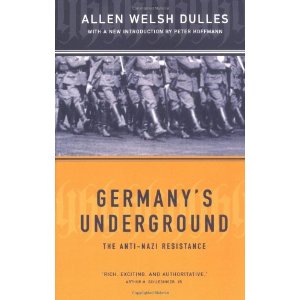
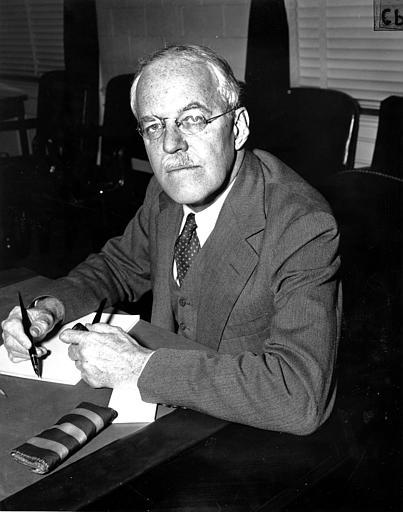
Whole Dude-Whole Agency: Allen Dulles reveals the secrets of World War II, but remained silent about the secret operation in Tibet(1958-1964) which was supported by the US President, Indian Prime Minister, and His Holiness the 14th Dalai Lama, the spiritual and temporal leader of the autonomous State of Tibet.Whole Dude-Whole Agency: During World War II, Allen Dulles served as the Chief of the OSS Office in Bern from October 1942 to May 1945. He played a role in the surrender of German troops in northern Italy.Whole Dude-Whole Agency: Interesting account of the role of Office of Strategic Services in Europe during World War II. Fortunately, now we have interesting accounts of the CIA’s Secret War in Tibet. The credit goes to the Director of the CIA.Whole Dude-Whole Agency: Allen Dulles described the ‘Craft of Intelligence’ but kept the CIA Operation in Tibet as a Secret.Whole Dude – Whole Agency: Allen Welsh Dulles shaped the history of the Central Intelligence Agency. During World War II, he had served in the Office of Strategic Services(1942-1945), and when CIA formed in 1951, he served as Deputy Director under General Walter Bedell Smith. He was appointed the Director by President Dwight D. Eisenhower during January 1953.
The Spirits of Special Frontier Force are pleased to pay this special tribute to Allen Welsh Dulles(b. April 7, 1893, Watertown, NY – d. January 29, 1969, Washington, DC), US diplomat, intelligence expert who was the Director of the Central Intelligence Agency during its period of growth. Dulles received M.A. from Princeton in 1916. His service to the nation started during the administration of Woodrow Thomas Wilson(28th President of the US 1913-1921). He served in various diplomatic posts until 1922, and was named chief of the State Department’s Near Eastern Division. He obtained Law degree in 1926, and served as counsellor to the US delegation in Peking. He returned to the US and joined the New York law firm in which his brother John Foster Dulles was a partner. During World War II, Dulles joined the office of Strategic Services(OSS). From October 1942 to May 1945, Dulles served as Chief of OSS office in Bern, Switzerland. He played a critical role in the surrender of German troops in northern Italy. He received the Medal of Merit and Medal of Freedom for his service during the War. In 1948, Dulles served as the Chairman of a three-man committee that surveyed the US intelligence system. After the Central Intelligence Agency was established in 1951, he served as deputy director under General Walter Bedell Smith. In 1953, he was appointed Director of CIA by President Dwight D. Eisenhower(34th President of the US, 1953-1961). He was the first Chairman of U.S. Intelligence Board. Dulles carried out a number of major operations, notably the overthrow of the governments of Mohammad Mossadeq in Iran in 1953, and Jacob Arbenz in Guatemala in 1954. He was reappointed by President John F. Kennedy. Unfortunately, he had to shoulder the blame for the failure of the Bay of Pigs invasion of Cuba in April 1961. He was forced to resign to defend the reputation of the presidency. He was awarded the National Security Medal on November 28, 1961(and the citation for granting this Medal is attached as a pdf file). President Lyndon B Johnson had appointed him as one of seven commissioners of the Warren Commission to investigate the assassination of President John F. Kennedy. He authored several books, notably Germany’s Underground(1947), The Craft of Intelligence(1963), and The Secret Surrender(1963).
Whole Dude – Whole Agency: Allen Welsh Dulles rendered remarkable service to the nation and won the admiration of President John F. Kennedy even though he had to accept the blame for the failed mission in Cuba. I salute him for his support to defend Freedom and Democracy in Tibet. The CIA operation in Tibet had also failed during March 1959, but I would not blame CIA for that failure.Whole Dude – Whole Agency: On November 28, 1961, Allen Welsh Dulles, the outgoing CIA Director received the National Security Medal from President John F. Kennedy.Whole Dude – Whole Agency: President Lyndon B. Johnson demonstrated his confidence in the former CIA Director Allen Welsh Dulles by appointing him to the Warren Commission that investigated the assassination of President John F. Kennedy. It was indeed a great honor and speaks of the trust in personal integrity earned by Dulles as the CIA Director.
Whole Dude-Whole Agency: A special tribute to Allen Welsh Dulles, the Director of CIA who organized training of Tibetans at Camp Hale, Colorado(May 1958 to November 1964).
Both US Government and the Central Intelligence Agency maintain their silence about the support given to the Tibetan Resistance Movement and the eventual creation of a military alliance/pact between the US, Tibet, and India to fight the military threat posed by Communist China when it occupied Tibet in 1950 and had forced His Holiness the 14th Dalai Lama to lead a life in exile. However, the US had finally acknowledged the CIA operation with the Tibetans and India by installing a Commemoration Plaque at the Camp Hale, Colorado training site on September 10, 2010. The Director of CIA was not present at the ceremony to honor the memory of people who were involved in this covert operation. It is my duty and privilege to pay this special tribute to Allen Welsh Dulles in due recognition of the services he had rendered to defend Freedom, Democracy, and Justice in the occupied Land of Tibet.
The Red Dragon’s Lust for Global Supremacy poses a great danger to Freedom and Democracy all over the world.
In the past, our main concern was about the dangers posed by Colonialism and Imperialism and little attention was given to the Communist Revolution in China and its potential to impact Freedom and Democracy all over the world. China’s founding father, Mao Tse-tung(1893-1976), the Chinese Communist leader; Chairman of the People’s Republic of China(1949-1959) and of its Communist Party(1949-1976) had clearly articulated a policy of territorial expansionism to become a global Superpower. Since that time, the Communist Dragon pursued the policy of annexation and military occupation and has constantly prepared itself to assert its military power and domination in Southeast Asia, and now the rest of the world. The huge continent of Africa is virtually colonized by China and China has gained access to natural resources all over the world including major countries in the West such as Canada. We need to wake up to this reality called China and respond to its greed for territory, and curb its lust for power.
I am pleased to share this essay titled “The Dragon Covets the Arctic” by Dr. A. Adityanjee, President, Council for Strategic Affairs, New Delhi, India. There is no escape from not knowing the military threat posed by Communist China and its policy of expansionism.
R. Rudra Narasimham, B.Sc., M.B.B.S., Personal Numbers:MS-8466/MR-03277K. Rank:Lieutenant/Captain/Major. Branch:Army Medical Corps/Short Service Regular Commission(1969-1972); Direct Permanent Commission(1973-1984). Designation:Medical Officer. Unit:Establishment No.22(1971-1974)/South Column,Operation Eagle(1971-1972). Organization: Special Frontier Force.
Sunday, March 31, 2013
Following the Communist Revolution that gave birth to People’s Republic of China, the Communists have expanded their territory in all directions to implement the policy of “Expansionism” clearly articulated by Mao Tse-tung( 1893-1976), the founding father, the Chairman of the People’s Republic of China(1949-1959) and of its Communist Party (1949-1976).
China’s lust for oil, minerals, rare earths, fish and desire for an alternative northern sea route boils the Arctic Geopolitics!
Introduction:
Iceland is a small, sparsely populated island nation with a population of only 320,000 and area of 40,000 square miles. It is the only member of the NATO that does not have an army of its own. Icelandic banks were part of the 2008 global financial crisis and meltdown when they exposed the Icelandic government of huge financial risks by indulging in risky loans and speculative foreign currency transactions without having enough liquidity and capital reserves. The fiscal crisis led to a former Icelandic prime minister losing his job and being hauled to court of law for not supervising the banks enough.
In an international capitalistic, mercantile system, if Iceland is a company, it would be a “sitting duck” for outright purchase and acquisition. Fortunately, foreigners are not allowed to buy any property or real estate in Iceland and need a special permit.
And here comes the Peoples’ Republic of China, rich with $ 3.4 trillion in foreign exchange reserves in its kitty. It has built a palatial embassy in Reykjavik, Iceland worth $250 million with only 7 accredited diplomats. China is negotiating a free trade area with Iceland, the first with any European nation. Former Chinese Prime Minister Wen Jiabao even paid a state visit to Iceland for two full days in 2012. Other Chinese ministers and officials have also been very active in Iceland with bilateral visits and cultural events.
In 2010, Huang Nubo, a “poetry loving” Chinese billionaire and former communist party official visited Iceland to meet his former classmate Hjorleifur Sveinbjornsson, a Chinese translator with whom he had shared a room in 1970s in the Peking University. He expressed his intense love for poetry and put up $ one million to finance Iceland-China Cultural Fund and organized two poetry summits, the first one in Reykjavik in 2010 and the second one in Beijing in 2011.
Last year (2012), Huang Nubo and his Beijing based company, the Zhongkun group offered to buy 300 sq km of Icelandic land ostensibly to develop a holiday resort with a golf course. This Chinese billionaire wanted to pay $7 million to an Icelandic sheep farmer to take over the land and build a $100 million 100-room five-star resort hotel, luxury villas, an eco-golf course and an airstrip with 10 aircrafts. A state-owned Chinese bank reportedly offered the Zhongkun group a soft loan of $ 800 million for this project.
The deal was blocked by the Icelandic Interior Minister who asked many pertinent questions but reportedly got no answers. Huang would not take no for an answer and has submitted a revised bid for leasing the land for $ one million instead of outright purchase. He makes an unbelievable assertion that there is a market demand for peace and solitude: “Rich Chinese people are so fed up of pollution that they would like to enjoy the fresh air and solitude of the snowy Iceland”.
The current Icelandic government, a left-of-center coalition has given this proposal a cold shoulder. But, with elections due in April 2013 in Iceland, China is hoping for a more sympathetic government to approve the project. Iceland looks like an easy bird of prey for the wily red Dragon with insatiable appetite.
China is showing generosity to another poor and sparsely populated, self-governing island of Greenland by offering investments in mining industry with proposal to import Chinese crews for construction and mining operations. Greenland is rich in mineral deposits and rare earth metals. China wants Greenland to provide exclusive rights to its rare earth metals in lieu of the fiscal investments. Under one such proposal, China would invest $2.5 billion in an iron mine and would bring 5000 Chinese construction and mining workers whereas the population of the capital of Greenland, Nuuk is only 15000.
Arctic Council Membership:
There are eight members of the Arctic Council that includes Canada, Denmark (including Greenland), Finland, Iceland, Norway, Russia, Sweden and the USA. All these eight countries have geographic territories within the Arctic Circle. It was constituted in 1996 as an intergovernmental body but has evolved gradually from a dialogue forum to a geo-political club and a decision-making body. There are continuing territorial disputes in Arctic Circle. Ownership of the Arctic is governed by the United Nations Convention of the Law of the Sea, which gives the Arctic nations an exclusive economic zone that extends 200 nautical miles from the land. Member countries signed their first treaty on joint search and rescue missions in 2011. A second treaty on cleaning up oil spills is being negotiated. The group established its permanent secretariat at Tromso, Norway in January 2013.
Arctic Melting and Opening of Newer Sea Lanes:
With global warming becoming a reality, the Arctic ice has started to melt rapidly opening the northern sea-lanes that were frozen earlier. In summer of 2012, 46 ships sailed through the Arctic Waters carrying 1.2 million tonnes of cargo. There are legal questions about the international status of the northern sea lanes.
China’s Lust for Arctic Resources:
The Arctic has 13% of the world’s undiscovered oil and 30% of gas according to the US Geological Survey. Greenland alone contains approximately one tenth of the world’s deposits of rare earth minerals. China which already has a monopoly on world’s rare earth metal trade wants to continue controlling this global trade. China piously claims that the Arctic resources are the heritage of the entire mankind while insisting that the South China sea is its exclusive sovereign territory.
In 2004, China set up its first and the only Arctic scientific research station, curiously named “Yellow River Station” on the Svalbard Island of Norway. China, so far, has sent 6 arctic expeditions. China plans to build more research bases. In 2012, the 170-meters long icebreaker “Snow Dragon” (MV Xue Long) became the first Chinese Arctic expedition to sail along the Northern Sea Route into the Barents Sea. Incidentally, as early as 1999, this 21000 metric ton research icebreaker Xue Long had docked in the Canadian North-Western territory unexpectedly. China is building another 120-meter long icebreaker with the help of Finland while the Polar Research institute in Shanghai trains scientists and other personnel for Arctic expeditions.
China’s Previous Use of Deception:
There is no mandarin character for word transparency. China has been known to use duplicity and deception since the Art of War was written by Sun Tzu. China’s rhetoric of “peaceful and harmonious rise” and hegemonic behavior are predictably diametrically opposite to each other. China’s use of deception to camouflage its intentions in geopolitical matters is not surprising. While China joined the NPT in 1991, it provided 50 kg of highly enriched uranium to Pakistan, provided that country with a nuclear weapon design and supervised Pakistan’s first nuclear test at the Chinese nuclear testing site of Lop Nur. China purchased in 1998 an unfinished aircraft carrier from Ukraine after the breakup of Soviet Union ostensibly for developing a floating casino. The same “floating casino” is now China’s first aircraft carrier projecting Chinese naval and maritime power in the South China Sea.
China’s Application in Arctic Council Membership:
China currently has an ad hoc observer status with Arctic Council. China’s application for permanent observer-ship was denied by Norway in 2012 owing to bilateral dispute over awarding of Nobel peace prize to China’s Liu Xiaobo in 2010. China still has a pending application to be decided in May 2013 Arctic Council summit in Sweden when Canada takes over the chair for the next two years. With a permanent observer status, China would get full access to all Arctic Council meetings. Permanent observers do not have voting rights in the council but can participate in deliberations.
China is trying to distinguish itself from the rest of the applicants as a “Near Arctic State” on the perfidiously clever but fallacious grounds that the northernmost part of China in the province of Manchuria (the Amur river) is only one thousand miles south to the Arctic circle. The fallacy is that Manchuria was a separate, independent country that was annexed by China after the Communist take-over. Manchus had ruled over China for centuries during the reign of Manchu dynasty and last Chinese Emperor Pu Yi was actually the last Manchu emperor. Chinese ownership and annexation of Manchuria (Manchu-Kuo) is still not settled. A disputed territory cannot be used by China to make a geopolitical claim for being a “Near Arctic State”.
Other Pending Applications:
Other countries or non-state actors with pending applications for permanent observer-ship status include Japan, South Korea, India, Singapore, European Union, and non-state actors like Greenpeace and the International Association of Oil and Gas Producers. All these applications will be decided one way or the other in May 2013. The vote has to be unanimous for acceptance and how the US and Russia will vote is the crucial issue. In the past, Norway had vetoed China’s membership application. Some of the Arctic Council members may not approve European Union’s application because of EU’s penchant for restrictive and narrow rulings. Whereas Sweden, Canada, Iceland and Denmark may support China’s application, there are doubts about Norway, Russia and the US. Russia is currently the most vociferous member of Arctic Council that has serious reservations in expanding the Arctic club.
Strategic Issues:
China has voracious appetite for new territories and has been seeking new frontiers for the last three hundred years with Inner Mongolia, Manchuria, Xinjiang and Tibet. China’s list of “core issues” is ever-expanding, starting with Taiwan and Tibet. China has included the whole the South China Sea and its islands as a core issue. China is aggressively claiming sovereignty on these islands based on historical maps and manufactured mythological evidence. China has now a license from the UN for deep-seabed mining for minerals in the Indian Ocean and has developed naval bases in Indian Ocean and Arabian Sea ports. If China manages to get a toehold in Arctic Circle, its behavior will become as belligerent in Arctic as it is in the South China Sea. It might claim sovereignty over the whole of the Northern route sea lanes based on “historical evidence”. If in 22nd century, China decides that the Arctic Circle is its core national issue, one would be seeing Chinese aircraft carriers in the Arctic Sea and Chinese nuclear powered submarines in the Barents Sea along with military bases with “Chinese characteristics” in the Iceland and Greenland.
Whole Dude – Whole Master: A special tribute to Spymaster John Alexander McCone, the 6th CIA Director who played a leading role during the Cuban Missile Crisis. EXCOMM meeting at the White House Cabinet Room during the Cuban Missile Crisis on October 29, 1962. (Photo credit: Wikipedia)
SPECIAL FRONTIER FORCE – THE GREAT SPYMASTER:
Establishment No. 22 is a military establishment that represents a military pact/alliance between the United States, India, and the Tibetan Government -in-Exile. It came into existence during November 1962 and during 1966, this organization was named Special Frontier Force. Between the Central Intelligence Agency and the members of Special Frontier Force there has been a Master-Student relationship. This organization is the child of CIA’s Secret War in Tibet and it will be correct to recognize CIA as the ‘Mastermind’ of this operation to defend Freedom, and Democracy in the occupied Land of Tibet. The Spirits of Special Frontier Force take this opportunity to pay a special tribute to its ‘Master’, John Alexander McCone(b. January 04, 1902 – d. February 14, 1991) who served as the Director of CIA from November 1961 to April 1965.
Whole Dude-Whole Master: This is a special tribute to Spymaster John Alexander McCone who served as CIA’s 6th Director from November 1961 to April 1965.
John A. McCone obtained a bachelor’s degree in Mechanical Engineering from University of California at Berkeley. He built his career in the steel, construction, shipping, shipbuilding, and aircraft production industries. He founded the Bechtel-McCone Steel Company and his role in shipbuilding, and military aircraft production had attracted the attention of President Harry S. Truman who had appointed him to the Air Policy Commission in 1947 to develop strategy for American military airpower. During 1948, he was appointed as the Special Deputy to the Secretary of Defense. In 1950, he was appointed as Undersecretary of the Air Force. President Dwight Eisenhower appointed him as the Chairman of the Atomic Energy Commission during 1958 and held that position until 1961.
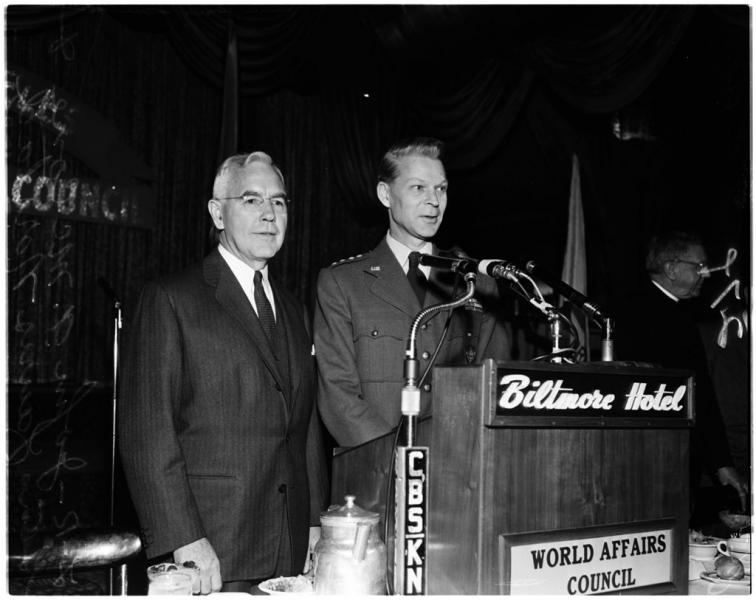
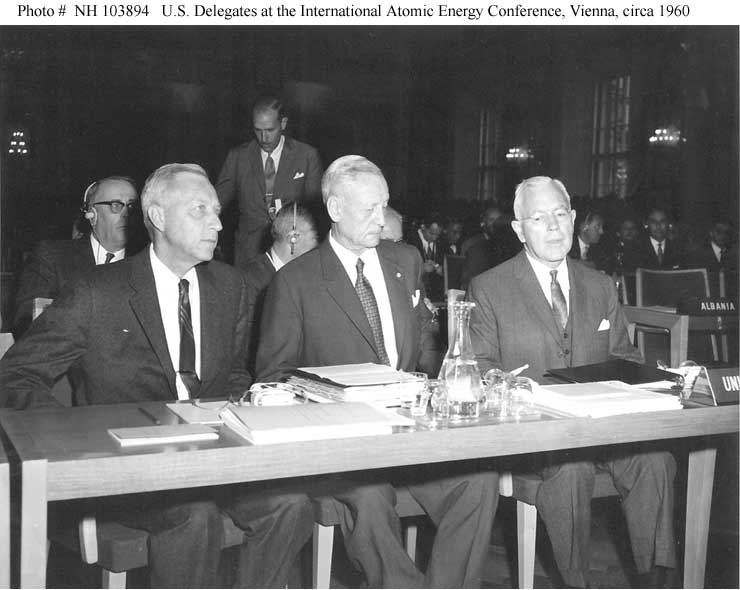
Whole Dude-Whole Master: In this photo taken during 1958, John A. McCone, Chairman of the World Affairs Council is seen with General Lauris Norstad, Supreme Commander of the Allied Powers in Europe.Whole Dude-Whole Master: U.S. delegates to the Fourth General Conference of the International Atomic Energy Agency, Vienna, Austria 1960. Left to Right:- Ambassador John S. Graham, Vice Admiral Paul F. Foster, US Navy(Retd), the Permanent U.S. Representative to the IAEA, and John A. McCone, Chairman of the U.S. Atomic Energy Commission.
During his tenure as the Chairman of the U.S. Atomic Energy Commission, John McCone made very significant disclosures about Israel’s nuclear capabilities. After the disaster of the Bay of Pigs Invasion of Cuba, President Kennedy forced the resignation of the CIA director Allen Welsh Dulles and Richard Bissell, the Deputy Director for Plans and Operations who had a major role in making the plan for this CIA’s Black Operation. In a very surprising, and sudden move, President Kennedy called John McCone, a Republican to take charge of the Central Intelligence Agency disregarding the fact that McCone had no prior experience in Intelligence.
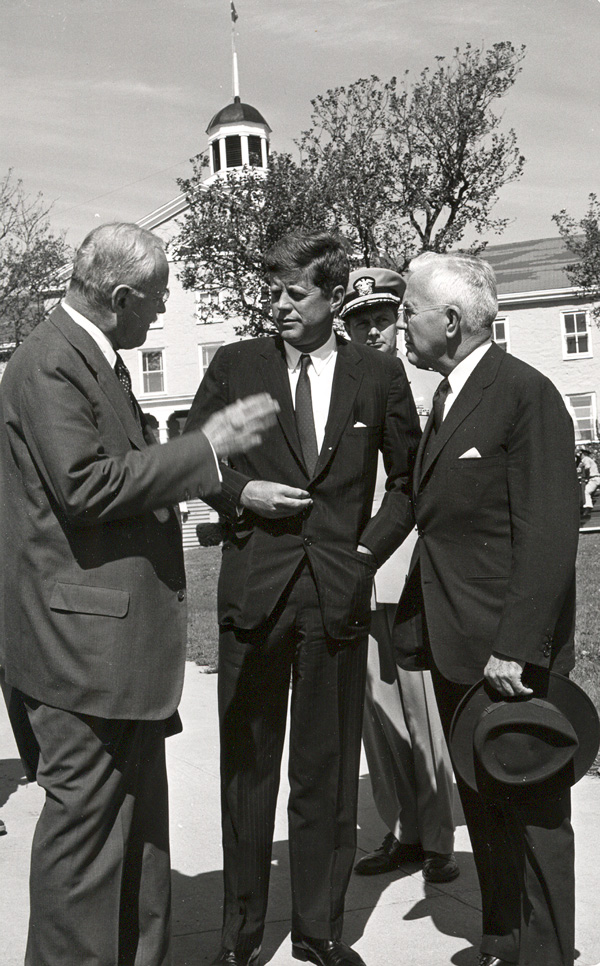
Whole Dude-Whole Master: President John F. Kennedy’s selection of Spymaster during 1961. Left to Right:- Allen Welsh Dulles, 5th Director of CIA, Richard Bissell, Deputy Director of Plans/Operations, President John F. Kennedy, and the newly selected 6th Director of CIA, John A. McCone.Whole Dude-Whole Master: September 27, 1961. President Kennedy with CIA Director Allen Dulles and his new pick, John A. McCone.Whole Dude-Whole Master: November 29, 1961. President John F. Kennedy with outgoing CIA Director Allen Dulles.Whole Dude-Whole Master: November 29, 1961. President John F. Kennedy welcomes the 6th Director of CIA, John Alexander McCone.
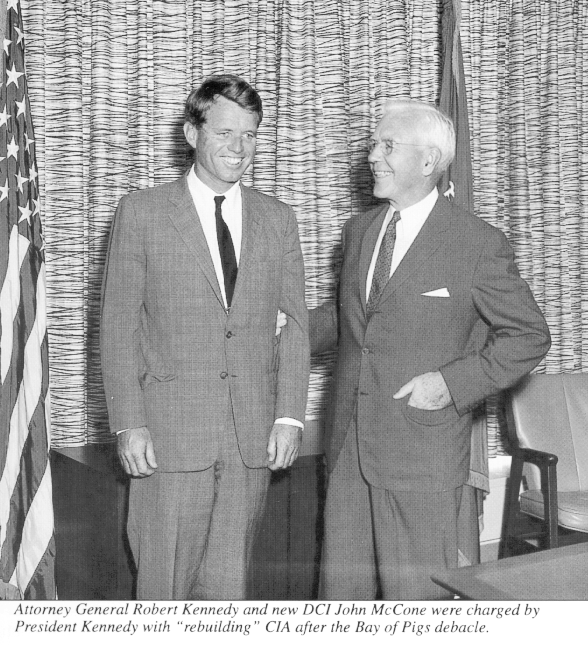
Whole Dude-Whole Master: John Alexander McCone gets the task of “rebuilding” CIA after the Bay of Pigs debacle.Whole Dude-Whole Master: A new chapter in the history of CIA. John Alexander McCone became the “Government’s principal foreign intelligence Officer” and he would work the heads of all departments and agencies, such as the State, Defense, the Attorney General, and the Chairman of the Atomic Energy Commission, that have responsibilities in the foreign intelligence field. In this photo McCone is seen with Robert Kennedy, the Attorney General. The DCI would coordinate and direct the total intelligence community.
John McCone played a leading role in strengthening the intelligence gathering abilities of CIA by launching a technological revolution. On August 05, 1963, he created the Directorate of Science and Technology.
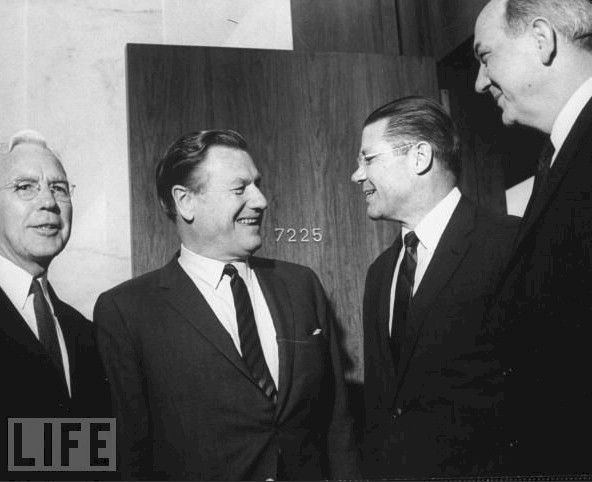
Whole Dude-Whole Master: May 01, 1964. Presidential candidate, New York State Governor, Nelson a. Rockefeller gets Intelligence briefing. Left to Right:John McCone, DIC; Governor Nelson A. Rockefeller; Robert S. McNamara, Defense Secretary; Dean Rusk, Secretary of State. Photo credit: Francis Miller/Time & Life.
McCone was responsible for a number of covert operations in Vietnam, Laos, Cuba, Ecuador, and Brazil. John McCone was present in the meeting held at The White House on November 19, 1962 to enter into an agreement/pact with India, and the Tibetan Government-in-Exile to formulate Establishment No. 22/Special Frontier Force to address the military threat posed by People’s Republic of China’s military occupation of Tibet. This operation that involves India and Tibet remains a secret. McCone was a key figure during the October 1962 Cuban Missile Crisis. He had predicted that the Soviet Union would place offensive nuclear weapons in Cuba. However, he had differences with President Lyndon B. Johnson and had resigned from his post during April 1965 and was replaced by Admiral William F. Raborn. President Ronald Reagan during 1987 presented John McCone with the Presidential Medal of Freedom.
I say that John McCone was one of the best managers that CIA ever had. What do you want to say???
Rudra N. Rebbapragada, Ann Arbor, Michigan, U.S.A.,
Organization: The Spirits of Special Frontier Force.
Whole Dude – Whole Master: Spymaster John Alexander McCone created the Directorate of Science and Technology on August 05, 1963 and launched technological revolution in Intelligence. (Photo credit: Wikipedia)
The Spymaster of Special Frontier Force: Director of the Central Intelligence Agency Richard Helms, in the White House Cabinet Room. His famous quote: “God did not give prescience to human beings.” (Photo credit: Wikipedia)
SPECIAL FRONTIER FORCE AND THE CENTRAL INTELLIGENCE AGENCY:
The Spirits of Special Frontier Force would like to pay a respectful tribute to Richard McGarrah Helms( b. March 30, 1913 – d. October 23, 2002, Washington D.C. ), the Chief Spymaster of the Central Intelligence Agency from June 1966 to February 1973.
Whole Dude – Whole Spy : Richard M Helms during the year 1980, in this White House ceremony received an award from President Ronald Reagan for “Exceptionally Meritorious Service.” It may be noted that George Herbert Walker Bush who was the Vice President at that time had also served as the Director of CIA (1976-1977)during the presidency of Gerald Ford.
RICHARD M HELMS – THE INTELLIGENCE PROFESSIONAL:
Whole Dude – Whole Spy: Richard Helms was appointed as the eighth Director of CIA on June 30, 1966. In a function held in the East Room, White House, President Lyndon B. Johnson is seen speaking to Dennis Helms, son of the newly sworn in CIA Director.Whole Dude – Whole Spy: This World War II era letter from Richard Helms to his young son Dennis reveals the long history of meritorious service rendered by Helms since the time he served in the wartime Office of Strategic Services. This letter is most interestingly written on Adolf Hitler’s private stationery.
Richard Helms was the chief architect of the legislation, National Security Act of September 1947 that created the Central Intelligence Agency replacing the wartime Office of Strategic Services. CIA came into existence during the presidency of Harry S Truman, 33rd President of the US(1949-1952). The National Security Council that is chaired by the President formed in 1949, CIA was established in 1951.
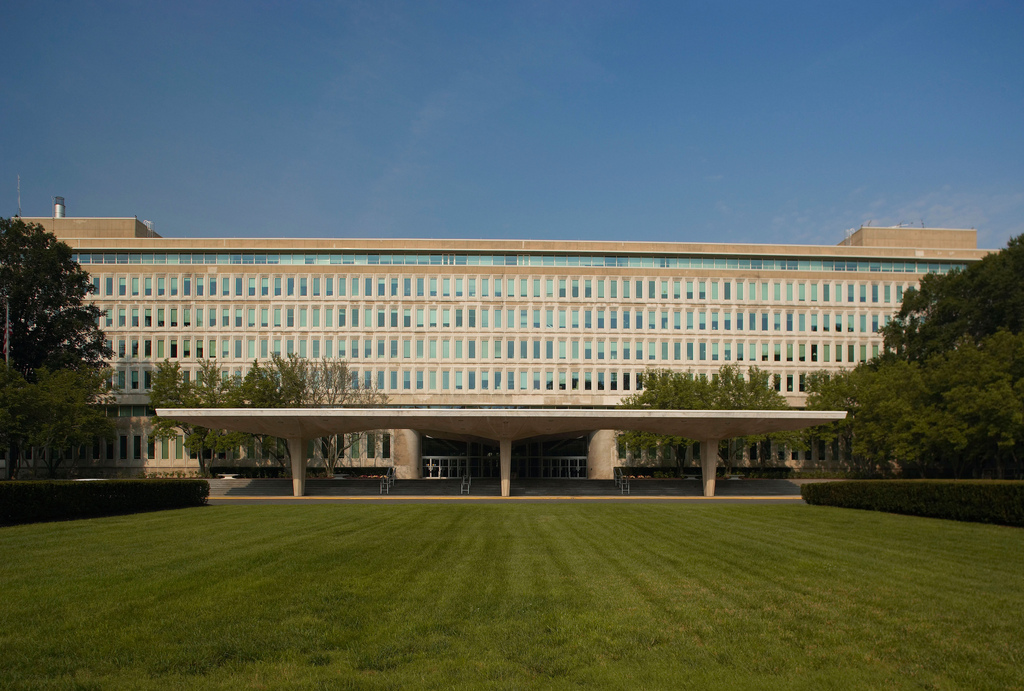
Whole Dude – Whole Spy: The Original Headquarters Building(OHB) reflects the vision of Allen Welsh Dulles, the 5th Director of CIA. CIA is the principle Intelligence and Counterintelligence agency of the US Government. It is organized as 1. The Intelligence Directorate, 2. The Directorate of Operations which includes espionage, 3. The Directorate of Science and Technology, and 4. The Directorate of Administration.The entrance to the Central Intelligence Agency headquarters. In a world of sovereign nations, information is a prime element of national power. Intelligence is best defined as evaluated information, is the vital and pivotal foundation for national decisions. The Director of CIA is Adviser to the National Security Council which is chaired by the President. (Photo credit: Wikipedia)
Richard Helms was commissioned into US Naval Reserve during 1942 and served as Lieutenant Commander. He had served with Office of Strategic Services and its successors from 1943 to 1947. He held various appointments within the CIA. He was the Deputy Director of Plans from 1962 to 1965. He was the Deputy Director of the CIA from April 28, 1965 to June 1966. Intelligence in service to Liberty found an unsurpassed Champion in Richard Helms who served two presidents, Lyndon B. Johnson, and Richard M. Nixon.
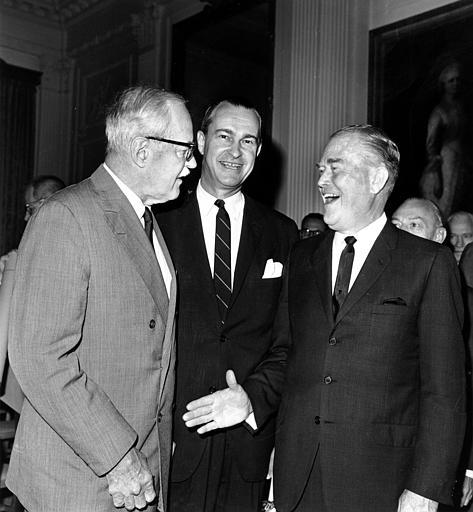
Whole Dude – Whole Spy: June 30, 1966 The White House. Richard Helms replaced CIA Director William F. Raborn who served from 1965 to 1966. The 5th Director of CIA, Allen Welsh Dulles attended this swearing-in ceremony.
Allen Welsh Dulles, the 5th Director of CIA told US Congress, “The CIA should be directed by a relatively small but elite corps of men with a passion for anonymity and a willingness to stick at that particular job.” Helms truly depicts the qualities demanded by Allen Welsh Dulles. Helms said, “Intelligence was not merely a job but rather a calling.” He had asked his employees to “Make Intelligence a profession, not just an occupation.”
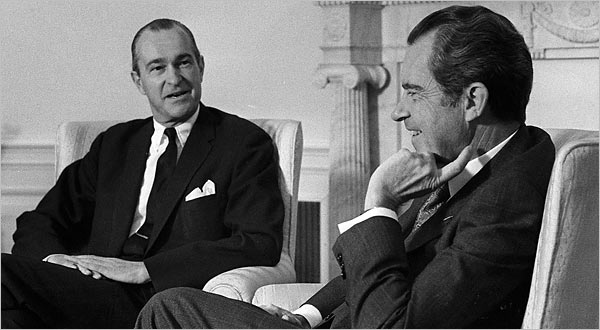
Whole Dude – Whole Spy: During the presidency of Richard Nixon, the CIA Director was placed under tremendous pressure to accomplish the political agenda of the President without real concern for national interests.Whole Dude-Whole Spy: The National Security Council briefing by CIA Director Richard Helms. It must be noted that Dr. Henry Kissinger had used his position to undermine the importance of Central Intelligence Agency. Kissinger had also undermined the role of the Secretary of State before he became the Secretary of State. Kissinger’s foreign policy initiatives are not based upon analysis of Intelligence.
Between 1950 and 1973, the CIA had also carried on extensive mind-control experiments at universities, prisons, and hospitals which included the use of LSD and other mind-altering drugs on unwitting test subjects. However, there is a huge concern about CIA tactics to prevent Salvador Allende from winning the 1970 elections in Chile and later when CIA worked to topple him from power. CIA had tried to assassinate several foreign leaders, including Fidel Castro of Cuba. But, the CIA had not acted on its own and was only trying to serve the political bosses of their times.
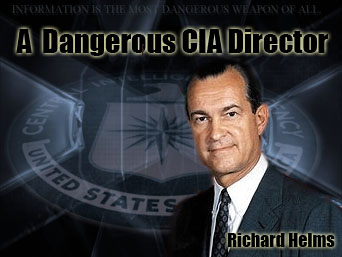
Whole Dude-Whole Spy: Richard Helms got ensnared in US Congress’s investigation because a successor, William Colby released a trove of documents, nicknamed “The Family Jewels” detailing the misdeeds of the Agency. Helms testified in Congressional hearings.Whole Dude – Whole Spy: Apart from the Congressional hearings, Richard Helms had faced news media during April 1975 and spoke to reporters who had very little understanding of Agency’s great performance in other countries.Whole Dude-Whole Spy: Damage was done to the personal reputation of Richard Helms and he was painted as a dangerous CIA Director while he tried his best to serve the President and the country without any political bias.Whole Dude – Whole Spy: The CIA celebrated its 50th Anniversary during 1997 and the former Director Helms was most warmly received and was acknowledged for his great contribution to the Organization in a variety of capacities.
It may be noted that there is not much awareness about CIA’s covert operations inside countries like Tibet. I sincerely appreciate the dedication of CIA officers who had served in Southeast Asia to defend freedom, and democracy in the occupied Land of Tibet.
Whole Dude-Whole Spy: The CIA covert operations inside Tibet led to the creation of a military organization called Establishment Number. 22, or Special Frontier Force which was formed in 1962 during the presidency of John F. Kennedy.
I would like to recognize Richard M. Helms as a Cold War era Hero who did his best to support and encourage the cause of political freedom, liberty, and democracy in the world in very difficult times.
Whole Dude-Whole Spy: The Spirits of Special Frontier Force recognizes CIA Director Richard Helms as a Cold War era Hero. Helms was skeptical about the likely success of large-scale covert actions meant to manipulate political and economic events abroad. CIA should not try to bite more than what it can chew.
I say Richard Helms is a great Spymaster who had ever served the Central Intelligence Agency and what do you want to say???
Rudra N. Rebbapragada/R. Rudra Narasimham,
Ann Arbor, Michigan, U.S.A.
Organization: The Spirits of Special Frontier Force.
The Central Intelligence Agency must become the Champion of Freedom and Democracy in the rest of the world. In its entire history of existence, the CIA’s work in Tibet truly reflects the ideals of Human Rights, Peace and Liberty. (Photo credit: Wikipedia)
THE U. S. CENTRAL INTELLIGENCE AGENCY – OPERATION FREE TIBET:
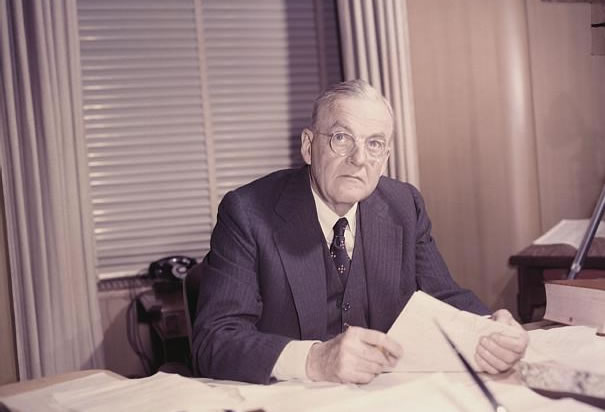
On behalf of ‘The Spirits of Special Frontier Force’, I am pleased to post this special tribute to John Foster Dulles who served as the US Secretary of State(1953 to 1959) under President Dwight D. Eisenhower.
John Foster Dulles was the architect of major elements of US Foreign Policy in the Cold War era after World War II. He was the architect of the policy to oppose Communist expansion and laid the foundation for the creation of a military alliance/pact between the United States, India, and Tibet to defend Freedom, and Democracy in the occupied Land of Tibet.The Spirits of Special Frontier Force pay tribute to this US Secretary of State for providing military assistance to Tibetan people to resist the military occupation of their Land by People’s Republic of China.
John Foster Dulles( b. February 25, 1888, Washington, D.C. – d. May 24, 1959, Washington,D.C.) was described by President Eisenhower in the following words: “He is one of the truly great men of our time.” Dulles was awarded the Medal of Freedom during May 1959 just prior to his death.
This Freedom Medal that was awarded to the US Secretary of State John Foster Dulles during May 1959 truly represents the aspirations of Tibetan people to find Freedom and Democracy in their occupied Land of Tibet. This Medal gives them the hope and encouragement to resist the military occupation by People’s Republic of China.
Dulles belonged to a family that served the United States with great distinction and honor. His maternal grandfather, John Watson Foster served as Secretary of State under President Benjamin Harrison. His uncle, Robert Lansing was Secretary of State under President Woodrow Wilson. Dulles had specialized in international law. He was the US delegate to the San Francisco Conference that created the United Nations and he had served as the US Representative to the United Nations from 1945-1949. He negotiated Japanese Peace Treaty 1951 formally ending World War II. He formulated a policy of collective security of the US and its allies through foreign economic and military aid. He advocated the development of nuclear weapons and became a leading figure in the Cold War. In 1954, he initiated the Manila Conference which resulted in the Southeast Asia Treaty Organization(SEATO). In 1955 he initiated the Baghdad Pact later named the Central Treaty Organization(CENTO). His foreign policy was determined by his profound detestation of Communism. As an international lawyer, he strongly believed in the value of treaties. His passionate hostility to Communism was the testimony of his policy. Under his stewardship, go “to the brink” of War had become a necessary aspect of US diplomacy. When the Tibetans fought to oust the Chinese, he had initiated the Central Intelligence Agency’s Secret War in Tibet. His younger brother, Allen Welsh Dulles, 5th Director of CIA directed this military operation to establish the Tibetan Resistance Movement.
January 24, 1953.Central Intelligence Agency-Operation Free Tibet. Allen Welsh Dulles, the 5th Director of Central Intelligence Agency, the younger brother of John Foster Dulles took the initiative to address the problem of military threat posed by Communist China’s expansion into Southeast Asia.SECRET WAR IN TIBET by Kenneth Conboy and James Morrison, published by The University Press of Kansas provides a detailed account of the Struggle for Freedom in Tibet.The quest for Freedom in Tibet. A military training Camp known as Camp Hale was established in Colorado under the supervision of CIA officers Roger E. McCarthy and John Reagan.
The geopolitical interests of the United States are best served by the defeat of the Chinese Communism and the achievement of Tibetan Self-Determination. The Spirits of Special Frontier Force acknowledge John Foster Dulles as the Man of Freedom, and the Champion of Liberty.
FREEDOM IN TIBET: THE WAR AGAINST COMMUNISM. John Foster Dulles and US President Dwight D Eisenhower continued the “TRUMAN DOCTRINE” to combat Communism using military alliances and pacts.
I say the United States must support the cause of Freedom and Democracy in the occupied Land of Tibet and what do you want to say?
Central Intelligence Agency – Operation Free Tibet: Eleanor Roosevelt and John Foster Dulles, the champions of Human Rights at United Nations in Paris – (Photo credit: Wikipedia)
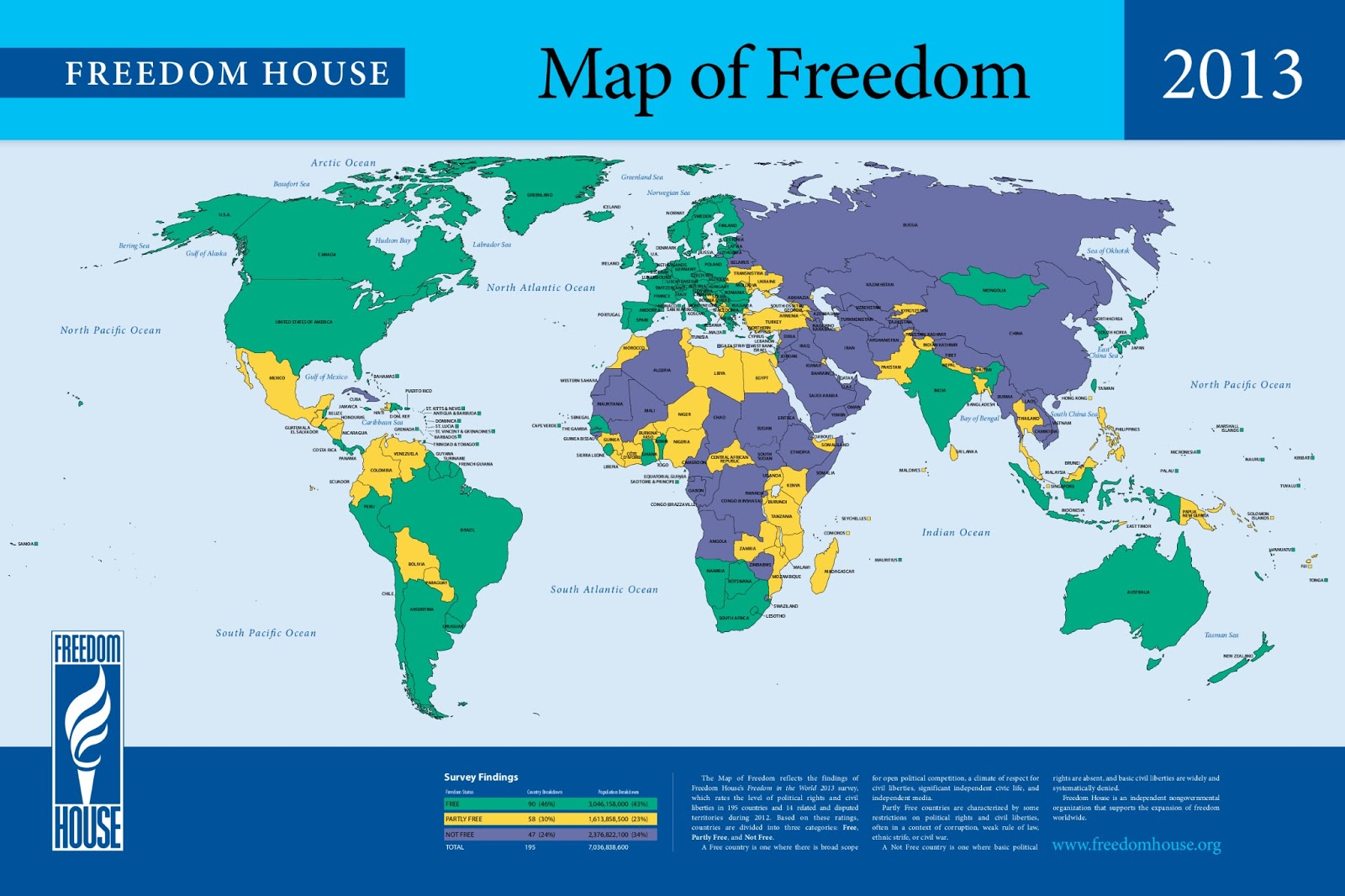
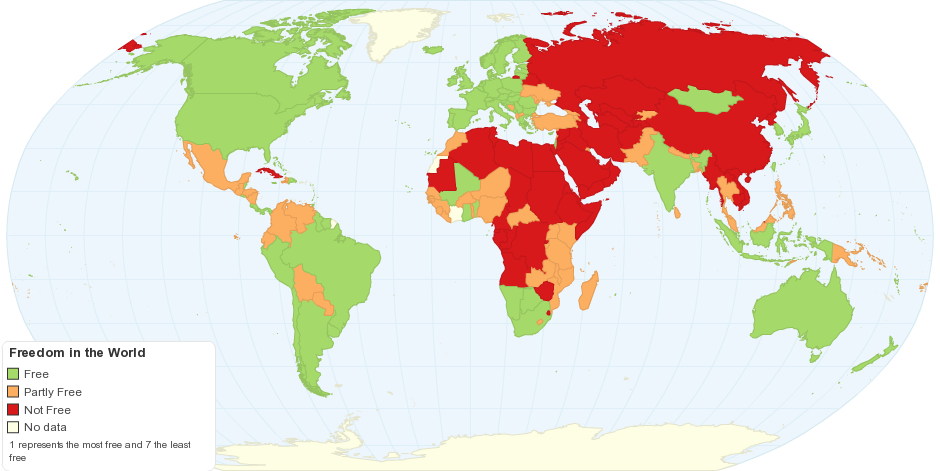
FREEDOM HOUSE’S FREEDOM IN THE WORLD MAP: I lived in India since my birth and I left India during 1984 due to a concern about my Freedom after alienation or estrangement from my birth social community. I had reached the United States during 1986 to discover that I have lost all Freedom; I had given up the Freedom associated with my Indian citizenship and found that my existence is not dependent upon Freedom but on Divine Providence and Divine Grace. Do I have a choice? Is Freedom an entitlement? Is there Freedom in Free World??? Freedom is it self-determined or is it determined by external causes???
The word ‘Freedom’ has many meanings – theological, metaphysical, psychological, moral, natural, and civil. Freedom may mean enjoyment of personal liberty, of not being a slave, nor a prisoner, and in essence it speaks about the freedom in acting and choosing. Freedom may imply the state of not being subject to determining forces. Is it self-determined or is it determined by external causes???
FREEDOM AND FREE WORLD: 54th TIBETAN NATIONAL UPRISING DAY, MARCH 10, 2013:
Kalon Tripa Dr. Lobsang Sangay, political head of the Tibetan people, unfurls and raises the Tibetan National Flag on the 53rd National Uprising Day on March 10, 2012 in Dharamsala, India. Tibetan people are demanding their Right to Natural Freedom that was taken away by the military occupation of their Land. Freedom in Tibet is about oppression caused by foreign occupation.
Freedom in Free World: I have arrived in the United States for I shared the Motto of this Nation: “In God We Trust.” The New Testament Book, The Epistle of Apostle Paul to Ephesians, Chapter 2, verse# 19 speaks of my quest for Freedom: “Consequently, you are no longer Foreigners and Aliens, but fellow citizens with God’s people and members of God’s household,…” How can I find that Freedom to enter God’s household if I am a Foreigner, or Alien??? There is a promise in The New Testament Book, The Epistle of Apostle Paul to Romans, Chapter 9, verse# 25: As He says in Hosea: “I will call them ‘my people’ who are not my people;”
“Free World” is a Cold War era term often used by the US to describe those countries that are not in the sphere of influence of Communist States like the Soviet Union, or the People’s Republic of China. United States is the Leader of the Free World, and it is the world’s Democratic Superpower. In response to Communist China’s military occupation of the autonomous nation of Tibet, United States to defend its own national interests and to combat the threat of Communist expansionism, initiated a program to render assistance to the Tibetan resistance movement to uphold the principles of Freedom and Democracy in the Land of Tibet. John F. Kennedy, the 35th President of the United States(1961-1963) created a military alliance/pact between the US, India, and Tibet to fight the military threat posed by China. During 1969, I made a deliberate choice to serve in India’s Armed Forces to face the military challenge and threat posed by China after it had brutally attacked India across its Himalayan frontier during 1962. On completion of my military training, I had joined this US, India, Tibet military alliance/pact and was posted to a military establishment called Establishment No. 22, a military organization also described as ‘Special Frontier Force’. I was very passionate about defending the cause of Freedom and Democracy. I spent several years in India and I had imagined that I had freedom to choose and act and had deliberately expressed this sense of personal freedom when I got married during 1973. This choice had its consequences. It initiated a process of alienation and estrangement from my birth-related Hindu-Brahman, social community. The first blow to my sense of social identity and birth affiliation was delivered during 1976 while I was at Armed Forces Medical College, Pune. By year 1982, I have recognized I have no freedom to choose, or act without compromising my sense of self-respect, and self-dignity. For all practical purposes, I was transformed into a Foreigner or Alien while I was still serving my country as a Commissioned Officer of its Armed Forces. It undermined my ability to serve in the Armed Forces to defend the Freedom of the country while I was perceived as a Foreigner or Alien. At that time, as the father of two young children, I felt that I have no choice other than that of leaving India to find a place in another part of Free World. Now, I am conscious of the lack of freedom to make choices, or I may state that I am only free to make a choice that is foreordained, or predetermined. In the drama of human life and history, do we have the capacity to choose our Life??? The issue of human freedom, and freedom in world may have to be reconciled with God’s omniscience, and omnipotence to understand as to what extent the will of an individual can and does determine some of his acts. If man is entirely dependent upon God’s power, can man make bad, or evil choices??? Do we need divine grace for both meritorious, and even bad acts??? How to define the problem of the universal supposition of responsibility for personal actions??? Can there be Freedom in the absence of Divine Providence, and Divine Grace???
DETERMINISM AND FREE WILL:
This Kid is apparently has Free Will and can choose to get wet in the rain. He can also choose to remain under a shade and keep dry. This ability to choose is operated by an external contingency called rain. Does man have the natural ability to make choices in the face of all types of external contingencies??? Plato held that actions are determined by the extent of a person’s understanding, or reasoning. The New Testament Book, The Epistle of Apostle Paul to Romans, Chapter 8, verses 28-30 describe the concept of “Predestination.” Verse# 30 reads: “Moreover, those He predestined, them He also called; those He called, them He also Justified; those He justified, them He also glorified.” I live in the expectation of finding this ‘glory’ in the eyes of God.
The term Free Will refers to the power or capacity to choose among alternatives. It refers to the ability to act in certain situations independently of natural, social, or divine restraints. Will is the factor which turns human thought into human action and behavior. Existentialist thinkers like Jean Paul Sartre speak about the concept of a radical, perpetual, and frequently agonizing freedom of choice. Sartre claims that man is “condemned to be free” even though his situation may be wholly determined. Behavioral psychologists hold the view that human action and behavior is determined by the nature of an external environmental stimulus. Sigmund Freud held the view that human actions are determined by hidden mental causes which control their actions; “You have an illusion of a psychic freedom within you which you do not want to give up.” Freud recommends that this “deeply rooted belief in psychic freedom and choice” must be given up because it “is quite unscientific.” Man appears to be subject to the Law of Cause and Necessity, or is governed by a doctrine of Determinism.
THE DOCTRINE OF PREDESTINATION:
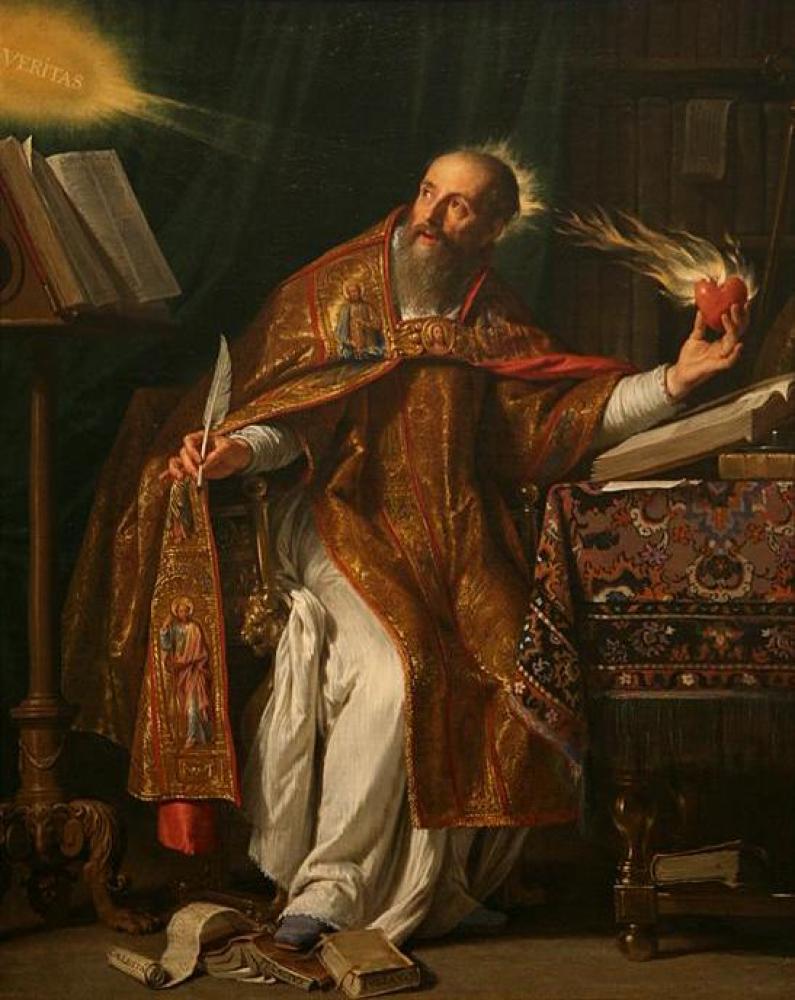
Saint Augustine(354-430), Doctor of the Church, founder of Christian theology followed the doctrine of predestination or divine grace that states God’s superintendence of the Whole Cosmos and everything in it.
Martin Luther(November 10, 1483 to February 18, 1546), German theologian, leader of the Protestant Reformation held the view that everything is determined by God from the beginning.
John Calvin(1509 – 1564), French Protestant theologian of the Reformation held the view that human free will is predetermined. While rejecting the role of free will, Calvinism maintains that God’s grace is irresistible.
Saint Thomas Aquinas held the view that God’s omnipotence does not include the predetermination of human will. The Roman Catholic Church teaches that predestination is consistent with free will since God moves the soul according to its nature. Do I make my own choices while God foreordained my circumstances? Does God have foreknowledge of my reaction to His Choice? If God foreordained the circumstances, the choices, and the destiny of the person according to His Perfect Will, how to explain the exercise of free will? It appears to me that God may elect or predestinate the circumstances of a person and make a choice on His own initiative on the basis of His knowing in advance the reactions of the person to His Will. Man’s free will is like the game of chess; man can make his moves while playing the game according to God’s plan while God is the second Player with whom man has to contend.
The Hindu Temple, Malibu, Southern California. Is this the Temple in which I am destined to worship the LORD GOD??? The New Testament Book, The Epistle of Apostle Paul to Ephesians, Chapter 2, verse# 21 reads: “In Him the Whole building is joined together and rises to become a Holy Temple in the LORD.” Why does the Hindu-Brahmin community treat me as a Foreigner and Alien and provided the contingency to take away my Freedom???
Rudra N. Rebbapragada/ R. Rudra Narasimham, B.Sc., M.B.B.S.,
While this Map shows Freedom in the World, there is a Hindu-Brahmin Spirit in a Prison for defending the cause of Freedom and Democracy in the occupied Land of Tibet.
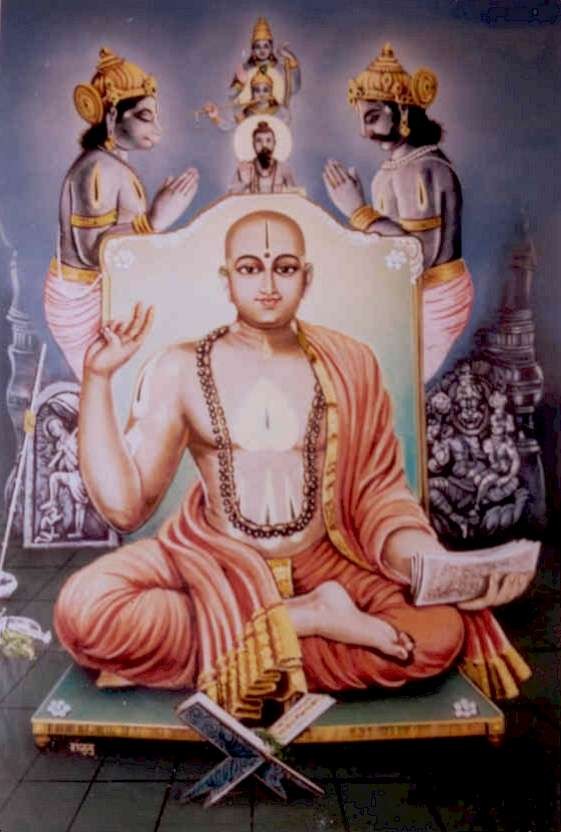
Spiritualism and Fundamental Dualism: Madhvacharya(c. 1199 – c. 1278) is the exponent of “DVAITA”, the Indian School of Philosophy that claims a basic difference in kind between God and individual souls.
Madhva of India had glorified difference between things. He traced back his dualistic thought to the Hindu scriptures known as the ‘Upanishads’. His main works are his commentaries on the Upanishads, the Bhagavad Gita, the Vedanta-Sutras, and the Indian epic poem of Mahabharata. Five types of distinctions, or differences are central to Madhva’s system of “DVAITA” philosophy: 1. distinction between soul and God, 2. distinction between soul, and soul, 3. distinction between soul, and matter, 4. distinction between God and matter, and 5. distinction between matter, and matter. Madhva refuted the “ADVAITA”, or Non-dualistic philosophy of Shankara(A.D. 788 – A.D. 820) who believed that the individual soul and the absolute Spirit(Brahman) are totally identical in all aspects and cannot be differentiated into two separate categories. Madhva rejected the Shankara theory of “MAYA” or ‘illusion’ which taught that only spirituality is eternal and the material world is illusory and deceptive. Madhva maintained that the simple fact that things are transient and ever-changing does not mean that they are not real. Madhva while rejecting the Advaita concepts of falsity and indescribability of world, did not oppose the distinction between the human body and the individual human soul. It appears that the various Schools of Indian philosophy to a large extent agree to a view that separates the individual human soul from its human body. However, it is interesting to note that Madhva thinks that the human individual is “Free” and is dependent only upon God. Madhva shared the Hindu belief in endless transmigration of souls through cycles of birth, death, and rebirth and stated that the “Release” is obtained by devotion to God. He promoted a view, ultimately it is God’s grace that saves man and that man must receive God’s grace through worship.
SPIRITUALISM – WHAT IS THE BASIS FOR HUMAN EXISTENCE?
SPIRITUALISM AND THE BASIS FOR HUMAN EXISTENCE: The structure and function of human ovum or the egg cell must be clearly understood to know the Spiritual Basis for Human Existence. This egg cell is capable of immanent actions, displays cognitive abilities, and performs intelligent functions. It is conscious and is fundamentally distinct from non-living, inanimate, insentient, inorganic matter.
My view about human soul and spirit differs from the views shared by the three major Indian Schools of philosophy. In my opinion, the ground substance that is called ‘cytoplasm’ is a spiritual substance(the substance that I recognize as the substance associated with Soul/Spirit) and this corporeal substance or living matter is fundamentally distinct from non-living matter. The entire human organism is derived from the single, fertilized egg cell; therefore, the individual human soul cannot be separated from the human body it constitutes and develops to establish a human individual that lives or exists as a real, physical being that has objective identity apart from subjective living experience. To interpret the term ‘spirituality’, or ‘spiritualism’, I make a fundamental distinction between life, and non-life, between organic, and inorganic matter, between animate, and inanimate, between sentient, and insentient, between intelligent and mechanical functions, and between immanent actions, and transitive actions.
Rudra N. Rebbapragada/R. Rudra Narasimham, B.Sc., M.B.B.S.,
Ann Arbor, Michigan, U.S.A.
Organization: The Spirits of Special Frontier Force.

























 Whole Dude - Whole Spirituality