puṇyaḥ—pure; gandhaḥ—fragrance; pṛithivyām—of the earth; cha—and; tejaḥ—brilliance; cha—and; asmi—I am; vibhāvasau—in the fire; jīvanam—the life-force; sarva—in all; bhūteṣhu—beings; tapaḥ—penance; cha—and; asmi—I am; tapasviṣhu—of the ascetics
BG 7.9: I am the pure fragrance of the Earth, and the brilliance in fire. I am the life-force in all beings, and the penance of the ascetics.
WHAT IS MATTER ?
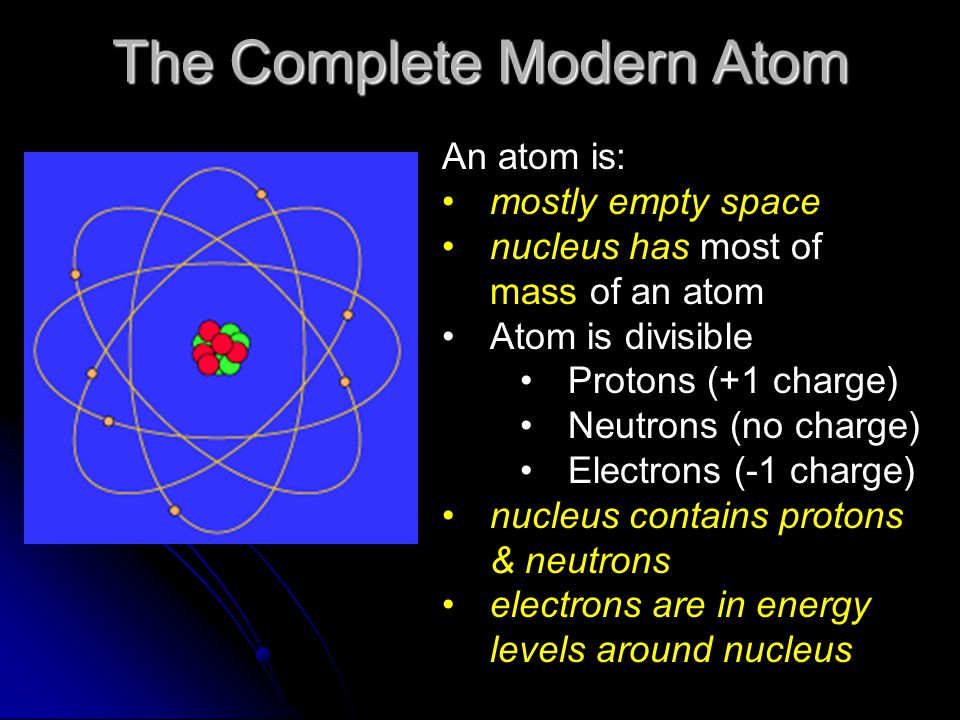
Earthly Existence. Enjoy the Fragrance. What is Matter? An atom is: mostly empty space. nucleus has most of mass of an atom. Atom is divisible. Protons (+1 charge) Neutrons (no charge) Electrons (-1 charge) nucleus contains protons & neutrons. electrons are in energy levels around nucleus.
To understand existence, it is very important to know about the nature of matter. Matter, either living or nonliving is made up of basic building blocks known as atoms. All atoms contain particles called electrons that carry a negative electrical charge. At the center of the atom lies the atomic nucleus which is composed of two types of particles; the proton which carries both mass and a positive electric charge, and the neutron which has about the same mass as a proton but is electrically neutral. Protons, neutrons, and electrons are the constituents of ordinary matter. But these are only three of a vast number of similar particles which differ only in a few properties such as their mass, electrical charge, and their stability against spontaneous decay. Protons, and neutrons are part of a much larger family of similar objects which are collectively called nucleons. Many of these fundamental particles are combinations of elementary particles popularly known as Quarks.
THE FOUR FUNDAMENTAL INTERACTIONS
Earthly Existence. Enjoy the Fragrance. The Four Fundamental Interactions.
Any influence that causes a collection of particles to undergo some change is known as Fundamental Interaction.
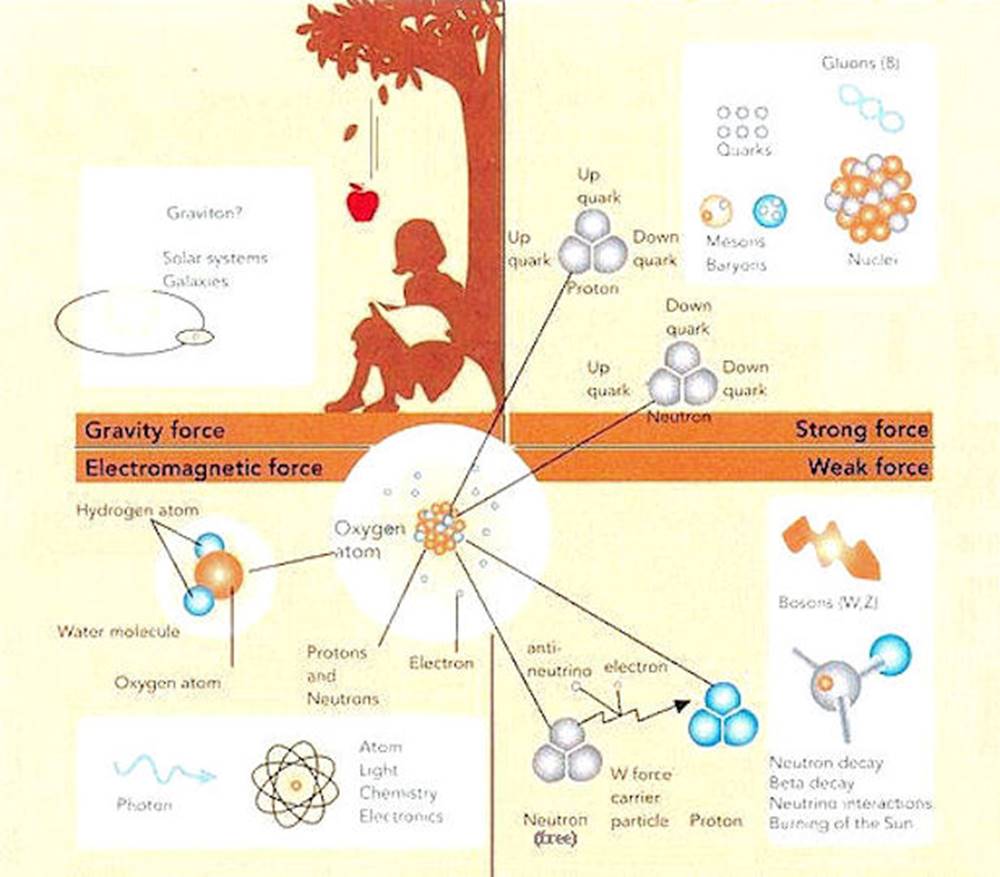
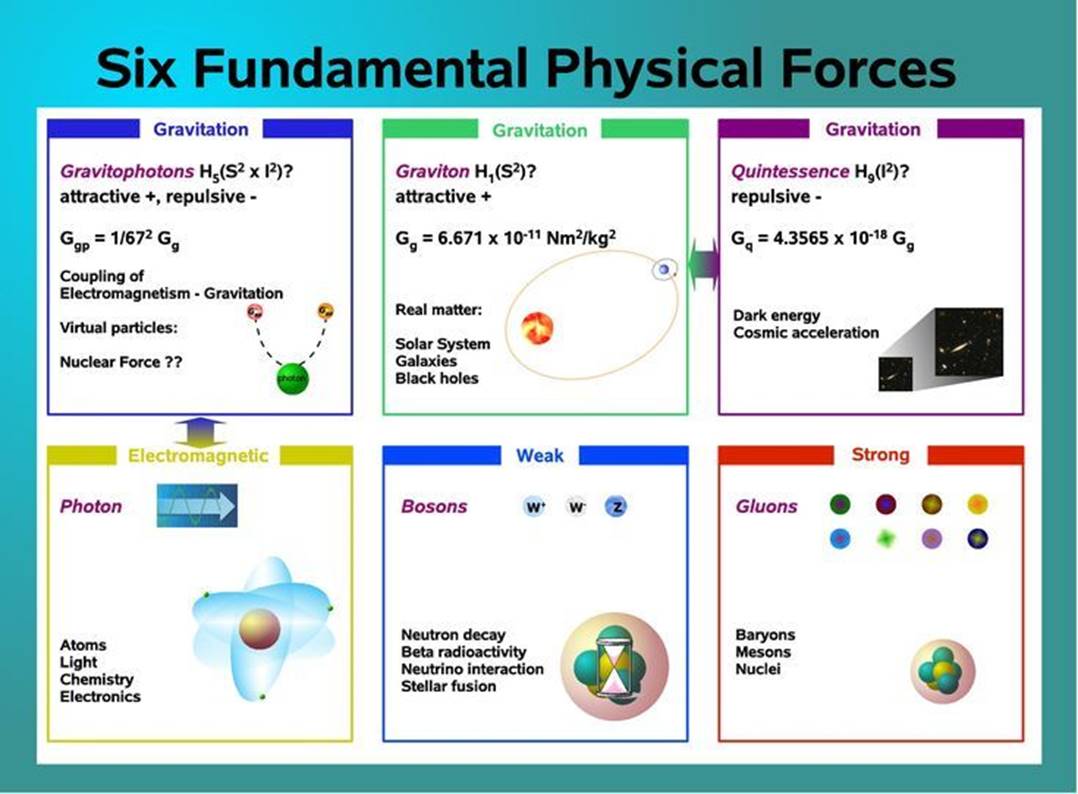
All known physical interactions of matter occur through the agency of four basic physical or fundamental kinds of forces. These Four Fundamental Forces, in decreasing order of strength are, the Strong Nuclear, the Electromagnetic, the Weak Nuclear, and the Gravitational Force. Each force has a characteristic strength and a range or distance over which they can exert their effects. The Strong Nuclear force is the strongest force known in nature. Its range is about a distance of 10 to the power of (-)13 cm. It weakens rapidly with distance. The particles of the atomic nucleus are tightly bound by the Strong Nuclear force. The Weak Nuclear force is involved in nuclear decay processes and in interactions involving the fundamental particles called neutrinos. If the Strong Nuclear force between two protons is assigned a strength of 1, then the Electromagnetic, Weak Nuclear, and Gravitational forces between the same two protons have relative strengths of 10 to the power of (-)2, 10 to the power of (-)5, and an incredibly small 10 to the power of (-)40. Thus the effect of Gravitational force on interactions among particles of atomic size is negligible. The Electromagnetic attractive force between a proton and an electron is several (10 to the power of 40) times greater than the Gravitational force at the same separation.

GRAVITATIONAL FORCE
Earthly Existence. Enjoy the Fragrance. Isaac Newton formulated the theory to explain Gravitation as the Force that causes apples to fall from trees.
Gravitation has several basic characteristics that distinguish it from the other Fundamental Interactions. First, it is universal, affecting all forms of matter and energy in essentially the same way whereas all the other interactions directly affect only certain types of particles, for example, Electromagnetic force affects only charged particles. Second, Gravitation is always ‘attractive’, since it interacts with mass-energy which is always positive, whereas Electromagnetic forces can either ‘attract’ or ‘repel’. Third, Gravitation is a long range interaction. Electromagnetism is also long-range, but the Strong and Weak Nuclear forces generally operate only within a distance, the size of an atomic nucleus. Fourth, Gravitation is the weakest of the Four Fundamental Forces with negligible effect on elementary particles.
Earthly Existence. Enjoy the Fragrance. Sir Isaac Newton and the discovery of Gravitational Theory.
Sir Issac Newton made the most significant contribution to Gravitational Theory when he perceived (1666) that the orbit of the Moon depended on the same type of force that causes an apple to fall on Earth. According to Albert Einstein’s Theory of Relativity, Gravity affects all forms of matter and energy, all of which move in Space-Time (SPACE-TIME CONTINUUM).
Earthly Existence. Enjoy the Fragrance. For consideration of earthly existence, Gravitation can be explained as a Force of Attraction.
Gravity is by far the weakest known force in nature and therefore plays no role in determining the internal properties of everyday matter. Gravitational force becomes appreciable only when at least one of the attracting masses is very large, typically of planetary size. A Gravitational force exerted by the Earth on the Moon keeps it in a circular motion about the Earth. The trajectories of planets in the Solar System are determined by the Laws of Gravity. The revolution of the Earth in relationship to the Sun, the motion of the Sun around the center of the Milky Way Galaxy, and the geometric structure of the universe itself are the results of the Gravitational force. Because of its long reach and universality, Gravity plays a central role in shaping the structure of stars, galaxies, and the entire universe. Hence, it would be correct to claim that Gravitational force is the most pervasive and dominant force in the universe.
TERRESTRIAL GRAVITATION
Earthly Existence. Enjoy the Fragrance. The Body Mass or the Body Weight is the Constitutive Principle and Terrestrial Gravitation is the Regulative Principle of the human existence on the surface of planet Earth.

Terrestrial Gravitation is the force that tends to draw all bodies in the Earth’s sphere toward the center of the Earth. The fall of bodies released from a height to the surface of the Earth and the weight of resting bodies at or near the surface are the most familiar manifestations of Terrestrial Gravitation.
Earthly Existence. Enjoy the Fragrance. The Constitutive and the Regulative Principles of earthly human existence. The man is the Object of his own experience. The Body Mass is the Constitutive Principle. Terrestrial Gravitation is the Regulative Principle. The man may or may not acknowledge the operation of the Regulative Force or Power that gives the experience of his Body Mass.

Because of the Gravitational force exerted by the Earth’s mass, all bodies have a weight or downward force of gravity proportional to their mass. The word gravity is derived from the Latin word ‘gravitas’ which means weight or heaviness.
Atmosphere, the nearly transparent envelope of gases that surrounds the Earth, profoundly influences the environmental, and the climatic conditions on the planet’s surface. Life could not exist without the physical and chemical processes involving the atmospheric gases. Terrestrial Gravitation is the force that holds the atmosphere in its place.
EARTHLY EXISTENCE
Earthly Existence. Enjoy the Fragrance: The most important function of Light is not that of providing visual sensation. Light performs several non optical functions. Plants have the ability called photoreception and can measure the length of the day without performing the function called Vision. Plants have the ability to use light energy to perform biochemical reactions such as Photosynthesis which is a creative mechanism to trap light energy as chemical energy that living things can further use to perform a variety of their living functions.
The earthly human existence is possible only because of the Four Fundamental Interactions of matter. All living entities are energy dependent. The primary source of energy is Sun. The Strong Nuclear, the Weak Nuclear, and the Electromagnetic Force Interactions are involved in the burning of Sun’s hydrogen fuel to provide the energy that the man needs for his earthly existence. According to the Laws of Nature, this source of energy would eventually bring about disastrous consequences to earthly existence. The Sun continues to spend its abundant hydrogen fuel and the fuel supply is not everlasting.
The Gravitational Force maintains earthly existence in two ways. Firstly, it maintains Earth’s relationship with Sun and secondly, it firmly holds the Earth’s atmosphere in its place. The most important effect of Gravity is that it provides us the Subjective experience of our own body weight which helps to appreciate the physical reality of our earthly existence.
EARTHLY FRAGRANCE
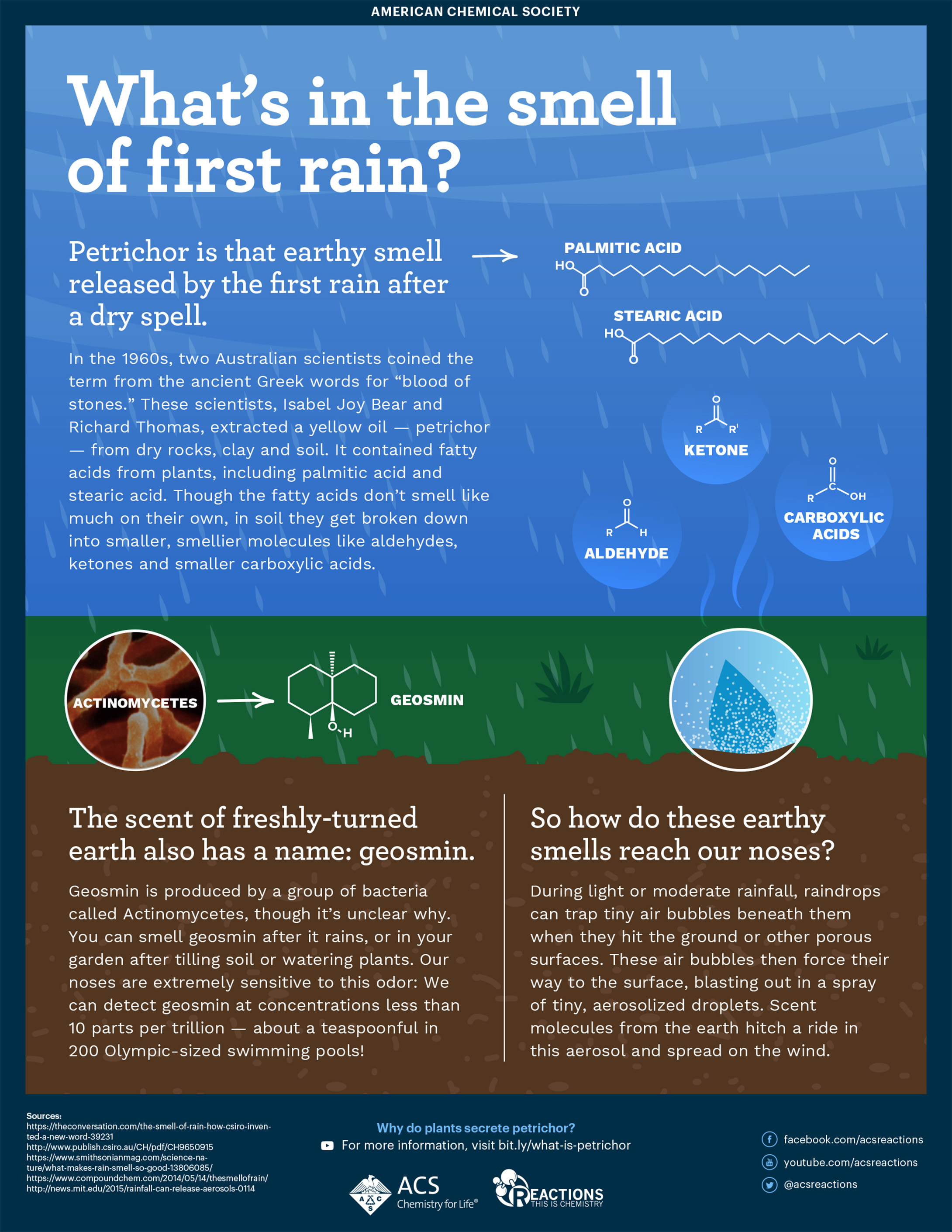
Earthly Existence-Enjoy the Fragrance. Earth’s Soil can generate an aroma of its own which the man can experience very easily.
Soil is the earthen material that covers land surfaces and is formed by the action of natural physical, chemical, and biotic forces on the rocks and minerals on the Earth’s surface. Among its many important functions, soil serves as a substratum of plant life. It provides the terrestrial home for land based animals and humans.
Earthly Existence-Enjoy the Fragrance.
This surface layer of Earth has a characteristic fragrance of its own. It could be described as a sweet smell, a pleasant odor. It is not fruity, flowery, or spicy. The volatile compounds that generate this odor should reach our noses and the gas molecules should get dissolved in the nasal mucus and activate the receptors of smell or olfactory sensation. To perceive this scent, the soil should not be too cold and frigid. At cold temperatures, the odor generating chemicals do not get vaporized. The soil should not be too hot, as excessive heat tends to destroy these scent chemicals. The Earthly fragrance is best appreciated after rain showers and also during the Spring Season. This fragrance is unique and makes planet Earth a special place. This scent is original. In nature, all products such as flowers, fruits, and herbs which are fragrant could be easily identified as the fragrance and its source are connected. The individual components of the soil are not the direct source of earthly fragrance.The physical, chemical, and biotic factors that interact to generate this fragrance are not available on any other celestial body in the universe that we know today.The Four Fundamental Forces are united in their purpose to produce this new and original product. The originality of Earth’s fragrance could be deemed as an act of creation.
Earthly Existence and the Cosmic Connection. SUN GOD, LORD SURYANARAYANA, LORD OF SKY AND WATER, SAVITA – THE COSMIC FATHER
WATER FOR LIFE
Water is vital to life, participating in virtually every process that occurs in all living creatures. All living things consist mostly of water, for example, the human body is about two-thirds water. The contents of a living cell known as cytoplasm by its composition is about 70 to 90 percent water. The versatility of water as a universal solvent is essential to living organisms. Earthly life depends upon aqueous solutions that are used for carrying out biological processes such as circulation, and digestion.
Water is the most common substance on Earth covering more than 70 percent of the planet’s surface. About 97 percent of the Earth’s water is in the oceans, 2 percent is permanently frozen as polar ice caps, and glaciers, and most of the reminder about 1 percent consists of groundwater or surface streams, rivers, and lakes. The abundant sea water being too salty is of no direct use to the terrestrial forms of life. For earthly existence, the vast majority of plants, animals, and human beings depend upon water that reaches the ground as precipitation from the sky.
THE WATER CYCLE OR HYDROLOGIC CYCLE
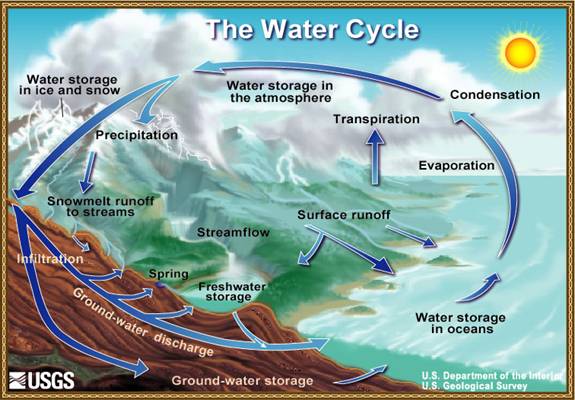
The Water Cycle or Hydrologic Cycle demonstrates the Connection between Earthly Existence and Cosmic Power.
The Greek philosopher of nature, Anaxagoras (500 – 428 BC) who lived in Athens, provided the earliest description of the hydrologic cycle, stating that the Sun lifts water from the sea into the atmosphere, from which it falls as rain. The Roman architect and engineer Marcus Vitruvius (1 st century BC) described that the groundwater is derived from rain and snow by infiltration of the soil.
The hydrologic cycle is the process by which water circulates continuously between the atmosphere and the surface of the Earth, falling as precipitation, evaporating or transpiring from vegetation back into the atmosphere, or collecting as surface runoff via streams and rivers and flowing to the sea, there to evaporate again into the atmospheric portion of the cycle. It involves the continuous circulation of water in the Earth-Atmosphere system. The most important processes involved in the water cycle are evaporation, condensation, precipitation, and runoff as streams and rivers. Evaporation involves the transfer of water in the liquid state from the surface of the Earth to the gaseous or vapor state in the atmosphere. The main factors affecting evaporation are solar radiation (the source of heat/temperature), humidity, and wind speed. The radiant energy from the Sun also melts the snow and ice to perpetuate the surface runoff that we recognize as streams and rivers.
THE SUN GOD, LORD SURYANARAYANA, VYOMANATHA (LORD OF SKY AND WATER), SAVITA – THE COSMIC FATHER
All living entities upon Earth are energy dependent and they thrive by drawing the material energy from nature. Sun is the cosmic source of energy for earthly life. Apart from energy, the Sun is the source of freshwater for all terrestrial life. Sun’s role in the hydrologic cycle could be compared to the role heart plays in the human circulatory system. Human heart is considered to be a vital organ as it works like a mechanical pump to circulate purified blood which sustains all the essential functions of the entire body. Just like the human heart, the Sun provides the energy, which very much like a mechanical pump, lifts water from the oceans into the atmosphere and during this process of evaporation the salt water is transformed into purified fresh water. This water vapor is the most important component of Earth’s atmosphere and it provides the opportunity for our earthly existence. Being the source of energy, and of fresh water, it is appropriate to describe the Sun as the Cosmic Father. His heat may put us to trouble, arouse our sense of thirst, but His rains quench our thirst. Indian Cultural traditions recognize Sun as SAVITA which means Cosmic Father and He is often described as the provider of great rains, and as a friend of waters that flow across the land surface. Earthly existence is simply impossible without this harmonious relationship between the Cosmic Sun and earthly living creatures.
A HYMN TO THE SUN GOD
Earthly Existence and the Cosmic Connection. A hymn to the Sun God.
In the epic poem of RAMAYANA, sage AGASTYA taught LORD RAMA the hymns to worship the Sun God who is also known as ADITYA, RAVI, DIVAKAR, PRABHAKAR, MITRA,BHASKARA and other names. The hymns are known as ‘ADITYA HRUDAYAM’. The Sun illuminates the external world, and the same illumination could also dispel the darkness, the ignorance from our hearts, the inner world.
Life is a condition that describes Synchronized Existence, the synchronization of activities, the connection between energy dependent life functions and its Source of Power.
He is the Lord of the sky and water. He dispels darkness and ignorance. He had obtained the essence of Vedic Scriptures (Rig, Yajur, and Saama) and hence is the Master of Knowledge. He is the provider of great rains, and He is the friend of waters that flow across the land. He quickly traverses the celestial plane and we see Him moving over the Vindhya mountains.
व्योमनाथस्तमोभेदी ऋग्यजुः सामपारगः। घनवृष्टिरपां मित्रो विन्ध्यवीथीप्लवङ्गमः॥ १३ Transliteration: vyomanāthastamobhedī ṛgyajuḥ sāmapāragaḥ। ghanavṛṣṭirapāṃ mitro vindhyavīthīplavaṅgamaḥ॥ 13 English translation: He is the Lord of the firmament and ruler of the sky, remover of darkness. the master of the three Vedas Rig, Yaju, Sama, he is a friend of the waters (Varuna) and causes abundant rain. He swiftly courses in the direction South of Vindhya-mountains and sports in the Brahma Nadi. Hindi translation: सूर्य अंतरिक्ष के स्वामी, आकाश के शासक, अंधेरे के विद्वान, तीन वेदों रिग, यजुर एवं साम वेद के स्वामी है । भारी वर्षा के कारण भी यही है, या भगवान वरुना के दोस्त हैं । ये विंध्या रेंज को पार कर ब्रह्मा नदी को भी पार कर लिया है ।
The Border called the McMahon Line between India and Tibet is not my primary concern. In 1913-14, Tibet and China had the opportunity to negotiate a deal to determine and demarcate the border between China and Tibet. They failed to do so.
Representatives of Tibet, Great Britain, and China at Simla Accord 1914. Front row, from left: an assistant to Ivan Chen; Sekyong Trulku, Prince of Sikkim; Ivan Chen, Chinese plenipotentiary; Sir Henry McMahon, British Plenipotentiary; Lonchen Shatra, Tibetan Plenipotentiary; Teji Trimon, assistant; Nedon Khanchung, Secretary.
I contest the occupation of Tibet by the People’s Republic of China since 1950. In my analysis, annexation of Tibet by China is not a done deal. Tibetans have never agreed to submit their territory to be ruled over by the Communist Party of China. Tibet is never a part of China. In fact, there is no deal between China and Tibet on the demarcation of their border.
Annexation of Tibet by China. It’s Not a Done Deal. In fact, there is no deal between Tibet and China on the border issue.
BOOK EXCERPT
How the McMahon Line came to be the border between India and Tibet (and, later, China)
Contested Lands: India, China and the Boundary Dispute, Maroof Raza, Westland Non-Fiction.
An excerpt from ‘Contested Lands: India, China and the Boundary Dispute’, by Maroof Raza.
Maroof Raza
The original draft of the MacMohan Line in 1914: West (left) and East (right)
Lt Col Arthur Henry McMahon was formally nominated to represent the British government at the Simla Conference. With the rank of “secretary” in the foreign department of the British Government of India, McMahon was “empowered to sign any Convention, Agreement or Treaty, which may be concluded at the Conference”.
As a young captain, he had spent two years demarcating the Durand Line that separates Pakistan from Afghanistan today. He was moulded “in the furnace of responsibility and the anvil of self-reliance and relished the creation and laying down of boundaries.” His task at the Simla Conference, however, was neither enjoyable nor easy.
…China, wary of a Britain-Tibet deal, took a while to announce their representative or plenipotentiary for the Simla Conference. Eventually, when they did so, the Chinese first stated that Ivan Chen, an experienced diplomat, and Hu Hanmin would be their representatives. However, China decreed that they would be called pacificators, and would carry “no territorial powers”.
The British objected. It was only after threats and prodding that a Chinese presidential order was signed appointing Ivan Chen as their plenipotentiary and authorising him “to sign articles that may be agreed upon in order that all difficulties which have existed in the past may be dissolved”. He just about made it in time for the opening convention of the conference.
In contrast, the Dalai Lama was decisive and swift in appointing Lonchen Shatra Paljor Dorje, his Prime Minister who later impressed everybody with his quiet dignity, as his choice for the tripartite talks. Shastra was described as “a man of great ability and patriotism”. Moreover, an official statement from the Grand Lama stated “the Chief Minister Shatra Paljor Dorje is hereby authorised to decide on all questions which may benefit Tibet and to seal all documents relating thereto”.
Both sides made their positions known in the very first meeting held at Simla on 13 October 1913. With the Chinese defeated and evicted from Tibet, Lhasa made it known that it had an “independent” status and placed a document to this effect. But the Chinese still insisted that Tibet formed an integral part of the Chinese territory and no attempts shall be made by Tibet or by Great Britain to interrupt the continuity of this territorial integrity.
For China, unlike the British Government of India, Tibet’s precise boundaries weren’t important. The British hosting the conference wanted a defined boundary for Tibet, not just with India, but also with China. This was the primary reason for the Simla Conference to have dragged on for over six months, with contestable results.
The Chinese also made a range of ridiculous claims over Tibet, most notably over its territories from the Kunlun Mountains, southeast and south of the River Tsangpo (Brahmaputra) on to the River N’Maikha in Burma (now Myanmar). Even though McMahon was prepared for some surprises, he didn’t expect this cartographic aggression based on inconsistent and vague historical assertions.
However, there were factors that restrained McMahon from defining the boundaries. For one, a draft prepared by officials at Britain’s India Office had only envisaged a two-party meeting between representatives of Peking and Delhi. With Tibet’s entry in the deliberations, McMahon had to put up appearances to hide his limitations.
In reality, in the absence of clarity about the southern limits of Tibet, McMahon was awaiting some survey reports from the expeditions along the Himalayas, particularly from India’s northeast and the tri-junction between India, Tibet and Bhutan. This region had many unsurveyed “grey areas” along a frontier of over 1,000 kilometres and was often covered with mist or clouds with many snow-covered mountains that couldn’t be easily accessed from the Indian side. This prevented McMahon from presenting a clear proposal to the conference plenipotentiaries on this part of the boundary.
Thus McMahon opened the “second meeting” of the conference on 18 November 1913 by sharing his dilemma with colleagues. He placed a skeleton map of what should be “Tibet”, admitting – after both sides had made widely divergent claims – that he was “at a loss as to what really was Tibet”.
Thereafter, he conveyed to both the Chinese and the Tibetans that without an agreement on the “limits of Tibet”, further progress was not possible. China’s Chen first said he’d have to refer the matter to Peking and then he took to bed after the meeting, claiming he was ill! Thus, with no hope of an immediate headway and with the winter in Simla bringing life to a virtual standstill, the conference venue was shifted to Delhi. It was over subsequent meetings in Delhi, both formal and informal, that there was some movement forward.
The Tibetans brought to these meetings more than ninety records and documents and backed their boundary claims with historical records in their original form, including fifty-six different registers, with numbers of monasteries and details of families, “where the writ of the Dalai Lama was unquestioned”. The Chinese, on the other hand, made historically refutable claims based on scanty evidence.
Moreover, the Tibetans’ statements were extremely critical of the “scorched earth” policies of the Chinese, especially its military commander Zhao Erfeng, who had destroyed many of their temples and villages and massacred hundreds of lamas and people. Erfeng was known to have made paper shoe soles from the leaves of Buddhist scriptures containing the teachings of Lord Buddha!
The Tibetans were thus unwilling to accept Chinese claims based on the ruthless military campaigns by Erfeng, stating that “Chao Erh-feng had been guilty of such glaring misdeeds and that even if he had a hundred lives he should forfeit every one of them to the law…”
Thus, the hotly contested territorial claims of the Chinese and Tibetans put McMahon in a spot in his attempts to find common ground, to end their “state of war” and to move the conference towards its conclusion. However, given his vast experience in map-making, McMahon proposed the division of Tibet into two zones – with the approval of Whitehall in London – by drawing lines on a map to mark: Inner (by a blue line) and Outer (by a red line) Tibet.
But the Chinese were unwilling to accept the concept of Inner or Outer Tibet. Even then, McMahon was hopeful of a settlement at the fifth conference in Delhi that was to be held on 11 March 1914. At the fifth conference, McMahon, apprehensive that China–Tibet hostilities would stall his best efforts, warned both parties that any attempts to change the ground realities to attain a favourable deal at the conference would have grave consequences. He demanded instead statesmanship from Ivan Chen and Lochen Shatra.
There was, however, a quiet spoiler lurking on the sidelines. Lu Hsing Chi was a Chinese spy at the conference, who set alarm bells ringing in China about a possible outcome that would put China at a disadvantage vis-à-vis Tibet, and thus, Peking virtually rejected the entire draft that McMahon and his team had painfully put together, demanding a better deal. Sensing that the conference might collapse, McMahon threatened to present proposals that were more stringent. This kept the Chinese team on board until the conference shifted back to Simla in April 1914, when McMahon had a private chat with Chen.
McMahon warned that if Chen failed to initial the documents in the final meetings, it would be withdrawn. Deep inside he was also prepared for the conference to end without any results even though McMahon had hoped that this was to be a decisive phase of the conference. Thus, he resorted to theatricals.
He began with a summary of earlier conference proceedings and when he ran into resistance by the Chinese and then by the Tibetans, his patience ran out. As a shocker to those in attendance, he ordered the withdrawal of the convention “with as much ceremony as possible”, as recorded by observers, to drive home his frustration with the negotiations.
This unnerved Ivan Chen, the Chinese plenipotentiary in Simla. However, in one last attempt, the conference was reconvened the next day, to give them a final chance to reconsider their positions. Facing the distinct possibility of China being left out of the border arrangements, Chen made up his mind to initial the draft and the map and, much to the relief of all, proceeded with the formalities.
However, Chen announced that he was still “bound to await definite authority from his government in Peking before the convention was formally signed and sealed”. Even as it appeared that matters had finally come to a successful conclusion, this was not to be. Chen informed McMahon’s office that his government had refused to accept – “repudiated” – his signing of the convention! McMahon was disappointed, given his multiple attempts to accept Chinese demands.
It soon became known that the man who influenced Peking to put the brakes was Lu Hsing, their Calcutta-based spy, who was elevated to an official position to negotiate with Lhasa. London was brought into these talks and soon Chinese officials suggested that Chen had been forced to agree to the terms of the convention, whereby its venue should be shifted to Peking or London. There is a view that this process reflects a conflict of interest as McMahon was both the arbitrator and the interested party here.
On the brighter side, however, the conference yielded another outcome. After Peking and Lhasa had presented enough documentation to back their conflicting territorial claims on the Sino-Tibetan frontiers, which had led to no agreement, the focus of the conference shifted to the Indo-Tibetan boundary. On this, the Chinese delegate opted to stay out, as he claimed he wasn’t authorised to discuss it.
Thus, McMahon and the Tibetan delegate agreed on an Indo-Tibet boundary on 24-25 March 1914. To that effect, McMahon drew a line on a small-scale map and this line came to be known as the McMahon Line. This boundary was marked in red ink along the crest of the Himalayas—the watershed that gave northeast India a defined boundary with Tibet. This was a major outcome after many months of negotiations, even though this was a secondary objective of the Simla Conference.
Annexation of Tibet by China. It’s Not a Done Deal. In fact, there is no deal between Tibet and China on the border issue.
An All-Inclusive Perspective about human existence on the surface of planet Earth.
What it is to be a Substance? and What it is to Exist? We need to establish knowledge about the man and the world on a firm basis and the information it provides must be tested for its accuracy and consistency with an external reality. We have to make the fundamental distinction between the living and the non-living matter. The scientific advances of the 19th and 20th centuries reinforced the materialistic position concerning the basic similarity of organic living and inorganic physical matter. The man is viewed as a product of natural evolution and is thought to be subject to the same laws of Physics and Chemistry or mechanistic principles.
We need a methodology to study philosophy and to understand philosophical statements. Logical Positivism, also known as Scientific Empiricism aims to clarify concepts in both everyday and scientific language. It describes analysis of language as the function of philosophy. This analysis of language and of concepts is important to understand questions of belief and ideology which affect what we think we ought to do individually and socially. I would use this method of ‘Applied Philosophy’ to analyze the concept of Spiritual Optics, the Spiritual dimension of designing the Solar System and the designing of the Living Systems.
A POUND OF FOOLISHNESS IS BETTER THAN A PENNY OF WISDOM:
What is Reality? The Golden Gate Bridge is real, Pacific Ocean is real, Sun is real. The Sunset is not real. Can man experience the Reality? How would Reality impact the man’s existence?
The social scientist Bruno Latour, from France’s “Institut d’ Etudes Politiques de Paris” was in New Delhi, India and spoke about what it means to be modern with Deep K Datta-Ray of Times of India. In essence, I support his view and there is a need for a new approach; the use of irrational belief and not that of scientific rational belief. I suggest that a Pound of Foolish or irrational belief is better than a Penny of Wisdom or rational belief. The conditioned nature of human existence leaves me with no choice other than that of being Penny Wise and Pound Foolish.
CAN SCIENCE PROVIDE THE EXPERIENCE OF REALITY?
Rational vs Irrational Belief. Pencil in Water Illusion. Can Science influence the nature of Perception? The Perception of bent Pencil is caused by the properties of Light rays. Science can only explain the reason for this Optical Illusion. Science has no Power to eliminate the Illusion. The only way man can experience the Reality of this Pencil would be that of changing the State of Pencil’s Conditioned Existence. It is easy to remove the Pencil from Water and experience the Reality. But, can Man remove himself from his Conditioned Existence and experience Reality?
It would be totally irrational to believe that Science must provide the experience called Reality. Science is not POWER/FORCE/ENERGY which operates in the natural world. Science provides information to understand things and it has no power or force to influence things. Science may reveal the understanding of the nature of Reality and such revelation could be of no use in the context of human existence on planet Earth as the man lives because of illusion he experiences of the world and the universe in which he exists.
THE REALITY OF EARTH’S MOTION:
The Material Basis of Spirituality Science. Rational vs Irrational Belief. The man is constituted as a Rational Being. The man cannot experience the reality of this world.
The speed of earth’s motion can be described in two ways; 1. The Angular Speed: The earth rotates 360 degrees in 24 hours and the speed is 1,000 miles/hour. 2. The Linear Speed: The distance earth travels is 584 million miles per year. The Linear Speed of earth is 66, 660 miles/hour.
Science may explain the fact of the speed of a point on the surface of the earth but can not force a man to experience the Reality of that Speed. The man exists on the surface of the earth without ever experiencing the Reality of earth’s true motions. There is no physical experience of this basic Reality. There is no direct mental experience of this fundamental Reality. The man may intellectually visualize this Reality by understanding the facts explained by Science. If the human brain and body is constantly engaged by the fact of earth’s motions, the Reality of earth’s Angular Speed and Linear Speed, the man would immediately experience a mental breakdown and would not be able to function as a living organism. Just think about the sense of fear, anxiety generated by a brief event like earthquake. The Subjective Reality of man’s Physical Existence on the surface of earth is sustained, is supported, and is protected by a Fundamental Force called Gravitation. Because of the operation of Gravitational Force the man is virtually saved from any experience of Earth’s motions. The man only experiences the environmental changes caused by earth’s motions. Further, this Subjective Reality of man’s Physical Existence is governed by a FORCE/POWER/ENERGY that imposes an illusion generating the experience of Sun’s apparent movement across the sky. Science explains the Reality of Sun’s motion at a speed of 155 miles/second. But, man exists on the surface of earth with no physical or mental experience of Sun’s true or real motion. What man experiences is the apparent motion of Sun and experiences Sunrise and Sunset. Science may explain the Reality and teach us the fact of Sun shining with brightness all the time. Man has invented stories and has created folk tales about Sun’s Journey in the Sky. The Reality described by Science does not govern human existence. The biological activities, the Biological Rhythms (Circadian/Diurnal/Solar Rhythms) are synchronized with the experience of ILLUSION and not that of Scientific Reality.
BIOLOGICAL CLOCK AND MAN’S LIFE JOURNEY:
Rational vs Irrational Belief. The man’s existence on the surface of planet Earth and the duration of his life’s journey is measured by the internal Biological Clock. The time duration is measured by the alternating periods of Light and Darkness, the experience of Day and Night, the experience of Sunrise and Sunset which drives the Biological Rhythm. In Reality, the Sun is shining with brightness at all times during the entire length of man’s life journey. Man gets no chance to experience that Reality and the Biological Clock is not influenced by that Reality of Sun shining at all the hours of man’s earthly existence.
The man can not exist on the surface of physical earth if he has direct body or mental experience of the Reality explained by rational Scientific Belief. The very nature of human existence in this vast universe can not be rationally understood. There is no evidence to suggest that Life could be discovered in other parts of our universe. There is no chance that the man could find an opportunity to leave the Solar System and find a Home in a different part of the universe. The man has no control over the structure and organization of the universe. The man has no choice other than that of accepting the conditioned nature of his energy dependent existence with no other place to call as Home. Rational beliefs have no role and do not define the status of man in nature and in the universe. It is more likely that man’s existence could be supported by an irrational belief in Ultimate Reality, which operates the POWER/FORCE/ENERGY which delivers MERCY/GRACE/COMPASSION to spread a veil of ILLUSION to defend the man from the direct physical or mental experience of Reality of the Universe in which man lives.
Rational vs Irrational Belief. Man can only exist in this Universe if he does not directly experience the Reality of this Universe. Man’s earthly existence is defended by ILLUSION and Science has no Power to provide man a chance to experience Reality which is hidden by the ILLUSION.
The social scientist Bruno Latour , from France’s Institut d’Etudes Politiques de Paris (Sciences Po), was in New Delhi and spoke about what it means to be modern with Deep K Datta-Ray .
Why do you argue that Western Europe has never been modern?
The only shibboleth the West has is science. It is the premise of modernity and it defines itself as a rationality capable of, indeed requiring separation from politics, religion and really, society. Modernisation is to work towards this.
A move away from the pre-modern, which is a period of embroilment and entanglement of everything but when one looks at the practice of science in a laboratory, as i did, this division is revealed as false.
Scientists are very much entangled in their culture and this culture is not pristine, untouched by other cultures and practices. The real history of Europe therefore is one of a constant interaction, a mixing of Peoples, various cultures and the material.
What does this mean for our understanding of what the modern world actually is, how institutions thought of as quintessentially modern function?
There’s very little on how today’s world actually functions. Instead there is the official story of modernization. Meanwhile, there is a prominent discourse in India about modernization.
My argument is that the baseline for understanding modernity requires interrogation, which destabilizes expectations of what a modernising society should do.
Traditionally, the moderns criticised the supposedly archaic, symbolised by the East. Everyone wanted to become modern – but my work demonstrates that being modern was never as clear as presumed. So, when India begins to modernise what happens?
There is a double instability – of an uncertain baseline and then what happens when that is implemented in a society far away and especially in an institutional setting and in an area so close to the state such as governance. So there has to be more work on this.
This is especially important because there are so many more people here, it is possible to have institutions of a different complexion altogether, of alternative ways instituted here. India is a reservoir of alternative interpretations of what the global is and these ways of viewing the world need to be exposed.
Could it also be said that the idea of a universalizing ‘modern’ rationality is not necessarily European but became dominant in Europe?
For that there has to be more work on the non-western world. Regardless of place, there have to be thicker descriptions of practice, of what the modern world actually is, how do banks work for instance, because all we have is the utopian description of how modernity functions. The dream of utopia killed descriptive work because the focus was on a universalizing rationality, not how rationality actually plays out in practice. It should be clear that I’m not saying the East is somehow different, exotic. If one looks at the works of Newton to Einstein they were never scientists in the way modernity understands the term.
What are the implications of this type of work on politics?
Well, politics cannot keep to the scientific ideal quite simply because science in practice meant our moving from the country to the city and getting progressively disconnected from nature. But now one cannot discuss anything without thinking of the whole. Science was supposed to take us out of the cosmos and into a universalizing rationality but that has produced all sorts of problems which are being corrected today by new approaches which are reminiscent of the non-modern, such as the politics of nature. This is a cosmological approach, one that ties in everything to make a decision.
The Material Basis of Spirituality Science. Rational vs Irrational Belief. In matters of faith and belief, a Pound of Foolishness is Better than a Penny of Wisdom
The Material Basis of Spirituality Science. The Rational Basis of Idol Worship. The Lord of Spring Season. Lord Madhava with Goddess Madhavi: In the Divine Song called Bhagavad Gita, Chapter X, ‘The Infinite Glories of the Ultimate Truth’-‘VIBHUTI VISTARA YOGA’ describes the LORD God Creator’s Infinite Divine Attributes, in verse # 35, Lord Krishna describes Himself as The Lord of Spring Season – The Flowery Season: “Rtunam Kusumakarah.”
What it is to be a Substance? and What it is to Exist? We need to establish knowledge about the man and the world on a firm basis and the information it provides must be tested for its accuracy and consistency with an external reality. We have to make the fundamental distinction between the living and the non-living matter. The scientific advances of the 19th and 20th centuries reinforced the materialistic position concerning the basic similarity of organic living and inorganic physical matter. The man is viewed as a product of natural evolution and is thought to be subject to the same laws of Physics and Chemistry or mechanistic principles.
The Material Basis of Spirituality Science. The Rational Basis for Idol Worship. The creative process called Ritual in the worship of the Creator.
We need a methodology to study philosophy and to understand philosophical statements. Logical Positivism, also known as Scientific Empiricism aims to clarify concepts in both everyday and scientific language. It describes analysis of language as the function of philosophy. This analysis of language and of concepts is important to understand questions of belief and ideology which affect what we think we ought to do individually and socially. I would use this method of ‘Applied Philosophy’ to analyze the concept of Spiritual Optics, the Spiritual Connection between Energy and Life. The Laws of Thermodynamics are important unifying principles of Biology. The First Law of Thermodynamics, also known as the Law of Conservation of Energy, states that Energy can neither be created nor destroyed. Spiritual Optics accounts for the capacity of photoreception and the term Spiritual Light refers to the creation of Light by God to begin the designing of Matter and the designing of the Living Matter. The man describes God as the Creator but the worship of God is not easy as God is not an Object that the man can manipulate. The man devised the rituals of God worship using his creative abilities to seek the Creator who remains aloof, distant, separate, and even disinterested or uninvolved with his own acts of creation.
The Material Basis of Spirituality Science. The Rational Basis of Idol Worship. Essence and Existence. Lord Shiva’s Essence in this idol/image is described as “ARDHANARISHWARA”, Half-Male and Half-Female, A perfect Union of Matter, Energy, and The Energy Controller.
The knowledge of Vedic thoughts and concepts spread to Greece and Europe shaping the thinking of Jews, Christians, and Muslims. Moses, and the various Old Testament prophets and Prophet Muhammad condemn idol worship for reasons shared by the Indian philosopher Dayananda Saraswati, the founder of Arya Samaj and other Indian thinkers like Kabir, and Guru Nanak. People like the Sultan of Ghazna invaded India to prove that idols that the Hindus worship are mere stones.
The Material Basis of Spirituality Science. The Rational Basis for Idol Worship. I acknowledge the spiritual nature of the matter without concern for the forms created using matter such as soil, stone, metal, or wood.
In the context of idol worship, I ask you to recognize the writings of Benedict Spinoza who was expelled by Jews as heretic. I can smash stone idols into pieces. But, I can neither create matter nor destroy matter. For God created Matter, the man cannot doubt God’s existence unless and until man can create or destroy matter. It is rational to attach God’s presence to Matter and to visualize God’s presence in stone idols carved by man.
The Material Basis of Spirituality Science. The Rational Basis for Idol Worship. The man’s physical existence on the surface of a fast spinning celestial object demands the operation of Force/Power/Energy that can impose its veil to defend the man from experiencing the reality of earth’s speed which makes earth an inhospitable place.
The Building Blocks of Matter and Life. WHAT IS SPACE? CAN MAN MASTER THE DIMENSION CALLED SPACE? CAN MAN CREATE A MINI MODEL OF THE SOLAR SYSTEM REPLICATING PLANETARY MOTIONS?
Space is defined as three-dimensional, continuous expanse extending in all directions and containing all matter; variously thought of as boundless or indeterminately finite. As far as living things are concerned, they define their existence by separating from space that surrounds them as they need to constantly define and defend the boundaries of their identity called ‘SELF’ and prevent intrusion or invasion by ‘Non-Self’. Living things need ‘Living Space’. To some extent, the same rule may govern identity of celestial bodies for they need to maintain their originality taking advantage of ‘Space’ that surrounds them. They always exist in relationship with dimension called space. It is a dimension which the man finds difficult to manipulate. For example, I have no ability to create a miniature Solar System; I can easily manipulate the size of celestial bodies to make a miniature Solar System, but the problem comes with creating enough Space to hold the System together. As we explore ‘Outer Space’, man has to come to a better understanding of Living Space he needs to keep his existence.
The Law of Individuality. The Concept of Whole Patent. The Human Genes cannot be patented.
What it is to be a Substance? and What it is to Exist? We need to establish knowledge about the man and the world on a firm basis and the information it provides must be tested for its accuracy and consistency with an external reality. We have to make the fundamental distinction between the living and the non-living matter. The scientific advances of the 19th and 20th centuries reinforced the materialistic position concerning the basic similarity of organic living and inorganic physical matter. The man is viewed as a product of natural evolution and is thought to be subject to the same laws of Physics and Chemistry or mechanistic principles.
We need a methodology to study philosophy and to understand philosophical statements. Logical Positivism, also known as Scientific Empiricism aims to clarify concepts in both everyday and scientific language. It describes analysis of language as the function of philosophy. This analysis of language and of concepts is important to understand questions of belief and ideology which affect what we think we ought to do individually and socially. I would use this method of ‘Applied Philosophy’ to analyze the concept of Spiritual Optics, the Spiritual dimension of the designing of the Living Systems.
WHOLE DUDE – WHOLE PATENT:
THE LAW OF INDIVIDUALITY. THE CONCEPT OF WHOLE PATENT: Angelina Jolie has become the face of a lawsuit that involved the legality of giving patents to human genes. On Thursday, June 13, 2013, the US Supreme Court ruled that companies cannot patent parts of naturally occurring human genes. She underwent a genetic screening test and because of the naturally occurring breast cancer gene called BRCA1 she had double mastectomy.
The term ‘patent’ refers to the governmental grant of the exclusive privilege of making, using, and selling and authorizing others to make, use, and sell an invention, or discovery. The term derives from the medieval letters patent, public letters granting monopolistic control of useful goods to an individual. Patents are granted to encourage inventions and their disclosure to the public. The US Constitution (Article 1, Section 8)grants Congress the power to establish a patent system. The first US patent law was passed in 1790, and a basic system was enacted in 1836 (revised in 1870 and 1952). The US Patent Office was first established in 1836 and it is now operated as part of the Department of Commerce and is known as the US Patent and Trademark Office. The Office has granted about 4 million patents since 1836. With rapid advances in biotechnology, and bio engineering, patents are now issued to genetically modified organisms. In 1980 the US Supreme Court ruled that genetically engineered organisms could be patented, and methods of genetic engineering have since received patents as well. Patenting in the field of biotechnology poses some moral, and ethical problems. However, patents are granted to cover some 40 percent of the human genome. The Human Genome may contain about 20, 000 genes, and the US Patent and Trademark Office has granted patents on at least 4,000 genes to parties that have discovered and decoded them.
WHOLE DUDE-WHOLE INDIVIDUALITY:
The Law of Individuality. The Concept of Whole Patent : The artistic depiction of the Double-Helix structure of the DNA molecule. The DNA molecule always exhibits individualistic variation in its behavior. In other words, with a natural, or synthetic genome, two living entities will always exist as Individuals with Individuality. Life as such is a created phenomenon, with or without patent, no individual, or corporation has the ability to transgress this fundamental Law of Nature.
The biotechnology corporation known as Myriad Genetics Inc had obtained seven patents on two human genes that are identified as BRCA1, and BRCA2. These genes are associated with the risk of developing breast and ovarian cancer. Genetic screening tests could be of practical use to identify people at a high risk of developing these kinds of cancer. Myriad Genetics Inc also obtained 24 different patents that relate to the BRCA Gene Analysis test. Myriad Genetics established its exclusive rights to these naturally occurring human genes by obtaining patents. These patents violate the rights of individual patients and of other medical researchers involved in the study of genetics. The US Supreme Court in its unanimous verdict delivered on Thursday, June 13, 2013 has ruled that companies cannot patent parts of naturally occurring human genes, Laws of Nature, Natural Phenomena, and abstract ideas. The Law of Nature that I call the Law of Creation and Individuality is above the ability of man to issue patents. With or without a patent, the DNA molecule always exhibits individualistic variation like all other polymers. In other words, synthetic, or naturally occurring DNA will always behave with individualistic variation to establish a living Individual with Individuality of its own. Two living entities will always be known and can be identified as separate Individuals. The Law of Nature proclaims that Life is about Individuality and the man has no ability to transgress this Law of Creation and Individuality that always brings forth, or creates all new living things as original, one of its own kind, unique, and distinctive objects. It is my impression that the LORD God Creator has granted His own patent which I describe as “WHOLE PATENT” for the creative process that He uses to create the living things. The man may invent or discover many things and yet he will not be able to manufacture life in violation of the Whole Patent that is granted for the creative process that always brings forth new Individuals with Individuality without any exceptions..
WHAT WOULD KRISHNA DO? Professor Jonardon Ganeri, The School of Oriental and African Studies (SOAS), University of London in 2014. Now, he teaches in the Department of Philosophy, University of Toronto, Canada. He studies philosophy of self, consciousness, and self-knowledge and brings Indian Sanskrit philosophical traditions into focus.
What Would Krishna Do? Or Shiva? Or Vishnu?
Jonardon Ganeri is a philosopher whose work draws on a variety of philosophical traditions to construct new positions in the philosophy of mind, metaphysics and epistemology. He advocates an expanded role for cross-cultural methodologies in philosophical research, together with enhanced cultural diversity in the philosophical curriculum. His research interests are in consciousness, self, attention, the epistemology of inquiry, the idea of philosophy as a practice and its relationship with literature. He works too on the history of ideas in early modern South Asia, intellectual affinities between India and Greece, and Buddhist philosophy of mind.
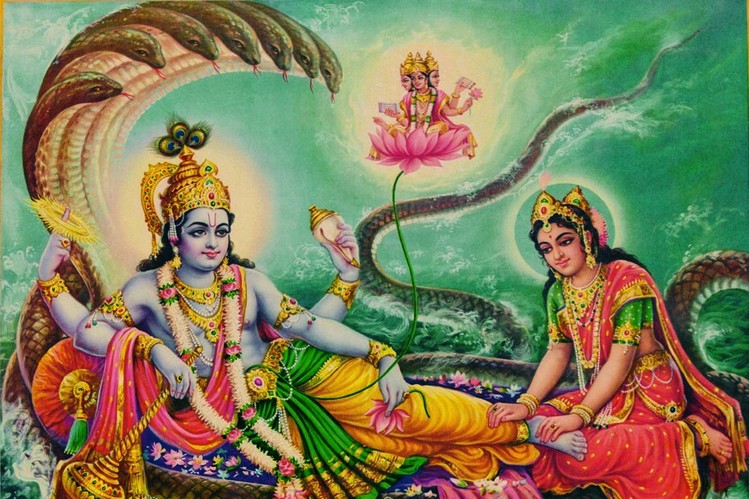
Bharat Darshan. Devotion is the Method of Inquiry used by Krishna, Brahma, Vishnu, Shiva, and all other Hindu Gods. Goddess Sarasvati, the Goddess of Knowledge, the Source of Consciousness and Intelligence that is required to establish the living functions of a man’s mortal existence.
Jonardon Ganeri, Professor of Philosophy, Department of the Study of Religions, The School of Oriental and African Studies(SOAS), University of London displays a commendable understanding of Indian Schools of Thought in an interview that is titled, ‘What Would Krishna Do? Or Shiva? Or Vishnu?’ published by The New York Times in the Opinion posted by Gary Gutting on August 03, 2014. He shares an opinion of Hinduism as a profusion of gods and sacred texts that lack a single theological structure, but they sustain a long tradition of tolerance, and many paths to the divine.
In my analysis, Professor Jonardon Ganeri fails to acknowledge the Method of Inquiry used by Hinduism to discover the Ultimate Truth and Reality. In the Indian tradition, the Divine Mother Goddess Sarasvati symbolizes the Original Source of Pure Knowledge and Perfect Wisdom. All the Gods of Hinduism and all Hindus recognize the limitations of their own cognitive abilities. Without any exceptions all Gods including Krishna, Brahma, Vishnu, Shiva, and others worship Goddess Sarasvati with a great sense of devotion to receive the Gift of Knowledge.
Devotion is the Method of Inquiry to know the Reality of the man and the World:
Bharat Darshan. Devotion is the Method of Inquiry used by Krishna, Brahma, Vishnu,Shiva, and all other Hindu Gods. Goddess Sarasvati represents Pure Knowledge and Perfect Wisdom. God implants this supernatural Knowledge in matter which then becomes conscious and gains the ability to perform all of its living functions.
What it is to be a Substance? and What it is to Exist? We need to establish knowledge about the man and the world on a firm basis and the information it provides must be tested for its accuracy and consistency with an external reality. We have to make the fundamental distinction between the living and the non-living matter. The scientific advances of the 19th and 20th centuries reinforced the materialistic position concerning the basic similarity of organic living and inorganic physical matter. The man is viewed as a product of natural evolution and is thought to be subject to the same laws of Physics and Chemistry or mechanistic principles.
We need a methodology to study philosophy and to understand philosophical statements. Logical Positivism, also known as Scientific Empiricism aims to clarify concepts in both everyday and scientific language. It describes analysis of language as the function of philosophy. This analysis of language and of concepts is important to understand questions of belief and ideology which affect what we think we ought to do individually and socially. I would use this method of ‘Applied Philosophy’ to analyze the concept of Spiritual Optics, the Spiritual dimension of designing the Solar System and the designing of the Living Systems. The principal Method of Inquiry I use is called Devotion or Bhakti in the Indian Sanskrit language.
WHAT WOULD KRISHNA DO? MAN’S LIFE JOURNEY ON THE SURFACE OF EARTH IS GOVERNED BY THE ILLUSION THAT GENERATES THE APPARENT MOTION OF SUN ACROSS THE SKY. THE MAN’S LIFETIME OR LIFE-SPAN IS MEASURED BY USING ENVIRONMENTAL STIMULI CAUSED BY SUNRISE AND SUNSET WHILE IN REALITY THE SUN SHINES ALL THE TIME.
In the context of knowing the man and the world, I discuss about the motions of Earth. The Milky Way Galaxy is moving at about 1.2 million miles/hour (not all the stars of the Milky Way Galaxy System move at this speed). Sun is moving at about 140 miles per second to revolve around the Galactic Center.. Earth is revolving around Sun at about 66,660 miles/hour and is spinning around its axis at about 1,000 miles/hour. In my life journey on the surface of planet Earth, I partake in all these motions as I have no other individual choice, no freedom of action or ability to rule or govern myself according to my individualistic choice.
WHAT WOULD KRISHNA DO? NICOLAUS COPERNICUS (1473-1543), POLISH ASTRONOMER DESCRIBED THE HELIOCENTRIC SOLAR SYSTEM, THE SUN IS THE CENTER OF THE SOLAR SYSTEM. BUT, THE MAN’S EXPERIENCE OF THE WORLD STILL DEMANDS SUNRISE AND SUNSET, THE APPARENT MOTIONS OF SUN IN THE SKY.
Nicolaus Copernicus (1473-1543) Polish astronomer discovered that planets revolve around the Sun and that the turning of the Earth on its axis from West to East accounts for the apparent rising and setting of the stars (includes Sunrise and Sunset), and it forms the basis for modern astronomy.
WHAT WOULD KRISHNA DO? JOHANNES KEPLER (1571-1630), GERMAN ASTRONOMER AND MATHEMATICIAN IS KNOWN FOR THE LAWS OF PLANETARY MOTIONS. THE MAN CAN DESCRIBE MOTIONS OF PLANETS BUT CANNOT ACCOUNT FOR THE FORCE THAT INITIATED EARTH’S ROTATION AROUND ITS AXIS.
Johannes Kepler (1571-1603) German astronomer and mathematician discovered the Kepler’s Laws of Motion.
WHAT WOULD KRISHNA DO? SIR ISSAC NEWTON (1642-1727), ENGLISH PHYSICIST, MATHEMATICIAN, AND NATURAL PHILOSOPHER FORMULATED THE LAWS OF GRAVITY AND MOTION. THOSE LAWS OF PHYSICS MAY NOT ACCOUNT FOR EARTH’S ROTATIONAL SPIN.
Sir Issac Newton (1642-1727) English mathematician, physicist, and natural philosopher formulated the Laws of Gravity and Motion.
WHAT WOULD KRISHNA DO? ALBERT EINSTEIN (1879-1955), US PHYSICIST, BORN IN GERMANY FORMULATED THE THEORY OF RELATIVITY. MY LEARNING EXPERIENCE OR ACQUIRED KNOWLEDGE WILL NOT PREVENT THE SENSORY EXPERIENCE OF SUN’S APPARENT MOTION ACROSS THE SKY. IT IS THIS ILLUSION THAT SUPPORTS THE HUMAN EXISTENCE.
Albert Einstein (1879-1955), US physicist, born in Germany formulated the Theory of Relativity. The most important matter and energy equation is that of the ability of the living things to exploit matter and energy to their advantage in support of their own individualistic existence.
WHAT WOULD KRISHNA DO? THE MAN CAN DESCRIBE THE REALITY OF EARTH’S MOTIONS FOR HE HAS NO DIRECT SENSORY AWARENESS OF THE SPEED OF EARTH. FROM THE APPARENT MOTIONS OF STARS THE MAN RECOGNIZES THE REALITY BUT STILL NEEDS THE ILLUSION TO SYNCHRONIZE HIS BIOLOGICAL FUNCTIONS WITH ENVIRONMENTAL CHANGES CALLED DAY AND NIGHT.
I respectfully acknowledge their contributions and there are several others who had verified the information provided by them. However, it may be noted that none of those contributors are physicians and their primary concern is not about the problems of human existence. For man is a mortal being, there is no escape from the problems of aging, and longevity. Man exists with a life-span, and has a lifetime which is measured by the time interval between two events that cause a significant environmental change that the human body recognizes as if it is operated by a precise clock. Of all the motions that I described, to account for the problems of human existence, I have to examine the spinning motion of Earth around its own axis. All other celestial motions are relevant but my life’s journey on planet Earth is impacted by Earth’s spinning motion. In Medical Science, we recognize Vital Functions, Vital Operations, and Vital Principles. A physicist has not accounted for any of the Vital Functions that govern or rule or regulate the human existence. So, at a fundamental level, to understand the issues that involve human existence, we need a method of inquiry that a physicist may not use.
I am asking my readers to learn to make the distinction between mechanical actions and intelligent actions. We need to separate mechanical operations from vital operations. There is the difference between mechanical performance and intelligent performance. People make the distinction between Transitive Action and Immanent Action. The action performed by an inert body on another inert body is called Transitive Action. In contrast, Immanent Action perfects the agent that performs the action. To establish life, in the performance of the vital, living functions, the agent is perfected by its own actions such as growing, sensing, understanding, and developing. For example, heating is a Transitive Action for the hot thing loses its own heat. In the performance of Vital Functions and Intelligent Actions, the results of action remain in the agent to provide some benefit, advantage, or purpose. The term purposiveness describes actions that are guided to achieve a future end and it includes the selection or the choice of means to accomplish or obtain the desired goal.
The word ‘animal’ is derived from Latin name for “SOUL” the Vital Principle of animation. It helps to divide Matter into two kinds; animate, and inanimate, living, and nonliving, sensible, and insensible, or Physical Matter, and Living Matter. The biological property called consciousness describes the difference between Vital Powers and the Capacities of inert or Physical Matter. Consciousness describes the difference between animate and inanimate things. Consciousness accounts for the power of Self-Nutrition ( In Physiology, called ‘NUTRITION’), which is the original Power the possession of which leads us to speak of things as living or nonliving. Apart from Physics, Biology demands explanation for knowing Matter, Energy, and Motions of Objects. The Laws of Physics cannot account for the correct understanding of Vital Powers, Vital Functions, Vital Operations that are based on Intelligent Actions.
WHAT WOULD KRISHNA DO? THE DIVINE SONG, THE BHAGAVAD GITA, CHAPTER VII, VERSE #25 EXPLAINS: “I AM NOT MANIFEST TO EVERYONE, BEING VEILED BY MY ILLUSORY POTENCY IN THE EXTERNAL ENERGY. THE IGNORANT IN THE WORLD CANNOT UNDERSTAND ME, THE UNBORN AND IMPERISHABLE.”
In the Divine Song popularly known as The Bhagavad Gita, Chapter VII, verse #25, Lord Krishna speaks to Prince Arjuna: “Naham prakasah sarvasya Yoga-Maya-samavrtah; Mudho’ yam nabhijanati loko mam ajam avyayam.” “I am never manifest to the foolish and unintelligent. For them I am covered by My eternal creative potency (“MAYA”) and so the deluded world knows Me not, who am unborn and infallible.”
WHAT WOULD KRISHNA DO? OR LORD MAHA VISHNU DO? THE MAN’S PHYSICAL EXISTENCE ON THE SURFACE OF A FAST, SPINNING CELESTIAL OBJECT DEMANDS THE OPERATION OF FORCE/POWER/ENERGY THAT CAN IMPOSE ITS VEIL AND DEFEND THE MAN FROM EXPERIENCING THE REALITY OF MOTIONS THAT ARE INHERENTLY POWERFUL AND MAKE EARTH AN INHOSPITABLE PLACE. IF MAN NEEDS LIGHT AND ITS ENERGY, MAN EQUALLY NEEDS DARKNESS OR NIGHT FOR SLEEP AND REST.
The scientific method of inquiry is relevant to understand certain aspects of Matter, Energy, and Motion. There is an aspect of human existence that is operated by the Force of Grand Illusion(“MAYA”) and this existence is not accounted by the realities of the world and the universe in which man finds his existence without any choice of his own. To account for this human existence which needs the operation of illusion, I make my inquiry using “DEVOTION” as my tool or method to investigate the problem.
MADHU, MADHAVI, AND MADHURYA:
WHAT WOULD KRISHNA DO? IN THE INDIAN TRADITION LORD GOD IS THE CONTROLLER OF THE FORCE AND HAS A MASCULINE IDENTITY AND THE FORCE IS DESCRIBED AS HIS CONSORT WITH A FEMININE IDENTITY. GODDESS MADHAVI IS THE CONSORT OF LORD MADHAVA (THE LORD OF SPRING SEASON WHICH BRINGS A SENSE OF JOY AND SWEETNESS). THE WORD MADHAVI IS DERIVED FROM MADHU WHICH DESCRIBES SUGAR, WINE (FERMENTED SUGAR) AND NECTAR. WHEN MADHAVI IS KNOWN AS FORCE/POWER/ENERGY, ITS APPLICATION IS KNOWN BY THE SENSATION IT IMPARTS, THE SENSATION OF SWEETNESS CALLED MADHURYA, JOY, OR BLISS.
Sugar, alcohol and sweetness are related terms. Photoreception is the basis for Photosynthesis and it always performs a creative action to produce sugars and other plant products. We often miss the point about the creative generation of sugars. Madhavi symbolizes a person associated with this creative power that is involved in the generation or production of sugar (the fermented liquid, wine or alcohol is called Madhu) and it is easily identified by the taste sensation it imparts. In other words, the creative power, potency can be physically experienced using the taste sensation. Creation is not an abstract idea. The man experiences the fact of creation using the five organs of sense perception.
The man and the Computer Interactions. A tribute to the Father of the Mouse: A special tribute to Dr. Douglas Carl Engelbart who introduced the use of a device called ‘Mouse’ to control the operations of a computer. This photo is from 1968 showing the device. He died at the age of 88-years in California, on Tuesday night, July 02, 2013.The man and the Computer Interactions. A tribute to the Father of the Mouse.: The patent for the first computer mouse.The man and the Computer Interactions. A tribute to the Father of the Mouse.: A special tribute to Dr. Douglas Carl Engelbart the inventor of computer mouse. The prototype of the first computer mouse.
The term ‘inventor’ is used to describe a person who devises a new contrivance. This is a post to pay tribute to Dr. Douglas Carl Engelbart who during 1968 invented the first computer ‘mouse’ and has revolutionized the manner in which people can use the electronic medium to communicate with each other, and to perform a myriad of functions with absolute ease. I am happy to acknowledge the thirty-year track record of Engelbart in predicting, designing, and implementing the future of organizational computing. The invention of ‘mouse’, a device to control the desktop computer has helped the development of interactive computer technologies. Engelbart had authored over 25 publications, generated 20 patents, including the patent for the first computer mouse. In the late 1980s the mouse became the standard way to control a desktop computer.
In Doug’s Words:
” The mouse we built for the [1968] show was an early prototype that had three buttons. We turned it around so the tail came out the top. We started with it going the other direction, but the cord got tangled when you moved your arm.
I first started making notes for the mouse in ’61. At the time, the popular device for pointing on the screen was a light pen, which had come out of the radar program during the war. It was the standard way to navigate, but I didn’t think it was quite right.
Two or three years later, we tested all the pointing gadgets available to see which was the best. Aside from the light pen there was the tracking ball and a slider on a pivot. I also wanted to try this mouse idea, so Bill English went off and built it.
We set up our experiments and the mouse won in every category, even though it had never been used before. It was faster, and with it people made fewer mistakes. Five or six of us were involved in these tests, but no one can remember who started calling it a mouse. I’m surprised the name stuck.
We also did a lot of experiments to see how many buttons the mouse should have. We tried as many as five. We settled on three. That’s all we could fit. Now the three-button mouse has become standard, except for the Mac.”
Doug Engelbart in The Click Heard Round The World, by Ken Jordan, WIRED 2004
The man and the Computer Interactions. A tribute to the Father of the Mouse.
Mouse inventor who foresaw the modern internet
Published: in the HINDU, July 5, 2013.
The man and the Computer Interactions. A tribute to the Father of the Mouse.
AP VISIONARY: Douglas Engelbart poses with the computer mouse he designed, in this 1997 picture.
The first computer mouse was a wooden shell with metal wheels. The man behind it, tech visionary Doug Engelbart, has died at 88 after transforming the way people work, play and communicate.
The mild-mannered Engelbart had audacious ideas. Long before Apple founder Steve Jobs became famous for his dramatic presentations, Engelbart dazzled the industry at a San Francisco computer conference in 1968.
Working from his house with a homemade modem, he used his lab’s elaborate new online system to illustrate his ideas to the audience, while his staff linked in from the lab. It was the first public demonstration of the mouse and video teleconferencing, and it prompted a standing ovation.
“We will miss his genius, warmth and charm,” said Curtis R. Carlson, the CEO of Stanford Research Institute International, where Engelbart used to work. “Doug’s legacy is immense. Anyone in the world who uses a mouse or enjoys the productive benefits of a personal computer is indebted to him.”
Back in the 1950s and 1960s, when mainframe computers took up entire rooms and were fed data on punch cards, Engelbart already was envisioning a day when computers were far more intuitive to use.
One of the biggest advances was the mouse, which he developed in the 1960s and patented in 1970. The idea was way ahead of its time. The mouse didn’t become commercially available until 1984, with the release of Apple’s then—revolutionary Macintosh computer. Engelbart conceived the mouse so early in the evolution of computers that he and his colleagues didn’t profit much from it. The technology passed into the public domain in 1987, preventing him from collecting royalties on the mouse when it was in its widest use. At least 1 billion have been sold since the mid-1980s.
Now, their usage is waning as people merely swipe their finger across a display screen.
“There are only a handful of people who were as influential,” said Marc Weber, founder and curator of the Internet history program at the Computer History Museum, where Engelbart had been a fellow since 2005. “He had a complete vision of what computers could become at a very early stage.”
Among Engelbart’s other key developments in computing, along with his colleagues at SRI International and his own lab, the Augmentation Research Center, was the use of multiple windows. His lab also helped develop ARPANet computer network, the government research network that led to the Internet.
Engelbart played down the importance of his inventions, stressing instead his vision of using collaboration over computers to solve the world’s problems. “Many of those firsts came right out of the staff’s innovations even had to be explained to me before I could understand them,” he said in a biography written by his daughter.
In 1997, Engelbart won the most lucrative award for American inventors, the $500,000 Lemelson-MIT Prize. Three years later, President Bill Clinton bestowed Engelbart with the National Medal of Technology “for creating the foundations of personal computing.”
Douglas Carl Engelbart was born January 30, 1925, and studied electrical engineering, taking two years off during World War II to serve as a Navy electronics and radar technician in the Philippines. It was there that he read Vannevar Bush’s “As We May Think” and was inspired by the idea of a machine that would aid human cognition. Engelbart later(1955) earned his PhD. at University of California, Berkeley, but after joining the faculty, he was warned by a colleague that if he kept talking about his “wild ideas” he’d be an acting assistant professor forever. So he left for the Stanford Research Institute, now SRI International.
Engelbart is survived by his wife, Karen O’Leary Engelbart; his four children, Diana, Christina, Norman and Greda, and nine grandchildren.
The man and the Computer Interactions. A tribute to the Father of the Mouse.
The Concept of Whole Machine, a Machine with an implanted Soul.
What it is to be a Substance? and What it is to Exist? We need to establish knowledge about the man on a firm basis and the information it provides must be tested for its accuracy and consistency with an external reality. We have to make the fundamental distinction between the living and the non-living matter. The scientific advances of the 19th and 20th centuries reinforced the materialistic position concerning the basic similarity of organic living and inorganic physical matter. The man is viewed as a product of natural evolution and is thought to be subject to the same laws of Physics and Chemistry or mechanistic principles.
We need a methodology to study philosophy and to understand philosophical statements. Logical Positivism, also known as Scientific Empiricism aims to clarify concepts in both everyday and scientific language. It describes analysis of language as the function of philosophy. This analysis of language and of concepts is important to understand questions of belief and ideology which affect what we think we ought to do individually and socially. I would use this method of ‘Applied Philosophy’ to analyze the concept of Spiritual Optics, the Spiritual Connection between Energy and Life. The Laws of Thermodynamics are important unifying principles of Biology. The First Law of Thermodynamics, also known as the Law of Conservation of Energy, states that Energy can neither be created nor destroyed. Spiritual Optics accounts for the capacity of photoreception and the term Spiritual Light refers to the creation of Light by God to begin the designing of Matter described by Physics and Chemistry. I may not be able to discover the Purpose in my Life if I exist in Spiritual Darkness. Can any man implant a purpose in the life of a Machine that the man designs performing intelligent actions? What is the distinction between Mechanical Actions and Spiritual Actions? What is intelligence?
WHOLE DUDE – WHOLE MACHINE:
WHOLE DUDE – WHOLE MACHINE: The Concept of Whole Machine, a Machine with an implanted Soul. What gives a man the ability to perform mechanical, and intelligent actions? Can any man implant Soul/Spirit in the Computer Machine?
The Machine of a New Soul is an article published by The Economist and it discusses the idea of producing better Computer Networks by understanding Brain Processes. This article is based upon the assumption that human brain, or mind is the seat of all human knowledge and it ignores the existence of knowledge that is innate to all living things. I describe Innate Knowledge as the intuitive ability with which each individual, independent, living cell performs very complex, sequential, purposeful functions to maintain its own existence. When knowledge is implanted in the substance, it becomes conscious, sensible, and intelligible and it becomes separated, or distinct from non-living, and other living matter. The term intellect should not be limited to the discerning ability of mind, or brain. If the term intellect refers to the ability to perform intelligent actions, we have to consider that all living functions have the characteristics of intelligent actions as compared to mechanical or transitive actions that could be performed by non-living things.
At a fundamental level, the Computer, the machine can only perform mechanical actions, and not intelligent actions. The reason is that of the Computer lacking the intellect to perform intelligent actions. For all living things, the primary intelligent action is that of acquiring energy from its external environment, and further manipulating, and transforming that energy to perform actions to repair, maintain, and to build its own structures to further its growth and development. The Computer takes no initiative of its own to acquire energy from its external environment. The Computer cannot manipulate, or transform the energy supplied to it; it cannot use energy to further improve its growth, and development by adding its own material, or structures. A Computer basically lacks the intellect, and knowledge of a virus particle which knows, and has the ability to enter its host, gain energy from the host, and use the machinery of the host to manufacture millions of its own copies. Man can use the Computer Machine to perform complex functions with a great degree of accuracy, and speed, but man lacks the intellect to create an intelligent Computer Machine. The man has the ability to perform a variety of physical, and mental tasks, but the question is; Can any man implant the vital, animating principle called Soul/Spirit in the Computer Machine? Without a Soul/Spirit, the Computer can only exist as a simple Machine that performs mechanical actions as directed.
WHOLE DUDE – WHOLE MACHINE: The Concept of Whole Machine, a Machine with an implanted Soul. The man performs both mechanical, and intelligent functions. Can he transplant intellect in a Computer Machine to perform Intelligent, or Immanent Actions?WHOLE DUDE – WHOLE MACHINE: The Concept of Whole Machine, a Machine with an implanted Soul. What is that Connection, or Process that Brain, or Mind (the Nerve Cell Neuron) uses to acquire energy from its environment to perform its functions? Computer can only exist as a Machine that performs mechanical functions as it is not Connected to the source of Energy called Divine Providence.
Volume 408, Number 8847, Pages 67-69
Neuromorphic computing
The machine of a new soul
Computers will help people to understand brains better.
And understanding brains will help people to build better computers.
Aug 3rd 2013 |From the print edition of THE ECONOMIST, August 3rd-9th, 2013
ANALOGIES change. Once, it was fashionable to describe the brain as being like the hydraulic systems employed to create pleasing fountains for 17th-century aristocrats’ gardens. As technology moved on, first the telegraph network and then the telephone exchange became the metaphor of choice. Now it is the turn of the computer. But though the brain-as-computer is, indeed, only a metaphor, one group of scientists would like to stand that metaphor on its head. Instead of thinking of brains as being like computers, they wish to make computers more like brains. This way, they believe, humanity will end up not only with a better understanding of how the brain works, but also with better, smarter computers. These visionaries describe themselves as neuromorphic engineers. Their goal, according to Karlheinz Meier, a physicist at the University of Heidelberg who is one of their leaders, is to design a computer that has some—and preferably all—of three characteristics that brains have and computers do not. These are: low power consumption (human brains use about 20 watts, whereas the supercomputers currently used to try to simulate them need megawatts); fault tolerance (losing just one transistor can wreck a microprocessor, but brains lose neurons all the time); and a lack of need to be programmed (brains learn and change spontaneously as they interact with the world, instead of following the fixed paths and branches of a predetermined algorithm). To achieve these goals, however, neuromorphic engineers will have to make the computer-brain analogy real. And since no one knows how brains actually work, they may have to solve that problem for themselves, as well. This means filling in the gaps in neuroscientists’ understanding of the organ. In particular, it means building artificial brain cells and connecting them up in various ways, to try to mimic what happens naturally in the brain. Analogous analogues The yawning gap in neuroscientists’ understanding of their topic is in the intermediate scale of the brain’s anatomy. Science has a passable knowledge of how individual nerve cells, known as neurons, work. It also knows which visible lobes and ganglia of the brain do what. But how the neurons are organised in these lobes and ganglia remains obscure. Yet this is the level of organisation that does the actual thinking—and is, presumably, the seat of consciousness. That is why mapping and understanding it is to be one of the main objectives of America’s BRAIN initiative, announced with great fanfare by Barack Obama in April. It may be, though, that the only way to understand what the map shows is to model it on computers. It may even be that the models will come first, and thus guide the mappers. Neuromorphic engineering might, in other words, discover the fundamental principles of thinking before neuroscience does. Two of the most advanced neuromorphic programmes are being conducted under the auspices of the Human Brain Project (HBP), an ambitious attempt by a confederation of European scientific institutions to build a simulacrum of the brain by 2023. The computers under development in these programmes use fundamentally different approaches. One, called SpiNNaker, is being built by Steven Furber of the University of Manchester. SpiNNaker is a digital computer—ie, the sort familiar in the everyday world, which process information as a series of ones and zeros represented by the presence or absence of a voltage. It thus has at its core a network of bespoke microprocessors. The other machine, Spikey, is being built by Dr Meier’s group. Spikey harks back to an earlier age of computing. Several of the first computers were analogue machines. These represent numbers as points on a continuously varying voltage range—so 0.5 volts would have a different meaning to 1 volt and 1.5 volts would have a different meaning again. In part, Spikey works like that. Analogue computers lost out to digital ones because the lack of ambiguity a digital system brings makes errors less likely. But Dr Meier thinks that because they operate in a way closer to some features of a real nervous system, analogue computers are a better way of modelling such features. Dr Furber and his team have been working on SpiNNaker since 2006. To test the idea they built, two years ago, a version that had a mere 18 processors. They are now working on a bigger one. Much bigger. Their 1m-processor machine is due for completion in 2014. With that number of chips, Dr Furber reckons, he will be able to model about 1% of the human brain—and, crucially, he will be able to do so in real-time. At the moment, even those supercomputers that can imitate much smaller fractions of what a brain gets up to have to do this imitation more slowly than the real thing can manage. Nor does Dr Furber plan to stop there. By 2020 he hopes to have developed a version of SpiNNaker that will have ten times the performance of the 1m-processor machine.
SpiNNaker achieves its speed by chasing Dr Meier’s third desideratum—lack of a need to be programmed. Instead of shuttling relatively few large blocks of data around under the control of a central clock in the way that most modern computers work, its processors spit out lots of tiny spikes of information as and when it suits them. This is similar (deliberately so) to the way neurons work. Signals pass through neurons in the form of electrical spikes called action potentials that carry little information in themselves, other than that they have happened. Such asynchronous signalling (so-called because of the lack of a synchronizing central clock) can process data more quickly than the synchronous sort, since no time is wasted waiting for the clock to tick. It also uses less energy, thus fulfilling Dr Meier’s first desideratum. And if a processor fails, the system will re-route around it, thus fulfilling his second. Precisely because it cannot easily be programmed, most computer engineers ignore asynchronous signalling. As a way of mimicking brains, however, it is perfect. But not, perhaps, as perfect as an analogue approach. Dr Meier has not abandoned the digital route completely. But he has been discriminating in its use. He uses digital components to mimic messages transmitted across synapses—the junctions between neurons. Such messages, carried by chemicals called neurotransmitters, are all-or-nothing. In other words, they are digital. The release of neurotransmitters is, in turn, a response to the arrival of an action potential. Neurons do not, however, fire further action potentials as soon as they receive one of these neurotransmitter signals. Rather, they build up to a threshold. When they have received a certain number of signals and the threshold is crossed—basically an analogue process—they then fire an action potential and reset themselves. Which is what Spikey’s ersatz neurons do, by building up charge in capacitors every time they are stimulated, until that threshold is reached and the capacitor discharges. Does practice make perfect? In Zürich, Giacomo Indiveri, a neuromorphic engineer at the Institute of Neuroinformatics (run jointly by the University of Zürich and ETH, an engineering university in the city) has also been going down the analogue path. Dr Indiveri is working independently of the HBP and with a different, more practical aim in mind. He is trying to build, using neuromorphic principles, what he calls “autonomous cognitive systems”—for example, cochlear implants that can tell whether the person they are fitted into is in a concert hall, in a car or at the beach, and adjust their output accordingly. His self-imposed constraints are that such things should have the same weight, volume and power consumption as their natural neurological equivalents, as well as behaving in as naturalistic a way as possible. Part of this naturalistic approach is that the transistors in his systems often operate in what is known technically as the “sub-threshold domain”. This is a state in which a transistor is off (ie, is not supposed to be passing current, and thus represents a zero in the binary world), but is actually leaking a very tiny current (a few thousand-billionths of an amp) because electrons are diffusing through it. Back in the 1980s Carver Mead, an engineer at the California Institute of Technology who is widely regarded as the father of neuromorphic computing (and certainly invented the word “neuromorphic” itself), demonstrated that sub-threshold domains behave in a similar way to the ion-channel proteins in cell membranes. Ion channels, which shuttle electrically charged sodium and potassium atoms into and out of cells, are responsible for, among other things, creating action potentials. Using sub-threshold domains is thus a good way of mimicking action potentials, and doing so with little consumption of power—again like a real biological system. Dr Indiveri’s devices also run at the same speed as biological circuits (a few tens or hundreds of hertz, rather than the hyperactive gigahertz speeds of computer processors). That allows them to interact with real biological circuits, such as those of the ear in the case of a cochlear implant, and to process natural signals, such as human speech or gestures, efficiently. Dr Indiveri is currently developing, using the sub-threshold-domain principle, neuromorphic chips that have hundreds of artificial neurons and thousands of synapses between those neurons. Though that might sound small beer compared with, say, Dr Furber’s putative million-processor system, it does not require an entire room to fit in, which is important if your goal is a workable prosthetic body part. Unusually, for a field of information technology, neuromorphic computing is dominated by European researchers rather than American ones. But how long that will remain the case is open to question, for those on the other side of the Atlantic are trying hard to catch up. In particular, America’s equivalent of the neuromorphic part of the Human Brain Project, the Systems of Neuromorphic Adaptive Plastic Scalable Electronics, SyNAPSE, paid for by the Defence Advanced Research Projects Agency, is also sponsoring two neuromorphic computers. The Yanks are coming One of these machines is being designed at HRL Laboratories in Malibu, California—a facility owned jointly by Boeing and General Motors. Narayan Srinivasa, the project’s leader, says his neuromorphic chip requires not a single line of programming code to function. Instead, it learns by doing, in the way that real brains do. An important property of a real brain is that it is what is referred to as a small-world network. Each neuron within it has tens of thousands of synaptic connections with other neurons. This means that, even though a human brain contains about 86 billion neurons, each is within two or three connections of all the others via myriad potential routes. In both natural brains and many attempts to make artificial ones (Dr Srinivasa’s included) memory-formation involves strengthening some of these synaptic connections and pruning others. And it is this that allows the network to process information without having to rely on a conventional computer program. One problem with building an artificial small-world network of this sort, though, is connecting all the neurons in a system that has a lot of them. Many neuromorphic chips do this using what is called cross-bar architecture. A cross-bar is a dense grid of wires, each of which is connected to a neuron at the periphery of the grid. The synapses are at the junctions where wires cross. That works well for small circuits, but becomes progressively less wieldy as the number of neurons increases. To get around this Dr Srinivasa employs “synaptic time multiplexing”, in which each physical synapse takes on the role of up to 10,000 virtual synapses, pretending to be each, in turn, for 100 billionths of a second. Such a system requires a central clock, to co-ordinate everything. And that clock runs fast. A brain typically operates at between 10Hz and 100Hz. Dr Srinivasa’s chip runs at a megahertz. But this allows every one of its 576 artificial neurons to talk to every other in the same amount of time that this would happen in a natural network of this size. And natural networks of this size do exist. C. elegans, a tiny nematode worm, is one of the best-studied animals on the planet because its developmental pathway is completely prescriptive. Bar the sex cells, every individual has either 959 cells (if a hermaphrodite) or 1,031 (if male; C. elegans has no pure females). In hermaphrodites 302 of the cells are neurons. In males the number is 381. And the animal has about 5,000 synapses. Despite this simplicity, no neuromorphic computer has been able to ape the nervous system of C. elegans. To build a machine that could do so would be to advance from journeyman to master in the neuromorphic engineers’ guild. Dr Srinivasa hopes one of his chips will prove to be the necessary masterpiece. In the meantime, and more practically, he and his team are working with AeroVironment, a firm that builds miniature drones that might, for example, fly around inside a building looking for trouble. One of the team’s chips could provide such drones with a brain that would, say, learn to recognise which rooms the drone had already visited, and maybe whether anything had changed in them. More advanced versions might even take the controls, and fly the drone by themselves. The other SyNAPSE project is run by Dharmendra Modha at IBM’s Almaden laboratory in San Jose. In collaboration with four American universities (Columbia, Cornell, the University of California, Merced and the University of Wisconsin-Madison), he and his team have built a prototype neuromorphic computer that has 256 “integrate-and-fire” neurons—so called because they add up (ie, integrate) their inputs until they reach a threshold, then spit out a signal and reset themselves. In this they are like the neurons in Spikey, though the electronic details are different because a digital memory is used instead of capacitors to record the incoming signals. Dr Modha’s chip has 262,000 synapses, which, crucially, the neurons can rewire in response to the inputs they receive, just like a real brain. And, also like those in a real brain, the neurons remember their recent activities (which synapses they triggered) and use that knowledge to prune some connections and enhance others during the process of rewiring. So far, Dr Modha and his team have taught their computer to play Pong, one of the first (and simplest) arcade video games, and also to recognise the numbers zero to nine. In the number-recognition program, when someone writes a number freehand on a touchscreen the neuromorphic chip extracts essential features of the scribble and uses them to guess (usually correctly) what that number is.
This may seem pretty basic, but it is intended merely as a proof of principle. The next bit of the plan is to scale it up. One thing that is already known about the intermediate structure of the brain is that it is modular. The neocortex, where most neurons reside and which accounts for three-quarters of the brain’s volume, is made up of lots of columns, each of which contains about 70,000 neurons. Dr Modha plans something similar. He intends to use his chips as the equivalents of cortical columns, connecting them up to produce a computer that is, in this particular at least, truly brainlike. And he is getting there. Indeed, he has simulated a system that has a hundred trillion synapses—about the number in a real brain. After such knowledge There remains, of course, the question of where neuromorphic computing might lead. At the moment, it is primitive. But if it succeeds, it may allow the construction of machines as intelligent as—or even more intelligent than—human beings. Science fiction may thus become science fact. Moreover, matters may proceed faster than an outside observer, used to the idea that the brain is a black box impenetrable to science, might expect. Money is starting to be thrown at the question. The Human Brain Project has a €1 billion ($1.3 billion) budget over a decade. The BRAIN initiative’s first-year budget is $100m, and neuromorphic computing should do well out of both. And if scale is all that matters, because it really is just a question of linking up enough silicon equivalents of cortical columns and seeing how they prune and strengthen their own internal connections, then an answer could come soon. Human beings like to think of their brains as more complex than those of lesser beings—and they are. But the main difference known for sure between a human brain and that of an ape or monkey is that it is bigger. It really might, therefore, simply be a question of linking enough appropriate components up and letting them work it out for themselves. And if that works perhaps, as Marvin Minsky, a founder of the field of artificial intelligence put it, they will keep humanity as pets.
From the print edition: Science and technology
Whole Dude-Whole Machine. The Concept of Whole Machine, a Machine with an implanted Soul.