

The military organization which is known as Special Frontier Force-Establishment No. 22-Vikas Regiment came into its existence during the presidency of Dr. Sarvepalli Radhakrishnan, the second President of the Republic of India, 13 May 1962 to 13 May 1967. While Special Frontier Force is a product of Cold War Era secret diplomacy, I share my personal story, the events from early childhood, that shaped the rest of my life and has formulated my bonding with this Organization and my desire to accomplish its military mission.
Author Archives: WholeDude
TE3N Movie on Netflix.com reveals my lifetime affiliation with Vikas Regiment

Special Frontier Force represents a military organization distinct from the Indian Army while it draws Indian Army personnel apart from other nationals. I served in Special Frontier Force- Headquarters Establishment No. 22-Vikas Regiment from September 22, 1971, to December 10, 1974. My affiliation with Vikas Regiment survives to this date as I host ‘The Living Tibetan Spirits’ in my consciousness since 1971 Bangladesh Ops (India-Pakistan War of 1971 that lead to the Liberation of Bangladesh). Because of my affiliation with Vikas Regiment, my Indian Army Picture ID photo image of 1972 appears in a scene in the TE3N movie of 2016.
The assassination of Bangladesh Prime Minister Sheikh Mujibur Rahman on August 15, 1975. Why India failed to defend his life?

I returned to Chakrata, India during the last week of January 1972 after the successful conclusion of Operation Eagle that initiated the Liberation of Bangladesh with military action in the Chittagong Hill Tracts. During February 1972, I had the opportunity to take part in the training of a National Security Force (Jatiyo Rakkhi Bahini) whose mission was very clear from the beginning. There was an utter sense of urgency and earnestness to defend the personal life of Bangabandhu Bangladesh Prime Minister Sheikh Mujibur Rahman as our intelligence information discovered a plot getting brewed by a few Bangladesh Army Officers who were not satisfied with Bangabandhu’s vision for a modern, democratic nation of Bangladesh.
In February 1972, the training of the National Defence Force (Jatiyo Rakkhi Bahini) commenced in Establishment 22, near Chakrata. I have direct personal insight of the training of Mujib Bahini before the 1971 War and of JRB in 1972 after the War.
Operation Eagle – Open Letter to Government of India – Release 1971 War Service Citation

An open letter to the Government of India regarding Operation Eagle 1971-72 in the Chittagong Hill Tracts, Bangladesh.
Bharat Darshan – The traditional art form of Burra Katha sows the seeds of Nationalism

A tribute to the Telugu traditional art form of Burra Katha and to the Telugu revolutionary freedom fighter Alluri Sitarama Raju.
Bharat Darshan pays tribute to Tibetan Martyrs

The term ‘Martyr’ is related to Greek word ‘martys’ which means a witness, Latin word ‘memor’ which means mindful, and Sanskrit word ‘smarati’ which means (he) remembers. Hence, ‘Martyr’ as a person has to be described by sharing as to what that person witnessed, as to what he(or she) is mindful, and as to what he remembers. Martyr is a person who dies as consequence of exposure to long-continued suffering, torment, or torture. Martyr is a person who remembers his experience or experience of others who suffer and suffered. Martyr is a person who chooses to suffer or die rather than give up his faith or principles. Martyr is a person who assumes an attitude of self-sacrifice or suffering in order to arouse feelings in others for his faith or belief.
Bharat Darshan Welcomes the Edict to Rebuild The Temple of God in Jerusalem

If Shahanshah Cyrus is asked to decide on the religious dispute between Muslims and Jews, he would direct us to rebuild the original House of God or Beth-El at Temple Mount in Jerusalem and to restore the faith and the worship of God that it represents. Let us rebuild ‘House of God’ and let its foundations be laid where it belongs.
The Spirit of a Jew – The Birth of Bangladesh
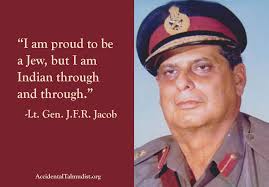
While Major General Jacob was the Chief of Staff at the Eastern Army Headquarters, the only other Jew in the Liberation War of Bangladesh was the Adjutant of my Unit.The Adjutant, Captain.Kottayam Chacko Kurien is a Kerala Jew. The Jews of Kerala were the first members of Jewish community to arrive in India and their migration dates back to the biblical times,starting with the Roman destruction of Jerusalem in 70 A.D. and even the earlier period of their Babylonian Exile.There is evidence to prove that there was a Jewish community in India prior to the arrival of Saint Thomas in 52 A.D.Since I had participated in the 1971 War without my personal weapon, Captain Kurien was also assigned the responsibility of defending me. He took that task with a sense of cheer and true to his spirit of a Jew, he had solemnly announced that I would be the last person to get killed (by the enemy) in my Unit and had assured me that I should have no concerns for being unarmed.
Bharat Darshan -Acharya Chanakya reviews the Doomed US Policy of Hegemony

Dr. Henry Alfred Kissinger who was chief foreign policy adviser and Secretary of State to Presidents Richard Nixon and Gerald Ford is described as the architect of American foreign policy which he named as hegemony. None of the foreign policy initiatives for global dominance could help America to balance its federal budget and control its deficit spending which is the root cause of the problems that its economy is facing now. If American economy suffers, it would definitely cause a ripple effect. I am not surprised to hear that the merchants in the New York city are willing to accept payments in Euros as an acknowledgement of the fact that the U.S. Dollar has become weak and will continue to remain weak in comparison to major global currencies.
Man’s Future – Evolution or Extinction?

Man’s Future? Could he survive a future major Extinction Event? Essentially, the modern synthetic view of evolution could be defined as a change in gene frequency. Evolution could be described as change in the genetic composition of a population through time. For purposes of speciation or separation into new species, we need to demonstrate cumulative and important changes in the population gene pool. In the last 250,000 years there is no evidence to show any important changes in the population gene pool. Practically speaking, man’s evolution into a new species is arrested because of the intervention of culture between man and his environment.

