SLEEPLESS IN PARIS SAVED BY EVENING IN PARIS. I AM INVITING READERS TO CONTRIBUTE A ROMANTIC STORY TO PARTICIPATE IN WHOLE ASSIGNMENT TITLED “EVENING IN PARIS.”
I am inviting my readers to contribute a romantic story to participate in a Whole Assignment titled “EVENING IN PARIS.” The story celebrates a fictional Archangel’s memorable trip to Paris to rescue a dame in dire distress.
SLEEPLESS IN PARIS SAVED BY EVENING IN PARIS. A STORY INSPIRED BY EDGAR ALLAN POE’S POEM ‘THE RAVEN’. CAN #ARCHANGEL RESCUE MISS POE POSSESSED BY ‘THE DEVIL’ ?SLEEPLESS IN PARIS SAVED BY EVENING IN PARIS.: “EVENING IN PARIS” IS THE TITLE FOR A SHORT STORY MY READERS ARE GIVEN THE WHOLE ASSIGNMENT TO COMPLETE THIS STORY THAT FOLLOWS MY BRIEF INTRODUCTION . I AM POETICALLY INSPIRED BY POEM “THE RAVEN” COMPOSED BY EDGAR ALLAN POE .
Edgar Allan Poe(born. January 19, 1809 – died. October 07, 1849) is one of the most brilliant and original writers in American literature. Poe is part of the American Romantic Movement . His short stories are ingenious and profound. Poe often theorized about the art of writing, as in his essay “The Poetic Principle.” In his view, a poem deserves its title only in as much as it excites by elevating the soul. I find that Poetic Inspiration, and excitement in his poem ‘The Raven’ :
Once upon a midnight dreary, while I pondered, weak and weary, over many a quaint and curious volume of forgotten lore –
While I nodded, nearly napping, suddenly there came a tapping,
As of some one gently rapping, rapping at my chamber door.
“Tis some visitor,” I muttered, “tapping at my chamber door –
Only this and nothing more.”
“The Raven” reminds me of ‘The Devil’, ‘The Satan’, ‘The Evil Spirit’ about which a Canaanite woman asked Jesus to show his mercy and drive the demon that took possession of her daughter. This parable about her great faith is in The Book of Matthew, Chapter 15, verses 21 to 28.
SLEEPLESS IN PARIS SAVED BY EVENING IN PARIS. : EVENING IN PARIS IS A SHORT STORY POETICALLY INSPIRED BY EDGAR ALLAN POE’S POEM “THE RAVEN.” IT IS ABOUT THE DEMON THAT TOOK POSSESSION OF THE YOUNG DAUGHTER OF THIS CANAANITE WOMAN WHO IS PLEADING JESUS TO SHOW HIS MERCY .
The New Testament Book of Matthew, Chapter 15, verse# 22 : “LORD, Son of David, have mercy on me! My daughter is suffering terribly from demon possession.” Both man and woman may become the victims of evil spirits or demons which can keep the mind troubled and prevent the joy or happiness obtained by good sleep. Man or woman need the help of a guardian angel to fight the demon that may trouble their hearts.
Evening In Paris(#EveningInParis) is a short story about a young woman by name Miss. Poe(“SLEEPLESS IN PARIS”) whose heart is troubled by a ‘Demon’ who keeps her awake all night denying her good sleep.
SLEEPLESS IN PARIS SAVED BY EVENING IN PARIS. ARCHANGEL IS THE FICTIONAL HERO WHO SAVES THE YOUNG WOMAN TROUBLED BY SLEEPLESSNESS IN PARIS. .
Just like “Saint Michael” who is prominent in Jewish, Christian, and Muslim traditions, the fictional “Archangel” is a young, handsome man who protects and serves young women by defending their Happiness and Excellence in whatever they do. He trains, instructs, and provides information that lets the young women to achieve excellence in their work performance and ensures happiness in their daily lives. #Archangel provides care and comfort to make sure that the young women get a chance to enjoy good sleep. Our “#Archangel” is the only certified “Whole Kisser” in the entire nation and perhaps in the entire world. “#Archangel” operates a Bedtime Reading Program in which he reads from his book ‘Conscious Capitalism’ and puts the young lady to sleep and delivers a ‘Whole Kiss’ as a blessing. ‘Whole Kiss’ is the most ‘Perfect Kiss’ ever described in entire human literature. Fairy Tales like ‘Sleeping Beauty’, ‘Snow White and the Seven Dwarfs, ‘ Frog Prince’ describe kisses that worked like miracles changing the fortunes of people. But none of those Fairy Tale Kisses come close to ‘Whole Kiss’ in terms of Perfection.
Sleepless in Paris Saved by Evening in Paris. The Magical Power of Kiss.
THE MAGICAL POWER CALLED KISS . A TINY GREEN FROG TURNS INTO A HANDSOME PRINCE WHEN KISSED BY PRINCESS .
SLEEPLESS IN PARIS SAVED BY EVENING IN PARIS.: KISS CAN WORK LIKE A MIRACLE . SNOW WHITE RECOVERS FROM THE EFFECTS OF A DEADLY POISON WHEN PRINCE PLANTED A KISS .SLEEPLESS IN PARIS SAVED BY EVENING IN PARIS. THE MAGICAL POWER OF KISS. SLEEPING BEAUTY WAKES UP FROM A LONG, DEEP SLEEP WHEN PRINCE KISSED HER . Sleepless in Paris Saved by Evening in Paris. Archangel is a Whole Kisser. The Magical Power of his perfect Kiss can either awaken a person from a long, deep sleep, or can ensure a perfect sleep if the person stays awake or sleepless due to troubled sleep.
EVENING IN PARIS IS A SHORT STORY ABOUT A YOUNG WOMAN BY NAME MISS. POE (“SLEEPLESS IN PARIS”) WHO IS TROUBLED BY A DEMON AND CANNOT SLEEP. #ARCHANGEL IS A CERTIFIED “WHOLE KISSER” WHO KNOWS HOW TO PUT A YOUNG LADY TO SLEEP WITH A PERFECT GOODNIGHT KISS.
Evening In Paris is a short story about “#Archangel’s encounter with a young woman by name Miss. Poe(“SLEEPLESS IN PARIS”). This encounter happens at Louvre, the French Museum of Art in Paris.
SLEEPLESS IN PARIS SAVED BY EVENING IN PARIS. EVENING IN PARIS IS A SHORT STORY ABOUT A YOUNG WOMAN BY NAME MISS. POE(“SLEEPLESS IN PARIS”) . SHE ACCIDENTALLY MEETS WITH “#ARCHANGEL” AT LOUVRE, THE FRENCH MUSEUM OF ART IN PARIS.
Evening In Paris is a short story about #Archangel who while visiting Paris, accidentally meets a young woman by name Miss. Poe(“SLEEPLESS IN PARIS”) at Louvre while viewing the great piece of marble sculpture “The Venus de Milo” by Alexandros of Antioch.
SLEEPLESS IN PARIS SAVED BY EVENING IN PARIS. EVENING IN PARIS IS A SHORT STORY ABOUT A YOUNG WOMAN BY NAME MISS. POE(“SLEEPLESS IN PARIS”) WHO ACCIDENTALLY MEETS WITH #ARCHANGEL WHILE VIEWING APHRODITE, THE VENUS OF MILO AT LOUVRE IN PARIS .
Evening In Paris is a short story that narrates the events following the accidental encounter between #Archangel and Miss. Poe(“SLEEPLESS IN PARIS”) at Louvre while viewing the famous sculpture of ‘Aphrodite’. Most interestingly, this story has connection to ‘The Bachelor’ Reality TV Show by ABC. In ‘The Bachelor’ TV Show, a young woman by name Kelsey Poe of Hudsonville, Michigan has competed with 29 other young women to win affection of Bachelor Chris Soules.
SLEEPLESS IN PARIS SAVED BY EVENING IN PARIS. EVENING IN PARIS IS A SHORT STORY ABOUT MISS . POE(“SLEEPLESS IN PARIS”). MICHIGAN NATIVE MS. KELSEY POE IS A CONTESTANT IN ‘THE BACHELOR’ TV SHOW . SHE COMPETED WITH 29 OTHER YOUNG WOMEN TO WIN THE AFFECTION OF BACHELOR CHRIS SOULES .
Evening In Paris is a short story about Miss. Poe(“SLEEPLESS IN PARIS”) who is single, restless, and is troubled by a demon who took possession of her mind and would not let her sleep. In ‘The Bachelor’ TV Show, the young woman Kelsey Poe had a panic attack which reveals her mind’s inner anxiety to find love, affection, care, and comfort through a relationship with another person .
SLEEPLESS IN PARIS SAVED BY EVENING IN PARIS. EVENING IN PARIS IS A SHORT STORY ABOUT MISS. POE(“SLEEPLESS IN PARIS”) . MICHIGAN NATIVE KELSEY POE WAS ELIMINATED FROM ‘THE BACHELOR’ TV SHOW DURING THE 6th EPISODE THAT FOLLOWED HER PANIC ATTACK.
Evening In Paris is a short story about Miss. Poe(“SLEEPLESS IN PARIS”) with a troubled mind and restless heart seeking love and affection. In ‘The Bachelor’ TV Show, Michigan native Kelsey Poe was eliminated in the 6th Episode that followed her panic attack . She had failed to capture the love and affection of Bachelor Chris Soules and went back home to find her destiny.
SLEEPLESS IN PARIS SAVED BY EVENING IN PARIS. EVENING IN PARIS IS A SHORT STORY ABOUT MISS . POE(“SLEEPLESS IN PARIS”) AND HER ENCOUNTER WITH #ARCHANGEL AT LOUVRE MUSEUM IN PARIS . MICHIGAN NATIVE KELSEY POE HAD ANNOUNCED HER PLANS TO BECOME A FULL- TIME AUTHOR AND MOVE TO FRANCE TO LIVE IN PARIS.
Evening In Paris is a short story about Miss. Poe(“SLEEPLESS IN PARIS”) and her accidental encounter with #Archangel at Louvre Museum. After her elimination from ‘The Bachelor’ TV Show, Michigan native Kelsey Poe had shared her future plans of becoming a full-time author and move to Paris, France.
SLEEPLESS IN PARIS SAVED BY EVENING IN PARIS. EVENING IN PARIS IS A SHORT STORY ABOUT A LONELY YOUNG WOMAN(“SLEEPLESS IN PARIS”) WHO IS RESTLESS AND IS DEEPLY TROUBLED BY DEMON’S POSSESSION OF HER BODY, MIND, AND SOUL. MICHIGAN NATIVE KELSEY POE WANTS TO FIND ONLY LOVE AND NOTHING MORE . FOR SHE HAD FAILED TO FIND THE ONLY THING, SHE IS MOVING TO PARIS, FRANCE .
Evening in Paris is a short story about a lonely, young woman(“SLEEPLESS IN PARIS”) who is restless and is deeply troubled by demon’s possession of her body, mind, and soul. Michigan native Kelsey Poe who contested in ‘The Bachelor’ TV Show wants to find only Love and nothing more. For she had failed to find the only thing she wanted, she may have decided to move to Paris, France and find comfort by becoming a full-time author.
SLEEPLESS IN PARIS SAVED BY EVENING IN PARIS. APPARENTLY KELSEY POE HAD VISITED PARIS IN THE PAST . MS POE OR #SLEEPLESSINPARIS IS A FICTIONAL CHARACTER INSPIRED BY EDGAR ALLAN POE’S POEM ‘THE RAVEN’.SLEEPLESS IN PARIS SAVED BY EVENING IN PARIS. FOR ANY PERSON WHO ENJOYS BEING IN PARIS, SLEEPLESSNESS WOULD POSE A HUGE PROBLEM . AT THE END OF THE DAY, GOOD SLEEP IS THE MOST PRECIOUS EXPERIENCE OF LIFE .SLEEPLESS IN PARIS SAVED BY EVENING IN PARIS. EVENING IN PARIS IS A SHORT STORY ABOUT A YOUNG WOMAN BY NAME MISS. POE(“SLEEPLESS IN PARIS”) . THE STORY IS POETICALLY INSPIRED BY THE EXCITATION OF THE SOUL FROM READING EDGAR ALLAN POE’S POEM ‘THE RAVEN’.
EVENING IN PARIS – #EVENINGINPARIS (“SLEEPLESS IN PARIS”):
SLEEPLESS IN PARIS SAVED BY EVENING IN PARIS. EVENING IN PARIS IS A SHORT STORY THAT GOES BEYOND MAN OR WOMAN’S DAILY LIVING NEEDS FOR BREAD, BUTTER, AND SHELTER . APART FROM A PLACE TO SLEEP, MAN OR WOMAN MAY NEED A SOULMATE TO SHARE MUTUAL FEELINGS OF LOVE AND AFFECTION .
Evening In Paris is a short story about a young woman’s(“SLEEPLESS IN PARIS”) quest for mental care and comfort for her body, mind, and soul are troubled by some unknown evil spirit. This Story goes beyond man or woman’s daily living needs like bread, butter, and shelter. Apart from a place to sleep, man or woman may need a Soulmate to share mutual feelings of Love and Affection. #Archangel” provides that missing dimension by putting a troubled Soul to sleep while reading a few pages from the famous book titled ‘Conscious Capitalism’ as a Bedtime Story.
Evening In Paris is a short story that has to be completed by my readers who participate in this Whole Assignment. Writing stories has its own rewards. Whole Story writers may make some dough if the story they share can uplift Miss. Poe(“SLEEPLESS IN PARIS”) from her mental misery caused by chronic sleep deprivation. The fictional #Archangel has the full potential to find and destroy the Demon who took possession of Miss. Poe’s Body, Mind, and Soul. Readers can post their stories as a ‘Comment’ using the ‘Leave a Comment’ feature.
After #Archangel has gone to Paris to rescue Miss Poe from the clutches of ‘The Devil’, we received this Postcard mailed from Paris I ask readers to narrate as to how #Archangel spent his #EveningInparis.
SLEEPLESS IN PARIS SAVED BY EVENING IN PARIS.
EVENING IN PARIS. #EVENINGINPARIS: AFTER #ARCHANGEL HAS GONE TO PARIS TO RESCUE MISS POE FROM THE CLUTCHES OF ‘THE DEVIL’ , WE RECEIVED A POSTCARD MAILED FROM PARIS .
Evening In Paris is an inspirational short story about a young woman by name Miss. Poe(“SLEEPLESS IN PARIS”) who discovers the three-dimensional Love following her accidental encounter with #Archangel” at Louvre Museum in Paris. The rest of this Story has to be contributed by readers who willingly accept the Whole Assignment.
Sleepless in Paris Saved by Evening in Paris is a short story about a young woman Miss Poe troubled by the Devil when she tries to sleep.
May 12. A tribute to Florence Nightingale on International Nurses Day.
International Nurses Day is celebrated around the world every May 12, the anniversary of Florence Nightingale’s birth.
May 12. A tribute to Florence Nightingale on International Nurses Day. The Art of Battlefield Medicine.
Each year, the International Council of Nurses (ICN) comes up with a theme to honor nurses. For 2020, the theme chosen for International Nurses Day is ‘Nursing the world to health.’
May 12. A tribute to Florence Nightingale on International Nurses Day. The art of battlefield medicine.
Florence Nightingale, popularly known as Lady with the Lamp, (born May 12, 1820, Florence [Italy]—died August 13, 1910, London, England), British nurse, statistician, and social reformer who was the foundational philosopher of modern nursing. The role of providing care and comfort to the battlefield victims is recognized from ancient times. The Indian epic poem Ramayana gives a very vivid account of providing care to Prince Laxmana on the battlefield.
The Art of Battlefield Medicine.The Battlefield Resuscitation of Prince Lakshmana by Lord HANUMAN.In the epic poem of Ramayana, the battle wounded Prince Lakshmana is resuscitated by a medicinal herb known as ‘SANJIVANI’, fetched by mighty Hanuman. Ramayana also describes the Art of Diagnosing the medical condition known as ‘SHOCK’ from the facial appearance of the Battle Casualty.Florence Nightingale became famous for her role in providing CARE and COMFORT to the Battle Casualties in the Crimean War.The Flag of the Indian Army Medical Corps symbolizes its Primary Mission. The Art of Battlefield Medicine.
SPECIAL FRONTIER FORCE-OPERATION EAGLE-LIBERATION WAR OF BANGLADESH 1971-72:
OPERATION EAGLE 1971-72 in the Chittagong Hill Tracts of Bangladesh. THE ART OF BATTLEFIELD MEDICINE
Indian Prime Minister Mrs. Indira Gandhi initiated Liberation of Bangladesh during 1971 with military action in the Chittagong Hill Tracts. The battle plan of this military action is known as Operation Eagle. This post is related to that battlefield experience.
Army represents a large organized force armed and trained for War. The Primary Mission of Army is to wage a War or to defend itself in a War. The purpose of Army Medical Corps is to support the Army to accomplish its Primary Mission. AMC provides support during the Battle, while preparing for the Battle and to keep the Army Battle-Ready at all times. In a Combat, when a direct or indirect contact with an enemy is made, Casualties could occur. These Casualties could fall into three groups :
Group I : These are killed outright or severely wounded past any help. I encountered such Battle Casualties who died in my presence. However, it is important to identify them and document the nature of injuries with an aim to develop a strategy to use more effective Battle Plans and in evolving better personal protective clothing and devices.
Group II : These Casualties are severely wounded, they require continuous medical support and supervision and transportation to a Field Hospital for appropriate Life saving Surgery and further definitive treatment in a Base Hospital.
Group III : These Casualties are less critically injured persons who need minimal medical attention. When appropriately treated at the Battalion level, they could be immediately returned to the Combat Operations and very useful in sustaining the numbers of the fighting force.
Army Medical Corps acts to prevent the loss of life among the Group II and Group III casualties. In doing so, AMC provides a blanket of ‘Care’ and ‘Comfort’ to those injured and it acts to boost up the morale of the entire fighting Force. AMC personnel take part in military Operations as Combatants and are entitled to carry their personal weapons.
THE EFFECTS OF BATTLE INJURIES:
The battle wound is a ‘CONTINUING’ injury and its effects on the entire body are dynamic ones. If left unattended, the physical condition of the Battle Casualty deteriorates. Hemorrhage or loss of blood from a blood vessel is a major contributing factor to Shock and death. Most of those patients with wounds of great vessels of the chest and abdomen bleed to death before getting medical help. Bleeding could be; (a) External or visible, or (b) Internal or invisible. Apart from loss of blood, injuries damage soft tissues, internal organs and structures like bones and nerves.
Resuscitation actually means the act of reviving or restoring the vital functions of a severely wounded person. Resuscitation involves those procedures which are carried out to counteract the effect of the wound. Since the wound is a ‘continuing’ injury and its effects on the entire body are ‘dynamic’ ones, the Resuscitation is a process of ‘continuing’ treatment. Since the effects of the wound start as soon as the man is injured, Resuscitation should start as soon as the wounded man is seen. Hence, ‘FORWARD’ Medical Care is essential for the survival of the wounded. Resuscitation must commence in the ‘Field’ where the Battle Casualty is found. The AMC personnel, Medical Officers, Nursing Assistants, and Ambulance Assistants are combatants and it is not unfair to send trained medical personnel to the Combat Zone. Use of a qualified doctor in the ‘Forward’ location is far more beneficial to the wounded soldier. During the India-Pakistan War of 1971, I was present in the Combat Zone and my services were immediately made available to the wounded soldiers. I witnessed the benefits of initiating early treatment of Battle casualties. The concept of ‘Combat Life Saver’ improves the chances of Casualty survival. Emergency life saving treatment must start as far ‘FORWARD’ as possible and it must continue as a Casualty is evacuated to the rear. It must be understood that swift medical treatment greatly enhances survival. AMC must plan to provide Emergency medical treatment of soldiers at or near a Combat Zone to increase the chances of survival. The next major problem which contributes to the death of Casualties is that of a faulty Evacuation Plan. Lack of transportation is often the primary cause of untimely Evacuation. I encountered this problem of lack of transportation during the initial phase of the India-Pakistan War of 1971 but I met this challenge with courage and had taken my patients in improvised stretchers on a memorable long march of about 40 miles and had them airlifted in a helicopter. All of my patients survived this ordeal. The initial treatment in the battle field is important to ensure that the Casualty will withstand the journey to the rear. The wounded patient must be able to survive the journey and should not arrive at the Field Hospital dead or dying.
THE PRIMARY AIMS OF TREATMENT AT BATTALION LEVEL:
1. If necessary, establish and maintain an adequate airway. The basic mechanisms of respiration should be intact. A ‘sucking’ wound of the chest must be immediately sealed.
2. Bleeding should be stopped or arrested. Severe blood loss may not be evident immediately after injury. After wounding, a blood-volume deficiency will always occur. As opposed to internal bleeding, bleeding from blood vessels in extremities can be controlled more easily. The pressure dressing used must be tight enough to control bleeding. If applied properly, pressure dressings will often control major hemorrhage than the use of a tourniquet. The aim is to prevent the onset of Shock, delay its progression and to stabilize patient’s condition to prepare him for transportation.
3. Relief of Pain : Pain induces and aggravates stress. Prompt relief of pain provides an enormous sense of Comfort. Pain aggravates the casualty’s poor condition. Fractures apart from causing pain, also increase damage to muscles and thereby promote further blood loss. Fractures must be adequately splinted. Patient must be properly immobilized to withstand Evacuation. The pain associated with most soft tissue injuries could be easily relieved by the use of Morphine. I had very effectively used Injection Tubonic Morphia/ Morphia syrettes 0.25 or 1/4 grain.
4. Prevention of Wound Infection : Wounds break the barriers against bacteria. Bandages should not be applied carelessly. When applied properly, bandages arrest bleeding, prevent disturbance of the wound by foreign objects and prevents further contamination. Battle wounds get easily contaminated. Before clinical evidence of infection, early administration of antibiotics is useful. I had orally administered Tetracycline tablets, a broad-spectrum antibiotic with very good results.
5. DO NOT LAY TOO MUCH EMPHASIS ON TRANSPORTATION : Hurried Evacuation leads to undue deterioration during transportation. The transportation should not be at the expense of proper treatment. The Medical Officer at the Battalion in a Combat Zone is not merely a First-Aid provider. He is the most important member of the Resuscitation Team. He must take time to institute initial procedures which will best prepare the wounded soldier for transportation. At all times, the Medical Officer must aim to put a Casualty in the best possible condition for transportation in the shortest period of time.
The Art of Battlefield Medicine. Army Medical Corps and the concept of CARE and COMFORT during Battle.
THE CONCEPT OF CARE AND COMFORT:
Army Medical Corps accomplishes its mission of providing ‘CARE’ by making an effort and actually by reaching the Battle Casualty as early as possible. The presence and the physical contact with a person providing medical aid gives the feeling of being cared for. The Battle Casualty should not struggle to find his way to reach the Regimental Aid Post. A Battle Casualty feels reassured if the medical care provider demonstrates a sense of resolve, determination, and purpose in reaching out to the wounded person in the Field. An early and effective medical intervention is the key to deliver ‘Care’ and ‘Comfort’. The human body experiences a sense of improvement when the bleeding is stopped, when the pain is relieved and when you are placed in a position that physiologically contributes to the sense of ‘Comfort’. I also speak about the role of compassionate care in the relief of pain and in the management of pain. Compassion acts like a Force/Power/Energy. It has an uplifting power. Compassion provides both a physical and mental experience to the person providing the care and on the person receiving the care. The caregiver experiences less physical and mental fatigue and would be able to accomplish a physically and mentally challenging task with ease and a sense of joy or happiness. The person receiving the care experiences a sense of calm and reassurance, his pain tolerance improves, he becomes pain resistant and wold require less effort in his pain management both in terms of the dose and the frequency of his pain relief medication. The psychological and physical stress caused by the battle injuries is reduced as the wounded person experiences a sense of joy or happiness for getting compassionate attention. Human touch is a powerful tool in the arena of Battlefield Medicine.
The Art of Battlefield Medicine. Armed Forces Medical College, Pune and the AMC Centre and School in Lucknow should prepare Medical Officers to face the greatest challenge of its Primary Mission.
THE GREATEST CHALLENGE FOR ARMY MEDICAL CORPS:
The lives of the seriously wounded soldiers depend upon the professional skills of the Medical Officer and other medical personnel deployed at the Battalion level. I served as a Medical Officer at a Battalion level during the India-Pakistan War of 1971, and later served in a Field Hospital providing support to an Infantry Division, and in a Medical Battalion providing medical support to an Armoured Division. I had also used this experience in serving the Land Forces of the Sultanate of Oman. The need for the best trained men in the most ‘FORWARD’ location where the greatest test of ability is made remains the greatest challenge for the Army Medical Corps. AMC must orient its policy and training to achieve this end. AMC must apportion training time of the Medical Officer so that a maximum training occurs in acquiring the skills to provide initial care to the battle casualty in the combat zone. To supervise the training of the medical care support personnel, the Medical Officer should also be trained to acquire the professional skills that are used by a Nursing Assistant and an Ambulance Assistant. In the Art of Battle-Field Medicine, no job is a small job.
The Art of Battlefield Medicine. The India-Pakistan War of 1971 and the Liberation of Bangladesh are very significant achievements of Prime Minister Indira Gandhi. As I was then serving in Establishment No. 22 under the Cabinet Secretariat, I had direct and personal understanding of her Foreign Policy Initiatives. She approved our military Operation in the Chittagong Hill Tracts. In the conduct of this War, we faced a very critical moment and it needed her personal intervention and a decision that she alone could make. I rendered my services to overcome the challenge posed by that critical situation. The importance of this situation could be understood as it needed an intervention from the Prime Minister. I am now asking the Government of India to recognize my GALLANT response in enemy’s territory without any concern for my personal safety.
Please feel free to share this page with your friends and others who may care about preserving the lives of the battle wounded persons.
Dr. R. Rudra Narasimham, B.Sc., M.B.B.S.,
Service Number: MS-8466; MR-03277K; Rank: Major; Branch: Army Medical Corps( Direct Permanent Commission) Designation: Medical Officer, Unit: South Column, Operation Eagle(1971-72)
Organization: Headquarters Establishment No. 22 C/O 56 APO; Vikas Regiment, Special Frontier Force/Directorate General of Security.
The Art of Battlefield Medicine. A tribute to Florence Nightingale on International Nurses Day.
My Musings on May 08, 1945, Victory in Europe, V-E Day. No Peace without preparing for War. The Legacy of World War II Hump Flights.
On May 08, 2020, 75-Years after the Victory in Europe, I want to claim that there will be no Peace without preparing for War. I am specifically speaking about Peace, Freedom, and Justice for the Tibetan people. During the concluding phase of World War II, after the celebration of Victory in Europe, Tibet received a golden opportunity to prepare for War to prevent the Chinese Aggression of 1950.
I ask my readers to learn about the Hump Flights which essentially describe the beginning of ‘The Cold War’ in Asia. Apart from defeating the Japanese aggression in China, the US was deeply concerned about the spread of Communism to mainland China. At the same time, Tibet was concerned about its own security. Tibetans were concerned about the military power of both the Nationalists and the Communists who were fighting to gain control over the mainland China. The US delivered arms and ammunition to Tibet using the Hump Flights. That military assistance was inadequate and insufficient to meet the security challenge to Peace and Freedom in Tibet. Between 1945 and 1950, Tibet missed this golden opportunity to prepare for War that would have prevented the Chinese military conquest in October 1950.
6 brutal facts about ‘flying the hump’ — the deadly World War II air route over the unforgiving Himalayas
Blake Stilwell, We Are The Mighty Jun 15, 2018, 11:43 AM
My Musings on May 08, 1945, Victory in Europe, V-E Day. No Peace without preparing for War. The Legacy of World War II Hump Flights.
“The Hump” was the nickname Allied pilots gave the airlift operation that crossed the Himalayan foothills into China. It was the Army Air Force’s most dangerous airlift route, but it was the only way to supply Chinese forces fighting Japan — and things weren’t going well for China.
World War II began in 1937 for Chiang Ki-Shek’s nationalist China. By the time the United States began running supplies to the Chinese forces fighting Japan, the Western part of the country was firmly controlled by the invading Japanese. The Japanese also controlled Burma, on India’s Eastern border, cutting off the last land route to the Chinese. Aid would have to come by air and American planes would have to come from the West — over the “Roof of the World.”
But getting there was terribly inefficient.
As a matter of fact, the original plan to bomb targets on the Japanese mainland involved flying B-29s loaded with fuel over the Hump from India into China. But when the planes landed at Chengdu, they would often have to take on fuel to ensure they could make the flight home, as recounted by then-Army Air Forces officer and later Secretary of Defense Robert McNamara in the film The Fog of War.
Beyond the inefficiency of flying the Hump, it was incredibly dangerous. More than 1,000 men and 600 planes were lost over the 530-mile stretch of rugged terrain, and that’s a very conservative estimate. It was dubbed the “Skyway to Hell” and the “Aluminum Trail” for the number of planes that didn’t make it.
1. Flying the Hump was central to winning the war.
My Musings on May 08, 1945, Victory in Europe, V-E Day. No Peace without preparing for War. The Legacy of World War II Hump Flights. The Curtis C-46 Commando in flight.
When reading about World War II’s Pacific Theater, what comes up most often is the gallantry and bravery of Marines, sailors, and coasties who were part of the island-hopping campaign.
We also hear a lot about the bomber groups of airmen who devastated the Japanese home islands. What we seldom hear about is the US Army in the China, India, Burma theater who were busy building a 1,000-mile road and flying over the Himalayan foothills to keep China in the fight.
And this was vitally important.
China is a vast country, and when the Communists and nationalists joined forces to take on the Japanese, they were a massive force to take on. Three million Chinese soldiers kept 1.25 million Japanese troops in China, away from the ever-creeping Allies who were taking island after island, slowly getting closer to the Japanese mainland.
2. Extreme weather took down more US pilots than the Japanese.
My Musings on May 08, 1945, Victory in Europe, V-E Day. No Peace without preparing for War. The Legacy of World War II Hump Flights.The extent of Japanese control, red, in 1940.
Forget, for a moment, that American pilots were flying planes dubbed “The Flying Coffin” — the Curtis C-46 Commando — at times. The mountain ranges of the Himalayas caused jetstream-strength winds and dangerous weather at extreme altitudes. And when that doesn’t take you, a Japanese Zero will be there to try.
Pilots would plod along at ground speeds of around 30 miles per hour while the wind lifted their planes to 28,000 feet and then back to 6,000 shortly after. If pilots weren’t fighting ice storms or thunderstorms, they were fighting the Japanese.
3. Many pilots flying the Hump were newbies.
My Musings on May 08, 1945, Victory in Europe, V-E Day. No Peace without preparing for War. The Legacy of World War II Hump Flights. A C-46 transport plane of the Air Transport Command in the China India Burma Theater about to be loaded for important flight across “The Hump” to China, May 29, 1944. (AP Photo)
Although the China National Aviation Corporation ran the route before the war and its pilots continued to run cargo over the Hump, the Army’s pilots were newly-trained flying officers with little experience flying in anything, let alone extreme weather. Even General Henry “Hap” Arnold — the only General of the Air Force ever bestowed such a title — got lost due to lack of oxygen flying the Hump.
This may have added to the fatality rate on the route — a full one-third of the men flying it died there.
4. If the weather didn’t get them, the terrain might.
My Musings on May 08, 1945, Victory in Europe, V-E Day. No Peace without preparing for War. The Legacy of World War II Hump Flights. Allied transportation lines in Burma and China’s Yunnan Province during World War II.
5. Inside the plane wasn’t great either.
My Musings on May 08, 1945, Victory in Europe, V-E Day. No Peace without preparing for War. The Legacy of World War II Hump Flights. Winging along over the 500-mile India-China air route that replaced the old Burma road, this plane from the Indian-China wing of the Air Transport Command returns to India from a trip into China on January 19, 1944. These ships, which fly the hazardous run alone, carry into China all supplies for the US 14th Air Force. AP Photo
Pilots were issued fleece-lined jackets, boots, and gloves to keep their extremities from freezing during the flight. Lack of oxygen could cause pilots to veer off-course and into an almost certain death. C-46 cargo planes did not glide, their heavy engines causing an almost immediate dive. Once out of fuel, crews would have to bail out with minimal protection, cold weather gear, and nine rounds of a .45-caliber pistol.
6. That last bullet is for you.
My Musings on May 08, 1945, Victory in Europe, V-E Day. No Peace without preparing for War. The Legacy of World War II Hump Flights.The India-China division of the Air Transport Command celebrated Air Force Day on August 1, 1945 by sending over the “Hump” the most cargo ever carried in a day in regularly scheduled air operations — more than 5,327 tons of military equipment for use in China. (AP Photo)
Whether crashing or bailing out into the freezing cold or jumping into enemy-held territory, there would be no search and rescue mission coming for crews flying the Hump. A rescue crew would be subject to the same extreme cold weather and fuel issues as any other plane. In enemy territory, Japanese patrols would capture American pilots, torture them, then kill them. Part of the training regimen for Hump pilots included the right way to use the last bullet on oneself.
My Musings on May 08, 1945, Victory in Europe, V-E Day. No Peace without preparing for War. The Legacy of World War II Hump Flights.
In this graphic, Julie Peasley shows how many one-dollar bills it would take to stack up to the total U.S. debt of $31.4 trillion.The Clinton Curse. 2020 records the biggest budget deficit in the US history.
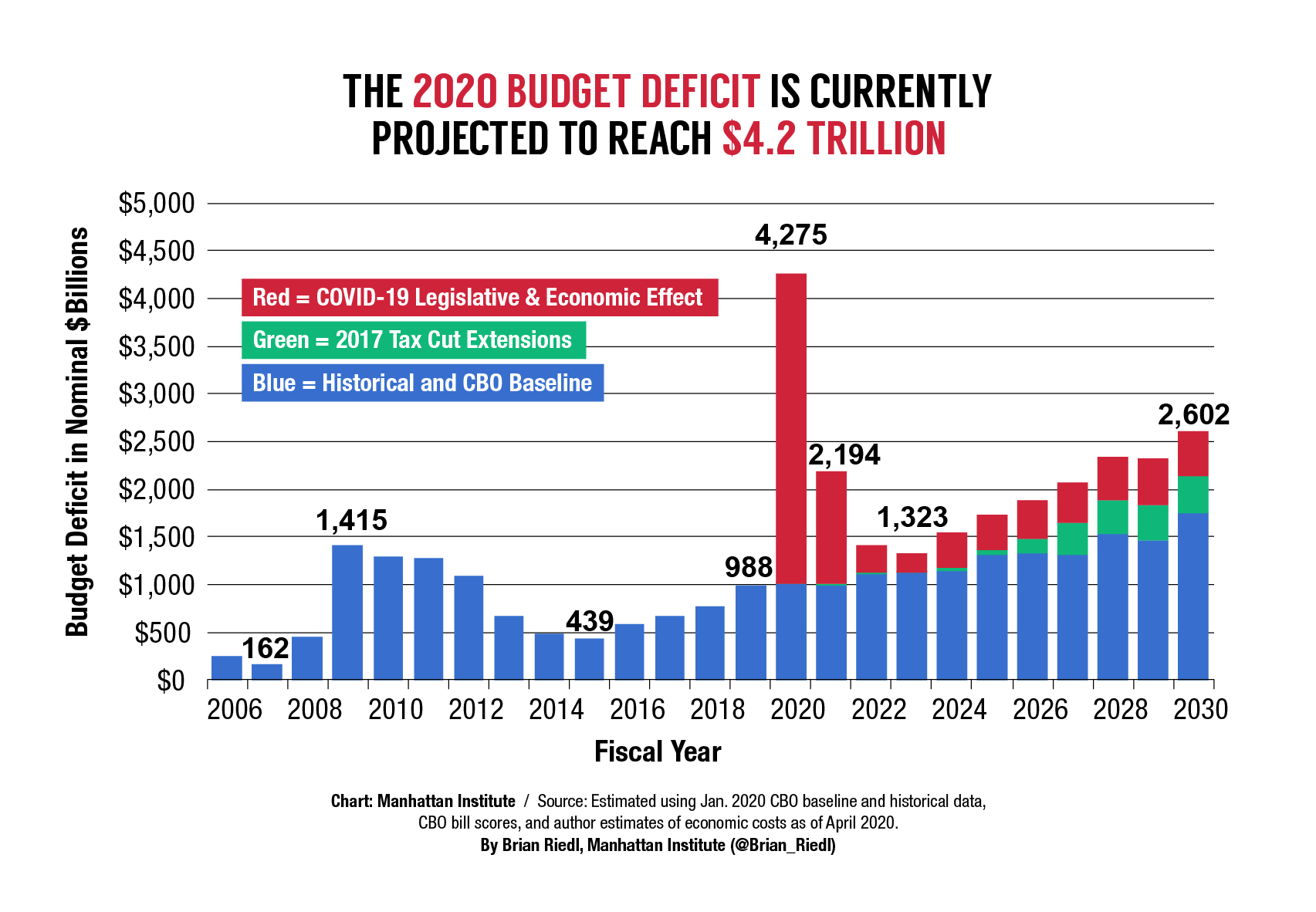
The baseline deficit entering 2020 was $1.0 trillion. The Congressional Budget Office (CBO) projects that the first four Coronavirus response bills will add $2.2 trillion to this year’s deficit. The remaining portion of the deficit consists of the economic and technical effects of the economic shutdown—the non-legislative costs such as fewer workers paying taxes and more people signing up for unemployment and Medicaid benefits. This analysis assumes approximately $1 trillion in these costs (bringing the total deficit to approximately $4.2 trillion), while the CBO presumably assumes a smaller economic and technical figure to reach its $3.7 trillion total.[
– The U.S. government suffered budget deficits every year from 1970 through 1997. – Democrat Bill Clinton was president in 1998, when the government finally recorded a surplus.
On January 27th, 1998, during his State of the Union, President Bill Clinton boasted of major progress in reducing the annual federal budget deficit.
“When I took office, the deficit for 1998 was projected to be $357 billion and heading higher,” he said.
“This year, our deficit is projected to be $10 billion and heading lower. For three decades, six Presidents have come before you to warn of the damage deficits pose to our nation. Tonight I come before you to announce that the federal deficit, once so incomprehensibly large that it had 11 zeros, will be, simply, zero. I will submit to Congress for 1999 the first balanced budget in 30 years.”
The Clinton Curse. 2020 records the biggest budget deficit in the US history.
In my analysis, the financial woes of the United States are entirely attributable to the fiscal policies of President Clinton who recklessly failed to seek the Blessings of the LORD to ensure that this nation will not borrow from other nations.
US Treasury seeks to borrow a record $3 trillion this quarter
Jeff Cox
Massive stimulus to support the U.S. economy through the Coronavirus crisis will cause the Treasury to borrow a record $3 trillion this quarter.
The department on Monday announced the total, which is actually $2.999 trillion.
“The increase in privately-held net marketable borrowing is primarily driven by the impact of the COVID-19 outbreak, including expenditures from new legislation to assist individuals and businesses, changes to tax receipts including the deferral of individual and business taxes from April – June until July, and an increase in the assumed end-ofJune Treasury cash balance,” the department said in a statement.
On top of that borrowing, Treasury also said it anticipates another $677 billion in the third quarter. First-quarter borrowing totaled $477 billion.
The red ink comes thanks to multiple stimulus efforts Congress has passed to resuscitate an economy brought to a standstill amid social distancing efforts to halt the virus spread. Allocations thus far have totaled more than $2 trillion, and at last one more package is expected to help the more than 30 million Americans who have hit the unemployment line as well as thousands of other businesses that have seen their revenue streams evaporate.
The Treasury Department also is backstopping several lending programs for the Federal Reserve, which is leveraging Treasury guarantees in programs aimed at providing another $2.2 trillion in funding to businesses and households.
Just since March 1, the national debt has grown by $1.5 trillion to $24.9 trillion, a 6.4% increase. The budget deficit through March, or the first six months of the fiscal year, totaled $744 billion, on pace to easily eclipse the biggest shortfall in U.S. history.
The Clinton Curse. 2020 records the biggest budget deficit in the US history,
Wednesday, April 29, 2020. Prayers for the downfall of Evil Empire code-named Babylon. REVELATION. Chapter 18.
On Wednesday, April 29, 2020, I offer my prayers for the downfall of Evil Empire code-named ‘Babylon’. Historically, life on planet Earth is impacted by collision events as celestial objects can unleash vast amounts of destructive power within a short duration of time. The LORD God Creator is aware of the man’s evil actions and they will never go unnoticed.
This Day in My Life – July 26 – My CIA Connection. In Man’s Plan, I exist as a mere Pawn used in the War on Communism, Legacy of Cold War Era Geopolitics. What is God’s Plan?
Mile-wide asteroid to zip past Earth on Wednesday
Mile-wide asteroid to zip past Earth on Wednesday, April 29, 2020.
Brian Lada, AccuWeather• April 28, 2020
A giant asteroid from the depths of our solar system will fly by Earth at midweek. This is the largest space rock to zoom past the planet since the start of the year.
Estimated to be a little over a mile wide, asteroid (52768) 1998 OR2 will make its closest approach to Earth on Wednesday, April 29; this is the closest it has come to the planet in over 100 years.
There is no chance that it will collide with the planet on Wednesday as it will safely glide by at a distance of around 4 million miles. To put this into perspective, this is about 16 times farther away than the moon is from the Earth.
Space rocks fly past the planet on a daily basis but according to Earthsky, this one in particular is the largest to zip by the Earth so far in 2020.
This animation was created using a series of delay-Doppler images taken on April 18, 2020. (Arecibo Observatory / NASA / NSF)
Wednesday, April 29, 2020. Prayers for the downfall of Evil Empire code-named Babylon. REVELATION, Chapter 18.
Although it poses no threat to hitting the Earth this time by, asteroid (52768) 1998 OR2 has been classified as a “Potentially Hazardous Asteroid.”
“Potentially Hazardous Asteroids (PHAs) are currently defined based on parameters that measure the asteroid’s potential to make threatening close approaches to the Earth,” NASA said.
By definition, any asteroid that is larger than 500 feet across and is projected to come within 4.6 million miles of Earth is called a PHA.
At over 5,000 feet wide, 1998 OR2 would cause some serious damage if it were on a crash course with the planet.
On June 30, 1908, an asteroid estimated to be around 262 feet across exploded over an uninhabited area of Siberia while entering the Earth’s atmosphere. The explosion had a force equivalent to that of the 1980 Mount St. Helens eruption, flattening 500,000 acres of forest. This is known as the Tunguska event.
However, it pales in comparison to the asteroid that is believed to have caused the dinosaurs to go extinct, which is estimated to have been around 6 miles across.
Wednesday, April 29, 2020. Prayers for the downfall of evil empire code-named Babylon. REVELATION, Chapter 18.
English: Asteroid 1998 OR2 as imaged by the Arecibo Radar on 18 April 2020. Some observers have noted that the asteroid appears to be wearing a face mask of its own in images. (Arecibo Observatory / NASA / NSF)
At 4 million miles away, the one-mile-wide rock may seem like it is too far away to see, but observers with a decent telescope may be able to spot it from their backyards, as long as Mother Nature cooperates.
Onlookers will need a telescope with a primary mirror of at least 6 or 8 inches that is pointed to the southern sky near the constellation Hydra, EarthSky said. At first, it may just look like another star, but over time, it will slowly drift in a different way than the stars around it.
After Wednesday, asteroid (52768) 1998 OR2 will not swipe past the Earth again until May 18, 2031.
Similar to this week, this next flyby will post no risk of collision as it will be more than 45 times farther away than the moon, according to NASA.
Wednesday, April 29, 2020. Prayers for the downfall of Evil Empire code-named Babylon. REVELATION, Chapter 18.
Modern-Day Involuntary Servitude and Slavery signed into Public Law by President Bill Clinton. The Clinton Curse of 1996 Compromised the Ability of Americans to Fight Coronavirus With Compassion.
In my analysis, ‘The Clinton Curse’ of 1996 compromised the ability of Americans to fight Coronavirus with Compassion. President Bill Clinton’s “A New Beginning” reintroduced Slavery in America by taking away the Rights sanctioned by the 13th Amendment to the Constitution of the United States of America.
The Clinton Curse of 1996 Compromised the Ability of Americans to Fight Coronavirus with Compassion.
The CARES ACT of 2020 may reflect upon the economic might of the United States to fight the Coronavirus. However, the manner in which the economic relief is dispersed clearly demonstrates the American inability to respond with Compassion.
‘Prayer Is Not Enough.’ The Dalai Lama on Why We Need to Fight Coronavirus With Compassion
The Clinton Curse of 1996 Compromised the Ability of Americans to Fight Coronavirus With Compassion. Photo image credit. Ruven Afanador for TIME
BY DALAI LAMA APRIL 14, 2020 5:23 PM EDT
Sometimes friends ask me to help with some problem in the world, using some “magical powers.” I always tell them that the Dalai Lama has no magical powers. If I did, I would not feel pain in my legs or a sore throat. We are all the same as human beings, and we experience the same fears, the same hopes, the same uncertainties.
From the Buddhist perspective, every sentient being is acquainted with suffering and the truths of sickness, old age and death. But as human beings, we have the capacity to use our minds to conquer anger and panic and greed. In recent years I have been stressing “emotional disarmament”: to try to see things realistically and clearly, without the confusion of fear or rage. If a problem has a solution, we must work to find it; if it does not, we need not waste time thinking about it.
We Buddhists believe that the entire world is interdependent. That is why I often speak about universal responsibility. The outbreak of this terrible coronavirus has shown that what happens to one person can soon affect every other being. But it also reminds us that a compassionate or constructive act—whether working in hospitals or just observing social distancing—has the potential to help many.
Ever since news emerged about the coronavirus in Wuhan, I have been praying for my brothers and sisters in China and everywhere else. Now we can see that nobody is immune to this virus. We are all worried about loved ones and the future, of both the global economy and our own individual homes. But prayer is not enough.
This crisis shows that we must all take responsibility where we can. We must combine the courage doctors and nurses are showing with empirical science to begin to turn this situation around and protect our future from more such threats.
In this time of great fear, it is important that we think of the long-term challenges—and possibilities—of the entire globe. Photographs of our world from space clearly show that there are no real boundaries on our blue planet. Therefore, all of us must take care of it and work to prevent climate change and other destructive forces. This pandemic serves as a warning that only by coming together with a coordinated, global response will we meet the unprecedented magnitude of the challenges we face.
We must also remember that nobody is free of suffering, and extend our hands to others who lack homes, resources or family to protect them. This crisis shows us that we are not separate from one another—even when we are living apart. Therefore, we all have a responsibility to exercise compassion and help.
As a Buddhist, I believe in the principle of impermanence. Eventually, this virus will pass, as I have seen wars and other terrible threats pass in my lifetime, and we will have the opportunity to rebuild our global community as we have done many times before. I sincerely hope that everyone can stay safe and stay calm. At this time of uncertainty, it is important that we do not lose hope and confidence in the constructive efforts so many are making.
The Dalai Lama is the Supreme Leader of Tibetans and a Nobel laureate
This article is part of a special series on how the coronavirus is changing our lives, with insights and advice from the TIME 100 community.
The Economic Fallout of The Clinton Curse. The United States needs the Blessings of the LORD God Creator. The Clinton Curse of 1996 Compromised the Ability of Americans to Fight Coronavirus With Compassion.
The Coronavirus Disease. Old solutions cannot resolve the new crisis.
The health care crisis caused by the Coronavirus Disease (COVID-19) is getting much attention for its fallout includes an economic disaster, the extent of which is still unknown. The US invested nearly $2.5 trillion dollars to provide economic relief to both individuals and business entities. In my analysis, the health care interventions and the economic interventions may not provide adequate relief. Firstly, the term health has to be correctly defined. Health is about the well-being of man. To define the term health, the Medical Science has to define the term man. What is Man? The singularity commonly viewed as man is indeed a spectrum of seven colors or dimensions. The physical, the mental, and the social dimensions of the man are well understood. However, the Science refuses to include the moral, the spiritual, and the rational dimensions of the man. The interventions do not work unless they recognize the man as a spiritual, moral, and rational being. I am using the term ‘spiritual’ not in the context of a religious faith or doctrine. The term ‘spiritual’ refers to the experience of peace, harmony, and tranquility in the living human condition. The man experiences the condition called ‘happiness’ if his living condition is consistent with the operation of peace, harmony, and tranquility. The plan to spend enormous amounts of money will only aggravate the problem of the debt burden as the US government relies upon deficit spending to operate its routine activities. Without the moral, spiritual, and rational constraints, the response to the pandemic remains inadequate and insufficient.
The Coronavirus Disease. Old solutions cannot resolve the new crisis. There is no Hearing without Healing.
The Real Economic Fallout of COVID-19
Apr 8, 2020
DENNIS J. SNOWER
The Coronavirus Disease. Old solutions cannot resolve the new crisis.
Dennis J. Snower, President of the Global Solutions Initiative, is a professor at the Hertie School of Governance in Berlin, Senior Research Fellow at the Blavatnik School of Government at Oxford University, a non-resident fellow at the Brookings Institution, and President Emeritus of the Kiel Institute for the World Economy.
Regardless of how long the current pandemic lasts, the existing organization of economic activities needs to change fundamentally. In particular, governments must support the shift in employment from physically interactive to physically disjointed activities.
BERLIN – Governments around the world are pursuing extremely expansive monetary and fiscal policies to combat the economic fallout from the COVID-19 pandemic. But such largesse is appropriate for an old-style depression, not for this public-health crisis.
We currently face a tradeoff between social triage and economic collapse. That is because much economic activity involves physical interactions among people, including in the retail trade, restaurants, tourism, live entertainment, and most forms of office work. With social distancing being enforced, such activity comes to a halt.
Worse, COVID-19 is the first pandemic to have struck a thoroughly integrated global economy. Most goods today are products of global supply chains, where physical interactions in one location are connected to physical interactions elsewhere. Stop the physical interactions in one place, and the economic fallout is felt in many others.
Higher government spending, lower taxes, and rock-bottom interest rates may keep people afloat in the short term, but do not stimulate productive activity when people cannot work. Nor will supplementing the incomes of the newly unemployed necessarily shore up consumption when most shops are closed and delivery services are unable to meet the exploding demand.
The problem is not a generalized drop in aggregate demand, as was the case during the Great Depression of the 1930s. Rather, it is a dramatic fall in the production and consumption of goods and services that rely on physical interactions, combined with an equally dramatic rise in the production and consumption of goods and services that don’t involve such interactions.
That is why business is currently booming for Amazon and Netflix, but slumping for hotels and restaurants. Infact, the pandemic has caused a Great Economic Mismatch: Many sectors that depend on existing production and distribution processes are shedding workers, while others are unable to hire enough.
Many governments have announced fiscal measures to mitigate the pandemic’s economic impact, such as paying much of the wages of furloughed workers (as in the United Kingdom) or sending taxpayers a stimulus check (as in the United States). Canada, Denmark, France, and others are paying large parts of company payrolls so that firms remain intact.
But such initiatives aim to preserve the income from jobs that have disappeared, rather than generating income from jobs that have yet to be filled. While policies like these are appropriate for combating an economic depression or covering a temporary shortfall in aggregate demand, they will not help to address the Great Economic Mismatch.
Indeed, it would be irresponsible for governments to formulate policy on the assumption that the current pandemic is a temporary, one-time occurrence. Policymakers should not think that it is enough to give employers and employees some money to tide them over before the prompt return of economic normality.
No one knows how long the pandemic will last. If it turns out to be lengthy, then the Great Economic Mismatch should induce governments everywhere to plan for a persistent structural change. Supporting incomes from non-existent jobs will cease to be an option, so helping people to find new jobs must become paramount.
If the pandemic is reasonably short, then governments must ensure that they are never again caught as unprepared as they are now. That will mean strengthening the economy’s resilience to pandemic shocks, by ensuring that people have the skills to perform new jobs.
So, regardless of how long the pandemic lasts, the organization of economic activities needs to change fundamentally. But thus far, governments have not risen to this challenge.
In order to understand the underlying problem and identify the policy solution, we need to devise new categories of economic activity. In particular, we need to divide production and consumption into physically interactive (PI) and physically disjointed (PD) activities.
The pandemic is dramatically restructuring global supply chains and consumption behavior to the detriment of PI activities and in favor of PD activities. Consequently, the primary job of governments is not to make up for a shortfall in aggregate demand, but rather to finance the adjustments needed to overcome the Great Economic Mismatch.
It is not enough to provide income support to people without jobs; governments must also give them access to essential goods and services such as food and medical care, as well as to PD support for mental and physical health. Nowadays, this access is far from assured in many countries, leading to widespread anxiety and despair.
Employment services can play a vital role by identifying the rapidly proliferating PD jobs and conveying this information to people engaged in PI activities. Finance and labor ministries, meanwhile, should subsidize relocation and training expenses.
To promote the movement of workers from vanishing PI jobs into readily available PD positions, governments should provide hiring subsidies. These are far superior to payroll-tax reductions, which aim to preserve old jobs rather than overcoming the mismatch.
Furthermore, a pandemic is a public bad, and individuals do not have to pay the full cost of the damage they cause to others by transmitting the virus. Because the free-market system cannot deal efficiently with this problem, testing and treatment must be financed by the government. This is accepted as a matter of course in some countries (such as Germany and South Korea), but woefully ignored by others (such as the US).
True, subsidizing the adjustment costs generated by the Great Economic Mismatch will be expensive. But the amounts involved would be small compared to the sums that many governments are currently planning to spend in response to the economic fallout of the pandemic.
The fallout is not slumping demand, but rather the abrupt and rapid shift in our production and consumption activities. Instead of desperately applying old solutions to a new problem, governments everywhere must help economies adjust to this change.
For this people’s heart is waxed gross, and their ears are dull of hearing, and their eyes they have closed; lest at any time they should see with their eyes, and hear with their ears, and should understand with their heart, and should be converted, and I should heal them. Three things they were failing to do—see, hear, and understand with the heart. Two blessings for all believers: Conversion, a change of direction, a new walk with God. Physical healing, a change of health, a new health in God. Even in this small group we have seen people come and visit, tell us how much they enjoyed it, but never return for more.
In God We Trust. The Uncaring Action of The CARES Act of 2020.
The fiscal policy of the United States must reflect the official Motto of the Nation. In my analysis, the Uncaring Action of The CARES Act of 2020 truly speaks of the Clinton Curse of 1996 that scorched the compassionate heart of the United States.
Rudra Narasimham Rebbapragada
Special Frontier Force-Establishment No. 22-Vikas Regiment
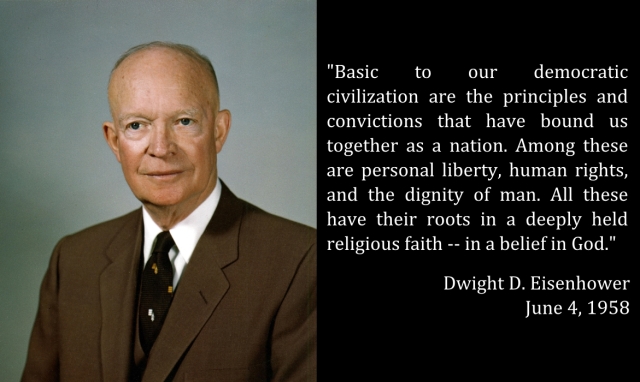
In God We Trust. The Uncaring Action of The CARES Act of 2020.
Millions of Taxpaying Immigrants Won’t Get Stimulus Checks
In God We Trust. The Uncaring Action of The CARES Act of 2020. In 1996, US President Bill Clinton scorched the compassionate heart of the nation.
Roughly 4.3 million mostly unauthorized immigrants who do not have a Social Security number file taxes using what’s known as a taxpayer identification number (ITIN)
In this April 3, 2020, photo, house painter Jose Martinez stands on his front porch in Greenfield, Mass. Martinez said a pandemic stimulus check could have helped cover at least a month’s worth of expenses, if he had qualified. The 34-year-old Mexican crossed the border illegally about 15 years ago and lives near the Vermont state line with his 4-year-old American-born daughter. (AP Photo/David Goldman)
The $2.2 trillion package that Congress approved to offer financial help during the coronavirus pandemic has one major exclusion: millions of immigrants who do not have legal status in the U.S. but work here and pay taxes.
That includes Carmen Contreras Lopez, a 48-year-old housekeeper who, though she earns low wages, files a tax return each year. Since the virus took hold, she has lost most of her clients and is getting by with help from her oldest son. But she won’t see a penny of the money promised to most Americans in response to the pandemic.
“It’s hard because to the government, we don’t exist,” said Contreras Lopez, who has lived in the U.S. for 30 years and has four grown children who are U.S. citizens.
The government expects to begin making payments to millions of Americans in mid-April. Anyone earning up to $75,000 in adjusted gross income and who has a Social Security number will receive $1,200. The payment steadily declines for those who make more. Legal permanent residents, or green card holders, are expected to benefit.
Roughly 4.3 million mostly unauthorized immigrants who do not have a Social Security number file taxes using what’s known as a taxpayer identification number, according to the Institute on Taxation and Economic Policy.
Many say they pay federal taxes because they hope it will one day help them achieve legal residency and because they feel it’s the right thing to do.
“We made that decision because we’re living in a country that’s welcomed us with a lot of love,” said Ingrid Vaca, a house cleaner in the Washington, D.C., area.
Vaca said immigrants take care of communities, children, the elderly and homes, but they will not receive any help themselves. Also left out are the workers’ 3.5 million children, many of whom are American citizens.
“This is a nightmare to me and many of my colleagues,” Vaca said, lamenting the lack of income for rent and basic necessities. “We need for us to be respected.”
Asked how immigrants without legal status will survive the pandemic’s economic toll without any aid, President Donald Trump acknowledged the difficulty but said many citizens without work need help first.
“It’s a really sad situation, and we are working on it. I will tell you I’m not going to give you a hard and fast answer because I just want to tell you it’s something I think about,” Trump said.
Democratic lawmakers introduced legislation last week in the House and Senate that would allow immigrants to access relief funds.
“COVID-19 does not care about your immigration status, so neither should our response,” U.S. Rep. Raúl M. Grijalva, an Arizona Democrat, said in a statement.
Maria Zamorano, a day laborer in the Los Angeles area, has also been left without work. Until recently, she worked seven days a week cleaning houses, earning roughly $700 weekly. But all of her employers canceled services. After she did an interview with The New York Times about her situation, two of those employers decided to keep paying her, she said, but she doesn’t know for how long. She’s still short on cash for food, rent and bills.
“Like thousands of others who don’t have legal status, we are left empty-handed in this crisis,” Zamorano said. “I pay taxes, but the government doesn’t consider that we should get help.”
In rural Massachusetts, Jose Martinez said a pandemic stimulus check could have helped cover at least a month’s worth of expenses, if he had qualified. The 34-year-old Mexican crossed the border illegally about 15 years ago and lives near the Vermont state line with his 4-year-old American-born daughter.
Martinez, a house painter, says work has dropped off during the pandemic. His boss still owes him more than $500 for recent jobs, and the restaurant where he washes dishes part-time has also been temporarily shuttered.
“The check would have given me the opportunity to stay at home, avoid sickness and keep my family safe,” Martinez said, referring to the stimulus money. “But I have to keep looking for work and exposing us to risk. I don’t know what else to do.”
Luis Jiménez, a 35-year-old Mexican who takes cares of calves in New York, near Canada, said he feels forgotten by the government even though his work is vital to feed Americans.
“We are essential to the economy and to feed this country, but we don’t get any help or support,” said the father of three, who has lived in the United States without legal status for 16 years.
Jiménez, who lives with his kids and spouse, said he makes about $38,000 a year and pays about $6,000 in taxes annually. He has been paying them since 2005, he said.
“Every day we go to work and we are exposed to everything. In the farm, there are hardly any protection measures” against coronavirus, he said.
___
Marcelo reported from Boston. Torrens reported from New York. Associated Press writers Nomaan Merchant in Houston, Regina Garcia Cano in Washington and Anita Snow in Phoenix also contributed to this report.Copyright AP – Associated Press
In God We Trust. The Uncaring Action of The CARES Act of 2020.
The economic fallout of ‘The Clinton Curse’. The United States needs the Blessings of the LORD God Creator
I reviewed the opinions of nine global thinkers on the issue of the economic fallout of the Coronavirus pandemic. None of the nine global thinkers mentioned about the need for the Blessings of the LORD God Creator. In my analysis, no man, and no nation can ever hope to be self-reliant. Both the individual entity, and the national entity will only exist if and only if the existence is granted by the LORD God Creator’s Mercy, Grace, and Compassion.
The economic fallout of ‘The Clinton Curse’. The United States needs the Blessings of the LORD God Creator.
How the Economy Will Look After the Coronavirus Pandemic
The economic fallout of ‘The Clinton Curse’. The United States needs the Blessings of the LORD God Creator: In this graphic, Julie Peasley shows how many one-dollar bills it would take to stack up to the total U.S. debt of $31.4 trillion.Americans will give attention to my words after they fail to resolve the Economic Crisis through either Liberal or Conservative Spending Plans to revive the National Economy.The economic fallout of ‘The Clinton Curse’. The United States needs the Blessings of the LORD God Creator. Americans will give attention to my words after they fail to resolve the Economic Crisis through either Liberal or Conservative Spending Plans to revive the National Economy.The economic fallout of ‘The Clinton Curse’. The United States needs the Blessings of the LORD God Creator.Whole Dude – Whole Plan: Americans will give attention to my words after they fail to resolve the Economic Crisis through either Liberal or Conservative Spending Plans to revive the National Economy.The Clinton Curse. America in Crisis. No Economist can Save the US from the present day economic downfall. Americans will give attention to my words after they fail to resolve the Economic Crisis through either Liberal or Conservative Spending Plans to revive the National Economy.
In my analysis, the Economic Policy of President Bill Clinton is fundamentally flawed for it violated the principles of Natural Law that make America a proud and prosperous nation in the world. The economic downfall of the United States is relentless and is almost unstoppable. There can be no healing and no recovery without the Blessings promised by God and living up to the Official Motto “IN GOD WE TRUST.”
THE CLINTON CURSE. THE RETURN OF ORIGINAL SIN. THE UNITED STATES IS CURSED TO RUN ITS GOVERNMENT WITH BORROWINGS FROM FOREIGN NATIONS.
The pandemic will change the economic and financial order forever. We asked nine leading global thinkers for their predictions.
BY JOSEPH E. STIGLITZ, ROBERT J. SHILLER, GITA GOPINATH, CARMEN M. REINHART, ADAM POSEN, ESWAR PRASAD, ADAM TOOZE, LAURA D’ANDREA TYSON, KISHORE MAHBUBANI APRIL 15, 2020, 5:10 PM
BRIAN STAUFFER ILLUSTRATION FOR FOREIGN POLICY. The Clinton Curse. The United States needs the Blessings of the LORD God Creator.
After many weeks of lockdowns, tragic loss of life, and the shuttering of much of the global economy, radical uncertainty is still the best way to describe this historical moment. Will businesses reopen and jobs come back? Will we travel again? Will the flood of money from central banks and governments be enough to prevent a deep and lasting recession, or worse?
This much is certain: The pandemic will lead to permanent shifts in political and economic power in ways that will become apparent only later.
To help us make sense of the ground shifting beneath our feet, Foreign Policy asked nine leading thinkers, including two Nobel-Prize-winning economists, to weigh in with their predictions for the economic and financial order after the pandemic.
We Need a Better Balance Between Globalization and Self-Reliance
by Joseph E. Stiglitz
Economists used to scoff at calls for countries to pursue food or energy security policies. In a globalized world where borders don’t matter, they argued, we could always turn to other countries if something happened in our own. Now, borders suddenly do matter, as countries hold on tightly to face masks and medical equipment, and struggle to source supplies. The coronavirus crisis has been a powerful reminder that the basic political and economic unit is still the nation-state.
The coronavirus crisis has been a powerful reminder that the basic political and economic unit is still the nation-state.
To build our seemingly efficient supply chains, we searched the world over for the lowest-cost producer of every link in the chain. But we were short-sighted, constructing a system that is plainly not resilient, insufficiently diversified, and vulnerable to interruptions. Just-in-time production and distribution, with low or no inventories, may be capable enough of absorbing small problems, but we have now seen the system crushed by an unexpected disturbance.
We should have learned the lesson of resilience from the 2008 financial crisis. We had created an interconnected financial system that seemed efficient and was perhaps good at absorbing small shocks, but it was systemically fragile. If not for massive government bailouts, the system would have collapsed as the real estate bubble popped. Evidently, that lesson went right over our heads.
The economic system we construct after this pandemic will have to be less shortsighted, more resilient, and more sensitive to the fact that economic globalization has far outpaced political globalization. So long as this is the case, countries will have to strive for a better balance between taking advantage of globalization and a necessary degree of self-reliance.
This Wartime Atmosphere Has Opened a Window for Change
by Robert J. Shiller
There are fundamental changes that happen from time to time—often during times of war. Though the enemy is now a virus and not a foreign power, the COVID-19 pandemic has created a wartime atmosphere in which such changes suddenly seem possible.Though the enemy is a virus and not a foreign power, the pandemic has created a wartime atmosphere in which fundamental changes suddenly seem possible.
This atmosphere, with narratives of both suffering and heroism, is spreading with the disease. Wartime brings people together not only within a country, but also between countries, as they share a common enemy like the virus. Those who live in advanced countries can feel more sympathy with those suffering in poor countries because they are sharing a similar experience. The epidemic is also bringing us together in countless Zoom get-togethers. Suddenly the world seems smaller and more intimate.
There is also reason to hope that the pandemic has opened a window to creating new ways and institutions to deal with the suffering, including more effective measures to stop the trend toward greater inequality. Perhaps the emergency payments to individuals that many governments have made are a path to a universal basic income. In the United States, better and more universal health insurance might just have been given new impetus. Since we are all on the same side in this war, we may now find the motivation to build new international institutions allowing better risk-sharing among countries. The wartime atmosphere will fade again, but these new institutions would persist.
The Real Risk Is Politicians Exploiting Our Fears
by Gita Gopinath
Over only a few weeks, a dramatic chain of events—tragic loss of life, paralyzed global supply chains, interrupted shipments of medical supplies between allies, and the deepest global economic contraction since the 1930s—has laid bare the vulnerabilities of open borders.People may self-assess their individual risks and decide to curtail travel indefinitely, reversing 50 years of rising international mobility.
If support for an integrated global economy was already declining before COVID-19 struck, the pandemic will likely hasten the reassessment of globalization’s costs and benefits. Firms that are part of global supply chains have witnessed firsthand the risks inherent in their interdependencies and the large losses caused by disruption. In future, these firms are likely to take greater account of tail risks, resulting in supply chains that are more local and robust—but less global. In emerging markets, whose embrace of globalization included a steady opening to capital flows, we risk seeing capital controls being reimposed as these countries scramble to shield themselves from the destabilizing forces of the sudden economic stop. And even as containment measures gradually come off worldwide, people may self-assess their individual risks and decide to curtail travel indefinitely, reversing half a century of rising international mobility.
The real risk, however, is that this organic and self-interested shift away from globalization by people and firms will be compounded by some policymakers who exploit fears over open borders. They could impose protectionist restrictions on trade under the guise of self-sufficiency and restrict the movement of people under the pretext of public health. It is now in the hands of global leaders to avert this outcome and to retain the spirit of international unity that has collectively sustained us for more than 50 years.
Another Nail in the Coffin of Globalization
by Carmen M. Reinhart
World War I and the global economic depression in the early 1930s ushered in the demise of a previous era of globalization. Apart from a resurgence of trade barriers and capital controls, an important explanation for this demise is the fact that more than 40 percent of all countries at the time entered default, cutting many of them off from the global capital markets until the 1950s or much later. By the time World War II ended, the new Bretton Woods system combined domestic financial repression with extensive controls of capital flows, with little resemblance to the preceding era of global trade and finance.Pandemic-induced recessions may be deep and long—and as in the 1930s, sovereign defaults will likely spike.
The modern globalization cycle has faced a series of blows since the financial crisis of 2008-2009: a European debt crisis, Brexit, and the U.S.-China trade war. The rise of populism in many countries further tilts the balance toward home bias.
The coronavirus pandemic is the first crisis since the 1930s to engulf both advanced and developing economies. Their recessions may be deep and long. As in the 1930s, sovereign defaults will likely spike. Calls to restrict trade and capital flows find fertile soil in bad times.
Doubts about pre-coronavirus global supply chains, the safety of international travel, and, at the national level, concerns about self-sufficiency in necessities and resilience are all likely to persist—even after the pandemic is brought under control (which may itself prove a lengthy process). The post-coronavirus financial architecture may not take us all the way back to the pre globalization era of Bretton Woods, but the damage to international trade and finance is likely to be extensive and lasting.
The Economy’s Preexisting Conditions Are Made Worse by the Pandemic
by Adam Posen
The pandemic will worsen four preexisting conditions of the world economy. They will remain reversible through major surgery but turn chronic and damaging absent such interventions. The first of these conditions is secular stagnation—the combination of low productivity growth, a lack of private investment returns, and near-deflation. This will deepen as people stay risk-averse and save more following the pandemic, which will persistently weaken demand and innovation.
Second, the gap between rich countries (along with a few emerging markets) and the rest of the world in their resilience to crises will widen further.Economic nationalism will increasingly lead governments to shut off their own economies from the rest of the world.
Third, partly as a result of flight to safety and the apparent riskiness of developing economies, the world will continue to be over-reliant on the U.S. dollar for financing and trade. Even while the United States becomes less attractive for investment, its attraction will increase relative to most other parts of the world. This will lead to ongoing dissatisfaction.
Finally, economic nationalism will increasingly lead governments to shut off their own economies from the rest of the world. This will never produce complete autarky, or anything close to it, but it will reinforce the first two trends and increase resentment of the third.
More Than Ever, the World Looks to Central Bankers for Deliverance
by Eswar Prasad
The economic and financial carnage wrought by the pandemic could leave deep scars on the world economy. Central banks have stepped up to the challenge by tearing up their own rulebooks. The U.S. Federal Reserve has bolstered financial markets with asset purchases and provided dollar liquidity to other central banks. The European Central Bank has declared “no limits” to its support of the euro and announced massive purchases of government and corporate bonds, and other assets. The Bank of England is financing government spending directly. Even some emerging-market central banks, such as the Reserve Bank of India, are considering extraordinary measures—all risks be damned.Central bankers, once considered cautious and conservative, have shown they can act with agility, boldness, and creativity.
Fiscal stimulus by governments, on the other hand, has proved to be politically complicated, cumbersome to implement, and often difficult to target where the need is greatest.
Central bankers, once considered cautious and conservative, have shown they can act with agility, boldness, and creativity in desperate times. Even when political leaders are unwilling to coordinate policies across borders, central bankers can act in concert.
Now and for a long time to come, central banks have become entrenched as the first and main line of defense against economic and financial crises. They may come to rue this immense new role and the unrealistic burdens and expectations it will impose on them.
The Normal Economy Is Never Coming Back
by Adam Tooze
As the lockdowns began, the first impulse was to search for historical analogies—1914, 1929, 1941? Since then, what has come ever more to the fore is the historical novelty of the shock we are living through. There is something new under the sun. And it is horrifying.
The economic fallout defies calculation. Many countries face a far deeper and more savage economic shock than they have ever previously experienced. In sectors like retail, already under fierce pressure from online competition, the temporary lockdown may prove to be terminal. Many stores will not reopen, their jobs permanently lost. Millions of workers, small-business owners, and their families are facing catastrophe. The longer we sustain the lockdown, the deeper the economic scars, and the slower the recovery.
The longer we sustain the lockdown, the deeper the economic scars, and the slower the recovery.
What we thought we knew about the economy and finance has been radically disturbed. Since the shock of the 2008 financial crisis, there has been a lot of talk about the need to reckon with radical uncertainty. We now know what truly radical uncertainty looks like.
We are witnessing the largest combined fiscal effort since World War II, but it is already clear that the first round may not be enough. There are few illusions about the unprecedented acrobatics that central banks are performing. To deal with the accumulated liabilities, history suggests some radical alternatives, including a burst of inflation or an organized public default (which would not be as drastic as it sounds if it affects government debts held by central banks).
If the response by businesses and households is risk-aversion and a flight to safety, it will compound the forces of stagnation. If the public response to the debts accumulated by the crisis is austerity, that will make matters worse. It makes sense to call instead for a more active, more visionary government to lead the way out of the crisis. But the question, of course, is what form that will take and which political forces will control it.
Many Lost Jobs Will Never Return
by Laura D’Andrea Tyson
The pandemic and subsequent recovery will accelerate the ongoing digitalization and automation of work—trends that have eroded middle-skill jobs while increasing high-skill jobs during the last two decades and contributed to the stagnation of median wages and rising income inequality.Many low-wage, low-skill, in-person service jobs, especially those provided by small firms, will not return with the recovery.
Changes in demand, many of them accelerated by the economic dislocation wrought by the pandemic, will change the future composition of GDP. The share of services in the economy will continue to rise. But the share of in-person services will decline in retail, hospitality, travel, education, health care, and government as digitalization drives changes in the way these services are organized and delivered.
Many low-wage, low-skill, in-person service jobs, especially those provided by small firms, will not return with the eventual recovery. However, workers providing essential services such as policing, firefighting, health care, logistics, public transportation, and food will be in greater demand, creating new job opportunities and increasing the pressure to raise wages and improve benefits in these traditionally low-wage sectors. The downturn will accelerate the growth of nonstandard, precarious employment—part-time workers, gig workers, and workers with multiple employers—leading to new portable benefits systems that move with workers and broaden the definition of employer. New low-cost training programs, digitally delivered, will be required to provide the skills required in new jobs. The sudden dependence of so many on the ability to work remotely reminds us that a significant and inclusive expansion of Wi-Fi, broadband, and other infrastructure will be necessary to enable the accelerating digitalization of economic activity.
A More China-Centric Globalization
by Kishore Mahbubani
The COVID-19 pandemic will accelerate a change that had already begun: a move away from U.S.-centric globalization to a more China-centric globalization.
Why will this trend continue? The American population has lost faith in globalization and international trade. Free trade agreements are toxic, with or without U.S. President Donald Trump. By contrast, China has not lost faith. Why not? There are deeper historical reasons. Chinese leaders now know well that China’s century of humiliation from 1842 to 1949 was a result of its own complacency and a futile effort by its leaders to cut it off from the world. By contrast, the past few decades of economic resurgence were a result of global engagement. The Chinese people have also experienced an explosion of cultural confidence. They believe they can compete anywhere.
Consequently, as I document in my new book, Has China Won?, the United States has two choices. If its primary goal is to maintain global primacy, it will have to engage in a zero-sum geopolitical contest, politically and economically, with China. However, if the goal of the United States is to improve the well-being of the American people—whose social condition has deteriorated—it should cooperate with China. Wiser counsel would suggest that cooperation would be the better choice. However, given the toxic U.S. political environment toward China, wiser counsel may not prevail.
The Economic Fallout of The Clinton Curse. The United States needs the Blessings of the LORD God Creator.
The Clinton Curse vs Universal Basic Income. Democratic presidential candidate Andrew Yang advocated the introduction of a Universal Basic Income.
A universal basic income is a government guarantee that each citizen receives a minimum income. It is also called a citizen’s income, guaranteed minimum income, or basic income. The intention behind the payment is to provide enough to cover the basic cost of living and provide financial security.
The Clinton Curse vs Universal Basic Income.
In my analysis, the problem of ‘The Clinton Curse’ will not allow the United States to embrace the concept of a Universal Income. The social inequity, the unfair, and the unjust Welfare Reform Act (PRWORA) introduced by President Bill Clinton in 1996 must be revoked, repealed, replaced, abrogated, and abolished to save the country from the bondage of foreign indebtedness. The US is living on a slippery slope.
THE CLINTON CURSE. THE RETURN OF ORIGINAL SIN. THE UNITED STATES IS CURSED TO RUN ITS GOVERNMENT WITH BORROWINGS FROM FOREIGN NATIONS.
By Ishaan Tharoor with Ruby Mellen
The pandemic strengthens the case for universal basic income
The Clinton Curse vs Universal Basic Income. People wait in line to file for unemployment benefits in Fort Smith, Arkansas, on April 6. (Nick Oxford/Reuters)
Just a year ago, the argument for “universal basic income” (UBI) still seemed a fringe theory. It was the pet project of a coterie of libertarian academics and some left-wing activists, and the subject of an economic experiment among a small group of people in Finland. The idea that governments should cut a monthly check to every citizen was largely scoffed at by mainstream conservatives ideologically opposed to handouts (that is, at least, to average citizens) and rankled left-leaning intellectuals, who were wary of diverting resources from already cash-strapped, means-tested programs for the poor.In the United States, Democratic presidential candidate Andrew Yang made UBI the cornerstone of his electoral bid, arguing that, in an era of technological disruption and increasingly precarious labor markets, governments needed to provide people more of an immediate cushion. Despite a cult following, Yang remained an outlier in the race and suspended his presidential campaign in mid-February.
Then came the coronavirus. Pandemic-induced lockdowns and stay-at-home orders have sent economies into free-fall. On Wednesday, the World Trade Organization warned that some projections for the ongoing drop in global trade could mean a new Great Depression. More than 17 million Americans have filed jobless claims in the past four weeks — a staggering, unprecedented figure. International humanitarian advocacy group Oxfam warned in a new study that the pandemic may force 500 million people around the world into poverty if urgent government action does not alleviate their plight.
As governments plot stimulus measures, UBI has become a central part of the discussion. “Across the globe, businesses are going to the wall; jobs are being lost; the self-employed are without work; mortgages are being defaulted; savings are being run through; and rent cannot be paid,” noted an open letter signed by more than 500 academics around the world, which called on governments to look beyond “traditional welfare policies” in this time of crisis. “Societies where a large majority of the population works in the informal sector will be hit especially hard — beyond earnings, there is next to no safety net.”
This week, Spain’s center-left government became the first to unveil plans regarding some form of guaranteed income to a large segment of its population. Though details remain unclear, with one report suggesting monthly payments of around $475, Spanish officials believe there’s broad legislative consensus behind the effort. And there also appears to be political will to ensure that payments continue beyond the passing of the pandemic.
“We’re going to do it as soon as possible,” Nadia Calviño, Spain’s minister of economic affairs, said in a radio interview Sunday. “So it can be useful, not just for this extraordinary situation, and that it remains forever.”
In the United States, elements of Yang’s platform have in the space of two months gone from being dismissed out of hand in Washington to winning broad bipartisan agreement. At the heart of the $2 trillion stimulus passed by Congress last month was a commitment to cut checks of around $1,200 to Americans below a certain income bracket, though many Democratic critics, including Yang, argue that a one-off payment is insufficient for the crisis. Though a permanent and universal monthly payment is not yet on the table, the political appetite for it may be building.
“All of a sudden, the cost of a UBI isn’t nearly as big a worry as it was even a month ago,” Matt Zwolinski, director of the Center for Ethics, Economics and Public Policy at the University of San Diego, told NPR’s Marketplace. “Americans across the political spectrum are calling for the government to spend very large sums of money to keep families on their feet, to keep small business afloat, and to keep the economy from collapsing. And there is a growing recognition that cash grants do that in a way that provides maximum flexibility in a time of drastic uncertainty and rapid change.”
For Yang, — who has given a flurry of interviews over the past few weeks — it’s an unfortunate, if not unexpected, reckoning. “We are in a generational public health and economic crisis and universal basic income or a version of it is going to become the obvious solution to getting money into the hands of Americans and people around the world,” he told Today’s WorldView. “What seems to some to be marginal or overambitious is going to become common sense pretty quickly.”
Yang argued that such measures were especially necessary in Washington. “The coronavirus is more lethal and devastating to people who have preexisting conditions and vulnerabilities,” he said in a Thursday phone interview. “And it turns out that the U.S. had a set of preexisting conditions that made us more vulnerable: A dysfunctional government, a polarized media, inaccessible health care and pervasive financial insecurity and need.”
He also insisted that UBI, or at least programs that guarantee income to those in particular need, shouldn’t be seen as a panacea, but a baseline government effort that “improves Americans’ day-to-day lives.” In the long run, he believes issues of health care, housing and climate change will require more sweeping political solutions.
“Much of northern Europe has been ahead of the U.S. on providing health care for their citizens, on having a strong, robust safety net, on having people feel if their job is eliminated that they’re not going to be left high and dry,” he said. “We should be moving toward having a much more solid safety net here in the U.S. beyond universal basic income.”
The pandemic is not a great leveler. What links Yang with a growing body of commentators and politicians elsewhere is a shared understanding that the ravages of the virus have only intensified the pain felt by those already at a disadvantage in societies where inequality is rife.
In a widely circulated Wednesday evening segment, BBC presenter Emily Maitlis gestured at the need for some form of UBI or other ambitious social spending amid the pandemic.
“This is a health issue with huge ramifications for social welfare, and it’s a welfare issue with huge ramifications for public health,” she said, before asking: “What kind of social settlement might need to be put in place to stop the inequality becoming even more stark?”
Yang’s answer, or modified versions of it, could be what many governments elect to pursue. On Thursday, Yang said he doesn’t have any regrets about suspending his campaign, but added that, “certainly, it seems that the energy around the ideas of my campaign has just shot up dramatically.”
The Clinton Curse vs Universal Basic Income. December 19, 1998. President Clinton was impeached for the wrong reasons.The Clinton Curse vs Universal Basic Income.