America’s Economic Crisis cannot be resolved without the repeal of the Clinton’s Welfare Reform Act

America’s Economic Crisis cannot be resolved without the repeal of the Clinton’s Welfare Reform Act. SPIRITUALITY SCIENCE-ESSENCE-IDENTITY-UNITY-EXISTENCE: MAN’S EXISTENCE IS GOVERNED BY THE ETERNAL LAW OF AGING. MAN EXISTS WHILE HE PASSES THROUGH VARIOUS STAGES SUCH AS BOYHOOD, YOUTH, ADULTHOOD, AND OLD AGE THAT IS ASSOCIATED WITH CHANGES IN FORM AND APPEARANCE.

In my analysis, President Clinton’s Economic Policy to formulate a Balanced Budget is not consistent with LORD God Creator’s Economic Plan for the man in his golden years of his life. The issue is not that of Austere Spending or Deficit Spending Plans of the US Federal Government. God’s Plan clearly demands that the dignity of the man must be upheld in his Old Age when the man needs rest from daily labor to support his mortal existence.

Americans will give attention to my words after they fail to resolve the Economic Crisis through either Liberal or Conservative Spending Plans to revive the National Economy.

Rudra Narasimham Rebbapragada

Special Frontier Force-Establishment No. 22-Vikas Regiment

America’s Economic Crisis cannot be resolved without the repeal of the Clinton’s Welfare Reform Act
Yahoo Money

America’s Social Security crisis is getting worse amid the coronavirus pandemic

Dhara Singh· Reporter August 7, 2020, 6:48 AM

Dhara Singh

Reporter Dhara Singh covers retirement and housing on the personal finance team. She worked previously as a full time analyst at JP Morgan Chase’s Asset Management arm and has experience writing for technology site CNET.com

Experts are warning that the economic effect of 55 million Americans filing for jobless claims and other issue amid the coronavirus pandemic will make the country’s Social Security crisis even worse.

The Old-Age and Survivors Insurance Trust Fund, which funds Social Security benefits, could deplete sooner than the projected 2035 date as fewer people pay into the system and the U.S. dollar continues to weaken.

“The coronavirus lockdown and current engineered artificial depression has made the Social Security system to be impaired as early as 2032,” Peter Earle, an economist at the American Institute for Economic Research, a non-profit academic think tank, told Yahoo Money. “Changes are going to have to be made, whether it’s lower benefits for recipients or different qualifications, such as a higher age to qualify.”

Nora and Anthony Szeluga sit at the counter of Perison's diner in the Broadway Market in Buffalo, New York. (REUTERS/Eric Thayer)
America’s Economic Crisis cannot be resolved without the repeal of the Clinton’s Welfare Reform Act. Nora and Anthony Szeluga sit at the counter of Perison’s diner in the Broadway Market in Buffalo, New York. (REUTERS/Eric Thayer)

A third of Americans depend on Social Security benefits for retirement, according to statistics from the Social Security Administration, with the average benefit hovering around $1,500.

The current economic situation, however, could affect how much money a person receives down the line.

“You don’t want millions of people to think: ‘I was going to get $1,500 a month and now I’m going to get $1,350,’” Dean Baker, senior economist at the Center for Economic and Policy Research, told Yahoo Money. “People [need] to have some degree of certainty about what they would look to get.”

‘It’s a game of musical chairs’

Today, workers pay 6.2% of their taxable earnings up to $137,700 into the system. But as of 2035 onward, beneficiaries who’ve consistently paid this amount are expected to receive only 76% of their scheduled benefits, according to the SSA.

Economists have said it’s unlikely that the government will have a reasonable solution anytime soon.

“This isn’t helped by the fact that traditionally Social Security has been a third rail issue where people who seek public office don’t have an incentive to attack this issue,” Earle said. “It’s a game of musical chairs where people want to dance around until it’s staring them in the face.”

Democratic U.S. presidential candidate and former Vice President Joe Biden speaks during a campaign stop in Los Angeles, California, U.S., March 4, 2020. REUTERS/Mike Blake TPX IMAGES OF THE DAY
America’s Economic Crisis cannot be resolved without the repeal of the Clinton’s Welfare Reform Act. Democratic U.S. presidential candidate and former Vice President Joe Biden speaks during a campaign stop in Los Angeles, California, U.S., March 4, 2020. REUTERS/Mike Blake TPX IMAGES OF THE DAY

Democratic nominee and former Vice President Joe Biden has stated that he plans to tax high-income earners in order make sure the program remains on solvent ground, and provide higher benefits to those who have already received Social Security for 20 years.

His plan also keeps the minimum benefit to stand at 125% of the poverty level for those who have worked at least 30 years, and tweaks the cost-of-living adjustment so that it places greater weight on items that matter more to senior budgets.

President Trump hasn’t outlined a specific proposal related to Social Security. The campaign has yet to respond to request for comment.

“I think, politically, it’s a no-win proposition because if you say everything is fine, then politicians are fed graphs and equations and anyone who says they’ll act now will face the wrath of the electorate,” Earle said.

Mark Zandi, chief economist at Moody’s Analytics, said that the issue revolves more around borrowing.

“Both candidates say Social Security will be promised, but it gets wrapped up in a broader issue of borrowing,” he told Yahoo Money. “Because the government can borrow in 0% interest rates, the concerns about the deficit are pushed on the back burner.”

U.S. President Donald Trump speaks during a news conference in the James Brady Press Briefing Room of the White House on August 5, 2020 in Washington, DC. (Photo by Alex Wong/Getty Images)
America’s Economic Crisis cannot be resolved without the repeal of the Clinton’s Welfare Reform Act. U.S. President Donald Trump speaks during a news conference in the James Brady Press Briefing Room of the White House on August 5, 2020 in Washington, DC. (Photo by Alex Wong/Getty Images)

‘We will need to get funds from other sources’

Another reason why there are concerns about Social Security’s solvency is that the U.S. dollar is continuing to weaken while the government passes more stimulus bills.

“With each additional dollar that comes out, it becomes a classic supply-and-demand scenario that more dollars lead to less [value],” Earle said. “This is why the Federal Reserve has a guarded view of the economy.”

Earle alluded to how a weak dollar could prolong “sluggish” growth and thereby reduce the longevity of the Social Security program. His comment coincided with recent efforts by Democrats and Republicans to pass another round of $1,200 stimulus checks, which are still ongoing.

The stimulus bills are weakening the U.S. dollar. (Photo by Chip Somodevilla/Getty Images)
America’s Economic Crisis cannot be resolved without the repeal of the Clinton’s Welfare Reform Act. The stimulus bills are weakening the U.S. dollar. (Photo by Chip Somodevilla/Getty Images)

So how will the government likely solve this depletion issue? There are a handful of options.

“Everything and anything such as personal income taxes, corporate taxes, tariffs that are posed to China — and if that’s not enough, they’ll issue Treasury bonds and use that to pay Social Security,” Zandi said. “The [same] way we [feed] the State Department salaries.”

Other methods include raising the minimum working quarters or raising the retirement age, said Chad Parks, CEO of Ubiquity Retirement and Savings.

“They can probably raise the 40 quarters to that of 60 or 80 quarters, which is kind of harsh,” he told Yahoo Money. “Otherwise you can push up the retirement age to receive full benefits.”

He also said that the government could consider slightly raising the Social Security tax rate.

Yahoo Money sister site Cashay has a weekly newsletter.
America’s Economic Crisis cannot be resolved without the repeal of the Clinton’s Welfare Reform Act. Yahoo Money sister site Cashay has a weekly newsletter.

“The Social Security tax rate is 6.2%, and so if they can raise that by 1%, it has a really big aggregate difference,” Parks said. “It will help the program.”

And while both sides of the political aisle come up with a solution for solvency, Zandi says near-retirees should focus on the other two pillars of the three-legged retirement stool.

“In the long list of things people should worry about, this would be on the bottom,” he said. “There are so many things like ‘Can I get a job?’ or ‘Am I saving enough between stocks and bonds to live in retirement?’ There’s a boatload of questions people should be asking themselves and they should be saving as much as they possibly can.”

Dhara is a reporter Yahoo Money and Cashay. Follow her on Twitter at @Dsinghx. 

America’s Economic Crisis cannot be resolved without the repeal of the Clinton’s Welfare Reform Act

Bharat Darshan defines Indian Identity. Truth Triumphs in Ayodhya

Bharat Darshan. Defines Indian Identity. Truth Triumphs in Ayodhya. The Construction of Ram Mandir, the Temple of God in Ayodhya.
Bharat Darshan defines Indian Identity. Truth Triumphs in Ayodhya. Bhoomi Pujan for Ram Mandir, the Temple of God in Ayodhya.

Indians associate the name “RAM” with the concept of Truth or ‘Satya’. For the vast majority of Indians, the Truth involves the simple demonstration of the correspondence between the man’s words and his actions. While the name “Ram” may denote the personification of the Final, Ultimate, or Absolute Reality, for all practical purposes, Indians make the basic assumption and have expectation that the man must uphold the principle of Truth in his own utterances and actions.

Rudra Narasimham Rebbapragada

Special Frontier Force-Establishment No. 22-Vikas Regiment

Bharat Darshan definines Indian Identity. Truth Triumphs in Ayodhya. Bhoomi Pujan for Ram Mandir, the Temple of God in Ayodhya.

In pics: Clad in golden dhoti-kurta, PM Modi performs bhoomi pujan rituals for Ram temple in Ayodhya

The prime minister’s first stop in Ayodhya was the 10th-century Hanuman Garhi temple in Ayodhya wherein he offered special prayers.

hindustantimes.com | Posted by Sparshita Saxena
Hindustan times, New Delhi

Bharat Darshan defines Indian Identity. Truth Triumphs in Ayodhya. Bhoomi Pujan for Ram Mandir, the Temple of God in Ayodhya. Prime Minister Narendra Modi performs ‘Bhoomi Pujan’ ceremony of Ram temple at Ram Janambhoomi site in Ayodhya, Uttar Pradesh.(ANI)

Prime Minister Narendra Modi arrived in the holy city of Ayodhya on Wednesday for the momentous foundation laying ceremony of Ram Temple, the Temple of God. Dressed in a golden-colored traditional dhoti kurta, the prime minister’s first stop was the 10th-century Hanuman Garhi temple wherein he offered special prayers.

PM Modi was presented with a headgear, silver ‘mukut’ and a stole by Sri Gaddinsheen Premdas Maharaj, head priest of the ancient Hanuman Garhi Temple.

The prime minister then went on to offer prayers to Ram Lalla and performed ‘sashtang pranam’ at Ram Janmabhoomi.

PM Modi also planted a Parijat sapling, considered a divine plant, ahead of foundation stone-laying of Ram Temple, the Temple of God.

Surrounded by seers, the prime minister took part in the rituals and performed Bhoomi Pujan for the Ram Temple, the Temple of God.

As per the priest at Ram temple Bhoomi Pujan, nine bricks were kept at the site of the ceremony which were sent by the devotees of Lord Ram from around the world in 1989.

Soil from more than 2000 pilgrimage sites and water from more than 100 rivers was brought for the rituals.

After performing the rituals, the prime minister released a commemorative postage stamp on the ‘Shree Ram Janmabhoomi Mandir’ and took to the stage to address the nation on the groundbreaking occasion.

PM Modi began his address by chanting Jai Siya Ram and thanked all citizens of the nation as well as Indian diaspora across the world on the pious occasion.

“A grand temple will now be built for our Ram Lalla who had been staying makeshift tent till now. Today, Ram Janmabhoomi breaks free of the cycle of breaking and getting built again – that had been going on for centuries,” the prime minister said.

https://bhavanajagat.com/2010/06/05/defining-indian-identity-listen-to-the-heart/

Bharat Darshan definines Indian Identity. Truth Triumphs in Ayodhya. Bhoomi Pujan for Ram Mandir, the Temple of God in Ayodhya. SPIRITUALITY SCIENCE – ESSENCE AND EXISTENCE – CHIDAMBARA RAHASYAM: LORD GOD IS JUST ONE AND THE SAME AND YET MAN KNOWS HIM BY DIFFERENT NAMES. IN INDIAN TRADITION, THE NAME RAMA IS THE PERSONIFICATION OF THE ABSOLUTE TRUTH OR THE ULTIMATE REALITY. LORD RAMA IS THE SOURCE OF KRUPA OR COMPASSION FOR HE HAD THE EXPERIENCE OF A LIFE JOURNEY IN HIS PHYSICAL MANIFESTATION AS A HUMAN BEING.

Democracy vs Communism or Donald Trump vs Xi Jinping. Mutual Antagonism defines the US-China Rift

Democracy vs Communism or Donald Trump vs Xi Jinping. Mutual Antagonism defines the US-China Rift.

In my analysis, the US-China rift has nothing to do with either President Donald Trump or President Xi Jinping. The US-China relations formulated by Nixon-Kissinger in 1971-72 are fundamentally flawed. I name Nixon-Kissinger initiative to befriend China as the “Original Sin.” The relations between Democracy and Communism can only be described as ‘Mutual Antagonism’.

Rudra Narasimham Rebbapragada
Special Frontier Force-Establishment No. 22-Vikas Regiment

Democracy vs Communism or Donald Trump vs Xi Jinping. Mutual Antagonism defines the US-China Rift.

 By Ishaan Tharoor
with Ruby Mellen

Ishaan Tharoor of The Washington Post. Today’s WorldView of July 24, 2020.

The U.S. ramps up its confrontation with China

Democracy vs Communism or Donald Trump vs Xi Jinping. Mutual Antagonism defines the US-China Rift.

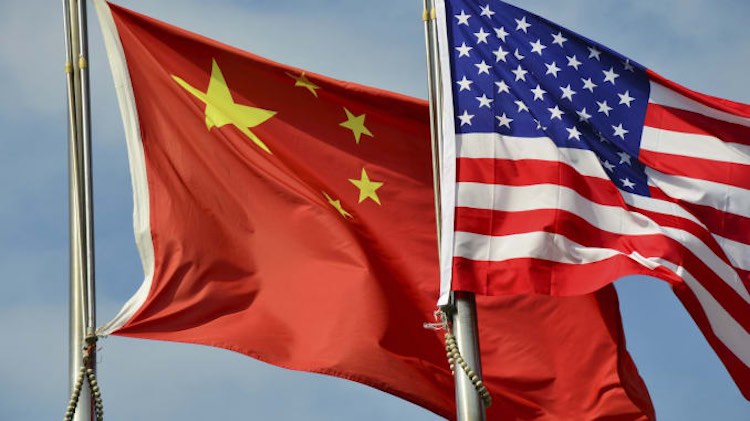
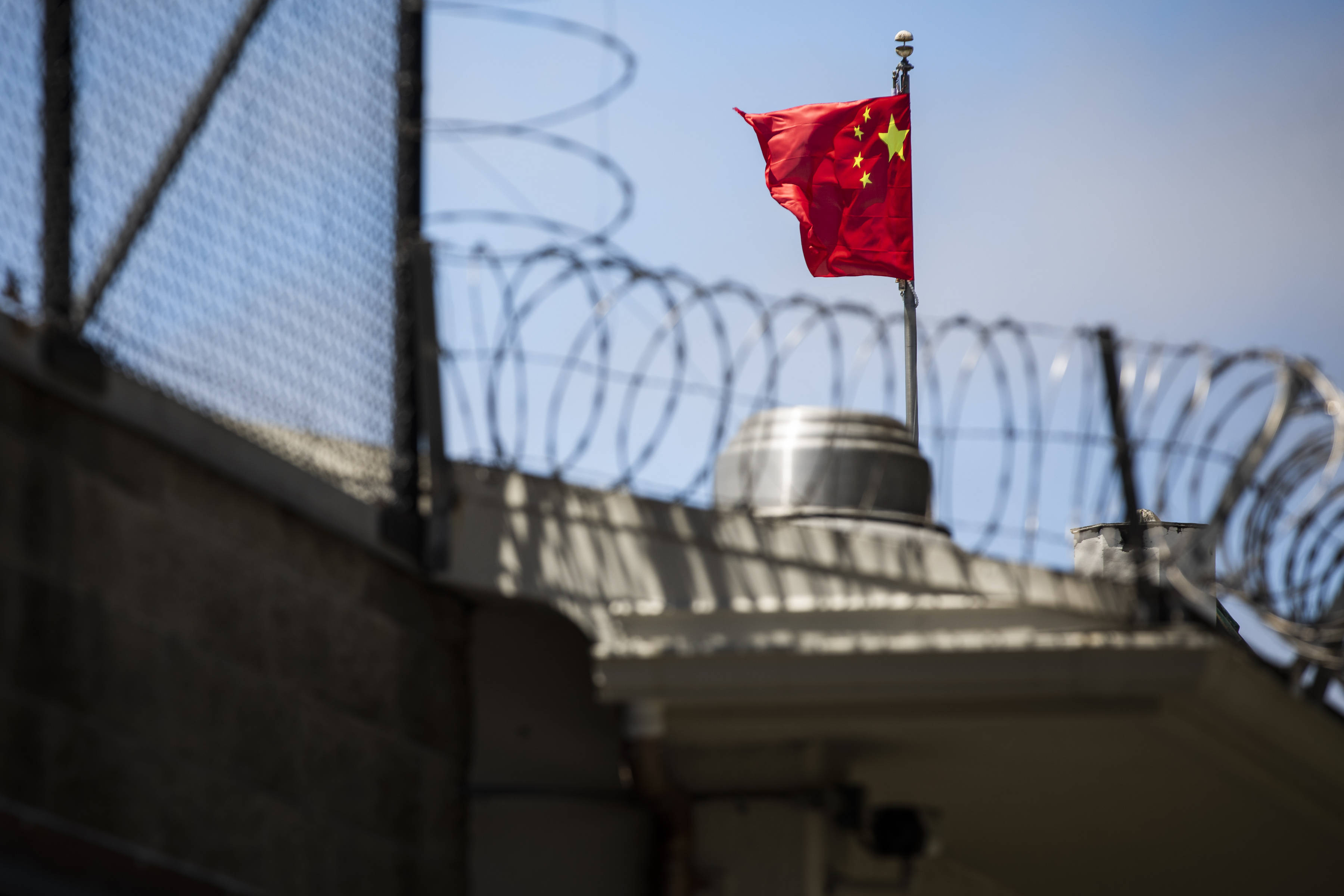
China’s flag flies behind barbed wire at the Chinese Consulate in San Francisco on July 23. (Philip Pacheco/AFP/Getty Images

Under President Trump’s watch, the United States is engaged in an intensifying cycle of confrontation with China. Earlier this week, U.S. authorities ordered the shuttering of the Chinese Consulate in Houston on the grounds that it was an espionage hub for Beijing. The Justice Department also said a fugitive Chinese scientist with ties to the People’s Liberation Army, China’s military, has been given sanctuary in the Chinese Consulate in San Francisco. Separately, the Commerce Department announced sanctions on a new group of Chinese companies for their alleged involvement in China’s “campaign of repression” against Uighurs and other ethnic minorities, including the use of forced labor.

It’s just another week in the spiraling U.S.-China relationship. At a news conference, Chinese Foreign Ministry spokesman Wang Wenbin hinted at retaliation, saying that “in response to the U.S.’s unreasonable actions, China must make a necessary response and safeguard its legitimate rights.” He described the U.S. allegations of espionage as “malicious slander.”

The Trump administration only further upped the ante. On Thursday, in what was billed as a “major” foreign policy speech, Secretary of State Mike Pompeo spoke of the dangers of “Communist China” to the future of the “free world.” He branded Chinese President Xi Jinping a “true believer in a bankrupt totalitarian ideology” in pursuit of global Marxist “hegemony.” Pompeo scolded those within the United States and elsewhere in the West who had chosen the path of “timidity” and acquiescence to China’s perceived manipulation of the global system and plans for further domination.

Speaking in California at the Richard Nixon Presidential Library and Museum — named after the president who first opened U.S. relations with the People’s Republic — Pompeo conjured a world shaped by an ideological war dividing the West and China. He declared that “if we want to have a free 21st century,” then “the old paradigm of blind engagement with China” could no longer continue, a reiteration of the administration’s view that its predecessors were too soft in their approach to Beijing.

But the United States’ top diplomat stopped short of outright calling for regime change. He said the Communist Party “fears the Chinese people’s honest opinions more than any foreign foe” and that it was incumbent on the West to better “engage and empower the Chinese people.” 

Democracy vs Communism or Donald Trump vs Xi Jinping. Mutual Antagonism defines the US-China Rift.

Pompeo’s critics in the United States are familiar with the script — a sort of belligerent posturing that has included the Trump administration’s “maximum pressure” campaigns against the regimes in Iran and Venezuela. But Pompeo, who conducted a quick trip this week to Europe, where he met a leading Hong Kong dissident in London, is seeking to harness growing global consternation with Beijing and echoed calls from some hawkish corners for a newfangled “alliance of democracies” to better counter China.

This comes at a time when China is asserting itself in bolder and more provocative ways than before, from draconian crackdowns at home to recent expansionist maneuvers in the seas to its east and along its mountainous border with India. Inside China, some nationalist commentators are openly discussing the idea of an invasion of Taiwan, even as the United States expands arms sales to the island democracy that Beijing views as its own.             

 While the Trump administration has essentially abdicated a position of global leadership during the coronavirus pandemic, China’s authoritarian rulers have hardly boosted their own image. “If there is a silver lining to the current crisis maelstrom, it may be that Beijing has pulled back its own curtain, giving the world an unsolicited preview of unconstrained Chinese might,” Kurt Campbell and Mira Rapp-Hooper wrote in Foreign Affairs. “By leaving a power vacuum in the world’s darkest hour, the United States has bequeathed China ample room to overreach — and to demonstrate that it is unqualified for a position of sole global leadership.”“

By choosing unprovoked aggression over enlightened generosity, China has squandered that historic opportunity and possibly also revealed its true character,” wrote Arvind Subramanian, a former chief economic adviser to the Indian government. “Soft power, China appears to believe, is for wimpy democracies.” 

Democracy vs Communism or Donald Trump vs Xi Jinping. Mutual Antagonism defines the US-China Rift.

But either Trump or his Democratic opponent Joe Biden — should the latter emerge victorious in November — will have to take stock of the risks of the current path of escalation. “Closing the consulate does not appear to be part of a coherent strategy to deter or compel China to alter its behavior,” Jessica Chen Weiss, an expert on Chinese foreign relations, told my colleagues. “It looks more like a ‘shock and awe’ strategy to distract U.S. voters from the Trump administration’s disastrous response to the pandemic.”

Kurt Tong, a former U.S. consul general in Hong Kong, argued during a webinar this week that the United States needs to pursue “concerted diplomacy,” rather than rhetorical broadsides, to remind China of its own overreach and miscalculations. He waved away Pompeo’s insistence on plunging the world into a grand ideological struggle. “China is an authoritarian state,” said Tong, but “the U.S. isn’t going to succumb to authoritarianism because China is abusing its own population.”

“Both sides should practice some ideological humility,” wrote Jie Dalei, a professor of international studies at Peking University, as part of a compilation of U.S. and Chinese academic voices on the current state of affairs. “One does not have to change [or] become the other to be able to coexist. In fact, the existence of multiple competitive ideologies is the normal state of affairs throughout most of human history. The domination of one ideology in the global marketplace of ideas is the exception rather than the rule.”

Ishaan Tharoor

Washington, D.C.

Columnist covering foreign affairs, geopolitics and history. Education: Yale University, BA, honors in history and ethnicity, race and migration. Ishaan Tharoor is a columnist on the foreign desk of The Washington Post, where he authors the Today’s WorldView newsletter and column.

Democracy vs Communism or Donald Trump vs Xi Jinping. Mutual Antagonism defines the US-China Rift.

The Struggle for Free Tibet begins in Kham Province, Eastern Tibet

The Struggle for Free Tibet begins in Kham Province, Eastern Tibet.

The Struggle for Free Tibet naturally begins in Kham Province of eastern Tibet. China annexed Tibetan territory during 1955-57 and the demand for the meaningful autonomy in Tibet includes the restoration of Tibet’s original borders.

Rudra Narasimham Rebbapragada
Special Frontier Force-Establishment No. 22-Vikas Regiment

The Struggle for Free Tibet begins in Kham Province, Eastern Tibet.

Tibet in mind: Why China chose to close US Consulate in Chengdu amid other options

Chengdu, capital city of Sichuan province in western China, is an important post for the US since it covers consular affairs in several provinces including Southwest China’s Tibet Autonomous Region (TAR), Myanmar and western sector of the India-China border.

Geeta Mohan, India Today, New Delhi. July 24, 2020.

Geeta Mohan, India Today, New Delhi.
Chinese President Xi Jinping chose to order closure of US Consulate in Chengdu because this post is strategically significant for the US. (Photo: Reuters)

In a diplomatic tit-for-tat response to the US order of shutting down the Chinese Consulate General in Houston, two days on, Beijing has ordered the US Consulate in Chengdu to be closed down within 72 hours. Besides ordering closure of the US Consulate, China has also responded to US allegations that Chinese officials were indulging in acts of “espionage”. China has now accused American diplomats of engaging in activities which are “inconsistent” with their “identities”.

“Some personnel from the US Consulate General in Chengdu have engaged in activities inconsistent with their identities. China has made representations and the US side is fully aware,” Wang Wenbin, Spokesperson of China’s Foreign Ministry, said at Friday’s media briefing while commenting on the closure of the US consulate.

However, while China has decided to shut down the US Consulate in Chengdu, it has asked Washington to reconsider its decision that could lead to greater escalation.

“The current situation between China and the US is something China does not want to see, and the responsibility rests entirely with the US. China’s Consulate General in Houston is still operating. We urge the US to withdraw its erroneous decision,” said the Chinese foreign ministry spokesperson.

He added, “We once again urge the US to revoke its decision and create necessary conditions for the return of bilateral relations.”

On Thursday, US Secretary of State Mike Pompeo had said, “I’m very confident that we’ll proceed in a way that makes clear that it’s not okay to use your diplomats to engage in industrial espionage, it’s not okay to steal intellectual property, it’s not okay to engage in those kind of behaviors. That’s the reason we did it (ordered closure of Chinese consulate). We did it to protect the American people, and we’re going to make sure that that happens.”

STRATEGY BEHIND CHENGDU

Meanwhile, closure of the US consulate in Chengdu is being looked at as a strategic decision by China, amid earlier speculations that the US Consulate in Wuhan could have been the one to be shut. There were also speculations that is Beijing wanted real escalation, then the US Consulate in Hong Kong and Macau could have been evicted.

Strategic affairs expert Professor Stobdan observed, “This is further escalation after Taiwan and Hong Kong.”

By choosing Chengdu, Beijing would be dismantling a strategic infrastructure of Washington DC in the Chinese mainland.

Speaking to India Today TV, Rajeshwari Rajagopalan, Distinguished Fellow, ORF, said, “The tit-for-tat reaction where China has asked the US to close its Consulate in Chengdu is a fairly normal reaction. I am sure the US had considered this possibility when it made its decision on Houston.”

WHY IS CHENGDU SO IMPORTANT?

Chengdu, capital city of Sichuan province situated in western China, is an important post since it covers consular affairs in several provinces and regions including Southwest China’s Tibet Autonomous Region (TAR), Myanmar and western sector of the India-China border.

It was opened in October 1985 by former US President George Bush and has ever since been an important part of the intelligence warfare.

Traditionally, most of Sichuan is a part of undivided Tibet, and has the restive Kham area which is the western part of Tibet (outside TAR). All activities and resistance against China, including self-immolation take place there. Although Lhasa is quite far away, this is the critical and rebellious part of Tibet.

It is significant since in the past, the western sector of the India-China border was controlled by the Chengdu military district.

Former Indian intelligence official, Jayadev Ranade, says that this would hamper access for Washington.

“The shutting down of the US Consulate in Chengdu by China is well thought and severely minimizes US access to Tibet. It will also curb US efforts to assess China’s annual agriculture production,” he said.

If this consulate shuts down then the source of information will dry up for the US to a great extent.

The consulate was also the scene of a major political incident in 2012 when Wang Lijun, former vice-mayor and police chief of Southwest China’s Chongqing, tried to defect after being demoted by Chinese administration for revealing to the United States consulate details of British businessman Neil Heywood’s murder and subsequent cover-up. But, after 30 hours of remaining in the consulate, he finally left the building out of his own volition.

The Struggle for Free Tibet begins in Kham Province, Eastern Tibet.

What is the future of the Living Tibetan Spirits?

What is the future of the Living Tibetan Spirits?

What is the future of “The Living Tibetan Spirits”? I claim that I am the host of the spirits of some young Tibetan soldiers who gave their precious lives while participating in the military action in the Chittagong Hill Tracts during the Liberation War of Bangladesh in 1971.

In the traditions of Tibetan Buddhism, these young men have no opportunity to seek Reincarnation. For they are not Christians, they may not get the benefit of Resurrection. In the Hindu belief, the soul is Reborn after the death of the individual. But, Tibetan Buddhism does not embrace the concept of Soul or Spirit. In my analysis, the entities named as Body, Mind, and Soul do not have an independent existence of their own. The singularity that we recognize as man exists in the physical world because of the unity of body, mind, and soul during all stages of his existence.

I validate the concepts of Rebirth, Reincarnation, and Resurrection as the mechanism called death or the dying process always precedes the mechanism called Birth and the living process. In other words, Death always precedes Life. Without the intervention of a natural mechanism called Death, the living condition called Life cannot come into its existence. As per the Fundamental Laws of Conservation, matter including the living matter is neither created nor destroyed. Certain values are always conserved in the operation of all natural phenomena including the events called Birth and Death.

Rudra Narasimham Rebbapragada

Special Frontier Force-Establishment No. 22-Vikas Regiment

Man is a mortal being who must eventually die. When Lazarus died and was laid in a tomb for four days, Jesus performed a miracle and Lazarus came back to life from death. The Book of John, Chapter 11, narrates this event. In verses 41 and 42, Jesus said,”Father, I thank You that You have heard Me. And I know that You always hear Me, but I said this for the benefit of the people who are standing here, that they may believe that You sent Me.” The risen Lazarus had eventually died.

As Dalai Lama turns 85, his lineage’s future is as uncertain as Tibet’s

What is the future of the Living Tibetan Spirits?

Exiled Tibetan artists perform a special song to mark the 85th birthday of their spiritual leader, the Dalai Lama, whose portrait is seen behind at an official function in Dharmsala, India, on July 6, 2020. (AP Photo/Ashwini Bhatia)July 6, 2020

Ira Rifkin

(Religion News Service) — The Dalai Lama, the spiritual leader of Tibetan Buddhism, who turns 85 Monday (July 6), is not only arguably the world’s best-known Buddhist figure. Through the force of his personality he has made his nation’s struggle for autonomy from China a global cause, and his influence has prompted many in the West to adopt if not Buddhism as a religion then many of its practices and principles, such as meditation and spiritual visualization.

Yet as fans of the Dalai Lama celebrate a landmark birthday, the future of his 600-year-old lineage and its ramifications for his occupied homeland are uncertain.

Though His Holiness, as followers refer to the Dalai Lama, is said by Tibetan officials to be in good health after hospitalization in 2019 for a reported chest infection, the looming question for Tibetan Buddhists and the Tibetan national cause is, what will happen when the 1989 Nobel Peace Prize winner inevitably —  in blunt Western terms — dies? 

“Of course we Tibetans think about this a good deal,” said Ngodup Tsering, head of the North America branch of the Office of Tibet, an arm of Tibet’s official government in exile. “It is foremost for us.”

The title Dalai Lama, which translates roughly as “ocean of wisdom,” is rooted in the traditional and intricate Tibetan Buddhist concept of reincarnation. Certain highly evolved spiritual adepts, such as the Dalai Lama, are believed to be able to control their reincarnations.

What is the future of the Living Tibetan Spirits?

Tibetan spiritual leader the Dalai Lama greets devotees as he arrives to give a religious talk at the Tsuglakhang temple in Dharmsala, India, on Nov. 4, 2019. (AP Photo/Ashwini Bhatia)

For Tibet, this holds profound political implications. The Himalayan nation has been under Chinese military occupation since 1950. Since then the government in Beijing has taken methodical steps to erase Tibet’s distinct culture, flooding the region with ethnic Han Chinese brought from outside Tibet while limiting religious activity and all signs of reverence for the Dalai Lama.

Until 2011, when he voluntarily transferred that role to a democratically elected leadership, the Dalai Lama was also Tibet’s political chief. His abdication, said Tsering, who is based in Washington, D.C., “allows a new generation of younger Tibetans to take the mantle of leadership.” 

However, the question of his religious leadership remains.

The current Dalai Lama — the 14th in a line of tulkus, or human reincarnations of, it’s believed,  the very first Dalai Lama, born in 1391— fled Tibet for India in 1959 after a failed uprising. He has lived in exile ever since.

China’s leadership, its avowed atheism notwithstanding, insists that the Dalai Lama must reincarnate so that the position can continue. Tibetans maintain Beijing’s interest is only motivated by its intent to seize the next Dalai Lama while he is still a young boy to control him and crush the political movement for Tibetan autonomy.

This is the course it took with the Panchen Lama, Tibetan Buddhism’s second ranking official. Three days after the current Panchen Lama was recognized in 1995, he and his family were kidnapped by the Chinese and he has not been heard from since.

Beijing has installed a proxy in his place, though he has been rejected by an overwhelming majority of Tibetans as a Chinese political tool.

The Dalai Lama has said for several years that he might not reincarnate, hoping to avoid leaving his own successor with a similar fate, or to prevent the Chinese from presenting their own version of the Dalai Lama. “There is no guarantee that some stupid Dalai Lama won’t come next,” he said in 2014. Other times he has said that if he does reincarnate, it’s likely to occur in the global Tibetan refugee diaspora rather than in Tibet itself.

In late 2019, the various factions that comprise the Central Tibetan Administration, which directs the Tibetan exile government, voted to urge the Dalai Lama to reincarnate.

“The Tibetan people and the administration want him to come back,” Tsering said. “So many around the world are encouraged by him. It would be demoralizing if there was no Dalai Lama and a great political loss. The position is so central to the Tibetan tradition, to the Tibetan mind.”

“I’m sure (Tibetans) will keep the name for sure,” said Robert A.F. Thurman, a Columbia University professor emeritus who directs Tibet House, a Tibetan cultural center in New York, and is one of the Dalai Lama’s closest Western associates. “One way or another, there will be a Dalai Lama.”

What is the future of the Living Tibetan Spirits?

The Dalai Lama, child in center, during his first trip to Lhasa in 1939. The Dalai Lama was roughly 4 years old at the time. Photo courtesy of Ira Rifkin

Among the possibilities, according to Tibetan beliefs, is that the Dalai Lama will reincarnate himself before he dies, said Thurman.

“It’s called maday tulku. The idea is that the Dalai Lama is reborn as a child while he still exists as an adult. The child is then raised for 20 years clandestinely so he can enter the picture with the charisma of  his adult self.”

Melvin McLeod, editor-in-chief of Lion’s Roar, a leading English-language international Buddhist magazine based in Halifax, Canada, explained  the complexity of Tibetan reincarnation thinking as follows:

“Buddhism in general holds to a basic assumption that we experience a series of rebirths to progress up the spiritual ladder. Tibetan Buddhism in particular has a very highly developed understanding of what happens after death and prior to rebirth. … It allows for certain individuals who because of their high level of spiritual development attained over years of deep meditative practices can guide their reincarnation.”

The Dalai Lama himself appears to be in no rush, despite his age, to resolve the issue. His official website maintains that when he is about 90, and in consultation with Tibetan Buddhist leaders and ordinary followers, he will decide whether and how he will reincarnate. He indicated he will leave written instructions as to how his reincarnated self can be found to minimize the possibility of Chinese deception.

Last year, the Dalai Lama also said he had dreamed that he will live to 110, a statement that Tibetans take very seriously because of their belief in his advanced spiritual powers.

Tsering said “the Dalai Lama will do what he thinks is best for all humanity, not just Tibetans, because as a Buddhist he is concerned with the betterment of all humanity.”

And for now, those close to him say there is little urgency. At 85 — 86 according to Tibetan tradition, which adds a year for time spent in the womb — “he’s in excellent shape,” said Thurman. “The Mayo Clinic watches over him with Western medical diagnostics and he has Tibetan physicians who watch him with traditional Tibetan methods.”

The global Tibetan Buddhist diaspora will celebrate the Dalai Lama’s birthday with a host of events, which because of the pandemic are restricted to online. To mark the milestone, the Dalai Lama has released an audio album titled “Inner World,” in which he recites teachings and mantras (words or sounds that serve as meditation aids)  accompanied by music. 

And how will the Dalai Lama himself  celebrate his day?

“As a Buddhist, as a lama (monk), as a renunciate, the Dalai Lama doesn’t attend birthday events or make a big deal over his birthday. It’s just not important to him,” said Tsering. “He asks people to mark a birthday only with doing something good for others.”

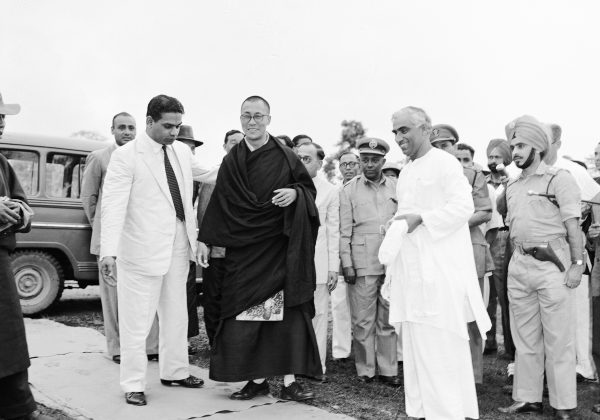
THE SPIRITS OF SPECIAL FRONTIER FORCE: WE ARE OPENLY SHARING THIS PHOTO ILLEGALLY OBTAINED BY A CHINESE SPY. THE PHOTO WAS TAKEN AT CHAKRATA ON 03 JUNE, 1972 WHILE HIS HOLINESS THE 14th DALAI LAMA WAS PRESENTED A GUARD OF HONOR BY MAJOR GENERAL SUJAN SINGH UBAN, AVSM, INSPECTOR GENERAL, SPECIAL FRONTIER FORCE. MY INDIAN ARMY CAREER BEGAN AT THIS LOCATION AND I WILL CONTINUE TO FIGHT FOR FREEDOM AND DEMOCRACY IN THE OCCUPIED LAND OF TIBET.

The Unknown Soldier of America pays his tribute to the US Representative John Lewis.

The Unknown Soldier of America pays his tribute to the US Representative John Lewis.

“Do not get lost in a sea of despair. Be hopeful, be optimistic. Our struggle is not the struggle of a day, a week, a month, or a year, it is the struggle of a lifetime. Never, ever be afraid to make some noise and get in good trouble, necessary trouble.”

 I am indeed sorry to hear about the loss of the US Representative John Lewis. I used to read about the Civil Rights Movement in America while I was a college student in India. During the Civil Rights Era, I used to think that I will never ever set my foot on the American soil. But, fate and destiny have their own power. I wanted to serve in the Indian Army and my very first posting placed my services in the hands of the US Central Intelligence Agency (CIA). The government gave me the choice to withdraw myself and return to the Indian Army Service. At that time, just like the Civil Rights, the Political Rights of Tibetans is a issue that bothered me. I had no choice other than that of accepting the CIA as my Master.

I want to pay my tribute to Congressman John Lewis using his own words. His struggle for Civil Rights continues to inspire me to carry on my struggle for the Political Rights of Tibetans.

“Do not get lost in a sea of despair. Be hopeful, be optimistic. Our struggle is not the struggle of a day, a week, a month, or a year, it is the struggle of a lifetime. Never, ever be afraid to make some noise and get in good trouble, necessary trouble.”

The Great Problem of Tibet must not be left on the Back Burner. In the words of Representative Lewis, I ask,

“IF NOT US, THEN WHO? IF NOT NOW, THEN WHEN?”

Rudra Narasimham Rebbapragada
Special Frontier Force-Establishment No. 22-Vikas Regiment

John Lewis, Towering Figure of Civil Rights Era, Dies at 80

Katharine Q. Seelye  

The Unknown Soldier of America pays his tribute to the US Representative John Lewis. Mr. Lewis in June 1967. He had been “involved in a holy crusade,” he later said, and getting arrested had been “a badge of honor.”
The Unknown Soldier of America pays his tribute to the US Representative John Lewis. Mr. Lewis, foreground, being beaten by a state trooper during the voting rights march in Selma, Ala., on March 7, 1965.
The Unknown Soldier of America pays his tribute to the US Representative John Lewis. Mr. Lewis, third from left, marching with the Rev. Dr. Martin Luther King Jr., right, from Selma to Montgomery, Ala., on March 21, 1961.
The Unknown Soldier of America pays his tribute to the US Representative John Lewis. Mr. Lewis and a fellow Freedom Rider, James Zwerg, after they were attacked by segregationists in Montgomery, Ala., in May 1961.
The Unknown Soldier of America pays his tribute to the US Representative John Lewis. Mr. Lewis spearheaded a sit-in by Democratic House members on the steps of the Capitol in June 2016 in support of gun-control legislation.
The Unknown Soldier of America pays his tribute to the US Representative John Lewis. Mr. Lewis, right, and a fellow student demonstrator, James Bevel, stood inside the door of a Nashville restaurant in 1960 during a sit-in to protest the establishment’s refusal to serve Black people.
The Unknown Soldier of America pays his tribute to the US Representative John Lewis. Mr. Lewis with other members of Congress staging a sit-in on the floor of the House of Representatives in June 2016, demanding that the Republican-led body vote on gun control legislation after the Orlando nightclub massacre.
The Unknown Soldier of America pays his tribute to the US Representative John Lewis.Mr. Lewis in 2017. “Our struggle is not the struggle of a day, a week, a month, or a year,” he said, “it is the struggle of a lifetime.”

Representative John Lewis, a son of sharecroppers and an apostle of nonviolence who was bloodied at Selma and across the Jim Crow South in the historic struggle for racial equality, and who then carried a mantle of moral authority into Congress, died on Friday. He was 80.

His death was confirmed in a statement by Nancy Pelosi, the speaker of the House of Representatives.

Mr. Lewis, of Georgia, announced on Dec. 29 that he had Stage 4 pancreatic cancer and vowed to fight it with the same passion with which he had battled racial injustice. “I have been in some kind of fight — for freedom, equality, basic human rights — for nearly my entire life,” he said.

On the front lines of the bloody campaign to end Jim Crow laws, with blows to his body and a fractured skull to prove it, Mr. Lewis was a valiant stalwart of the civil rights movement and the last surviving speaker at the historic March on Washington for Jobs and Freedom in 1963.

More than a half-century later, after the killing in May of George Floyd, a Black man in police custody in Minneapolis, Mr. Lewis welcomed the resulting global demonstrations against police killings of Black people and, more broadly, against systemic racism in many corners of society. He saw those protests as a continuation of his life’s work, though his illness had left him to watch from the sidelines.

“It was very moving, very moving to see hundreds of thousands of people from all over America and around the world take to the streets — to speak up, to speak out, to get into what I call ‘good trouble,’” Mr. Lewis told “CBS This Morning” in June.

“This feels and looks so different,” he said of the Black Lives Matter movement, which drove the anti-racism demonstrations. “It is so much more massive and all inclusive.” He added, “There will be no turning back.”

He died on the same day as did another stalwart of the civil rights movement, the Rev. C.T. Vivian, a close associate of the Rev. Dr. Martin Luther King Jr.

Mr. Lewis’s personal history paralleled that of the civil rights movement. He was among the original 13 Freedom Riders, the Black and white activists who challenged segregated interstate travel in the South in 1961. He was a founder and early leader of the Student Nonviolent Coordinating Committee, which coordinated lunch-counter sit-ins. He helped organize the March on Washington, where Dr. King was the main speaker, on the steps of the Lincoln Memorial.

Mr. Lewis led demonstrations against racially segregated restrooms, hotels, restaurants, public parks and swimming pools, and he rose up against other indignities of second-class citizenship. At nearly every turn he was beaten, spat upon or burned with cigarettes. He was tormented by white mobs and absorbed body blows from law enforcement.

On March 7, 1965, he led one of the most famous marches in American history. In the vanguard of 600 people demanding the voting rights they had been denied, Mr. Lewis marched partway across the Edmund Pettus Bridge in Selma, Ala., into a waiting phalanx of state troopers in riot gear.

Ordered to disperse, the protesters silently stood their ground. The troopers responded with tear gas and bullwhips and rubber tubing wrapped in barbed wire. In the melee, known as Bloody Sunday, a trooper cracked Mr. Lewis’s skull with a billy club, knocking him to the ground, then hit him again when he tried to get up.

Televised images of the beatings of Mr. Lewis and scores of others outraged the nation and galvanized support for the Voting Rights Act, which President Lyndon B. Johnson presented to a joint session of Congress eight days later and signed into law on Aug. 6. A milestone in the struggle for civil rights, the law struck down the literacy tests that Black people had been compelled to take before they could register to vote and replaced segregationist voting registrars with federal registrars to ensure that Black people were no longer denied the ballot.

Once registered, millions of African-Americans began transforming politics across the South. They gave Jimmy Carter, a son of Georgia, his margin of victory in the 1976 presidential election. (A popular poster proclaimed, “Hands that once picked cotton now can pick a President.”) And their voting power opened the door for Black people, including Mr. Lewis, to run for public office. Elected in 1986, he became the second African-American to be sent to Congress from Georgia since Reconstruction, representing a district that encompassed much of Atlanta.

‘Conscience of the Congress’

While Mr. Lewis represented Atlanta, his natural constituency was disadvantaged people everywhere. Known less for sponsoring major legislation than for his relentless pursuit of justice, his colleagues called him “the conscience of the Congress.”

When the House voted in December 2019 to impeach President Trump, Mr. Lewis’s words rose above the rest. “When you see something that is not right, not just, not fair, you have a moral obligation to say something,” he said on the House floor. “To do something. Our children and their children will ask us, ‘What did you do? What did you say?’ For some, this vote may be hard. But we have a mission and a mandate to be on the right side of history.”

His words resonated as well after he saw the video of a Minneapolis police officer kneeling on Mr. Floyd’s neck for more than eight minutes as Mr. Floyd gasped for air.

“It was so painful, it made me cry,” Mr. Lewis told “CBS This Morning.” “People now understand what the struggle was all about,” he said. “It’s another step down a very, very long road toward freedom, justice for all humankind.”

As a younger man, his words could be more militant. History remembers the March on Washington for Dr. King’s “I Have a Dream” speech, but Mr. Lewis startled and energized the crowd with his own passion.

“By the force of our demands, our determination and our numbers,” he told the cheering throng that August day, “we shall splinter the segregated South into a thousand pieces and put them together in the image of God and democracy. We must say: ‘Wake up, America. Wake up!’ For we cannot stop, and we will not and cannot be patient.”

His original text was more blunt. “We will march through the South, through the heart of Dixie, the way Sherman did,” he had written. President John F. Kennedy’s civil rights bill was “too little, too late,” he had written, demanding, “Which side is the federal government on?”

But Dr. King and other elders — Mr. Lewis was just 23 — worried that those first-draft passages would offend the Kennedy administration, which they felt they could not alienate in their drive for federal action on civil rights. They told him to tone down the speech.

Still, the crowd, estimated at more than 200,000, roared with approval at his every utterance.

An earnest man who lacked the silver tongue of other civil rights orators, Mr. Lewis could be pugnacious, tenacious and single-minded, and he led with a force that commanded attention.

He gained a reputation for having an almost mystical faith in his own survivability. One civil rights activist who knew him well told The New York Times in 1976: “Some leaders, even the toughest, would occasionally finesse a situation where they knew they were going to get beaten or jailed. John never did that. He always went full force into the fray.”

Mr. Lewis was arrested 40 times from 1960 to 1966. He was beaten senseless repeatedly by Southern policemen and freelance hoodlums. During the Freedom Rides in 1961, he was left unconscious in a pool of his own blood outside the Greyhound Bus Terminal in Montgomery, Ala., after he and others were attacked by hundreds of white people. He spent countless days and nights in county jails and 31 days in Mississippi’s notoriously brutal Parchman Penitentiary.

Once he was in Congress, Mr. Lewis voted with the most liberal Democrats, though he also showed an independent streak. In his quest to build what Dr. King called “the beloved community” — a world without poverty, racism or war (Mr. Lewis adopted the phrase) — he routinely voted against military spending. He opposed the Persian Gulf war of 1991 and the North American Free Trade Agreement, which was signed in 1992. He refused to take part in the 1995 “Million Man March” in Washington, saying that statements made by the organizer, Louis Farrakhan, leader of the Nation of Islam, were “divisive and bigoted.”

In 2001, Mr. Lewis skipped the inauguration of George W. Bush, saying he thought that Mr. Bush, who had become president after the Supreme Court halted a vote recount in Florida, had not been truly elected.

In 2017 he boycotted Mr. Trump’s inauguration, questioning the legitimacy of his presidency because of evidence that Russia had meddled in the 2016 election on Mr. Trump’s behalf.

That earned him a derisive Twitter post from the president: “Congressman John Lewis should spend more time on fixing and helping his district, which is in horrible shape and falling apart (not to mention crime infested) rather than falsely complaining about the election results. All talk, talk, talk — no action or results. Sad!”

Mr. Trump’s attack marked a sharp detour from the respect that had been accorded Mr. Lewis by previous presidents, including, most recently, Barack Obama. Mr. Obama awarded Mr. Lewis the Presidential Medal of Freedom, the nation’s highest civilian honor, in 2011.

In bestowing the honor in a White House ceremony, Mr. Obama said: “Generations from now, when parents teach their children what is meant by courage, the story of John Lewis will come to mind — an American who knew that change could not wait for some other person or some other time; whose life is a lesson in the fierce urgency of now.”

To His Family, ‘Preacher’

John Robert Lewis grew up with all the humiliations imposed by segregated rural Alabama. He was born on Feb. 21, 1940, to Eddie and Willie Mae (Carter) Lewis near the town of Troy on a sharecropping farm owned by a white man. After his parents bought their own farm — 110 acres for $300 — John, the third of 10 children, shared in the farm work, leaving school at harvest time to pick cotton, peanuts and corn. Their house had no plumbing or electricity. In the outhouse, they used the pages of an old Sears catalog as toilet paper.

John was responsible for taking care of the chickens. He fed them and read to them from the Bible. He baptized them when they were born and staged elaborate funerals when they died.

“I was truly intent on saving the little birds’ souls,” he wrote in his memoir, “Walking With the Wind” (1998). “I could imagine that they were my congregation. And me, I was a preacher.”

His family called him “Preacher,” and becoming one seemed to be his destiny. He drew inspiration by listening to a young minister named Martin Luther King on the radio and reading about the 1955-56 Montgomery bus boycott. He finally wrote a letter to Dr. King, who sent him a round-trip bus ticket to visit him in Montgomery, in 1958.

By then, Mr. Lewis had begun his studies at American Baptist Theological Seminary (now American Baptist College) in Nashville, where he worked as a dishwasher and janitor to pay for his education.

In Nashville, Mr. Lewis met many of the civil rights activists who would stage the lunch counter sit-ins, Freedom Rides and voter registration campaigns. They included the Rev. James M. Lawson Jr., who was one of the nation’s most prominent scholars of civil disobedience and who led workshops on Gandhi and nonviolence. He mentored a generation of civil rights organizers, including Mr. Lewis.

Mr. Lewis’s first arrest came in February 1960, when he and other students demanded service at whites-only lunch counters in Nashville. It was the first prolonged battle of the movement that evolved into the Student Nonviolent Coordinating Committee.

David Halberstam, then a reporter for The Nashville Tennessean, later described the scene: “The protests had been conducted with exceptional dignity, and gradually one image had come to prevail — that of elegant, courteous young Black people, holding to their Gandhian principles, seeking the most elemental of rights, while being assaulted by young white hoodlums who beat them up and on occasion extinguished cigarettes on their bodies.”

In three months, after repeated well-publicized sit-ins, the city’s political and business communities gave in to the pressure, and Nashville became the first major Southern city to begin desegregating public facilities.

But Mr. Lewis lost his family’s good will. When his parents learned that he had been arrested in Nashville, he wrote, they were ashamed. They had taught him as a child to accept the world as he found it. When he asked them about signs saying “Colored Only,” they told him, “That’s the way it is, don’t get in trouble.”

But as an adult, he said, after he met Dr. King and Rosa Parks, whose refusal to give up her bus seat to a white man was a flash point for the civil rights movement, he was inspired to “get into trouble, good trouble, necessary trouble.”

Getting into “good trouble” became his motto for life. A documentary film, “John Lewis: Good Trouble,” was released this month.

Despite the disgrace he had brought on his family, he felt that he had been “involved in a holy crusade” and that getting arrested had been “a badge of honor,” he said in an oral history interview in 1979 with Washington University.

In 1961, when he graduated from the seminary, he joined a Freedom Ride organized by the Congress of Racial Equality, known as CORE. He and others were beaten bloody when they tried to enter a whites-only waiting room at the bus station in Rock Hill, S.C. Later, he was jailed in Birmingham, Ala., and beaten again in Montgomery, where several others were badly injured and one was paralyzed for life.

“If there was anything I learned on that long, bloody bus trip of 1961,” he wrote in his memoir, “it was this — that we were in for a long, bloody fight here in the American South. And I intended to stay in the middle of it.”

At the same time, a schism in the movement was opening between those who wanted to express their rage and fight back and those who believed in pressing on with nonviolence. Mr. Lewis chose nonviolence.

Overridden by ‘Black Power’

But by the time of the urban race riots of the 1960s, particularly in the Watts section of Los Angeles in 1965, many Black people had rejected nonviolence in favor of direct confrontation. Mr. Lewis was ousted as chairman of the Student Nonviolent Coordinating Committee in 1966 and replaced by the fiery Stokely Carmichael, who popularized the phrase “Black power.”

Mr. Lewis spent a few years out of the limelight. He headed the Voter Education Project, registering voters, and finished his bachelor’s degree in religion and philosophy at Fisk University in Nashville in 1967.

During this period he met Lillian Miles, a librarian, teacher and former Peace Corps volunteer. She was outgoing and political and could quote Dr. King’s speeches verbatim. They were married in 1968, and she became one of his closest political advisers.

She died in 2012. Mr. Lewis’s survivors include several siblings and his son, John-Miles Lewis.

Mr. Lewis made his first attempt at running for office in 1977, an unsuccessful bid for Congress. He won a seat on the Atlanta City Council in 1981, and in 1986 he ran again for the House. It was a bitter race that pitted against each other two civil rights figures, Mr. Lewis and Julian Bond, a friend and former close associate of his in the movement. The charismatic Mr. Bond, more articulate and polished than Mr. Lewis, was the perceived favorite.

“I want you to think about sending a workhorse to Washington, and not a show horse,” Mr. Lewis said during a debate. “I want you to think about sending a tugboat and not a showboat.”

Mr. Lewis won in an upset, with 52 percent of the vote. His support came from Atlanta’s white precincts and from working-class and poor Black voters who felt more comfortable with him than with Mr. Bond, though Mr. Bond won the majority of Black voters.

Not surprisingly, Mr. Lewis’s long congressional career was marked by protests. He was arrested in Washington several times, including outside the South African Embassy for demonstrating against apartheid and at Sudan’s Embassy while protesting genocide in Darfur.

He supported Mr. Obama’s health care bill in 2010, a divisive measure that drew to the Capitol angry protesters, including many from the right-wing Tea Party. Some demonstrators shouted obscenities and racial slurs at Mr. Lewis and other members of the Congressional Black Caucus.

“They were shouting, sort of harassing,” Mr. Lewis told reporters at the time. “But it’s OK. I’ve faced this before.”

In 2016, after a massacre at an Orlando, Fla., nightclub left 49 people dead, he led a sit-in on the House floor to protest federal inaction on gun control. The demonstration drew the support of 170 lawmakers, but Republicans dismissed it as a publicity stunt and squelched any legislative action.

Through it all, the events of Bloody Sunday were never far from his mind, and every year Mr. Lewis traveled to Selma to commemorate its anniversary. Over time, he watched attitudes change. At the ceremony in 1998, Joseph T. Smitherman, who had been Selma’s segregationist mayor in 1965 and was still mayor — though a repentant one — gave Mr. Lewis a key to the city.

“Back then, I called him an outside rabble-rouser,” Mr. Smitherman said of Mr. Lewis. “Today, I call him one of the most courageous people I ever met.”

Mr. Lewis was a popular speaker at college commencements and always offered the same advice — that the graduates get into “good trouble,” as he had done against his parents’ wishes.

He put it this way on Twitter in 2018:

“Do not get lost in a sea of despair. Be hopeful, be optimistic. Our struggle is not the struggle of a day, a week, a month, or a year, it is the struggle of a lifetime. Never, ever be afraid to make some noise and get in good trouble, necessary trouble.”

Roy Reed, who covered the civil rights movement for The New York Times and who died in 2017, contributed reporting from an earlier version of this obituary. Sheryl Gay Stolberg also contributed reporting.

The Unknown Soldier of America pays his tribute to the US Representative John Lewis.

The Unknown Soldier of America thanks the US President for giving direct financial support to Tibet

The Unknown Soldier of America thanks the US President for giving direct financial support to Tibet. Honourable Sikyong Dr Lobsang Sangay, Finance Kalon Karma Yeshi and Chief Resilience Officer/SARD Director Kaydor Aukatsang lead the press briefing on the USAID’s direct funding of almost USD 1 million to CTA. 

Dharamshala: The United States Agency for International Development (USAID) awarded a sum of $997,124 to SARD to “strengthen the financial and cultural resilience of the Tibetan people and contribute towards a sustained resilience of the Tibetan people’s economic and cultural identity.” This award represents a historic milestone as it is the first time any funding agency affiliated with the United States government has awarded development assistance directly to the Central Tibetan Administration (CTA). The Cooperative Agreement was signed on SARD/CTA’s behalf by Kaydor Aukatsang, Chief Resilience Officer/SARD Director, and the award was made on June 23, 2020.

“The awarding of direct funding to the CTA fulfils a long desired aspiration and represents the culmination of many years of effort since my first term. I want to thank the USAID and hope this award paves the way for a more substantial funding relationship between the USAID and the CTA,” said Sikyong Dr. Lobsang Sangay.

The award from USAID will support the Tibetan Resilience Project (TRP) where funds will initially go towards Tibetan language revitalization and capacity building of Gangjong Development Finance (GDF). The language program will be implemented by the Department of Education and the GDF component will be managed by SARD. The program will be implemented over a two-year period. Key activities under language revitalization includes production of Tibetan animation and audio books; publication of children’s literature for students in classes VI to XII; development of a language learning portal; and an annual summer language and cultural immersion program targeting Tibetan youth in the ages 18-30 and primarily residing outside South Asia. Key activities under GDF include development of a strategic business plan; purchase and customization of an appropriate MIS; technical assistance for implementation of action plan developed by Dalberg; and training.

“The awarding of direct funding is a momentous occasion for the CTA. I want to thank USAID for their generous support and extend my congratulations to the SARD leadership and team for their hard and excellent work,” said Mr. Karma Yeshi, Finance Kalon.

The formal process for the direct funding to the CTA began with a pre-award assessment of SARD in February 2019 where a team of senior staff from the USAID office in New Delhi visited Dharamsala and reviewed various aspects of SARD and its operation. The report was positive. This was followed up by the visit of a senior technical team from USAID in December 2019 to co-create the proposal which was submitted in March. In between, there were many rounds of email exchanges and phone calls between SARD and USAID.

“The direct funding sends a strong message of confidence in SARD and CTA’s ability to handle development assistance from foreign governments. The direct relationship with government funding agencies will have multiple benefits including saving funds and further strengthening SARD’s capacity. With the receipt of this award, SARD has taken a significant step forward in truly becoming the development agency to support the CTA and the Tibetan community,” said Kaydor Aukatsang, Chief Resilience Officer/SARD Director.

-Filed by SARD

The Unknown Soldier of America thanks the US President for giving direct financial support to Tibet. SIkyong Dr Lobsang Sangay and Finance Kalon Mr Karma Yeshi at the press conference on 3 October 2016.

Dharamshala — The Tibetan government in exile announced in a press conference today that the United States Agency for International Development (USAID) has awarded a grant of $23 million USD in order to strengthen self-reliance and resilience of Tibetan communities in South Asia.

The grant is effective from October 1, 2016 and will be awarded over a period of five years.

The overall goal of the program is to strengthen the self-reliance and resilience of Tibetans and Tibetan communities in South Asia by equipping them to thrive economically, become effective leaders; and maintaining the vitality of Tibetan communities and institutions while sustaining their unique identity and culture.

According to a press release from the Central Tibetan Administration (CTA), key program areas consist of leadership development, including institutional capacity building; establishing of a banking-like institution; and an integrated settlement development through community participatory process.

The programs will maximize local participation and ownership of the development process and a crosscutting gender component will incorporate women’s perspective and participation in the design and implementation of all sustainable livelihoods strategies.

CTA will partner with the Tibet Fund and other organizations and make maximum efforts to achieve the core program goals.

US sends message to China, starts direct funding to exiled Tibet govt in India

Anirban Bhaumik | New Delhi | Deccan Herald | JUL 14 2020

The United States has for the first time directly provided funds to the Tibetan Government-in-Exile based in India, a move likely to rile up China.

The US Agency for International Development or the USAID has committed to providing nearly $ 1 million to the Social and Resources Development Fund (SARD Fund)—a non-profit organisation set up by the Tibetan Government-in-Exile (TGiE), formally known as Central Tibetan Administration (CTA) and based at Dharamshala in Himachal Pradesh.

This is the first time any US government agency has provided funds directly to the TGiE, signalling a subtle move by President Donald Trump’s administration towards acknowledging a political entity spearheading the campaign against China’s occupation of and continued rule over Tibet.

The US move came amid the military stand-off between India and China in eastern Ladakh

“This funding signifies the US government’s support to the Central Tibetan Administration and the Tibetan community,” Kaydor Aukatsang, the Director of the SARD Fund of the CTA, told the DH on Monday.

The Dalai Lama set up the CTA on April 29, 1959, just a few weeks after he escaped from Tibet and arrived in India. The CTA calls itself the “continuation of the government of independent Tibet”.

Beijing accuses the Dalai Lama and the CTA of running a separatist campaign against China. Though New Delhi publicly maintains that the Dalai Lama was an honored guest of India, it never formally acknowledged the CTA as the exiled government of the erstwhile independent Tibet. China has always objected to India’s tacit support to the CTA and often demanded its closure.

The CTA set up the SARD Fund in 1997 to help mobilize resources and support development efforts of Tibetans living in South Asia. The Ministry of Home Affairs of the Government of India allowed it “to receive any amount of donations and foreign contribution for relief and development purposes”.

The direct funding by the USAID was an acknowledgement of “the capacity of the SARD as an international development agency to receive and manage such assistance”, said Aukatsang. The SARD earlier received financial support from the foreign governments through intermediary non-profit organizations. The USAID fund of $997,124 to the SARD fund of the CTA is intended to support “strengthening the financial and cultural resilience of the Tibetan people and contribute towards a sustained resilience of the Tibetan people’s economic and cultural identity.”

The US has been slamming China over the past few weeks for its military aggression, not only along its disputed boundary with India in eastern Ladakh but also in the South China Sea, the East China Sea and the Taiwan Strait. The US Navy deployed its two aircraft carrier strike groups – USS Nimitz and USS Ronald Reagan – in the South China Sea, in response to maritime muscle-flexing by the communist country.

President Donald Trump’s administration also imposed visa restrictions on some officials of the Chinese Government and the Communist Party of China (CPC) as they were allegedly involved “in the formulation or execution of policies” denying access for foreigners” to Tibet. The move was in accordance with the US Reciprocal Access to Tibet Act of 2018. The law allowed the Trump Administration to bar Chinese Government and the CPC officials from entering America if it is found that they had a role in denying permission to the US citizens, journalists and diplomats to Tibet.

US Secretary of State Mike Pompeo recently accused the Chinese government of human rights abuses in Tibet and said that the US remained committed to “meaningful autonomy” for the Tibetans.

The US also imposed visa-restrictions and economic sanctions on the Chinese government and the CPC officials for atrocities on the Uighurs and violation of human rights in Xinjiang Autonomous Region of China. The Trump Administration also initiated similar measures for the Chinese government’s officials “responsible for, or complicit in, undermining Hong Kong’s high degree of autonomy”. The move came after China imposed a new National Security Law in Hong Kong, which critics say would undermine the “one country, two systems” notion that the communist country had promised for the territory for 50 years while taking it back from the United Kingdom in 1997.

China too retaliated to the US move to impose visa restrictions on its officials.

The Unknown Soldier of America thanks the US President for giving direct financial support to Tibet.

JULY 12, 2020. The Celebration of the virtues of Simple Living

A day to take a moment
July 12, 2020. The Celebration of the virtues of Simple Living.

A day to take a moment

‘A field of water betrays the spirit that is in the air. It is continually receiving new life and motion from above. It is intermediate between land and sky.’ So Henry David Thoreau immortalized Walden Pond, but he could have been describing this calming image of Ežezers Lake in Latvia. Today, the birthday of that famous American advocate for pursuing a simple life is also National Simplicity Day, an annual reminder to unplug, slow down, step back, and consider your life. Thoreau’s most famous work (that you probably haven’t read since high school), ‘Walden,’ is his account of the two years, two months, and two days he spent away from society in a cabin near the shore of Walden Pond in Concord, Massachusetts. Through this work he encourages us to take a step back and look for ways to simplify our lives. ‘Our life is frittered away by detail,’ Thoreau observed. ‘Simplify, simplify.’

This advice is as sound today as it was 165 years ago when it first appeared in print. Some things you can do to mark the day are unplug from your devices (even this one—eventually); declutter your house; take a walk in the woods; and maybe even reread ‘Walden.’

July 12, 2020. The Celebration of the virtues of Simple Living.

In the Indian tradition, the purpose of life involves the discovery of the true or real ‘Self’. This discovery process demands the use of ‘simplicity’ as a tool to explore one’s own mind by removing its insatiable desires and cravings.

Rudra Narasimham Rebbapragada

BHAVANAJAGAT.ORG

July 12, 2020. The Celebration of the virtues of Simple Living. SPIRITUALISM – THE DISCOVERY OF BHAVANAJAGAT.org : What is the “Connection” between man and Sun? Does man have the physical and intellectual ability or capacity to harness Solar Energy to maintain his living functions?

The Red Alert. Red China Stepping On Too Many Toes

The Red Alert. Red China Stepping on Too Many Toes.

step on (someone’s) toes

To insult, offend, or upset someone, especially by getting involved in something that is  their responsibility.

To offend someone by doing something that they should be responsible for or that they have the authority to do.

Red China is marching ahead stepping on too many toes without care or concern for the pain and damage she is inflicting on people all over the world. I am sure that people will unite and stand firm to oppose the Red Dragon’s relentless reckless march.

Rudra Narasimham Rebbapragada

Special Frontier Force-Establishment No, 22-Vikas Regiment

China: The Dragon Has Overstepped Its Limits

Sunil Mahajan
09 July 2020 

The Red Alert. Red China Stepping On Too Many Toes.

The inexorable rise of China has been the most significant event in global geopolitics over the past three decades. From less than 3%, it now contributes 15% of the annual global output of goods and services. It is not only the second largest country economically, but also, there is a wide chasm separating it from Japan in the third place. Not surprisingly, it aspires for a role and influence in world affairs commensurate with its economic clout.

Nothing unusual about it; historically, every rising power has wanted a say in how the world affairs are run. Until recently, China followed the dictum of Deng Xiaoping to ‘hide your strengths and bide your time’.  

With Xi Jinping taking over in 2013, this policy was abandoned and China began to assert itself in global affairs. However, it wants to play by its own rules, disregarding global institutional order, international norms and the interests of the other countries, in particular its neighbors. It also suffers from a perceived feeling of historical injustice. The two, together with the dictatorial governance structure of China, form a recipe for disaster. 

The threat posed by China is nothing new. It has disregarded global norms for a long time. Since Xi Jinping took over as the head of the Communist Party of China (CPC), such threats have taken on ominous proportions. Lack of any significant opposition seems to have further emboldened China. In fact, during the current tragic COVID-19 crisis, it has started flexing its muscles even more. And the list of indiscretions and transgressions is now a rather long one. 

China has always claimed Taiwan to be its own territory and has firmly rejected the two nation theory. In recent times, it has threatened Taiwan militarily and its aircraft have repeatedly violated Taiwan’s airspace. 

China has passed the Hong Kong Security Law which ensures that for all practical purposes, Hong Kong is as integral a part of China as any other of its territory. It hardly felt constrained by the ‘One Nation Two Systems’ pact it had signed with the United Kingdom, as part of the handing over of Hong Kong in 1997. The agreement is lodged with the United Nations but is practically defunct now.   

China has been threatening to take control of the South China Sea for the last few years. It has ignored the judgement of the International Criminal Court (ICC) which ruled that there was ‘no legal basis for China to claim historic rights’ over the area. Countries in this region, such as Vietnam, Malaysia, Indonesia, Philippines, are all mortally in fear of what China may do next to hurt their interest. The area is critical since one third of global shipping passes through it. 

There is no better demonstration of China’s insidious ways than the way its relations with Australia have panned out. China has used its muscle and money power to influence politics in Australia. There have been instances of buying off politicians to influence their political thinking and even voting in the Parliament. Australia has been subjected to extensive cyberattacks by China. China has officially issued ‘threats of economic coercion’ when Australia proposed an inquiry into the origins of COVID-19. 

Australia, much smaller in size, is heavily dependent on China to keep its economic engine going. Hats off to the country for taking a principled stand on the matter and look China in the eye.  

The animosity with Japan is an old one and only getting worse, especially with China claiming sovereignty over the Senkaku islands. 

The worst and the most gruesome, of course, has been the attack on Indian soldiers and the attempt to annex Indian territory. China may have thought India would easily cave in; that was foolish and it has been in for a surprise it had not bargained for. India is now digging in for a long struggle and the cost to China may be more than it ever imagined. 

China has not learnt to work amicably with other countries. It regularly engages in a disinformation campaign, twisting truth to suit its own viewpoints. There is brutal opposition to anything they consider inimical to their interests. Wolf Warrior is a term coined to describe the aggressive nature of Chinese diplomacy or its social media policy towards other nations. The number of countries it has ‘warned’ for anti-Chinese activities over the past six months is large.  

Will China continue in its own merry ways, disregarding the rights of other nations and the global institutional order? Or, will the world have the courage and the sagacity to stop China’s nefarious ways? 

Over the past few months, China has overplayed its hands. It has behaved less like the great power it can be and more as a local bully. Initially, when a bully exercises its power, people give in, not wanting to pick up a fight. That emboldens the bully to ultimately overreach himself and burn out on his own. 

Or, its repeated misdemeanors unite everyone and the bully is effectively crushed. 

I firmly believe that China has shot itself in the foot on both counts. Simultaneously picking up fights with so many countries, at a time when it has itself been weakened by the COVID-19 pandemic and its own economic woes, is not very sensible. These weaknesses are likely to hurt China and ensure it is the loser in the fight. 

Second, China’s intransigent behavior is likely to lead to a united alliance that will confront China on many fronts – economic, political and military. 

Until recently, many countries were keen to maintain cordial relations with China, mainly due to its enormous economic strength, its high growth rate and the potential for business. Most of them are bound to have a rethink. 

Majority of European countries, Australia, Canada, Japan and now, of course, India have been hurt by China’s acts of aggression and must dread its likely future behavior if left unchecked. Smaller, less powerful neighbors who have been in awe of China, now realize that left to itself, China is going to gobble them up, slowly but surely.  

What the world must now do is to form an alliance against China and fight it at every stage, irrespective of the possible costs, financial or otherwise. China has left the rest of the world with no alternative. Such confrontation should have happened much earlier but now there is no time to lose. We either get together to fight China as one or be prepared to pay the price individually. 

The global front against China must be led by the US, being the largest economy and possessing by far the largest military resources.  

That ability has been undermined in the past few years by Mr Trump, who exudes no confidence with his lack of appreciation of issues involved and thinking required for such leadership. Most world leaders are unlikely to trust the US as long as Mr Trump remains the President. It is imperative that Mr Trump is defeated in the next US presidential elections in November later this year. Never ever has a US presidential election been so critical to global affairs.  

India, on its part, must change its strategy and be prepared to take on China wherever and whenever required. We were oscillating between aligning with the US and riding on two boats simultaneously. The shocking action in the last few days has forced our hand and left India with no choice. The time for any strategic ambiguity is over. We must actively promote and in fact, be in the forefront of the anti-China alliance. The need for such an alliance has never been more imperative and the chances of success never better. 

This promises to be a long struggle, in fact, a permanent one and we must be prepared to play it, keeping only our interests in mind, without worrying about how China perceives any action we take.  

We need not be too apprehensive of the fact that China is much stronger than us. China’s aggressive behavior on multiple fronts could possibly stem from its weaknesses rather than its strengths. Its economy is weakening, growth is declining and the financial system unsound. Weaknesses of a dictatorial system of governance are not immediately apparent; but when they manifest, the system implodes. No one believes China is nearing implosion but the weaknesses could be leading to dissensions and significant opposition to Xi and the CPC members. An internal struggle for power, a weakening economy and simultaneous battles on many fronts does leave China vulnerable. We must keep that in mind, without ever lowering our guard.  

(Sunil Mahajan, a financial consultant and teacher, has over three decades experience in the corporate sector, consultancy and academics.) 

The Red Alert. Red China Stepping On Too Many Toes.

China Grabbed Tibet Seventy Years Ago, the Unknown Soldier of America Cannot Let It Go

China Grabbed Tibet Seventy Years Ago, the Unknown Soldier of America Cannot Let it Go

On September 22, 1971, I arrived in Chakrata, India for my very first assignment after the grant of Short Service Regular Commission in the Indian Army Medical Corps during September 1969.

THE SPIRITS OF SPECIAL FRONTIER FORCE: WE ARE OPENLY SHARING THIS PHOTO ILLEGALLY OBTAINED BY A CHINESE SPY. THE PHOTO WAS TAKEN AT CHAKRATA ON 03 JUNE, 1972 WHILE HIS HOLINESS THE 14th DALAI LAMA WAS PRESENTED A GUARD OF HONOR BY MAJOR GENERAL SUJAN SINGH UBAN, AVSM, INSPECTOR GENERAL, SPECIAL FRONTIER FORCE. MY INDIAN ARMY CAREER BEGAN AT THIS LOCATION AND I WILL CONTINUE TO FIGHT FOR FREEDOM AND DEMOCRACY IN THE OCCUPIED LAND OF TIBET.

At Chakrata, I was introduced to the concept of being a ‘Soldier For Life’ while I embraced my role as ‘The Unknown Soldier of America.

China grabbed Tibet seventy years ago. The Unknown Soldier of America cannot ‘Let it Go’ as the act of aggression in Tibet is not yet resolved.

Rudra Narasimham Rebbapragada

Special Frontier Force-Establishment No. 22-Vikas Regiment

China Grabbed Tibet 70 Years Ago, New Sanctions Show US Hasn’t Forgotten That

By James Patterson
07/08/20 AT 7:02 AM

The United States on Tuesday restricted visas to an unspecified number of Chinese officials determined to be involved in “excluding foreigners from Tibet,” the once-independent country that communist China annexed in 1950.

In return, China said it will “impose visa restrictions on U.S. personnel who behave badly on Tibet-related issues.” Chinese foreign ministry spokesman Zhao Lijian also urged the U.S. to “immediately stop interfering in China’s internal affairs through Tibet-related issues.”

As tensions rise over China and the U.S. on various fronts, including because of Beijing’s expansionist claims over the lands of its neighboring countries, the State Department’s action revives memories of the Chinese Communist Party’s brazen land grab, the suppression of a peace-loving people and the destruction of their culture.

According to a 2009 publication by the National Academy of Science (NAS), humans lived on the Tibetan Plateau as far back as 21,000 years ago. About 16,000 years later, those humans were replaced by Neolithic immigrants from northern China setting a precedent that continues today but for many different reasons.

Tibet, home to Mount Everest, has fluctuated between eras of independence and times of servitude under the rule of powerful Chinese and Mongolian dynasties. In 1950, China deployed thousands of troops to Tibet. The outcome was the establishment of the Tibetan Autonomous Region along with other neighboring Chinese provinces.

After his exile, most of Tibet’s monasteries were destroyed during China’s Cultural Revolution. Thousands of Tibetans are believed to have been killed during these periods of repression and martial law.

More recent developments with Tibet include:

  • The 1980s “Open Door” reforms, spurred by international pressure and aimed at boosting outside investment, loosened Beijing’s grip on Tibet.
  • The Olympics Games in 2008 were hosted by Beijing and once again international attention was focused on Tibet. Clashes between anti-Chinese protesters and authorities resulted in some fatalities. This led to pro-Tibet demonstrations as the Olympic torch made its way from London to Beijing.
  • The Reciprocal Access to Tibet Act of 2018 was signed into law by U.S. President Donald Trump. The bill denies Chinese government officials’ access to the United States if they are responsible for creating or implementing restrictions on American government officials, journalists, independent observers, and tourists seeking access to Tibet.
  • Beijing denies any human rights abuses but continues with actions that seemingly promote it. Last week, the National Security Law for Hong Kong went into effect resulting in several arrests. It has angered many U.S. and European lawmakers.

President Trump finds himself in a precarious situation over how to treat China. On one hand, he must be critical of China’s alleged human rights abuses. With the presidential election rapidly approaching, he also needs to deflect criticism over the COVID-19 pandemic. China presents an easy target on which to shift the blame.

On the other hand, like Australia and other countries in the Pacific region, he needs China as a major trade partner, particularly with agricultural products that are produced by American farmers, a large segment of Trump’s rural political base.

Henrietta Treyz, director of economic policy with the Veda Partners consulting firm and a former congressional staffer, commented on the dilemma Trump is facing. “He wants to look tough on China but doesn’t want to be tough,” she said.

Tibet appears to be a piece in the unfinished political jigsaw puzzle between China and the rest of the world including the U.S and India. But unlike 5,000 years ago and even in 1959, Tibet now has ample help to counter Chinese oppression.

China Grabbed Tibet Seventy Years Ago, The Unknown Soldier of America Cannot Let It Go.

Definition of let it go

1: to forget or not care about something. Let it go is also a general phrase meaning to “stop thinking or being upset over something,” The Unknown Soldier of America signed a Declaration that would not sanction the option called “LET IT GO.”

China Grabbed Tibet Seventy Years Ago, The Unknown Soldier of America cannot Let It Go.