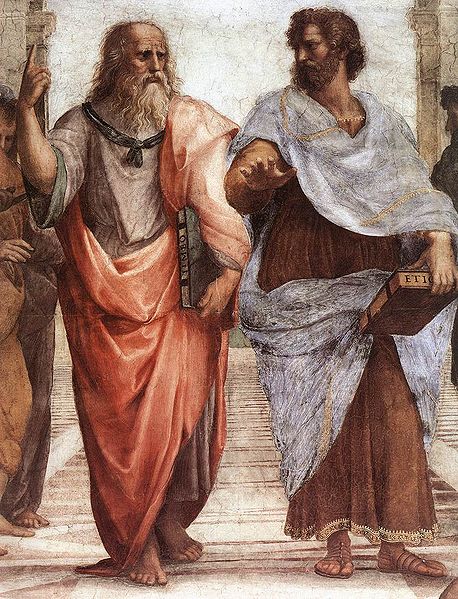


The Singularity called Man has its own Dimensions

What it is to be a Substance? and What it is to Exist? We need to establish knowledge about the man on a firm basis and the information it provides must be tested for its accuracy and consistency with an external reality. We have to make the fundamental distinction between the living and the non-living matter. The scientific advances of the 19th and 20th centuries reinforced the materialistic position concerning the basic similarity of organic living and inorganic physical matter. The man is viewed as a product of natural evolution and is thought to be subject to the same laws of Physics and Chemistry or mechanistic principles.
We need a methodology to study philosophy and to understand philosophical statements. Logical Positivism, also known as Scientific Empiricism aims to clarify concepts in both everyday and scientific language. It describes analysis of language as the function of philosophy. This analysis of language and of concepts is important to understand questions of belief and ideology which affect what we think we ought to do individually and socially. I use this method of ‘Applied Philosophy’ to analyze the philosophical doctrine of ‘Materialism’ and to study the views of Greek philosophers and their efforts to interpret human nature and human existence.
What is Man? The motivation to ask this question comes from a statement expressed in the Sanskrit language, ‘Sarvesham Svastir Bhavatu’, which seeks the well-being of all humans, of all races, of all cultures, of all religions, and of all nations.

Our efforts to support the well-being of Man would be affected by our understanding the ‘real’ or ‘true’ nature of Man. Aristotle describes corporeal substances are composite of two principles, 1. Form and 2. Matter.
It is important to seek a proper understanding of Human Form and to know the truth about Human Nature by describing the Form. Being born relates the man to the Subjective Reality of his physical existence and Human Nature is related to the fact of man’s existence in the physical world and universe. If the Objective Reality of the man is non-material or immaterial, we still need to know as to what exists in the world, and as to how it exists.
Plato’s Theory of Forms – The Dualism of Body and Soul:
Greek philosopher Plato (427 B.C. to 347 B.C.) describes Human Nature by his Theory of Forms. He describes four aspects or dimensions of Man; 1. The Logical Form, 2. The Epistemological Form, 3. The Moral Form, and 4. The Metaphysical Form.
I.The Logical Form: It describes the Physical Being, the Physical Form, and its Identity. Each human being has characteristic physical features using which he can be identified as a member of the genus Homo and he has very specific features that establish his identity that is shared by all the members of a species known as Homo sapiens, sapiens. Members of this species could be further identified as Specific Individuals using the present Identification Technology.
This Specific Individual will not exist with the same identifying features during the entire duration of his physical existence. The Logical Form of Man is impermanent and is subject to constant change and eventual death. However, the existence of this Physical Form is important to support the existence of Man and to know his Human Nature. Existence precedes Human Nature or Essence. The Essence (or, Who You Are) is defined and preceded by Existence (or, What You Do).
Man belongs to a Social Group, and always exists as an Individual with Individuality while his Physical Form changes and passes through various stages such as infancy, boyhood, teenage, adult and old age. The Logical Form is subject to change, decay, and death. Hence, the reality of this Form is often doubted. Plato has not known Man as a multicellular organism and his description of the Logical Form is not based on the study of Human Anatomy and Human Physiology.
II.The Epistemological Form: The term Epistemology deals with the Theory of Knowledge. It describes the possible kinds of Knowledge and the degrees of certainty for each kind of Knowledge. Plato describes the kind of Knowledge that Man can acquire through Education, a process of Learning from Sensory Experience, and teaching imparted by others. Plato expects to obtain full Knowledge of Human Forms through proper Education. In Plato’s view, such Self-Knowledge is important to know the Metaphysical Form of Man. Self-Knowledge leads to an understanding of the man’s true or real nature. Perception of impermanent, material, perishable Human Body is described by Plato as opinion or belief and he considers that such perception is not true Knowledge of Human Form.
Plato has not given attention to Knowledge that is Innate or that is not Acquired by the Learning Process. To perform Living Functions in support of existence, the man uses biological information that is Inherited and not Knowledge that has to be Acquired through Learning.
III.The Moral Form: It describes qualities such as Courage and Justice, the observable aspects of Human Nature described from Human Action and Human Behavior.
IV.The Metaphysical Form: Plato claims that the Metaphysical Form is not perceivable by any of the senses. The Metaphysical Form is the Real Form of Man as compared to the Logical Form which is considered to be unreal. The Metaphysical Form is not present in Space or Time, as it is beyond the World of changeable and perishable things. It belongs to the Realm of Unchanging, Eternal Forms. This Form being True can be fully known through Intuitive Knowledge.
Plato’s Theory of Body-Soul Dualism:
Plato divides Man into two categories; 1. Body – a material entity, and 2. Mind or Soul – a non-material or immaterial entity which can exist apart from the Body. Plato maintains that the Mind or Soul is indestructible, it existed eternally before Birth and will exist eternally after Death.
Plato further describes three parts of Soul as 1. Appetite – the seat of desires and passion such as hunger, thirst, and sexual desire, 2. Reason – the seat of discernment that chooses right from wrong and makes distinctions between good and evil, and 3. Spirit – the seat of self-assertion, self-interest, anger, indignation, and self-pride. Plato considers that the well-being of Man depends on harmonious interactions of three aspects of the Soul. Plato thinks that such harmonious interactions would only be possible when Reason controls both Spirit and Appetite. To strike this balance and to maintain harmony, Man has to obtain Knowledge of Eternal, Unchanging Metaphysical Form.
Plato thinks that Justice is revealed as a Principle of each thing performing the function most appropriate to its nature, a Principle of the proper adjudication of Activity and Being. The Principle of Justice is revealed or discovered in the Individual Human Soul when each part of the Soul performs its proper and appropriate function. Plato believes that Human Soul rules the Human Body. The Rule of Reason is required to combine the virtue of Temperance with Self-Mastery. Harmony results when all elements agree as to which should do what.
The Seven Dimensions of Man:

Whole Dude’s Whole Theory of Man defines Man as the ‘Spectrum of Seven Colors’. The Seven Colors or Dimensions of Man are, 1. The Physical, 2. The Mental, 3. The Social, 4. The Moral, 5. The Spiritual, 6. The Creative and 7. The Rational. Isaac Newton could easily verify his ‘Theory of Light’ by conducting his critical experiment in which he used two prisms to breakdown and to reconstitute white light rays. In case of Man, such experimental verification is not possible as Science does not have the capability to breakdown Man and reconstitute him. However, Science provides verified information about the building blocks of life and about basic living functions such as ‘Metabolism’ which essentially involve making, breaking, and repairing ‘Molecules of Life’.
Man–The Spectrum of Seven Colors

For purposes of defining Man the concept of Light Spectrum is useful. Light Spectrum appears continuous with no distinct boundaries. The ‘Singularity’ called Man can be easily witnessed at conception at the stage of Single, fertilized Egg Cell. The study of Man during all stages of his physical existence provides information about Man’s Seven Dimensions or Seven Colors. These are, 1. The Physical, Mortal Being, 2. The Mental Being, 3. The Social Being, 4. The Moral Being, 5. The Spiritual Being, 6. The Created Being, and 7. The Rational Being. Science called Cell & Molecular Biology can account for biomolecules of life and yet do not explain or account for the constitution of Man as a Rational Being.

I view Man as a multicellular organism that naturally hosts trillions of microbes and in fact exists as an interacting biological community or a social group. Man’s existence would be at risk if any of these Seven Dimensions is adversely impacted. Unless we seek clear, visual images of Human Form in all its Dimensions, we will fail to understand Man and his Purpose in Life.
Dr. Rudranarasimham, Rebbapragada, B.Sc., M.B.B.S.,
Father’s Name: R. Suryanarayana Murty
Sri Venkateswara University, M.B.B.S. Class of April, 1970
Andhra Pradesh Medical Council Medical Registration Number: AMC5282; Date of Registration: September 16, 1971


 Whole Dude - Whole Spirituality
I don’t think I’ll get $1000, but you know this is all Aristotle right? This isn’t Plato. Most of this is from Aristotle’s De Anima.
LikeLike
Hi Allen,
Thanks for visiting the blog post. Your doubt is far better than my certainty. The issue is not about Plato or Aristotle. The issue concerns the application of the Fundamental Laws of Conservation to the living matter.
Simon Cyrene
LikeLike