
The Reality of Man, The Rational Being

In my ‘Theory of Man’, I describe Man as a Rational Being besides his six other dimensions, the mortal Physical Being, the Mental Being, the Social Being, the Moral Being, the Spiritual Being, and the Created Being.

In my analysis, Man, the Rational Being seeks the verification of the reality of his own Subjective and Objective existence by using a Theory of Truth that cannot be refuted.
Spirituality Science – The Hegelian Model of Dialectics:

Georg Wilhelm Friedrich Hegel (b. August. 27, 1770, d. November. 14, 1831), German Idealist Philosopher, author of Phenomenology of Spirit or Phenomenology of Mind (1807), Science of Logic (1812-16), and Encyclopedia of the Philosophical Sciences (1817) and other works and lectures. He developed theories of Ethics, Aesthetics, History, Politics, and Religion. He developed a Dialectical scheme that influenced the development of Existentialism, Marxism, Positivism, and Analytic Philosophy.

Georg Wilhelm Friedrich Hegel influences most facets of modern philosophy. At the center of the universe, Hegel posits an enveloping absolute Spirit that guides all reality including human reason. His absolute ‘Idealism’ envisages a world-Soul, that develops from, and is known through, a process of change and progress termed as the Hegelian Dialectic. The doctrine of ‘Idealism’ makes the attempt to account for all objects in nature and experience as representations of the mind, and sometimes it assigns to such representations a higher order of existence. According to Hegel, the reality is Absolute Mind, Reason, or Spirit which manifests itself in both natural and human history. His famous dictum, “the real is rational and the rational real,” is an expression of the identity of reality and the rational process. Because the reality is rational, it acts in accordance with the laws of reasoning. Hegel suggests that understanding the nature of thought will lead to understanding the nature of reality as a whole. Dialectics is a form of logical argumentation that is applicable to diverse fields including thought, nature, and history. Hegel identifies dialectic as the tendency of a notion, or idea to pass over into its own negation as the result of conflict between its inherent contradictory aspects. He develops the concept that Mind or Spirit manifests itself in a set of contradictions and oppositions that it ultimately integrated and united without eliminating either pole or reducing one to the other. According to Hegelian principles, one concept or ‘thesis’ inevitably generates its opposite or ‘antithesis’; their conflict or interaction generates a new concept or ‘synthesis’ which in turn becomes the ‘thesis’ of a new triad. Hegel develops a dialectical scheme that emphasizes the progress of history and ideas from ‘thesis’ to ‘antithesis’ and then to a higher and richer ‘synthesis’. His main contribution is that of giving a clear view of reality; Reality can only be understood as a totality, “The Truth is the Whole”, and that the attempt to understand the apparently individual and unconnected phenomena of nature, history, and human life through separate categories of thought is utterly mistaken. I endorse his view and submit that Reality must be known as a Whole.
The Medical Doctrine of Dialectical Spiritualism:
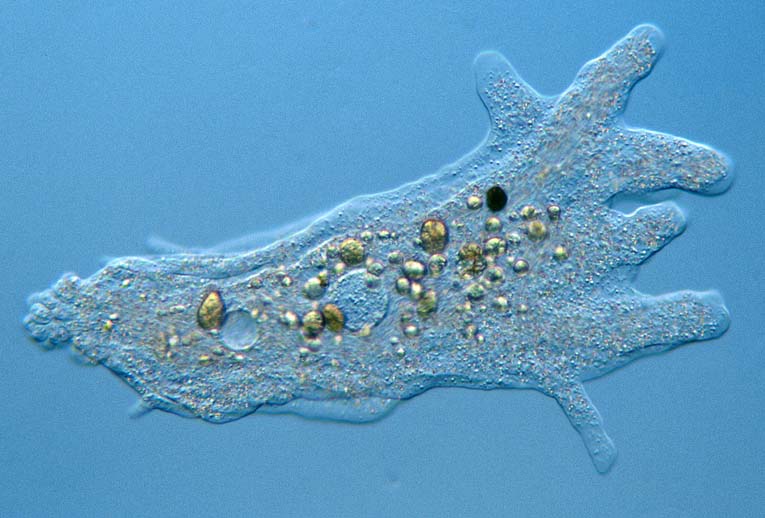
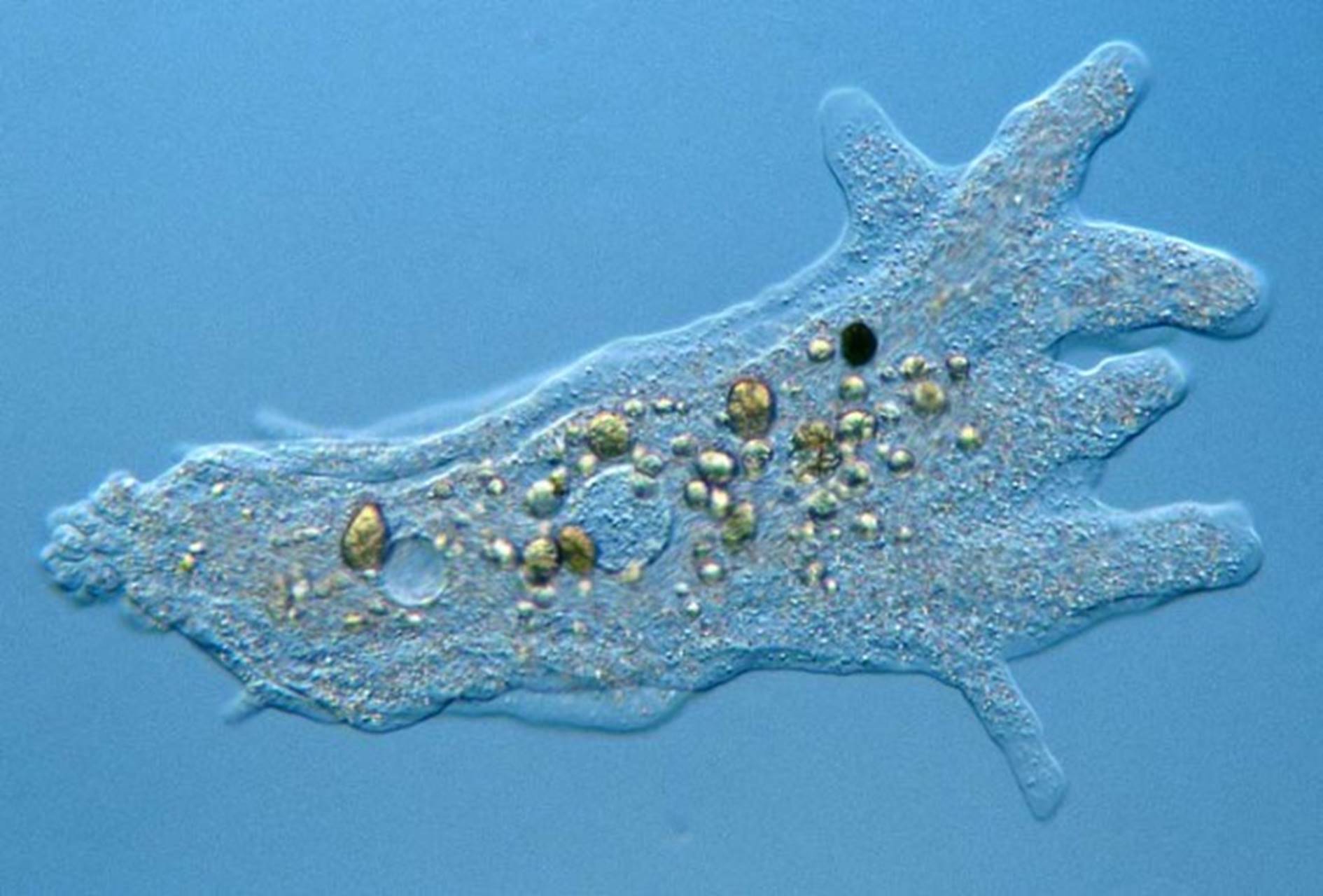
The Ground Substance of Spiritualism and Spirituality. The vital characteristics, the animating principles of Protoplasm could be known by observing Amoeba proteus. The Living Substance works as an organ of Motion or Movement, as an organ of Nutrition, and as an organ of Reproduction to generate new cells which have a life span of their own. In these physiological functions, I describe the characteristics such as Cognition, Consciousness, Memory, and Intelligence which have a Spiritual role as they bring functional unity and harmony in the interactions between different parts of the same individual organism while it exists in an environment as a member of a biological community.
Amoeba proteus and the understanding of Reality as a Whole or the ‘Whole Truth’.
To understand the reality of human life, we need to know and understand the Reality of a material substance that is common to all living organisms. This common substance called Protoplasm is found in all living cells including the cells of the human brain, an anatomical organ that is associated with thinking, and Mind the seat of thoughts. However, I ask my readers to know and understand Protoplasm, the substance in which thoughts are generated and reside. I give attention to the Spiritual Nature of this substance and divert attention from Mind and Brain.
Hegel in his book, Phenomenology of Mind or Phenomenology of Spirit traces the progression of consciousness from sense perception to Absolute Knowledge. In my view, Amoeba proteus is conscious and intelligent. I speak about Spirit or Soul in relation to a material substance called Protoplasm. I hesitate to equate Mind with Spirit as that would mislead people to think of consciousness and intelligence as the exclusive biological functions of an anatomical organ called brain. At the same time, it must be clearly understood that brain and mind perform their specialized functions using the same living matter or substance that is found inside Amoeba proteus. The fact that brain and mind perform very complex functions should not hide the fact of the true or real nature of Protoplasm. There is an inherent conflict in the nature of Protoplasm. It is inherently unstable; the living matter is thermodynamically unstable, and without a continuous supply of energy from an external source, it will dissolve into its constituent inorganic molecules and non-living Chemical Elements. This nature of energy dependence and the risk of its dissolution is the ‘thesis’ and it is opposed by its potency and potential to remain immutable, or unchanging, the ‘antithesis’. Protoplasm is unstable and is stable at the same time. It has survived and has continuously lived on the surface of planet Earth for billions of years after having come into existence. We have an account of several major and minor extinction events and yet Protoplasm has remained and existed without any apparent change in its properties, characteristics, and functions. Protoplasm has demonstrated the potentiality called Imperishability, Indestructibility, Immortality and the ability of Eternal or Everlasting Life. The interaction or conflict between unstable (‘thesis’) and stable (‘antithesis’) nature of Protoplasm has generated a new ‘synthesis’ called Immortality or Everlasting Life. I call this higher state of existence as ‘Dialectical Spiritualism’. Man is a Physical, Mortal Being and his body substance or matter is perishable. Through the process of Dialectical Spiritualism, the conflict and interaction between the unstable and stable nature of Protoplasm which is a Spiritual substance, Man progresses towards his goal of becoming a Complete or Whole Spiritual Being and his body substance will exist in its higher state of existence of Imperishability. The Medical Doctrine of Dialectical Spiritualism proposes the hypothesis of Man’s Immortality or Everlasting Life as a higher state of existence of a mortal or perishable substance that has the potentiality and progresses towards its natural goal of Imperishability and Indestructibility.
I use Amoeba proteus as my model to study the Reality as Whole Truth. The reasoning process begins when the organism recognizes its own dependence on an external source of matter and energy to perform its living functions.
Dr R. Rudra Narasimham, B.Sc., M.B.B.S.,
Kurnool Medical College, Kurnool, Andhra Pradesh, India,
M.B.B.S. Class of April 1970.
Related articles
· Spiritualism and Materialism (bhavanajagat.com)
· Spiritualism and Intelligence (bhavanajagat.com)
· Spiritualism and Knowledge of Human Nature (bhavanajagat.com)
.

 Whole Dude - Whole Spirituality