
The Study of Celestial Mechanics and Celestial Dynamics – The Discovery of a Creative Force spinning the cobwebs of Illusion
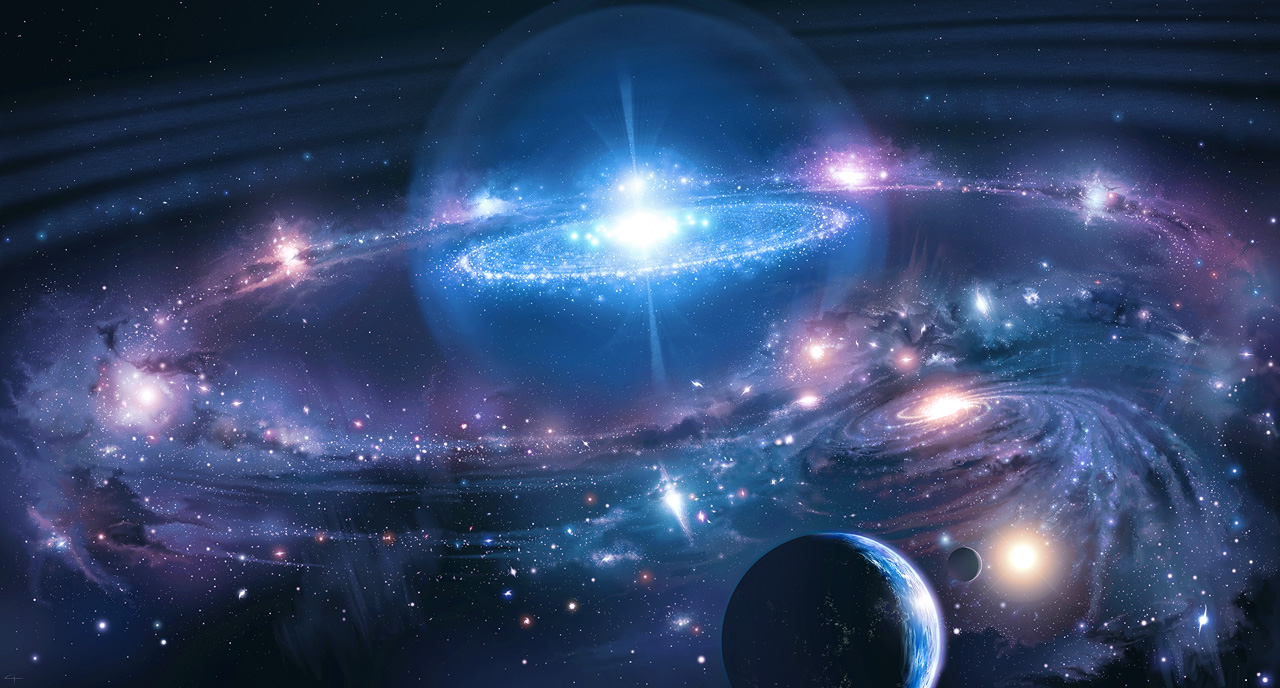
Maya (Sanskrit: māyā, माया) is a foundational concept in Indian philosophies, most prominently translated as “illusion,” “magic,” or “the creative force.” At its core, Maya describes the cosmic force that presents the absolute, unchanging reality as the changing, diverse, and material universe we experience.
The concept shifts significantly depending on the historical and philosophical context:
1. Etymology and Original Meaning
The word originates from the Sanskrit root mā, which means “to measure,” “to form,” or “to give shape.”
Early Vedic Texts: In ancient texts like the Rigveda, Maya did not mean a “fake” illusion. Instead, it referred to a divine creative power or extraordinary capacity used by gods to bring the physical world into visible form.
2. The Philosophy of Vedanta (Advaita)
In later philosophical schools, particularly Advaita Vedanta (non-dualism), Maya took on its most famous meaning as a cosmic veil or ignorance.
The Cosmic Illusion: It is the power that makes the singular, infinite reality (Brahman) appear as millions of separate objects, people, and things.

The Rope and Snake Metaphor: Scholars like Adi Shankara explained Maya using the classic analogy of a person mistaking a coiled rope for a snake in the dark. The “snake” (the material world) isn’t entirely non-existent; it is a real experience born of a misperceived reality (the rope/Brahman). Once you shine a light, the illusion of the snake vanishes.
Psychological Ignorance (Avidya): On a personal level, Maya acts as the ego and attachment that keeps humans blind to their true divine nature (Atman), trapping them in the cycle of suffering and rebirth (Samsara).
3. Meanings across Other Traditions
Buddhism: Maya refers to deceit, emptiness, or a magic show, emphasizing that all worldly things are interdependent and lack a solid, permanent essence. (Separately, Māyādevī is also the name of the historical mother of Gautama Buddha).
Jainism: It is categorized as a form of deceit or passion that binds negative karma to the soul.
Summary of what Maya is not
In Indian philosophy, saying the world is “Maya” doesn’t mean the physical world is literally non-existent or a holographic matrix hallucination. Rather, it means the world is impermanent, constantly changing, and fundamentally misunderstood when we mistake it for the ultimate, absolute truth.
Maya – The Concept of a Fifth Fundamental Force Operating the Magic of Creation

Man has already discovered numerous exoplanets outside our Solar System. Some of these exoplanets are described as ‘Earth-Like’ and even thought of as potentially habitable.

In my analysis, the known Fundamental Force Gravitation can only account for the revolving orbits or orbital motions of planets around their Sun and not of their Individualistic Rotational Spins. I am introducing the term “Maya” described in the Sanskrit language to formulate it as the creative force directing Celestial Mechanics which impart the initial momentums resulting in the varying rotational spin characteristics of all the known planets.
To create original, new, one of its own kind of celestial objects, Lord God Creator could be applying the creative force called “Maya” to impart varying amounts of momentum to new planets as they are born to begin their varying rotational spins. No two planets are alike when we compare their rotational spins.

Dr. Rudranarasimham, Rebbapragada, B.Sc., M.B.B.S.,
Father’s Name: R. Suryanarayana Murty, M.A., B.Ed.,
Sri Venkateswara University, M.B.B.S. Class of April, 1970
Andhra Pradesh Medical Council Medical Registration Number: AMC5282; Date of Registration: September 16, 1971
NASA Discovers 3 New Worlds 73 Light-Years Away: Are They Potentially Habitable?
Clipped from: https://www.ibtimes.com/nasa-discovers-3-new-worlds-73-light-years-away-are-they-potentially-habitable-2809788
Scientists from NASA have discovered three new alien planets orbiting a distant host star. According to their discovery, one of the planets could be habitable due to its environmental condition.
Using the space agency’s Transiting Exoplanet Survey Satellite (TESS), scientists discovered a small system of planets and catalogued it into their TESS Object of Interest (TOI) program.
At the center of this system is an M3-type of dwarf star known as TOI 270. According to the scientists, the star is about 40 percent smaller than the Sun and is located about 73 light-years away. Orbiting around the star are three planets known as TOI 270 B, TOI 270 C and TOI 270 D.
The scientists noted that the conditions within these planets vary depending on their distance from TOI 270.
“This system is exactly what TESS was designed to find – small, temperate planets that pass or transit, in front of an inactive host star, one lacking excessive stellar activity, such as flares,” lead researcher Maximilian Gunther of the Massachusetts Institute of Technology said in a statement.
“This star is quiet and very close to us, and therefore much brighter than the host stars of comparable systems,” he added. “With extended follow-up observations, we’ll soon be able to determine the make-up of these worlds, establish if atmospheres are present and what gases they contain and more.”
The planet TOI 270 B orbits closest to the host star and is about 25% larger than Earth. Due to its close proximity to TOI 270, scientists believe it has oven-like conditions and has an equilibrium temperature of around 490 degrees Fahrenheit.
The other two planets are about twice as big as Earth. Of the two, the planet farthest from the star, known as TOI 270 D, has the lowest temperature. Scientists estimated that it has an equilibrium temperature of 150 degrees Fahrenheit.
Scientists believe that further studies on this planet will reveal more helpful information regarding its environmental conditions. These future observations could also reveal if the planet is habitable.
“TOI 270 is perfectly situated in the sky for studying the atmosphere of its outer planets with NASA’s future James Webb Space Telescope,” the study’s co-author Adina Feinstein of the University of Chicago said.
“It would be observable by Webb for over half a year, which could allow for really interesting comparison studies between the atmospheres of TOI 270 C and D,” she added.
The findings of the scientists were detailed in a new study published in Nature Astronomy.
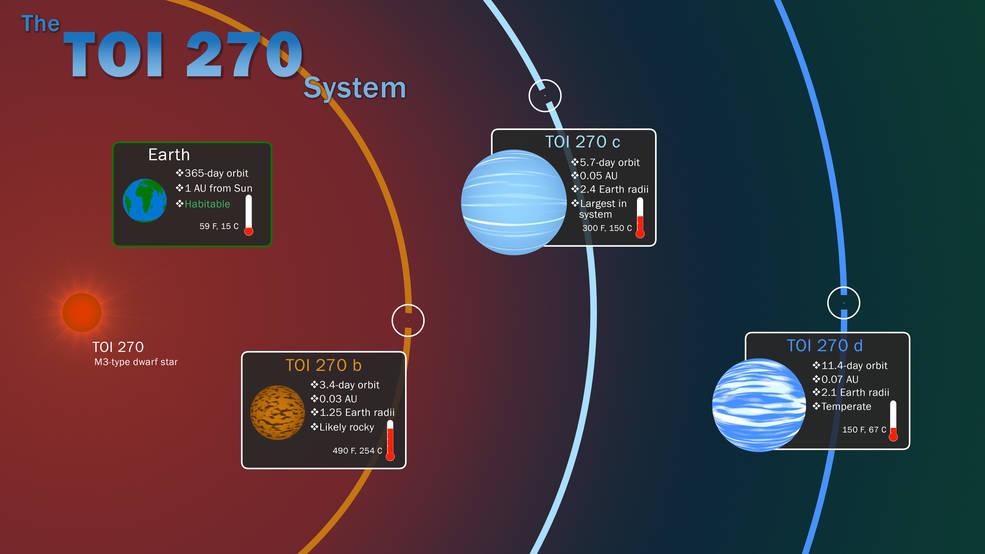
This infographic illustrates key features of the TOI 270 system, located about 73 light-years away in the southern constellation Pictor. The three known planets were discovered by NASA’s Transiting Exoplanet Survey Satellite through periodic dips in starlight caused by each orbiting world. Insets show information about the planets, including their relative sizes, and how they compare to Earth. Temperatures given for TOI 270’s planets are equilibrium temperatures, calculated without the warming effects of any possible atmospheres.
Photo: NASA’s Goddard Space Flight Center/Scott Wiessinger


