COMMUNIST CHINA STRANGLES HUMAN RIGHTS AT HOME AND ABROAD
The spread of Communism to mainland China compromised prospects of Freedom, Democracy, Peace, and Human Rights both inside China and in her occupied territories of Tibet, Inner Mongolia, and East Turkestan.
Rudranarasimham Rebbapragada
DOOM DOOMA DOOMSAYER
CHINA’S MANIPULATION OF UN HUMAN RIGHTS EFFORTS MUST BE STOPPED
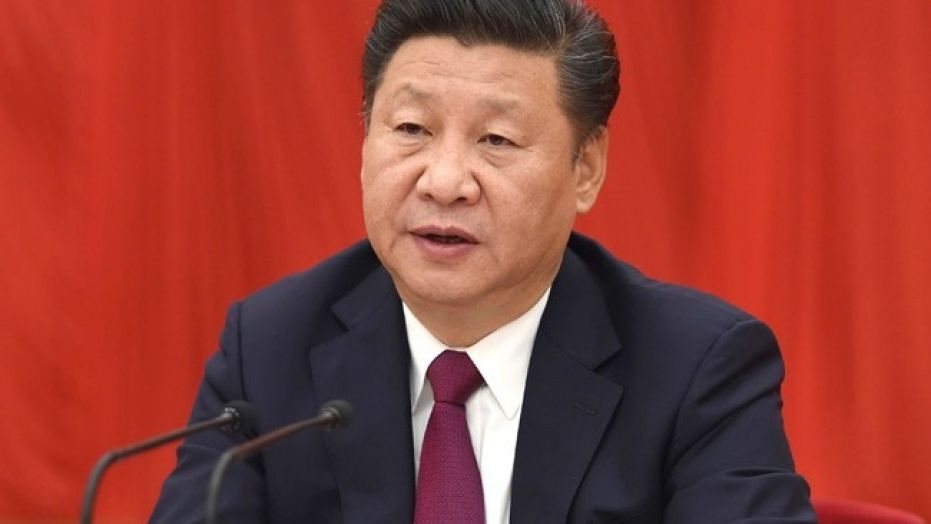
Chinese President Xi Jinping speaks during the opening ceremony of the BRICS Business Forum at the Xiamen International Conference and Exhibition Center in Xiamen in southeastern China’s Fujian Province, Sunday, Sept. 3, 2017. (AP Photo/Mark Schiefelbein)
China’s growing appetite for global power isn’t hard to spot: military muscle-flexing in the South China Sea, the trillion-dollar New Silk Road development initiative, even its proliferation of Confucius Institutes, academic outposts to spread its version of history and politics.
What’s less easy to see is that worsening human rights violations at home are increasingly reflected in Beijing’s diplomatic agenda to undermine human rights protections abroad, including at the United Nations.
The U.N. human rights system exists to protect people whose own governments cannot or will not do that for them. The system has many shortcomings, but even so it is a vital international forum for monitoring nations’ compliance with their human rights obligations, where critical independent voices can be heard and violators at times held accountable—or at least spotlighted.
For activists who work on China human rights issues, this venue is all the more important because the country’s president, Xi Jinping, has steadily strangled domestic options for obtaining justice through the courts and engaging in peaceful dissent.
Chinese authorities have prevented mainland activists from reaching the U.N. Human Rights Council in Geneva and harassed them at U.N. headquarters in New York. Chinese officials in Geneva have even threatened foreign diplomats and UN. human rights experts who support scrutiny of Beijing’s record.
As a new Human Rights Watch report exposes, President Xi’s government is working hard to weaken these U.N. mechanisms. Chinese authorities have prevented mainland activists from reaching the U.N. Human Rights Council in Geneva and harassed them at U.N. headquarters in New York. Chinese officials in Geneva have even threatened foreign diplomats and U.N. human rights experts who support scrutiny of Beijing’s record.
Reflecting its hostility to human rights monitoring generally, China has also blocked U.N. resolutions supporting human rights defenders globally—thus undermining protections for rights groups who do not even work on China.
Beijing is also trying to manipulate U.N. mechanisms to impose its political views on others. China—along with other countries hostile to human rights—sits on the U.N. committee that grants civil society groups accreditation needed to participate in U.N. meetings. Applicants have been told that getting approval means deleting from their organizations’ materials any reference to 2010 Nobel Peace Prize winner Liu Xiaobo. Any references to Taiwan or Tibet must reflect Beijing’s view that those territories are part of China.
China has jailed activists who wanted to participate in U.N. activities, and even blocked a commemoration of one who died trying to do so.
In September 2013, Chinese authorities detained Cao Shunli, a Beijing-based activist, prior to boarding a flight for Geneva, where she was going to participate in China-related U.N. training sessions. While in detention Cao fell critically ill, but the authorities denied her adequate medical care. She died in March 2014.
At the next session of the U.N. Human Rights Council, nongovernmental organizations sought to hold a moment of silence in her honor, but China coolly and cruelly succeeded in getting enough other Council members—including Cuba, Russia, Iran, Saudi Arabia and Venezuela– to prevent the gesture.
U.N. officials have at times rejected Chinese efforts at intimidation and ensured that independent voices are heard. Yet on other occasions they either fail to stand firm—allowing, for example, China to dictate that experts seen as critical of China not sit on key committees—or, worse, are complicit in abuses.
In April 2017, U.N. security officers forced Dolkun Isa, an accredited activist for China’s persecuted Uyghurs, to leave the New York headquarters, where he was participating in a conference on minority rights. When challenged about this incident, Secretary-General Antonio Guterres said he was “fully aware of the situation,” but failed to offer any explanation or plan of action to change things.
To be sure, China isn’t the only government that seeks to manipulate the U.N. human rights system for its own benefit. But Beijing’s global power, ambitions, and its status as a permanent member of the U.N. Security Council make it a sinister role model for other authoritarian governments.
China’s ability to block human rights initiatives is not absolute. The U.N. remains a high profile venue for countries intent on promoting human rights and for working to hold abusive governments to account. In March 2016, for example, the United States and 11 other countries issued an unprecedented joint statement condemning China’s arrest of human rights activists and attorneys.
Nonetheless, the trend is moving in the wrong direction. As Human Rights Watch’s research has shown, unless the U.N., with help from rights-respecting governments, pushes back by insisting on compliance with established human rights practices, adopting new ones to prevent future abuses, and holding China and other bad-faith players accountable, the integrity of the vulnerable U.N. human rights system—and the people around the world it helps to protect—are at grave risk.
Sophie Richardson is China director at Human Rights Watch. Follow her on Twitter at @SophieHRW.
SPIRITUALITY SCIENCE – WHO IS YOUR GOVERNOR? WHO IS “AL-WALI” ?
Spirituality Science – Who is Your Governor? Who is “Al-Wali”
I am student of Natural Sciences and Medical Science. I know that man does not rule or govern even a single cell of his own human body that comprises of trillions of Individual, Independent, and Autonomous Cells, the building blocks of Life.
Human Anatomy and Human Physiology explain the structures and functions of cells, tissues, organs, and organ systems of body. For man is not the ‘Governor’ of his own body, man has to know the ‘Governor’ who has authority over both body and the world in which body physically exists.
Spirituality Science – Who is Your Governor? Who is “Al-Wali” ?
Scriptures offer guidance. Man of understanding will follow the guidelines to arrive at Knowledge. Firstly, I ask my readers to understand Life as Knowledge in Action. All living functions demand purposeful, goal-oriented, non-random, sequential, and guided events. Scripture speak of LORD God Creator as “GOVERNOR.” If there is ‘Governor’, He will be known by study of Laws which govern Existence of Man and World.
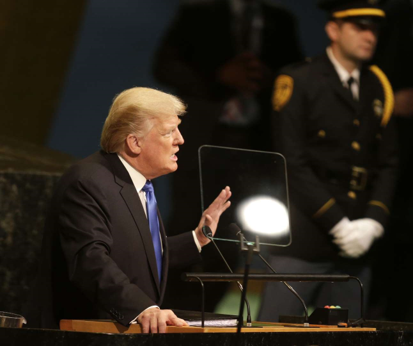
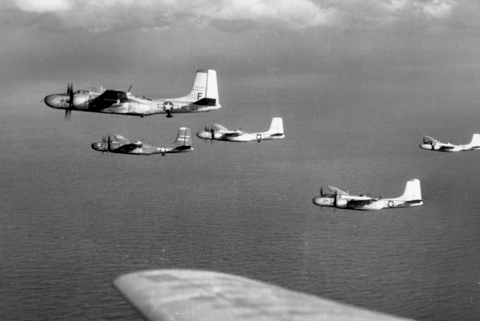
At U.N. General Assembly, on Tuesday September 19, President Trump delivered an empty threat to ‘totally destroy’ North Korea. United States tried twice in the past to destroy Korea and Vietnam on the battlefield. US failed in 1953 and 1975 for Korea and Vietnam are not the "Real Enemy." Korea and Vietnam survived the US bombing campaigns for they have the support of Communists.
I ask President Trump to Just Say "NO" to Communism, the "Real Enemy," to Win ‘The Cold War in Asia’.
Rudranarasimham Rebbapragada
SPECIAL FRONTIER FORCE
AT U.N., TRUMP WARNS U.S. MAY HAVE TO ‘TOTALLY DESTROY’ NORTH KOREA
UNITED NATIONS — U.S. President Donald Trump said on Tuesday that the United States will be forced to "totally destroy" North Korea unless Pyongyang backs down from its nuclear challenge, mocking North Korean leader Kim Jong Un as a "rocket man" on a suicide mission.
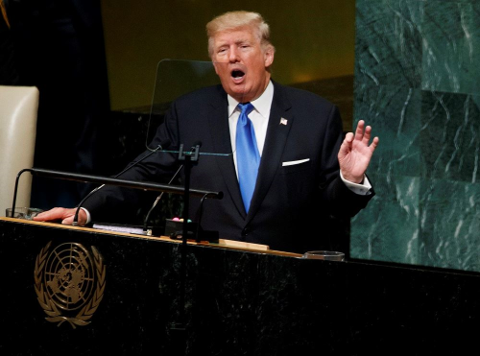
Loud murmurs filled the green-marbled U.N. General Assembly hall when Trump issued his sternest warning yet to North Korea, whose ballistic missile launches and nuclear tests have rattled the globe. Unless North Korea backs down, he said, "We will have no choice but to totally destroy North Korea."
"Rocket man is on a suicide mission for himself and his regime," he said.
North Korea’s mission to the United Nations did not immediately respond to a request for comment on Trump’s remarks. A junior North Korean diplomat remained in the delegation’s front-row seat for Trump’s speech, the North Korean U.N. mission said.
In his first appearance at the annual gathering of world leaders, the president used a 41-minute speech to take aim also at Iran’s nuclear ambitions and regional influence, Venezuela’s collapsing democracy and the threat of Islamist extremists.
He also criticized the Cuban government. But his strongest words were directed at North Korea. He urged United Nations member states to work together to isolate the Kim government until it ceases its "hostile" behavior.
He said North Korea’s pursuit of nuclear weapons and ballistic missiles "threatens the entire world with unthinkable cost of human life."
In what may have been a veiled prod at China, the North’s major trading partner, Trump said: "It is an outrage that some nations would not only trade with such a regime but would arm, supply and financially support a country that imperils the world with nuclear conflict."
Turning to Iran, Trump called the 2015 nuclear deal negotiated by his predecessor, Barack Obama, was an embarrassment and hinted that he may not recertify the agreement when it comes up for a mid-October deadline.
"I don’t think you’ve heard the last of it," he said.
He called Iran an "economically depleted rogue state" that exports violence. The speech marked his latest attempt to lay out his America First vision for a U.S. foreign policy aimed at downgrading global bureaucracies, basing alliances on shared interests, and steering Washington away from nation-building exercises abroad.
Trump, who entered the White House eight months ago, told world leaders at the 193-member global body that the United States does not seek to impose its will on other nations and will respect other countries’ sovereignty.
"I will defend America’s interests above all else," he said. "But in fulfilling our obligations to other nations we also realize it’s in everyone’s interest to seek a future where all nations can be sovereign, prosperous and secure."
Reading carefully from a script, Trump said the U.S. military would soon be the strongest it has ever been. Turning to Venezuela, Trump called the collapsing situation there "completely unacceptable" and said the United States cannot stand by and watch. He warned the United States was considering what further actions it can take. "We cannot stand by and watch," he said.
Shortly before Trump’s speech, U.N. Secretary-General Antonio Guterres appealed from the General Assembly lectern for statesmanship to avoid war with North Korea. "This is the time for statesmanship," said the former prime minister of Portugal.
"We must not sleepwalk our way into war.." The U.N. Security Council has unanimously imposed nine rounds of sanctions on North Korea since 2006 and Guterres appealed for the 15-member body to maintain its unity on North Korea.
Trump has warned North Korea that military action was an option for the United States as Pyongyang has carried out a series of tests toward developing the ability to target the United States with a nuclear-tipped missile. Financial markets showed little reaction to Trump’s speech, with most major assets hovering near the unchanged mark on the day.
PRESIDENT TRUMP’S DEFINING MOMENT – ARE YOU FRIEND OF FREEDOM AND DEMOCRACY?
PRESIDENT TRUMP’S DEFINING MOMENT – ARE YOU FRIEND OF FREEDOM AND DEMOCRACY?
On Tuesday September 19, 2017, President Trump will address the UN General Assembly. It will be President Trump’s defining moment. He has to prove his credentials to the world.
On behalf of Special Frontier Force, I ask Mr. President, "Are You Friend of Freedom and Democracy?"
Trump must verify his love, hate relationship with American Values. While defending Freedom and Democracy, the US lost its battle in Vietnam. Now, I have to know as to how President Trump plans to "WIN" ‘The Cold War in Asia’.
Rudranarasimham Rebbapragada
Ann Arbor, Michigan, USA 48104 – 4162
SPECIAL FRONTIER FORCE
TRUMP’S LOVE, HATE RELATIONSHIP WITH THE UNITED NATIONS – ABC NEWS
President Trump will make his first speech before the United Nations General Assembly on Tuesday. Will he bring the world together or sow division? Will he embrace an institution that he has previously called weak and incompetent?
His relationship with the New York-based global organization is long and complicated.
Trump, the candidate, says UN “not a friend of freedom”
During his March 23, 2016 speech before the American Israel Public Affairs Committee’s conference, then-candidate Trump issued some of his toughest commentary, speaking of the “utter weakness and incompetence of the United Nations.”
“The United Nations is not a friend of democracy. It’s not a friend to freedom,” Trump said. “It’s not a friend even to the United States of America, where, as you know, it has its home. And it surely is not a friend to Israel.”
Though a 2016 Global Attitudes Survey by Pew Research Center showed that 64 percent of Americans had a favorable view of the United Nations, Trump’s campaign promises for a protectionist economic policy and an aggressive approach to China come into conflict with the goals of multilateralism and the UN charter. His promotion of interrogation techniques “worse than waterboarding,” his push for a temporary ban on Muslims from entering the U.S. and his decision to pull out of the Paris Climate Accords have also put Trump at odds with UN allies.
Last December, Trump continued his assault on the institution, tweeting: “The United Nations has such great potential but right now it is just a club for people to get together, talk and have a good time. So sad!”
Trump, the real estate magnate: “I’m a big fan” of the UN
In 2005, Trump testified before a subcommittee looking at UN spending, calling himself a “big fan of the United Nations and all it stands for.” He told lawmakers the institution was one of the reasons he chose to build Trump World Tower, one of his luxury residential properties, where he did in 1998.
“If the United Nations weren’t there, perhaps I wouldn’t have built it in that location,” said Trump. “So it means quite a bit to me.” When Trump was planning the building, many UN officials, including Secretary General Kofi Annan, expressed disapproval of the massive construction project.
Trump’s renovation hopes
At a 2005 hearing, a Senate Homeland Security and Governmental Affairs subcommittee was looking at renovations at the UN New York headquarters and estimated development costs for similar projects in New York. Trump had met with UN officials to pitch his services, but they were refused. He told members he thought the project could cost $700 million, and he predicted the UN would end up spending upwards of $3 billion.
“You have to deal in New York City construction to see what tough people are all about,” Trump said at the time. “I listen to these people and they’re very naive, I respect them, but they’re very naive in this world. I might be naive in their world. But in this world, they’re naive.”
He also noted at a 2005 hearing that it was a dream of his to move the United Nations headquarters to the World Trade Center.
Seven years later, he shared another UN preoccupation, tweeting on Oct. 3, 2012: “The cheap 12 inch sq. marble tiles behind speaker at UN always bothered me. I will replace with beautiful large marble slabs if they ask me.”
On Tuesday, Trump will address the United Nations General Assembly and the world without his “beautiful large marble slabs” as a backdrop.
MR. PRESIDENT – MAKE YOUR CHOICE – TWITTER WAR vs UNFINISHED KOREA-VIETNAM WAR
Mr. President – Make Your Choice – Twitter War vs Unfinished Korea-Vietnam War
I ask President Donald J. Trump to make his choice; Twitter War vs Unfinished Korea-Vietnam War.
“VOTE ‘T’ ” – MAKE AMERICA GREAT AGAIN – VOTE FOR AMERICAN VALUES
Mr. President – Make Your Choice – Twitter War vs Unfinished Korea-Vietnam War
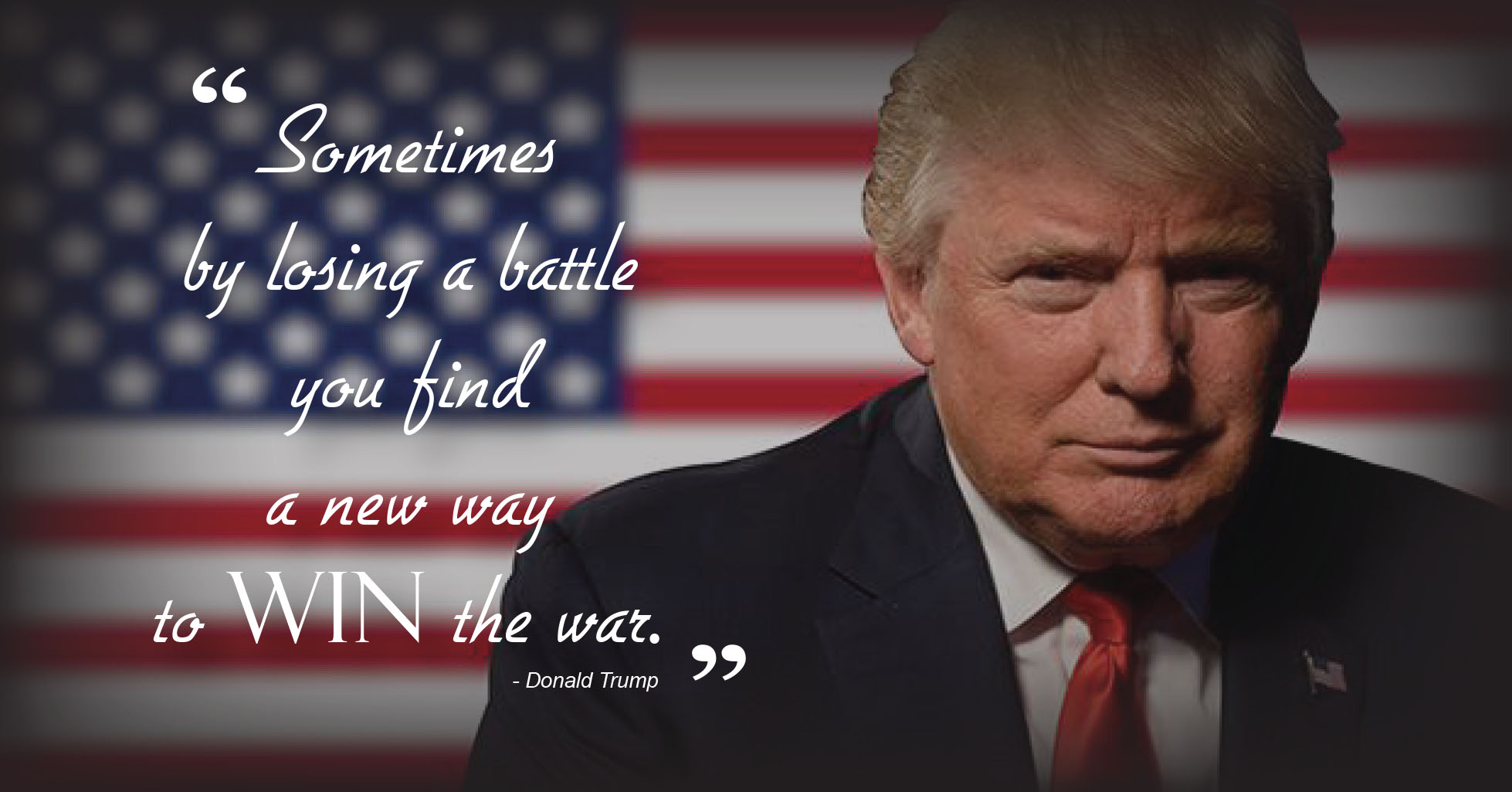
President Donald J. Trump successfully invented several insulting nicknames to win his 2016 presidential election. To win ‘The Cold War in Asia’, to achieve victory in ‘Unfinished Korea-Vietnam War’, and to ‘Make America Great Again’, Americans have to Vote for American Values and recreate independent American Spirit. I ask Mr. ‘T’ to Stand Up for Freedom, Democracy, Peace, and Justice in Asia and to Stop waging his ‘Twitter Warfare’ inventing nicknames.
Rudranarasimham Rebbapragada Ann Arbor, Michigan, USA 48104 – 4162., SPECIAL FRONTIER FORCE
Mr. President – Make Your Choice – Twitter War vs Unfinished Korea-Vietnam War
ANALYSIS : FROM ‘SLEEPY EYES’ TO ‘ROCKET MAN’ – A COMPENDIUM OF BELITTLING NICKNAMES TRUMP HAS INVENTED
Mr. President – Make Your Choice – Twitter War vs Unfinished Korea-Vietnam War
Without addressing the geopolitical wisdom of tweet-baiting an unpredictable dictator, even some of Trump’s critics had to admit that he’d come up with a pretty clever name. In a mere nine letters, the president simultaneously mocked Jong Un, belittled his regime’s missile arsenal and alluded to the popular lyrics of Elton John. But that really shouldn’t surprise anyone. A brief review of the long history of Trumpisms shows that, regardless of how he’s doing as leader of the free world, Trump has really stepped up his name game.
“Sleepy Eyes” and “Pocahontas”
While it’s hardly his most famous creation, one of Trump’s oldest and most enduring nicknames is reserved for Chuck Todd, or “Sleepy Eyes,” as Trump has repeatedly called the NBC host. Trump started using the term on Twitter during the 2012 presidential election, when he decided Todd — “an absolute joke of a reporter” — was too friendly to then-president Barack Obama. But Trump has kept “Sleepy Eyes” around into his own presidency, most recently when he complained that the soporific journalist was paying too much attention to “the Fake Trump/Russia story.” By then, “Sleepy Eyes” shared Trump’s imaginative landscape with many other characters, like Sen. Elizabeth “Pocahontas” Warren (D-Mass.), whose name he explained this way: Academics occasionally try to analyze the nicknames Trump invents, seeing in them either genius or a psychological malady. A writer for Psychology Today once called the names “a symptom of nounism” — or, in other words, the result of Trump’s compulsion to simplify people into objects, good or bad. Last year, a communications professor at the University of Wisconsin told Business Insider that the nicknames were crafty politics, allowing Trump to reference his enemies’ scandals and embarrassments in a breath, as prefix, every time he spoke their names.
Little Marco and Lyin’ Ted
As he fought his way through the candidate-clogged Republican primaries last year, Trump experimented with various insults for his many rivals. He briefly tried out “Robot Rubio” for Sen. Marco Rubio of Florida but found an alternative form far more successful when the two men met on stage at a debate in March 2016. “I have a policy question for you, sir,” the moderator told Trump. “Let’s see if he answers it!” Rubio chirped. “I will,” Trump replied, stone-faced. “Don’t worry about it, Marco, don’t worry about it. Don’t worry about it, Little Marco. I will.” Rubio tried get in a comeback over the cheers. “Well, let’s hear it, big — big Don, big Donald!” he said. But Trump just talked over him, not even looking at Rubio and simply repeating to wild applause, “Don’t worry about it, Little Marco.” Less than two weeks later, “Little Marco” Rubio dropped out of the race, and Trump moved on to his next big rival, Sen. Ted Cruz of Texas, a.k.a.:
“Crooked Hillary” and “Crazy Bernie”
Mr. President – Make Your Choice – Twitter War vs Unfinished Korea-Vietnam War
We don’t pretend this is a comprehensive list. The nicknames that Trump has come up with are probably uncountable, extending from his real estate and show-business days into his presidency. They encompass nonhuman antagonists, like the “Failing New York Times” and “Amazon Washington Post,” collectively part of the entity he deems “fake news.” And some monikers appear to live only in the president’s mind, or at least his private conversations. Like “Mr. Elegant,” whom Trump referenced in an interview with the Wall Street Journal last month, leaving everyone confused as to whom he was talking about. Finally, after all those people, there are the self-referential nicknames. The autotrumpisms. Trump is hardly the first politician to refer to himself occasionally in third person. But he has done so over the years with a typically Trump-like inclination toward brevity. His first tweet, in 2009, invited fans to “tune in and watch Donald Trump” on late-night TV. By 2013, as Trump congratulated himself for the success of his reality show, he had moved on to the more familiar “Donald:” And as Election Day approached last year, Trump had reduced himself to a single character — “Vote ‘T.’ ” We might chalk that up to the 140-character limit of Trump’s favorite medium. But he did it again a year later, as he complained of the FBI investigation around T’s young administration. Which isn’t to say that Trump will always be ‘T.’ Nor that Hillary must be Crooked, or Chuck Todd Sleepy. In fact, as Sunday’s “Rocket Man” saga demonstrated, nicknames are a little like nuclear weapons. They risk retaliation:
Mr. President – Make Your Choice – Twitter War vs Unfinished Korea-Vietnam WarMr. President – Make Your Choice – Twitter War vs Unfinished Korea-Vietnam WarMr. President – Make Your Choice – Twitter War vs Unfinished Korea-Vietnam War
CHANGE OF COURSE IN NORTH KOREA – UNFINISHED KOREA-VIETNAM WAR
CHANGE OF COURSE IN NORTH KOREA – UNFINISHED KOREA-VIETNAM WAR
Tensions in Korean Peninsula originated with spread of Communism to mainland China in 1949. UN sanctions on North Korea will not work. The problem remains the same since 1950 when the US fought against People’s Liberation Army on Korean soil. Single-Party Communist governance of mainland China imposes stumbling block for any change of course in North Korea.
Rudranarasimham Rebbapragada DOOM DOOMA DOOMSAYER
UN CONDEMNS NORTH KOREA’S ‘HIGHLY PROVOCATIVE’ MISSILE TEST
The Associated Press People walk past a public TV screen broadcasting news of North Korea’s launch of missile, in Tokyo, Friday, Sept. 15, 2017. North Korea launched an intermediate-range missile that flew over Japan in its longest-ever flight on Friday, showing that leader Kim Jong Un is defiantly pushing to bolster his weapons programs despite U.S.-led international pressure. (AP Photo/Eugene Hoshiko) The U.N. Security Council strongly condemned North Korea’s “highly provocative” ballistic missile test on Friday and demanded that Pyongyang immediately halt its “outrageous actions” and demonstrate its commitment to denuclearizing the Korean peninsula. The U.N.’s most powerful body accused North Korea of undermining regional peace and security by launching its latest missile over Japan and said its nuclear and missile tests “have caused grave security concerns around the world” and threaten all 193 U.N. member states. North Korea’s longest-ever test flight of a ballistic missile early Friday from Sunan, the location of Pyongyang’s international airport, signaled both defiance of North Korea’s rivals and a big technological advance. After hurtling over Japan, it landed in the northern Pacific Ocean. Since U.S. President Donald Trump threatened North Korea with “fire and fury” in August, the North has conducted its most powerful nuclear test, threatened to send missiles into the waters around the U.S. Pacific island territory of Guam and launched two missiles of increasing range over Japan. July saw the country’s first tests of intercontinental ballistic missiles that could strike deep into the U.S. mainland when perfected. The intermediate-range missile test came four days after the Security Council imposed tough new sanctions on the North for its Sept. 3 missile test including a ban on textile exports and natural gas imports — and caps on its import of oil and petroleum products. The U.S. said the latest sanctions, combined with previous measures, would ban over 90 percent of North Korea’s exports reported in 2016, its main source of hard currency used to finance its nuclear and missile programs. North Korea’s Foreign Ministry denounced the sanctions and said the North would “redouble its efforts to increase its strength to safeguard the country’s sovereignty and right to existence.” The Security Council stressed in Friday’s press statement after a closed-door emergency meeting that all countries must “fully, comprehensively and immediately” implement all U.N. sanctions. Japan’s U.N. Ambassador Koro Bessho called the launch an “outrageous act” that is not only a threat to Japan’s security but a threat to the world as a whole.” Bessho and the British, French and Swedish ambassadors demanded that all sanctions be implemented. Calling the latest launch a “terrible, egregious, illegal, provocative reckless act,” Britain’s U.N. Ambassador Matthew Rycroft said North Korea’s largest trading partners and closest links — a clear reference to China — must “demonstrate that they are doing everything in their power to implement the sanctions of the Security Council and to encourage the North Korean regime to change course.” France’s Foreign Ministry said in a statement that the country is ready to work on tougher U.N. and EU measures to convince Pyongyang that there is no interest in an escalation, and to bring it to the negotiating table. It said North Korea will also be discussed during next week’s annual gathering of world leaders at the General Assembly. The Security Council also emphasized the importance of North Korea working to reduce tension in the Korean Peninsula — and it reiterated the importance of maintaining peace and stability on the territory divided between authoritarian North Korea and democratic South Korea. The council welcomed efforts by its members and other countries “to facilitate a peaceful and comprehensive solution” to the North Korean nuclear issue through dialogue. Russia’s U.N. Ambassador, Vassily Nebenzia, strongly backed the need for dialogue saying the United States needs to start talks with North Korea, which the Trump administration has ruled out. Nebenzia told reporters after the meeting that Russia called on the U.S. and others to implement the “political and diplomatic solutions” called for in the latest sanctions resolution. “Without implementing this, we also will consider it as a non-compliance with the resolution,” Nebenzia said, adding that it also may be time for the council to “think out of the box” on how to deal with North Korea. The growing frequency, power and confidence displayed by Pyongyang’s nuclear and missile tests seem to confirm what governments and outside experts have long feared: North Korea is closer than ever to its goal of building a military arsenal that can viably target U.S. troops both in Asia and in the U.S. homeland. This, in turn, is meant to allow North Korea greater military freedom in the region by raising doubts in Seoul and Tokyo that Washington would risk the annihilation of a U.S. city to protect its Asian allies. South Korea’s Joint Chiefs of Staff said the latest missile traveled about 3,700 kilometers (2,300 miles) and reached a maximum height of 770 kilometers (478 miles). Guam, which is the home of important U.S. military assets, is 3,400 kilometers (2,112 miles) away from North Korea. Despite its impressive range, the missile probably still is not accurate enough to destroy Guam’s Andersen Air Force Base, said David Wright, a U.S. missile expert with the Union of Concerned Scientists. South Korean President Moon Jae-in, a liberal who initially pushed for talks with North Korea, said its tests currently make dialogue “impossible.” “If North Korea provokes us or our allies, we have the strength to smash the attempt at an early stage and inflict a level of damage it would be impossible to recover from,” he said. North Korea has repeatedly vowed to continue its weapons tests amid what it calls U.S. hostility — by which it means the presence of nearly 80,000 U.S. troops stationed in Japan and South Korea. Robust international diplomacy on the issue has been stalled for years, and there’s so far little sign that senior officials from North Korea and the U.S. might sit down to discuss ways to slow the North’s determined march toward inclusion among the world’s nuclear weapons powers. South Korea detected North Korean launch preparations Thursday, and President Moon ordered a live-fire ballistic missile drill if the launch happened. This allowed Seoul to fire missiles only six minutes after the North’s launch Friday. One of the two missiles hit a sea target about 250 kilometers (155 miles) away, which was approximately the distance to Pyongyang’s Sunan, but the other failed in flight shortly after launch.
Kim reported from Seoul. Associated Press writers Foster Klug in Seoul and Mari Yamaguchi in Tokyo contributed to this report.
THE COLD WAR IN ASIA – UNITED STATES NOT DOING ENOUGH
THE COLD WAR IN ASIA – UNITED STATES NOT DOING ENOUGH
North Korea’s nuclear and missile test programmes are mere symptoms of ‘The Cold War in Asia’. It is strange to read that the US expects China and Russia to do enough to stop North Korea. In my analysis, the US is not doing enough to contain the spread of Communism in Asia. This problem dates back to the Communist takeover of mainland China in 1949.
Rudranarasimham Rebbapragada
DOOM DOOMA DOOMSAYER
NORTH KOREA FIRES SECOND MISSILE OVER JAPAN AS US TELLS CHINA AND RUSSIA TO TAKE ‘DIRECT ACTION’
Unnerving alert sirens ring out in Japan in response to North Korea’s missile launch
00:36
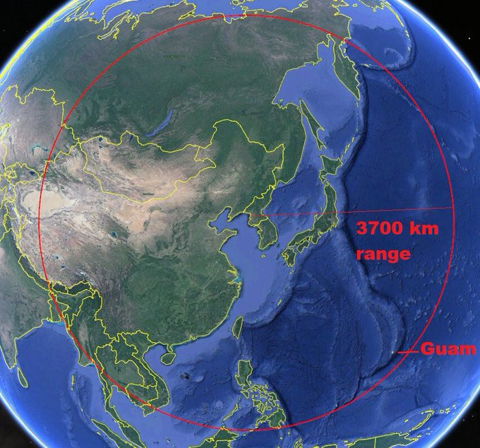
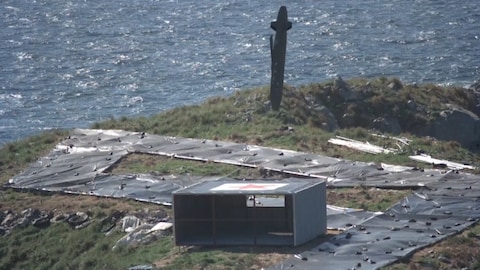
The missile, launched from Sunan, the site of Pyongyang’s international airport, flew farther than any other missile North Korea has fired. The distance it flew is slightly greater than between the North Korean capital and the American air base in Guam.
It was "the furthest over ground any of their ballistic missiles has ever travelled", Joseph Dempsey of the International Institute for Strategic Studies said on Twitter.
Physicist David Wright, of the Union of Concerned Scientists, added: "North Korea demonstrated that it could reach Guam with this missile, although the payload the missile was carrying is not known" and its accuracy was in doubt.
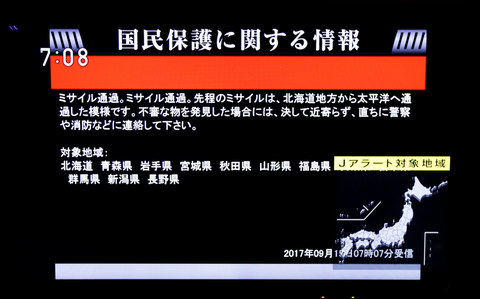
Sirens sounded and alerts were issued in Japan as residents were warned to take shelter while the missile passed over Hoakkaido.
"We can never tolerate that North Korea trampled on the international community’s strong, united resolve toward peace that has been shown in UN resolutions and went ahead again with this outrageous act," Shinzo Abe, the Japanese prime minister, said.
Jim Mattis, US Defence Secretary, called the latest missile launch a reckless act and "put millions of Japanese in duck and cover".
US Secretary of State Rex Tillerson urged China and Russia to do more to rein in North Korea.
"China and Russia must indicate their intolerance for these reckless missile launches by taking direct actions of their own," Mr. Tillerson said in a statement.
China said it "opposes" the test, but reiterated its call that "all parties" should exercise restraint.
"The situation on the Korean Peninsula is complicated and sensitive,” a spokeswoman said.
In response to the launch, South Korea’s military immediately carried out a ballistic missile drill of its own, the Defence ministry said, adding it took place while the North’s rocket was still airborne.
One Hyunmu missile travelled 250 kilometers into the East Sea, Korea’s name for the Sea of Japan – a trajectory intentionally chosen to represent the distance to the launch site at Sunan, near Pyongyang’s airport, it added.
But embarrassingly, another failed soon after being fired.
President Moon Jae-In told an emergency meeting of Seoul’s national security council that dialogue with the North was "impossible in a situation like this", adding that the South had the power to destroy it.
In New York, the Security Council called an emergency meeting for later on Friday.
However, a North Korean official said Pyongyang would continue to defy sanctions.
Choe Kang-il, deputy director general for North American affairs at the North’s foreign ministry, said: “You can impose whatever sanctions you want, but no matter how long these sanctions last – whether it is for 100 or 1,000 years – we will keep stepping up efforts and continue with our planned tests.”
North Korea last month used the airport to fire a Hwasong-12 intermediate range missile that flew over northern Japan.
The North then declared it a "meaningful prelude" to containing the U.S. Pacific island territory of Guam and the start of more ballistic missile launches toward the Pacific Ocean.
Japan’s Chief Cabinet Secretary Yoshihide Suga denounced North Korea’s latest launch, saying he was conveying "strong anger" on behalf of the Japanese people.
Mr. Suga said Japan "will not tolerate the repeated and excessive provocations."
China said it opposed North Korea’s latest missile test and warned that the situation on the Korean peninsula was “complicated and sensitive”, China Correspondent Neil Connor reports from Beijing.
Foreign ministry spokeswoman Hua Chunying said: “China opposes North Korea violating relevant UN Security Council resolutions by making use of ballistic missile technology to embark on launch activities.
“Currently, the situation on the Korean Peninsula is complicated and sensitive,” Ms Hua told a regular briefing in Beijing.
“All relevant parties should exercise restraint and should not make any moves which would escalate tensions.”
Boris Johnson urged united response to North Korea’s latest missile test
The latest missile launch by North Korea must be met with a united international response, Foreign Secretary Boris Johnson has urged.
Mr. Johnson condemned the test as "illegal" and the latest sign of "provocation" from Pyongyang.
"Yet another illegal missile launch by North Korea. UK and international community will stand together in the face of these provocations," he said on Twitter.
In a subsequent statement, he added: "The UK and the international community have condemned the aggressive and illegal actions of the North Korean regime, and the succession of missile and nuclear tests. We stand firmly by Japan and our other international partners.
"We are working to mobilize world opinion with the aim of achieving a diplomatic solution to the situation on the Korean peninsula.
"This week the most stringent UN sanctions regime placed on any nation in the 21st century was imposed on North Korea, after being unanimously agreed at the UN Security Council.
"These measures now need to be robustly enforced. We urge all states to play their part in changing the course North Korea is taking."
Before the latest launch, Mr. Johnson had called for China to use its influence over North Korea to ease tensions caused by Pyongyang’s nuclear and missile development programmes.
At a press conference with US counterpart Rex Tillerson on Thursday, Mr. Johnson said Pyongyang had "defied the world".
What kinds of missile was launched by North Korea?
The missile was launched from Sunan, the location of Pyongyang’s international airport and the origin of the earlier missile that flew over Japan.
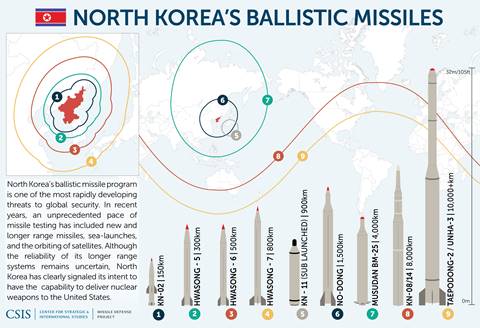
Analysts have speculated the new test was of the same intermediate-range missile launched in that earlier flight, the Hwasong-12, and was meant to show Washington that the North can hit Guam if it chose to do so.
This graphic explains what we know about North Korea’s missiles:
Japan’s Defence minister said on Friday that he believed North Korea "has Guam in mind" after its most recent missile launch, noting it had sufficient range to hit the US territory.
Pyongyang has threatened to hit the US Pacific territory with "enveloping fire," sparking dire warnings from US President Donald Trump.
Itsunori Onodera told reporters that the latest missile, which overflew Japanese territory, flew 2,300 miles – "long enough to cover Guam", which is 2,100 miles from North Korea.
"We cannot assume North Korea’s intention, but given what it has said, I think it has Guam in mind," Onodera said.
He warned that "similar actions (by the North) would continue" as Pyongyang appeared to have shrugged off UN sanctions agreed earlier this week.
The US Pacific Command confirmed the launch was an intermediate range ballistic missile (IRBM) but said it posed no threat to Guam or to the American mainland.
But, for the second time in less than a month, it overflew Japan’s northernmost island of Hokkaido, sparking loudspeaker alerts and warnings to citizens to take cover.
As North Korea continues to goad the world with its weapons programme, we examine in this video how much of a threat Kim Jong-Un’s regime is to Britain.
North Korea’s launch of a ballistic missile that flew more than 2,300 miles before falling into the Pacific Ocean is a "clear and unequivocal" message to the United States that Pyongyang has the ability to strike Guam.
The distance from Pyongyang to Guam is a little over 2,100 miles and North Korea identified it as a target in early August, threatening to launch four Hwasong-12 intermediate-range ballistic missiles into waters close to the island.
North Korea has threatened to attack the US base in Guam Credit: Reuters
The intention, according to analysts, was to demonstrate that Pyongyang would have no compunction in the event of war from targeting the resort island in order to interrupt air attacks on the North as well as efforts to reinforce ground forces on the Korean Peninsula.
"From previous launches and the altitude and ranges of those missiles, it has been assumed that Guam is within range of the North’s missiles, but this latest test is proof", Garren Mulloy, a Defence expert and associate professor of international relations at Japan’s Daito Bunka University, told The Telegraph.
South Korean President Moon Jae-in ordered his military to conduct a live-fire ballistic missile drill in response to the North Korean launch.
South Korea’s Joint Chiefs of Staff said one of the two missiles fired in the drill hit a sea target about 250 kilometers (155 miles) away, which was approximately the distance to Pyongyang’s Sunan, but the other failed in flight shortly after launch.
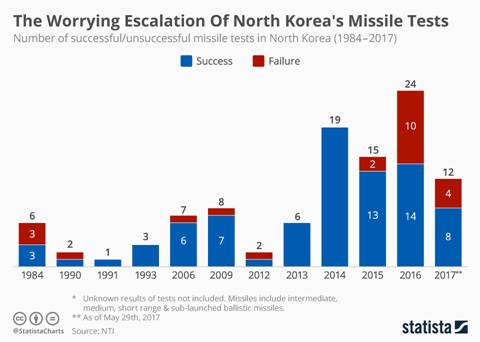
North Korea has launched dozens of missiles under young leader Kim Jong -un as it accelerates a weapons programme designed to give it the ability to target the United States with a powerful, nuclear-tipped missile.
Two tests in July were for long-range intercontinental ballistic missiles capable of reaching at least parts of the US mainland.
Yang Uk, a senior research fellow at the Korea Defence and Security Forum said:
"This rocket has meaning in that North Korea is pushing towards technological completion of its missiles and that North Korea may be feeling some pressure that they need to show the international community something."
Some residents in Japan have reacted angrily to the latest test.
"Japanese people have not been subjected to this kind of threat since the end of the war more than 70 years ago", Ken Kato, a Tokyo-based human rights activist, told the Telegraph.
"People genuinely feel that unless something is done quite soon, then their families are at risk", he told The Telegraph. "This is the situation we are in now and we have to adapt to these realities, but these missile launches and nuclear tests are leading a lot of people to conclude that Japan needs its own nuclear deterrent.
A passerby walks under a TV screen reporting news about North Korea’s missile launch in Tokyo Credit: Reuters
"Personally, the launch did not come as much of a surprise because this is becoming a fact of life for us in Japan", he said. "But there is also a growing sense of anger among ordinary people.
"North Korea is a terrorist nation and I expect this situation to escalate even further,"
Residents in northern Japan appeared calm and went about their business as normal despite the sirens warning them of a missile flying overhead.
It was the second such alert in a matter of weeks, but, for some residents, there was no question of this becoming a routine event.
Yoshihiro Saito, who works in the small fishing town of Erimo on Hokkaido, told AFP:
"I cannot say that we are used to this. I mean, the missile flew right above our town. It’s not a very comforting thing to hear.
"It’s pretty scary. I heard that it went 2,000 kilometers in the Pacific and dropped in the sea" where 16 of his ships were operating under the missile’s flight path."
The New York Times reports that the Trump administration chose not to take out the missile on the launching pad, even though they saw it being fueled up a day ago.
Officials said Vice President Mike Pence was even shown images of the missile during a visit to one of the nation’s intelligence agencies.
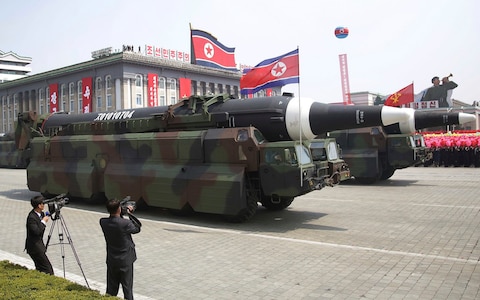
A North Korean Hwasong 12missile is paraded across Kim Il Sung Square during a military parade in Pyongyang Credit: AP
Air Koryo flight 151, which left the area of the missile launch 90 minutes after it was conducted, has now landed in Beijing – 10 minutes ahead of schedule.
South Korean President Moon Jae-in says North Korea’s latest launch of a missile over Japan will only result in further diplomatic and economic isolation for the North.
"President Moon ordered officials to closely analyze and prepare for new possible North Korean threats like EMP (electro-magnetic pulse) and biochemical attacks," Moon’s spokesman Park Su-hyun told a briefing.
North Korea said earlier this month it was developing a hydrogen bomb that can carry out an EMP attack. Experts disagree on whether the North would have the capability to mount such an attack, which would involve setting off a bomb in the atmosphere that could cause major damage to power grids and other infrastructure.
The missile was launched at 6.59am from Sunan, the site of Pyongyang’s international airport. An hour and a half later a passenger flight took off for Beijing.
Japanese Prime Minister Shinzo Abe says United Nations sanctions on North Korea needed to be firmly imposed.
Abe said that the international community must send a clear message to North Korea over its provocative actions.
"We can never tolerate that North Korea trampled on the international community’s strong, united resolve toward peace that has been shown in UN resolutions and went ahead again with this outrageous act."
US Defence Secretary Jim Mattis says North Korea’s missile launch over Japan "put millions of Japanese into duck and cover" before it landed in the Pacific Ocean, and added that top US officials had fully coordinated after the test-launch.
"We have just got done with the calls we always make to coordinate among ourselves. Steady as she goes," Mattis told reporters traveling with him during a visit to the U.S. Strategic Command, which oversees U.S. nuclear forces.
The United Nations Security Council will meet at 3 p.m. EDT (1900 GMT) on Friday on the latest North Korea missile test, diplomats said, at the request of the United States and Japan.
The 15-member Security Council unanimously stepped up sanctions against North Korea on Monday over its Sept. 3 nuclear test, imposing a ban on the country’s textile exports and capping imports of crude oil. It was the ninth U.N. sanctions resolution adopted on North Korea since 2006.
In confronting North Korea’s latest provocation, the focus will almost certainly shift once again to Beijing, China Correspondent Neil Connor says.
Donald Trump has warned that the United States would cease trading with any country that trades with North Korea – comments which were met with concern in China. And in London only hours before Pyongyang fired its latest projectile, the US secretary of state Rex Tillerson urged China to use its supply of oil to North Korea as leverage against the regime.
"That is a very powerful tool and it has been used in the past," Tillerson said at a news conference. "We hope China will not reject that."
In 2003, China shut down its oil pipeline to North Korea for three days after a missile launch. Officials said it was due to a mechanical failure, although it was thought to be deliberate and ultimately helped force a climb-down from Pyongyang.
US believe it was an intermediate range ballistic missile
The US Pacific Command says initial assessment indicates the projectile was an intermediate range ballistic missile.
It said the North American Aerospace Defence Command (NORAD) determined this ballistic missile did not pose a threat to North America, nor Guam.
"Our commitment to the Defence of our allies, including the Republic of Korea and Japan, in the face of these threats, remains ironclad. We remain prepared to defend ourselves and our allies from any attack or provocation.
South Korean experts said the August launch was Pyongyang’s attempt to make missiles flying over Japan an accepted norm as it seeks to test new projectiles and win more military space in the region dominated by its enemies.
The Offices of Guam Homeland Security and Civil Defence said the latest launch posed no immediate threat to Guam or the Marinas.
White House spokeswoman Sarah Huckabee Sanders says US President Donald Trump has been briefed on North Korea’s launch of the unidentified missile over Japan.
"The President has been briefed on the latest North Korea missile launch by General Kelly," Sanders said, referring to the president’s chief of staff.
South Korea’s Defence Ministry said the country’s military conducted a live-fire drill of a Hyunmoo-2 ballistic missile in response to the North’s launch on Friday.
It came two days after it said it conducted its first live-fire drill for an advanced air-launched cruise missile it says will strengthen its pre-emptive strike capability against North Korea in the event of crisis.
Watch as South Korea’s new Taurus cruise missile hits target
Australia, a strong and vocal ally of the United States, quickly condemned the launch. In an interview with Sky News, Prime Minister Malcolm Turnbull said:
"This is another dangerous, reckless, criminal act by the North Korean regime, threatening the stability of the region and the world and we condemn it, utterly.
"This is a sign, I believe, of their frustration at the increased sanctions on North Korea, recently imposed by the Security Council. It’s a sign that the sanctions are working."
The missile test has come shortly after the top commander of U.S. nuclear forces said he assumed the Sept. 3 nuclear test by North Korea was a hydrogen bomb, suggesting a heightened US concern that the North has advanced to a new level of nuclear firepower.
Air Force Gen. John E. Hyten, commander of Strategic Command, told reporters that while he was not in a position to confirm it, he assumes from the size of the underground explosion and other factors that it was a hydrogen bomb – which is a leap beyond the fission, or atomic, bombs North Korea has previously tested.
This before-and-after images courtesy of Planet, show a closer view of the Punggye-ri test site Credit: AFP
North Korea claimed they exploded a hydrogen bomb, and while U.S. officials have not contradicted them, they have not confirmed it, either.
"When I look at a thing that size, I as a military officer assume that it’s a hydrogen bomb," Hyten said. As head of Strategic Command, he would be in charge of all elements of the U.S. nuclear force in the event of nuclear war.
"I have to (assume this)," he added, "I have to make that assumption. What I saw equates to a hydrogen bomb. I saw the event. I saw the indications that came from that event. I saw the size, I saw the reports, and therefore to me I’m assuming it was a hydrogen bomb."
Seoul’s Defence ministry said it probably travelled around 3,700 kilometers and reached a maximum altitude of 770 kilometers – both higher and further than the previous device.
However, the intercontinental ballistic missile had the potential to fly further.
Details of the latest launch came within hours of reports suggesting that the North Koreans were preparing to carry out another underground atomic test.
Satellite images showed mining equipment and trucks close to the Punggye-ri Nuclear Test Site.
Further activity was also seen close to another underground access point.
The main concern had been whether the North Koreans have succeeded in developing a bomb small enough to fit onto an intercontinental ballistic missile.
Japan’s Chief Cabinet Secretary Yoshihide Suga says Japan is strongly protesting what it called Pyongyang’s latest intolerable provocation.
The missile was launched at 6:57 a.m. Japan time (2157 GMT), flew over Hokkaido and splashed down at 7:06 a.m. (2206 GMT) some 2,000 kilometers east of the northern island’s Cape Erimo, he said.
Japan protests the latest launch in the strongest terms and will take appropriate and timely action at the United Nations and elsewhere, staying in close contact with the United States and South Korea, Suga told reporters.
The Japanese government’s alert message called J-alert notifying citizens of a ballistic missile launch by North Korea is seen on a television screen in Tokyo Credit: Reuters
South Korea’s presidential Blue House has called an urgent National Security Council meeting.
The North’s launch comes a day after the North threatened to sink Japan and reduce the United States to "ashes and darkness" for supporting a U.N. Security Council resolution imposing new sanctions against it for its Sept. 3 nuclear test.
The North previously launched a ballistic missile from Sunan on Aug. 29 which flew over Japan’s Hokkaido island and landed in the Pacific waters.
COMMUNIST EXPANSIONISM IN ASIA – UNFINISHED KOREA-VIETNAM WAR
COMMUNIST EXPANSIONISM IN ASIA – UNFINISHED KOREA-VIETNAM WAR
Democracy, Freedom, Peace, and Justice in Asia are threatened by Communist Expansionism in Asia. United States tried hard to prevent the spread of Communism to mainland China. Having failed to do so, the United States fought battles in Korea and Vietnam but again failed for Korea and Vietnam are not real enemies posing the threat. The problem cannot be resolved by imposing UN sanctions on North Korea. Communist China’s Expansionism in all directions, including Tibet, and South China Sea must be challenged and contained simultaneously. US cannot win this battle without Knowing the Enemy.
Rudranarasimham Rebbapragada
DOOM DOOMA DOOMSAYER
TO STOP KIM JONG-UN, CHINA NEEDS A BIG PRIZE: THE SOUTH CHINA SEA
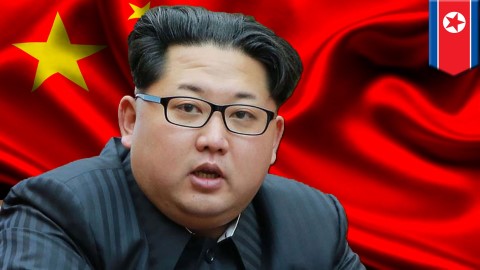
Without any doubt, China can stop Kim Jong-Un’s missile tests. Once and for all, and save a lot of trouble for America and its allies—and for Asian market investors.
But to do that, China needs a big prize, the South China Sea. All of it, so Beijing can write its own navigation rules, exploit all the riches that are hidden beneath, and satisfy the nationalistic sentiment it has nurtured.
(NOEL CELIS/AFP/Getty Images)
The Korean Peninsula is far away from the South China Sea. But the on-going crisis in the Korean Peninsula isn’t independent from what’s going on in the South China Sea, as there is a key player behind each conflict: China.
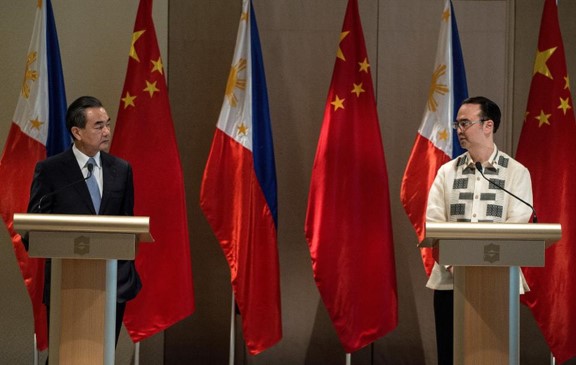
In fact, Kim Jong-Un has emerged as China’s decoy in South China Sea disputes. As the world is fixated on Kim’s nuclear tests and missiles launches, China continues the building of artificial islands in the South China Sea, bullying every neighboring country that dares to challenge its ambitions to dominate the vast waterway. Like threatening the Philippines with all-out war should it enforce an international arbitration ruling, which confirmed that China has no historic title over the waters of the South China Sea.
China also told Vietnam and India to stop searching for oil in the region, or else risk an attack on the oil and gas bases. And it has demanded that Indonesia rescind its decision to rename its maritime region in the southwest part of the South China Sea as the “North Natuna Sea,” asserting its own sovereignty in the area.
But it hasn’t stopped there. It further demanded that America’s close Asian ally, Japan, stay away from its “own” South China Sea.
Meanwhile, bilateral trade between China and North Korea has increased by nearly 20% last year, as Apostolos Pittas, adjunct professor of economics at Long Island University Post notes.
So far, Asian markets have been responding more to the Korean Peninsula crisis, losing a couple of percentage points any time Kim fires a missile and less on China’s South China Sea bullying.
Fund
5-day Performance
1-Month Performance
iShares MSCI Philippines (EPHE)
1.80%
-0.99%
iShares MSCI Indonesia (EIDO)
-.80
-0.34
Market Vectors Vietnam ETF (VNM)
1.0
-1.32
Source: Finance.yahoo.com 9/6/2017
That’s why China has no real intention of taming Kim’s ambitions — unless America and its allies are prepared to let Beijing take control over the entire South China Sea, and step up its bullying tactics.
SEPTEMBER 12, 1972 – NIXON-KISSINGER VIETNAM TREASON – UNFINISHED KOREA-VIETNAM WAR
SEPTEMBER 12, 1972 – NIXON-KISSINGER VIETNAM TREASON – UNFINISHED KOREA-VIETNAM WAR
On September 12, 2017 the United States is facing consequences of Unfinished Korea-Vietnam War which began in 1950 to contain the spread of Communism in Asia.
On September 12, 1972 US President Richard M Nixon was briefed about the presence of large numbers of North Vietnamese troops inside South Vietnam. This crucial factor was not taken into consideration when Dr. Henry Kissinger during Paris Peace Accords signed in January 1973. Further, US President Nixon gave false promise to South Vietnam when he assured them of continued US support in the War on Communism.
U.S. intelligence agencies (the Central Intelligence Agency and Defense Intelligence Agency) report to the National Security Council that the North Vietnamese have 100,000 regular troops in South Vietnam and can sustain fighting “at the present rate” for two years. The report further stated that while U.S. bombing had caused heavy casualties and prevented North Vietnam from doubling operations, the overall effects were disappointing because troops and supplies had kept moving south. It was estimated that 20,000 fresh troops had infiltrated into the South in the previous six weeks and that communist troops in the Mekong Delta had increased as much as tenfold–up to 30,000–in the last year. This report was significant in that it showed that the North Vietnamese, who had suffered greatly since launching the Easter invasion on March 31, were steadily replacing their losses and maintaining troop levels in the south. These forces and their presence in South Vietnam were not addressed in the Paris Peace Accords that were signed in January 1973, and the North Vietnamese troops remained. Therefore, shortly after the ceasefire was initiated, new fighting erupted between the South Vietnamese forces and the North Vietnamese troops who remained in the South. The South Vietnamese held out for two years, but when the United States failed to honor the promises of continued support made by President Nixon (who resigned on August 8, 1974, in the wake of the Watergate scandal), the North Vietnamese launched a major offensive and the South Vietnamese were defeated in less than 55 days. Saigon fell on April 30, 1975.
KNOW YOUR ENEMY – UN SANCTIONS ON NORTH KOREA WILL NOT WORK – UNFINISHED KOREA-VIETNAM WAR
KNOW YOUR ENEMY – UN SANCTIONS ON NORTH KOREA WILL NOT WORK – UNFINISHED KOREA-VIETNAM WAR
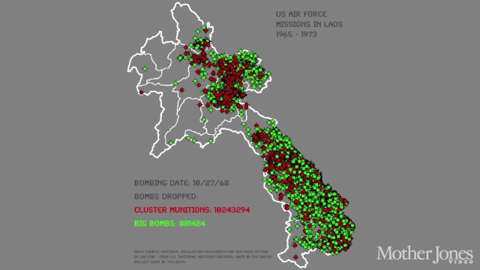
In my analysis, UN sanctions on North Korea will not work. Apart from sanctions, United States used millions of bombs to subdue North Vietnam and yet miserably failed to win the War. The Enemy is not Korea or Vietnam. The spread of Communism to mainland China in 1949 is the real Enemy posing threat to Freedom, Democracy, Peace, and Justice in Asia.
“Primarily these sanctions will affect the civilian population whose oil product uses are of lower priority to the [North Korean] state,” the report said.

























 Whole Dude - Whole Spirituality